
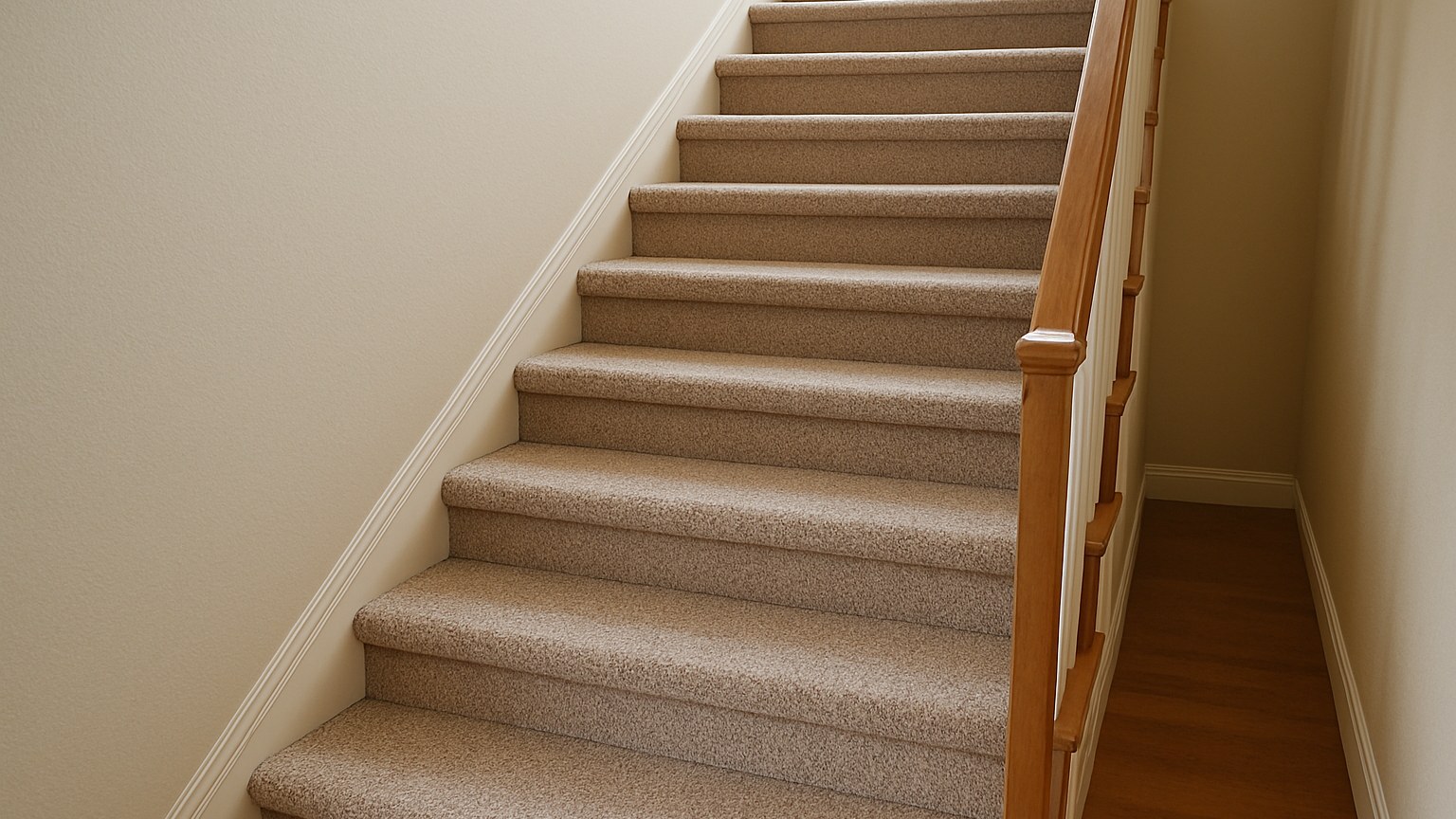
The cost to install carpet on stairs catches people off guard: full carpet runs about $20-$50 per step installed, while a wrapped runner runs $30-$75 per step, and that gap is exactly where a quote gets padded. Labor per step usually beats the price of the carpet itself. Here's how to read yours before you sign it.
Key takeaways
- Standard full (waterfall) stair carpet runs about $20-$50 per step all in; a wrapped runner runs about $30-$75 per step because it takes far more hand labor.
- A typical 13-step staircase lands around $300-$800 for full carpet or $450-$1,300 for a runner; 16 steps pushes both totals up roughly $70-$300.
- Material is the biggest swing: synthetic is the base, wool costs about 2-3x, and custom or patterned runners can run 3x or more per square foot.
- Curved or spiral stairs cost 2-3x a straight run, and L- or U-shaped stairs with pie-shaped winder steps add roughly 20-50% for the extra cutting.
- DIY full carpet on 13 straight stairs can cost about $170-$460 in materials and tool rental versus $400-$900 for a pro, but wrapped runners and curves are where hiring out earns its money.
What Carpet on Stairs Actually Costs (The Short Answer)
Standard full carpet on stairs runs about $20-$50 per step all in, meaning materials plus labor. A wrapped runner runs more, about $30-$75 per step, because it takes far more hand work at each nose (the front lip of the step).
Stairs cost more per square foot than a flat room for one simple reason: every step is its own cut-and-wrap job. You're not paying for a big roll laid across an open floor. You're paying for labor repeated a dozen or more times, one step at a time. A basement staircase costs more still, even compared to a straight run in an open living space above grade, tight stairwells, extra trips carrying material down, and often more finish work around the bottom landing all add labor time before the first staple goes in.
These are ranges from my own recent quotes and current US installer rates, not one flat national number. A real figure only comes from an in-home measure, where the installer counts your steps, checks the treads, and prices your actual carpet. A cheap synthetic on a straight flight lands at the low end. Wool or a custom runner on a fussy staircase lands at the top.
Full Stair Carpet vs. Runner: Two Different Price Paths
Here's the split most pricing pages skip: full carpet covers the whole step edge to edge, while a runner is a strip down the middle that leaves finished wood showing on both sides. They aren't the same job, and they don't cost the same.
Full carpet is usually installed "waterfall," where the carpet simply drapes over the nose and drops to the next tread. It's faster, so the labor is cheaper. A runner is usually "French-cap" (a style where the carpet is pulled tight over the nose and stapled underneath, so it wraps the edge with a clean, tailored line instead of just draping over it) or fully wrapped, where the carpet is pulled tight and tucked around the nose by hand. That's slow, careful work, and it costs more per step.
This wrap work follows an industry standard, too: according to the Carpet and Rug Institute's CRI 105 residential installation standard, stair noses should be rounded to a radius of about 3/4 inch to 1 inch before carpet goes down, so the carpet doesn't crease sharply at the edge and wear through early, part of why a careful wrap job takes real time and costs more than a simple drape.
A runner also brings its own material choices and sometimes hardware, like stair rods or fresh tackless strip (the thin wood strip with angled pins that grips the carpet). Full carpet needs more square footage but simpler cuts. For the actual method, my full stair-carpet install and buying guide walks through waterfall versus wrapped step by step.
| Install path | Materials per step | Labor per step | Total per step |
|---|---|---|---|
| Full wall-to-wall (waterfall over the nose) | $8-$20 | $10-$30 | $20-$50 |
| Runner (wrapped / French-cap, edges bound) | $12-$30 | $18-$45 | $30-$75 |
Source: Marcus Reed's recent stair quotes plus current US installer rates; confirm with a local in-home measure. Per-step cost for the two install paths, split into materials and labor, based on recent US stair quotes.
Scaling It to Your Staircase: 13 and 16 Steps
Take the per-step total and multiply by your step count, then add prep and removal. The two most-searched staircases are 13 and 16 steps, so here's where they land.
The math is simple enough to run yourself: per-step total times number of steps. A 13-step flight at $20-$50 per step comes to $300-$800 for full carpet. The same flight as a runner, at $30-$75 per step, comes to about $450-$1,300. Bump it to 16 steps and both totals rise roughly $70-$300. Basement stairs follow the same rule mentioned above, expect the higher end of these ranges, or above it, once you factor in the extra carry and finish work.
One warning: a landing or a turn eats extra carpet and time. A staircase with a mid-landing costs more than a straight flight with the same step count, because the landing is its own patch to cut and seam. Stairs also run pricier per square foot than a whole-room job. If you want the room-by-room breakdown, my carpet replacement cost guide lays out the open-floor numbers side by side.
| Staircase | Low | High |
|---|---|---|
| 13 steps, full carpet | $300 | $800 |
| 16 steps, full carpet | $370 | $1,000 |
| 13 steps, runner | $450 | $1,300 |
| 16 steps, runner | $550 | $1,600 |
Total installed cost ranges (materials plus labor) for 13 and 16 stairs, full carpet versus wrapped runner.
How Your Carpet Material Changes the Price
Material is the single biggest swing in your quote. Synthetic carpet is the base. Wool runs about 2-3 times that. A custom, patterned, or Persian-style runner runs 3 times or more per square foot, priced like goods on a bolt.
But price isn't the whole story on stairs. What matters at the nose is density, not softness. A dense, low-pile nylon holds that front edge for years, while a soft, deep plush goes bald at the nose fast because every foot lands on the same lip. A tight nylon is usually the smart pick for a busy staircase.
Each step eats roughly 2-3 square feet of carpet once you count the nose wrap and waste, so multiply your per-square-foot price by that. For help picking a fiber before you price it, start with my step-by-step guide to choosing carpet by room. On stairs, a mid-grade nylon is money well spent, while a bargain builder-grade plush is a false economy, you'll be looking at it worn and flattened within a year or two.
| Material | Price per sq ft (material only) | vs. synthetic | Note |
|---|---|---|---|
| Synthetic (polyester / nylon / triexta) | $2-$5 | Base (1x) | Nylon and dense low-pile wear best on the nose |
| Wool (natural fiber) | $8-$20 | About 2-3x | Durable, hides wear, higher upkeep |
| Custom / patterned / Persian-style runner | $20-$50+ | 3x or more | Priced as goods, plus binding and pattern-match waste |
Source: Current US retail carpet pricing and Marcus Reed's material takeoffs; roughly 2-3 sq ft of carpet per step. Material-only carpet pricing per square foot, at roughly 2-3 square feet of carpet per step.
Every number above is either per step or materials-only, so it's worth converting to the figure most flat-room flooring quotes actually use: an installed price per square foot, materials and labor combined. Divide the per-step installed totals from earlier ($20-$50 for full carpet, $30-$75 for a runner) by that same 2-3 square feet per step, and full carpet on stairs works out to roughly $7-$25 installed per square foot, while a wrapped runner works out to roughly $10-$38 installed per square foot. That's the blended figure to hold up against a flat-room carpet quote, and it runs well above typical open-floor installed pricing, which is exactly why stairs feel expensive per step even when the carpet itself is the same grade you'd put in a bedroom. The gap is labor, not material.
How Your Stair Shape Changes the Price
A straight flight is the base price. The more your stairs turn, the more custom cutting each step needs, and the higher the labor climbs.
L-shaped and U-shaped stairs usually have winders, the pie-shaped steps that fan around a turn. Each winder is wider on one side than the other, so it gets cut and fit on its own. That adds roughly 20-50% to the labor over a straight run of the same step count.
Curved and spiral stairs are another level. Every step is a one-off, templated and hand-fit, so they run about 2-3 times a straight flight. This is the clearest case for hiring a pro, because a curved staircase will punish a first-timer and waste a lot of expensive carpet on bad cuts.
| Stair shape | Labor impact | Why |
|---|---|---|
| Straight flight | Base (1x) | Uniform steps, repeatable cuts |
| L-shaped / U-shaped with winders | About +20-50% | Pie-shaped winder steps each need a custom cut |
| Curved / spiral | About 2-3x | Every step is a one-off template and hand-fit |
Labor multiplier by stair shape, measured against a straight flight of the same step count.
Padding, Old Carpet Removal, and Prep: The Extra Line Items
A low headline quote often leaves out the parts that make the job real. These are the line items that catch people, so ask about each one before you sign.
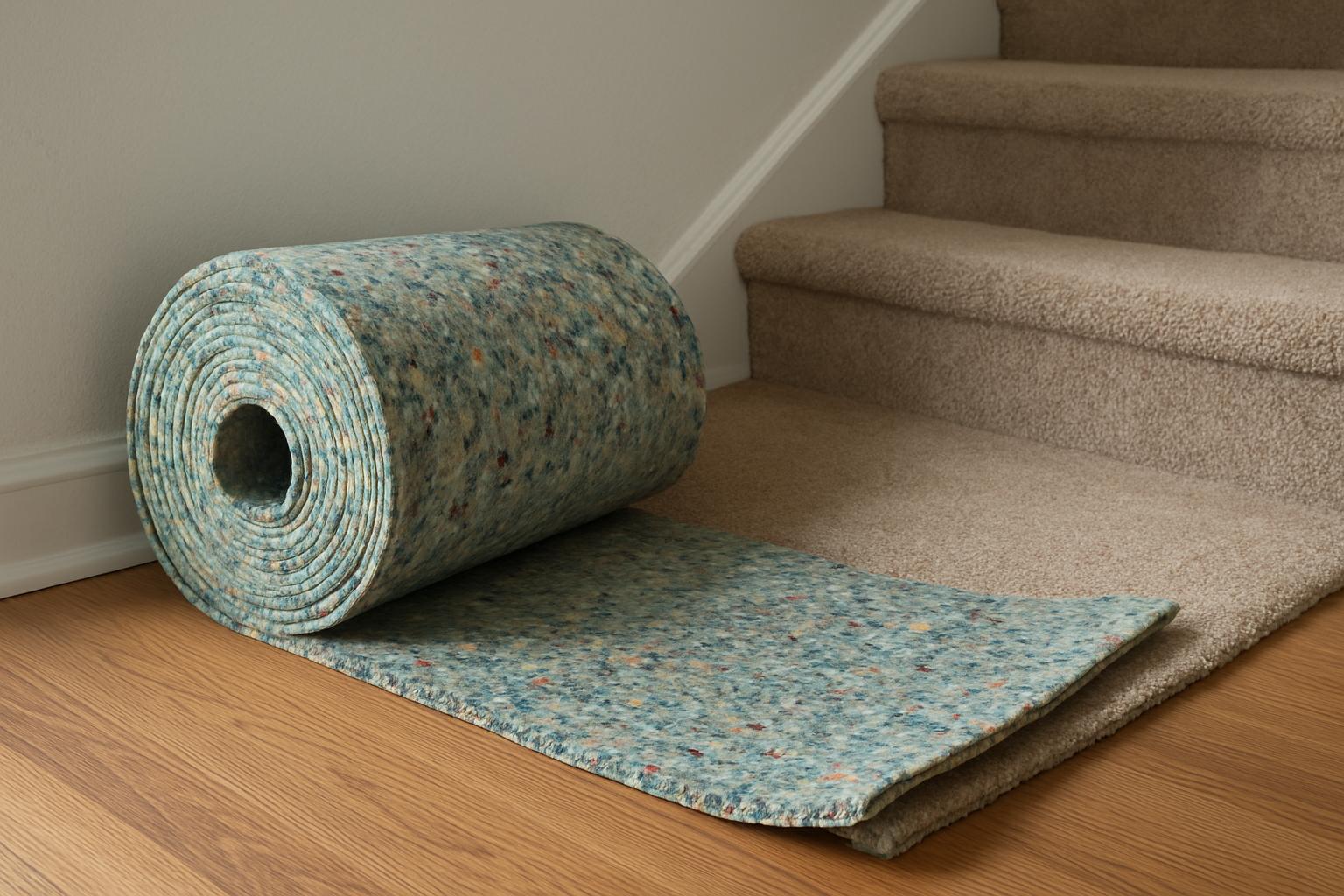
Stair padding is thinner and firmer than room padding, not thicker. A thick, soft pad on a step feels spongy and lets the carpet stretch off the nose, so installers use a denser, low-profile pad and usually price it per step or bundle it in. Old carpet removal and disposal is commonly a small per-step or flat fee, and it climbs if old staples and tackless strip fight the crew coming up.
One rule I never skip: loose or squeaky treads get fixed before the carpet goes down, never after. Once the carpet is stapled and tucked, that squeak is sealed in for the life of the floor. This lines up with the letter of the standard: CRI 105, the Carpet and Rug Institute's residential carpet installation standard, calls for treads and risers to be clean, dry, and structurally sound before carpet is installed.
- New stair pad: thinner and firmer than room pad, often a few dollars per step
- Tear-out and disposal of old carpet: per-step or a small flat fee
- Tread and riser repair: fixing squeaks and loose boards before install
- Runner hardware: stair rods or fresh tackless strip, if you want it
- Stairs charged separately from any adjoining room, not lumped in
Common add-on line items that a bare per-step quote often leaves out.
DIY vs. Hiring a Pro: Where the Money Actually Goes
For a straight 13-step flight in full waterfall carpet, doing it yourself can run about $170-$460, and hiring a pro runs about $400-$900. That's a real gap, but it only holds on the easy job.
The DIY figure is carpet plus pad plus tool rental, with no labor charge because the labor is your weekend. Budget roughly $120-$300 in carpet and pad for a mid-grade synthetic, plus $50-$160 to rent a knee kicker (a hand tool you brace against your knee and bump forward to stretch the carpet tight against the tack strip) and a stair tool, and to buy staples and tackless strip. The pro figure is that same carpet plus $250-$550 in labor, and you get a nose that's tucked tight and even.
Here's where I'd stop you. Waterfall full carpet on a straight flight is a fair DIY project if you're patient and measure twice. Wrapped runners, winders, and curved stairs are where a pro earns the money, because the hand-fit at each nose is exactly the part that's easy to botch and expensive to redo. If you're staring at a spiral, pay someone.
Sources
- CRI 105: Standard for Installation of Residential Carpet (Carpet and Rug Institute)
- CRI 104: Standard for Installation of Commercial Carpet (Carpet and Rug Institute)
- Carpet Is a Cost-Effective Flooring Choice (Carpet and Rug Institute)
- Carpet Installation Information for Business (Carpet and Rug Institute)
- Carpet Installation Standards Resources (Carpet and Rug Institute)