
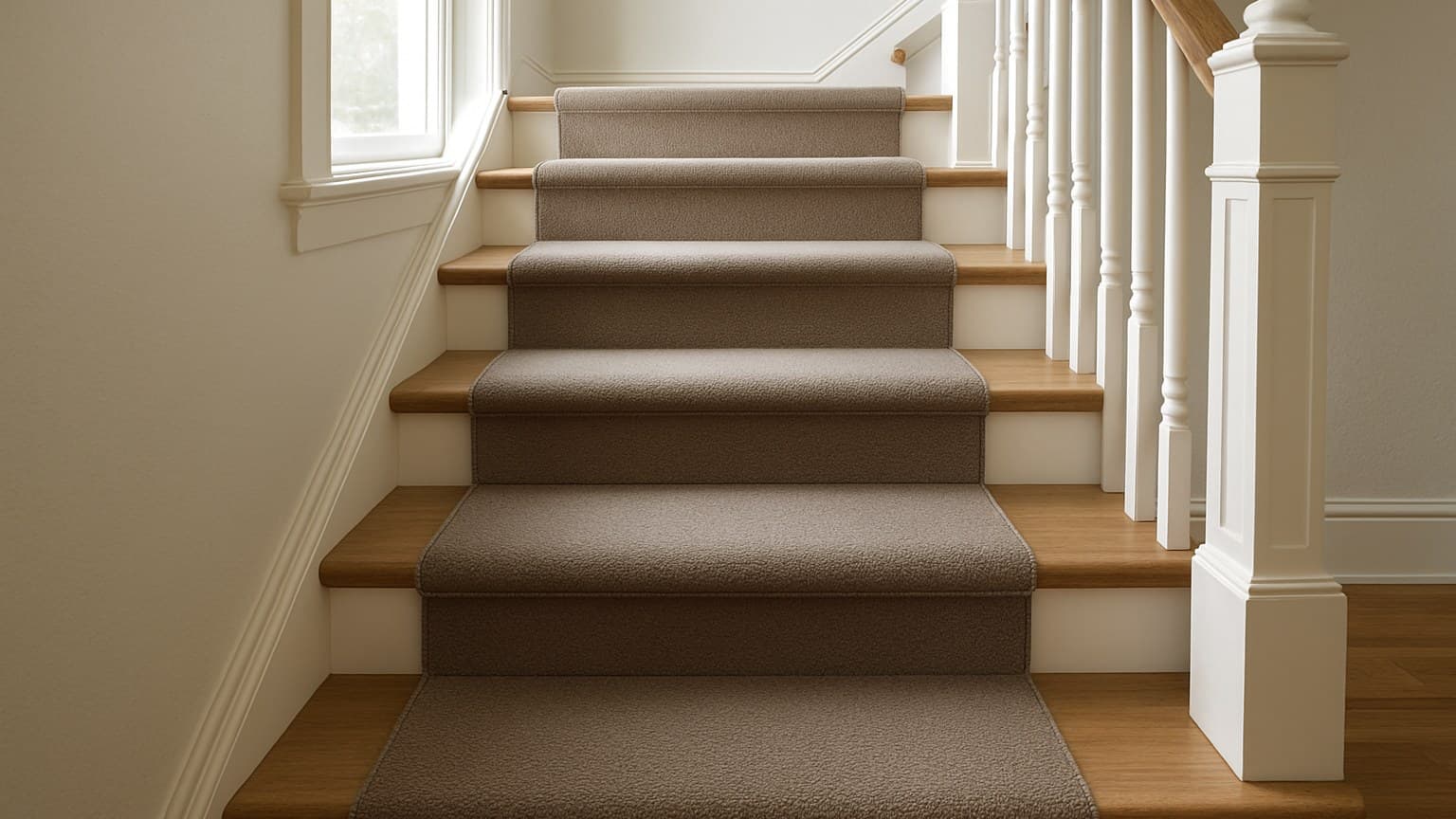
Most people who search for stair carpet costs just want one number, but a stair job is really seven priced pieces stacked together, not one flat charge. A typical 13- to 16-step flight with a small landing commonly runs about $500 to $950 installed in a mid-cost area, and that number only makes sense once you see what's inside it.
Below are the seven line items that make up almost every stair carpet quote, what a fair number looks like for each, and where an installer quietly rounds up. If you're weighing this against a whole-room job, the split works differently, and our carpet replacement cost breakdown covers that side.
Key takeaways
- Stairs are billed per step, not per square foot, so a straight waterfall flight always costs less than a hand-wrapped one because the labor per step is what changes.
- A standard 13-16 step flight with a small landing commonly runs about $500-$950 installed in mid-cost areas; rural jobs run lower and big-metro jobs run higher.
- Tear-out of old carpet, staple removal, baluster cuts, and a landing are each their own line item, so check they're spelled out and not buried in one round number.
- CRI 105 calls for a firm pad on stairs, roughly 3/8 inch thick at 8-10 lb density; a soft memory-foam pad can void the carpet's warranty.
- Wrapped (Hollywood) installs cost the most per step because each tread is hand-tucked around a rounded nose, while waterfall just drapes over the edge.
Line Item 1: Per-Step Labor (and Why Stairs Aren't Priced Like a Room)
Stairs are billed per step, not per square foot. Every tread, meaning the flat part you step on, plus its riser, the vertical face below it, gets the same cut, tuck, and fasten work no matter how you measure the room. So the honest unit is the step, and a good quote names a per-step price.
Some old-school installers still quote by the square yard, which is a 3-foot by 3-foot piece, or 9 square feet. If you get a square-yard number, ask them to convert it to a per-step price so you can compare apples to apples.
Here's the split. On a mid-tier carpet, the material for one step runs roughly $3 to $12, since a tread and riser eat about 1.5 to 2 square feet. Labor per step is the bigger swing, and it depends on the install method (Line Item 2) and your region (Line Item 7).
Watch for the job minimum. A single flight usually trips a minimum charge, so 13 steps almost never costs 13 times one step. That minimum covers the crew showing up, hauling tools, and setting up. It just means small jobs carry a higher per-step feel.
Fiber tier sets the material half of the cost. I won't over-explain fiber here, but if your stairs take heavy traffic or paws, spend up on the face fiber and read our guide to the best carpet for high-traffic areas before you pick.
Line Item 2: Install Method (Waterfall, Box, or Wrapped)
This line is almost pure labor, because the carpet material barely changes between methods. What changes is how much hand-work each step takes.
- Waterfall drapes the carpet straight over the nose, the rounded front edge of the step, and lets it fall to the next tread. Fastest and cheapest.
- Box (or capped) wraps the front face and tucks the carpet neatly under the nose. A cleaner look, middle price.
- Wrapped (or Hollywood) pulls the carpet around and under each nose and hand-tucks the sides tight. Slowest, priciest, and the look you want on an open-side staircase.
Your quote should say which method it's pricing. A wrapped price stuck on a plain waterfall job is padding, and it's easy padding to catch.
| Method | Look | Labor | Best for |
|---|---|---|---|
| Waterfall | Carpet drapes straight over each nose | Lowest, fastest to install | Budget jobs, straight flights |
| Box / capped | Front face wrapped, tucked under nose | Middle | A cleaner look without full cost |
| Wrapped / Hollywood | Hand-tucked around and under each nose | Highest, slowest | Open-side stairs, high-end look |
What each install method changes about look, labor, and fit.
Here's how the labor-per-step ranges stack up. These are labor only, from my own stair jobs, and they slide with region.
| Method | Labor per step (low) | Labor per step (high) |
|---|---|---|
| Waterfall | $5 | $20 |
| Box / capped | $10 | $30 |
| Wrapped / Hollywood | $18 | $45 |
One more thing sets the method: pile height, meaning how tall the carpet's yarn stands. A low pile carpet tucks clean and dense around a nose. A tall plush pile mats down and looks lumpy on the step edge, so if you love a soft carpet, keep it in the bedroom and put something denser on the stairs.
Line Item 3: Tear-Out and Old Staple Removal
Pulling the old carpet is its own line, not part of the install rate. Ripping out worn carpet, the old pad, every staple, and the tack strip fasteners is slow, dirty hand-work, and it should show as a separate charge. If the old pad left a musty smell behind, a good carpet deodorizer guide can help freshen the subfloor before the new carpet goes down.
The split is easy: near-zero material cost, all labor. On a standard flight I'd put fair tear-out around $75 to $200, and it climbs if the old job was fastened with a forest of staples or if a runner was glued down. Glue means scraping, and scraping means time.
Watch for two padding moves. One is a vague "prep" line with no explanation. The other is tear-out charged at the same per-step rate as a full install, which it should never be, since removing carpet is faster than fitting it.
There's an honest flip side, too. Once the old carpet comes off, a stripped stair sometimes shows its secrets. On a 1970s split-level I stripped last winter, three treads had worked loose and one nose had a hairline split you couldn't feel through the carpet. Tightening and gluing that before the new carpet goes down is real, fair prep, not padding, and a good installer will point at it and show you.
Line Item 4: The Landing Add-On
A landing is priced as a flat add-on, not folded into the per-step rate. It gets cut and stretched like a small piece of room floor, not tucked like a tread, so it's billed like a mini-room.
Materials for a typical landing run about $15 to $40, and the labor to cut and stretch it sits around $40 to $100 flat. A pie-shaped landing, called a winder, on a turning staircase costs more than a square one because the odd angles mean more cutting and fitting.
Your quote should show the landing on its own line. That's how you confirm it isn't being double-counted as extra steps somewhere else in the total.
Basement stairs and split-level turns tend to add seams and cuts, since the carpet has to piece around walls and corners. That legitimately raises this line, so don't be shocked if a basement landing costs more than an upstairs one.
Line Item 5: Baluster and Spindle Cuts (Open-Side Stairs)
When a stair is open on one side with balusters, the vertical posts that hold up the railing, the installer notches the carpet around each post by hand. That's a real per-post or per-open-step fee, and it's pure labor.
Fair pricing lands around $3 to $10 per post, more when posts sit close together, because tighter spacing means slower, fussier cuts. Ask how many cuts they're billing and the number should match the posts you can count.
Curved and spiral stairs are the biggest cut-heavy add-on of all. Every step is a different shape, so each one gets its own template, and the labor climbs hard. That's honest work, not a markup.
I used to quote flat by the square foot until a job full of open-side spindles and a bay-window landing ate a whole extra day I hadn't billed for. Now I count the cut-heavy areas on their own, because the open middle of a run is never where the time goes.
One check: a straight flight closed by walls on both sides should carry no baluster charge at all. If one shows up on a closed staircase, question it.
Line Item 6: The Pad (and the Spec That Voids Your Warranty)
The pad on stairs should be firm and dense, not the soft cushy stuff. The CRI 105 install standard calls for a firm stair pad commonly about 3/8 inch thick at 8 to 10 pound density, a spec also cited in the U.S. Department of Housing and Urban Development's cushion bulletin, HUD UM 72a.
Here's the warning that matters most: many carpet manufacturers' warranty terms state that using a pad thicker or softer than the stair spec can void the warranty on that installation, and a soft pad wears out fast right at the step edge. This is where a cheap quote cuts a corner you'll feel within a year, as a soft, dead spot on every nose. The pad line should name a density, not just say "pad included."
The materials are small, roughly $0.50 to $1.25 per square foot for a proper firm pad, plus a little labor to cut and staple it. It's not the place to save.
This is how the build stacks up over a step, which is why the pad choice changes everything above it.
The layer stack over a stair nose, per CRI 105 practice.
Line Item 7: Where You Live (The Region Swing)
Region is the line item that isn't written on the quote but explains half of it. Labor rates swing hard by area, so the same 14-step waterfall job can land far apart in two different zip codes.
Rough shape from what I see: a standard 13 to 16 step flight with a small landing commonly runs about $500 to $950 installed in mid-cost areas. Rural jobs come in lower, because labor is cheaper and minimums are smaller. Big-metro jobs run higher, sometimes well past that top number, because crew time costs more and parking, permits, and travel eat into the day.
Material cost barely moves with region, since carpet ships everywhere at similar prices. It's the labor half that stretches. So when you compare two quotes, compare the per-step labor, not the bottom line, and get at least two local numbers before you decide.
If you want the full method for choosing carpet room by room before you price any of this, our step-by-step guide to picking carpet for each room walks through traffic, moisture, and budget. And for the install itself, our main guide to carpet for stairs covers how to fit it so it won't slip or wear out at the nose.
Full Carpet vs. a Runner: A Different Price Path
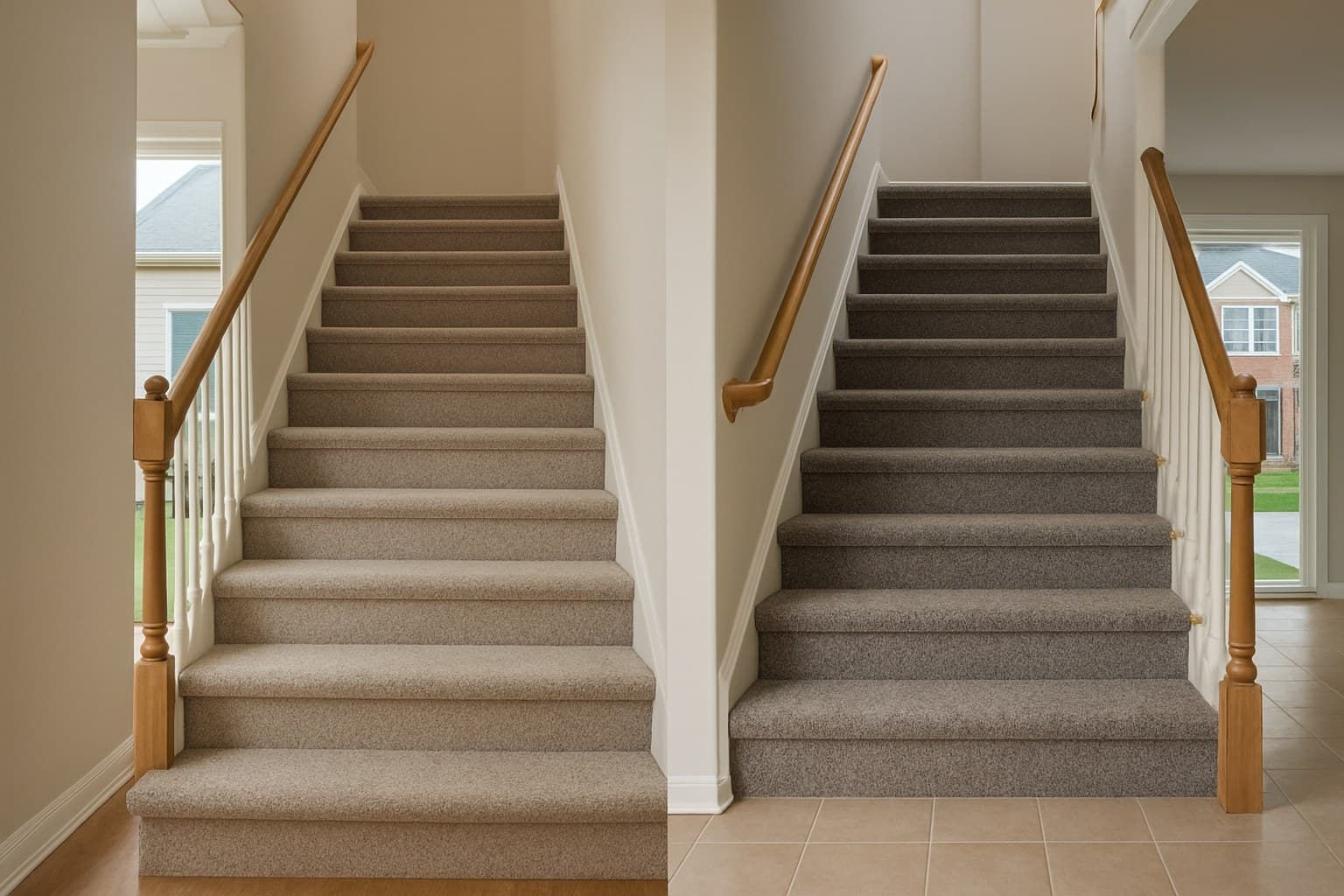
Everything above assumes wall-to-wall carpet running the full width of every step. A runner, a strip down the middle that leaves finished wood showing on both sides, is a different job with its own price, and it's worth knowing which one a quote is actually pricing before you compare it against another.
Full carpet on stairs runs about $20 to $50 per step installed. A runner runs more, about $30 to $75 per step, because the wrap work at each nose is slower and more careful, usually finished French-cap (pulled tight over the nose and stapled underneath for a clean, tailored edge) or fully wrapped, rather than a plain waterfall drape.
| Install path | Materials per step | Labor per step | Total per step |
|---|---|---|---|
| Full wall-to-wall (waterfall) | $8-$20 | $10-$30 | $20-$50 |
| Runner (wrapped / French-cap) | $12-$30 | $18-$45 | $30-$75 |
Source: Stair quotes I've written recently, still get a local in-home measure
Scale that to a flight and a 13-step staircase runs about $300 to $800 for full carpet or $450 to $1,300 for a runner; 16 steps pushes both totals up roughly $70 to $300. If a quote doesn't say which path it's pricing, ask, since the two aren't interchangeable and the gap between them is exactly where padding hides.
How Your Stair's Shape Changes the Price
A straight flight is the base price everything above assumes. The more your stairs turn, the more custom cutting each step needs, and the labor climbs with it.
L-shaped and U-shaped stairs usually have winders, the pie-shaped steps that fan around a turn. Each winder is wider on one side than the other, so it gets cut and fit on its own, which adds roughly 20-50% to the labor over a straight run of the same step count.
Curved and spiral stairs are the biggest jump. Every step is a one-off, templated and hand-fit, so they run about 2-3 times a straight flight. This is the clearest case for hiring a pro, since a first attempt will waste a lot of expensive carpet on bad cuts.
| Stair shape | Labor impact | Why |
|---|---|---|
| Straight flight | Base (1x) | Uniform steps, repeatable cuts |
| L-shaped / U-shaped with winders | About +20-50% | Pie-shaped winder steps each need a custom cut |
| Curved / spiral | About 2-3x | Every step is a one-off template and hand-fit |
DIY or Hire a Pro for Stair Carpet?
I'll be straight with you: stairs are one of the few flooring jobs I tell homeowners to hire out. A flat room with a rented stretcher is doable if you're patient. Stairs are not that. Every tread and riser needs its own tight tuck around a nose, and a sloppy tuck loosens fast under foot traffic and shows a gap within weeks.
The tools alone make this a hard DIY job. A knee kicker, meaning a padded tool you punch with your knee to stretch the carpet toward the tack strip, and a stair tool, used to force the fabric into the tight tread-riser joint, both take real practice to use without leaving lumps or gaps. Add balusters, a landing, or a curved run, and the hand-cutting gets even less forgiving.
If you're set on doing it yourself, a straight, closed flight with a basic waterfall install is the most realistic starting point. Anything wrapped, open-sided, or curved is where I'd pay for a pro, because the labor difference between a clean job and a redo is usually smaller than what fixing a bad DIY attempt ends up costing.