
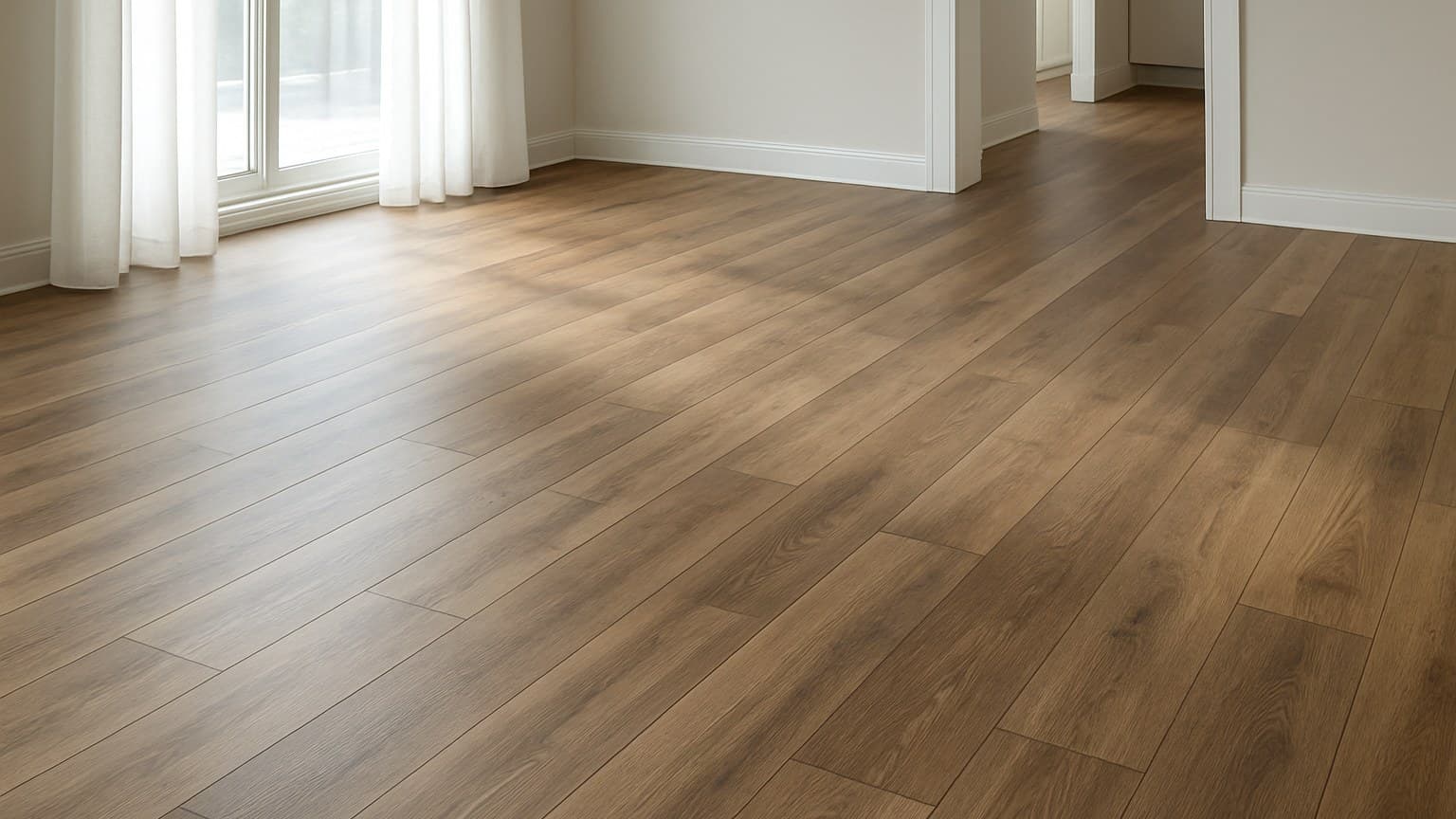
LVT gets sold under a dozen names, and the marketing pages rarely tell you the one thing that matters: how it's built and where it fails. Here's the short version. LVT means luxury vinyl tile, a vinyl floor printed to look like stone or ceramic, and it's the same product as LVP (luxury vinyl plank) in a different shape. If you want to know what that "luxury" word is actually promising you, this breakdown of what the luxury vinyl flooring label really means is worth a look. The core is what sets it apart from laminate, not the layers, and that's what decides how it handles water in your kitchen, bath, or basement.
Key takeaways
- LVT and LVP are the same product—tile-look squares versus wood-look planks—with LVT often used as the umbrella term for both
- Wear layer (measured in mils) predicts durability: 6-8 mil for light use, 12-20 mil for busy family homes, 20+ mil for pets or business settings
- A 'waterproof core' only prevents plank swelling—water still reaches the subfloor through seams, so LVT is water-resistant, not sealed
- LVT materials cost roughly $2-$7 per square foot, plus about $2-$5 per square foot for pro installation, with basements and stairs running higher
- Click-lock LVT is a realistic DIY project on a flat, dry subfloor, while glue-down installs, stairs, and large open-plan rooms are usually best left to a pro
What LVT Flooring Actually Is (and How It Differs from LVP, Laminate, and Vinyl Sheet)
LVT is a vinyl floor made in tiles that mimic stone or ceramic. LVP is the exact same construction shaped like wood planks. Many brands use "LVT" as the catch-all term and treat plank versus tile as just a style choice, so don't read too much into the letters.
The real split is between LVT and laminate. Laminate uses a core of HDF, which is pressed wood fiber. Wood fiber swells and stays swollen if water sits on it. LVT's core is vinyl or a rigid vinyl-based composite, so it shrugs off moisture far better. Flooring manufacturer Parterre puts it bluntly, describing LVT and laminate as "entirely different" products because laminate's wood-fiber core can't tolerate standing water the way LVT's vinyl core can. That difference is genuine, not a sales gimmick.
But laminate isn't the loser here. Good laminate often shows a more realistic wood grain, feels a little more like real wood underfoot, and usually costs less. So the honest tradeoff is laminate's look and price against LVT's water tolerance, and the right pick depends on the room.
LVT also beats vinyl sheet on looks but loses on seams. Sheet vinyl comes as one big flexible roll with almost no seams, which is great near water. LVT is made of individual tiles or planks, so it looks higher-end but has many more seams, and seams are where water sneaks through.
How LVT Is Made: The Layers That Actually Matter
Every LVT plank is a stack. From the bottom up, you get a backing or core, then a printed design layer (a high-resolution photo of wood or stone), then a clear wear layer on top that takes all the scuffs, dirt, and foot traffic. Yes, that layered build looks a lot like laminate. The core is the whole difference.
The design and texture layers are why cheap tiles look fake. A quality LVT has a texture pressed into it that lines up with the printed grain, so it catches light like real wood. Bargain tiles skip that step, print a repeating pattern, and your eye spots the fakery fast.
SPC vs WPC rigid core
Rigid-core LVT comes in two flavors. SPC stands for stone-plastic composite. It's thinner, harder, and rides better over a subfloor that isn't perfectly flat, so it hides small bumps. WPC stands for wood-plastic composite. It's a bit thicker, softer, and warmer underfoot, which some people prefer in a living room but it's less forgiving over a rough subfloor.
Flexible glue-down vs rigid click
Flexible LVT is thin and bends in your hand. It glues down flat to the subfloor and feels solid because it's bonded down. Rigid-core click LVT snaps together and floats over the subfloor with no glue. Same look on top, very different install and feel below.
LVT Thickness, Wear Layer, and Warranty Compared
The numbers that actually predict performance are the wear-layer thickness and the core type, not the total thickness alone. A mil is one-thousandth of an inch. Here's a general guideline for reading the spread (exact ratings vary by manufacturer):
- 6-8 mil: light use, a guest room or a rental you won't stress.
- 12-20 mil: busy family homes with normal traffic.
- 20+ mil: homes with big dogs, or a small business floor.
| Product | Typical thickness | Wear layer | Typical warranty | Moisture behavior |
|---|---|---|---|---|
| LVT / LVP (flexible) | 2-5 mm | 6-20 mil | 10-year residential common (e.g. TileBar) | Vinyl core won't swell; water still reaches subfloor through seams |
| SPC rigid-core LVT | 3-4.5 mm (Interface offers 3mm and 4.5mm) | 12-20+ mil | Varies by product, check the label | Stone-plastic core very stable; seams still the weak point |
| WPC rigid-core LVT | 5-8 mm | 6-20 mil | Varies by product, check the label | Wood-plastic core stable but softer; seams still let water through |
| Laminate | 6-12 mm | Rated by AC scale, not mils | Varies widely by product | HDF wood-fiber core swells if water sits on seams |
Comparison of core types by thickness, wear layer, and how each handles moisture. Warranty terms vary by product, so always read that specific product's sheet.
A couple of specifics worth naming. According to Interface's luxury vinyl tile line, thickness options include both 3mm and 4.5mm planks, so thickness is a real choice, not fixed. TileBar advertises a 10-year residential warranty across some of its luxury vinyl tile lines, a common benchmark in the category. But warranties swing a lot between products, so treat these as examples, not a rule for the whole category.
On cost, split it in your head. Materials run roughly $2-$7 per square foot for most LVT. Pro installation adds about $2-$5 per square foot on top. Basements and stairs cost more because of prep and cuts. And the cheap tiles almost always mean thinner wear layers, so a low price up front can cost you a re-do later.
Where to Use LVT, Room by Room
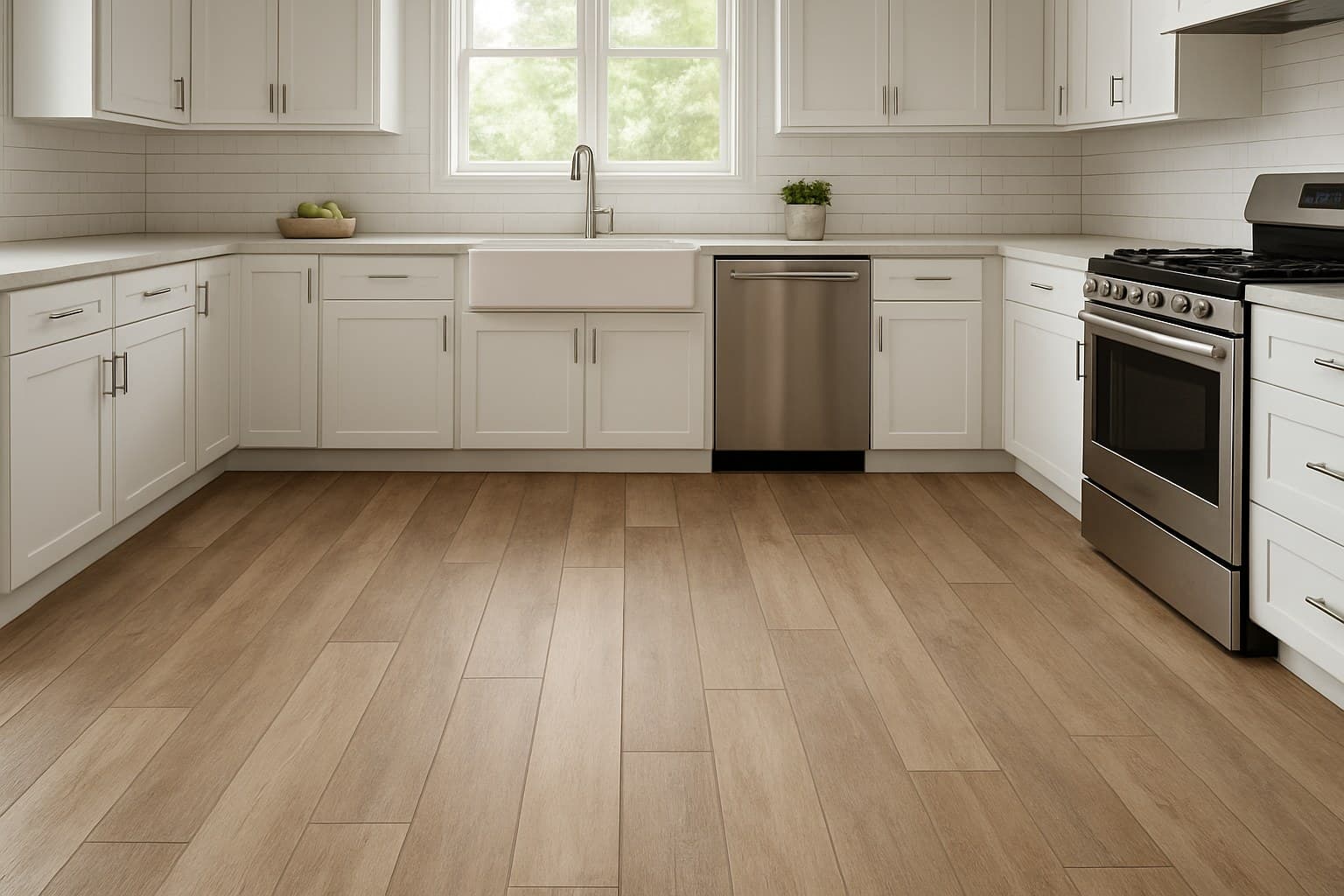
Kitchen. Strong pick. Spills wipe right up off the surface, but don't let a dishwasher leak sit overnight, seams are still the weak spot, no matter what the box says.
Bathroom. Works well, and there's grout-look LVT that mimics real tile without the cold and the cracking grout. For a powder room or a normal family bath, LVT is a fine call. In heavy splash zones like a big walk-in shower area, sheet vinyl can beat it because it has almost no seams.
Basement. LVT and especially SPC over concrete is a common win because vinyl doesn't care about the cool, slightly damp air the way wood does. But the slab decides everything. Moisture in the concrete can push up through and wreck the install, so test the slab before you pick anything. More on that below.
Where hardwood still wins. If you want a floor you can sand and refinish for decades, or you're chasing top resale in a high-end room, real hardwood still has the edge. LVT cannot be sanded back. Once the wear layer is gone, it's gone.
How to Install LVT (Subfloor First, Then the Planks)
Before you touch a single plank, deal with the subfloor. In the floors I get called back to fix, the failure is almost never the plank giving up. It's moisture nobody tested or a subfloor nobody flattened.
Subfloor flatness and moisture check
Before I quote any job, I get down on the floor with a long straightedge and a light behind it. The dips and humps that light shows tell me more than the box the customer already bought. Slide the straightedge across the floor and watch for gaps under it. High spots need grinding, low spots need filler, and the exact tolerance is on your product's install sheet, not a rule of thumb.
On concrete, run a moisture test before you choose an install method. I've stopped letting people talk me into skipping it to save a day, because the one time you skip it is the time the floor fails. Follow the moisture limit printed on that product's sheet.
Click-lock step-by-step
- Acclimate the planks in the room for the time the maker's sheet specifies. Conditions vary, so follow the sheet, not a generic "leave it a day."
- Clean and flatten the subfloor so it meets the product's flatness limit.
- Leave the expansion gap around the whole perimeter that the sheet calls for. Floating floors move with temperature and humidity, and a skipped gap causes buckling.
- Dry-fit your first row without locking it, to check your layout and your cuts.
- Lock the rows in one at a time, staggering the seams so joints don't line up.
Glue-down LVT spreads adhesive across the whole subfloor, which is fussier and less forgiving because you're committing the plank the moment it touches glue. Loose-lay relies on friction and a tight perimeter with little or no adhesive, so it's simpler but suited to smaller, stable rooms.
For cutting, a score-and-snap cutter handles straight runs quietly with no dust, which matters in a lived-in house. Save the jigsaw for the fussy cuts around pipes and door casings.
DIY or hire? Click-lock LVT on a flat, dry subfloor is a realistic weekend job for most handy homeowners. Glue-down, stairs, and big open-plan rooms with moisture transitions are where hiring a pro usually pays for itself.
Maintenance and Common LVT Myths, Fact-Checked
Cleaning LVT is simple. Dry sweep or vacuum first, with the beater bar shut off or on a hard-floor setting. The spinning brush scuffs the surface, not the vacuum brand. Then damp mop. Use the two-bucket method, one for clean water and one for rinsing, so you're not pushing dirty water back into the seams.
What to skip: many makers warn against steam mops and harsh strippers, because heat and strong chemicals can damage the wear layer or the glue. Check that product's care sheet before you reach for anything strong.
Now the myths worth killing:
- "Waterproof means sealed." Not quite, the core resists swelling, but seams are still the weak spot. Don't leave standing water and expect the floor to shrug it off.
- "It's just laminate." Different core, different water story. Laminate's wood-fiber core swells; LVT's vinyl core doesn't.
- "All LVT looks fake." Texture and a thicker wear layer separate the cheap stuff from the good stuff.
And the honest disadvantages: LVT can dent under heavy point loads like a fridge leg or a piano wheel, it can't be refinished, and thin bargain tiles telegraph every bump in the subfloor underneath.