
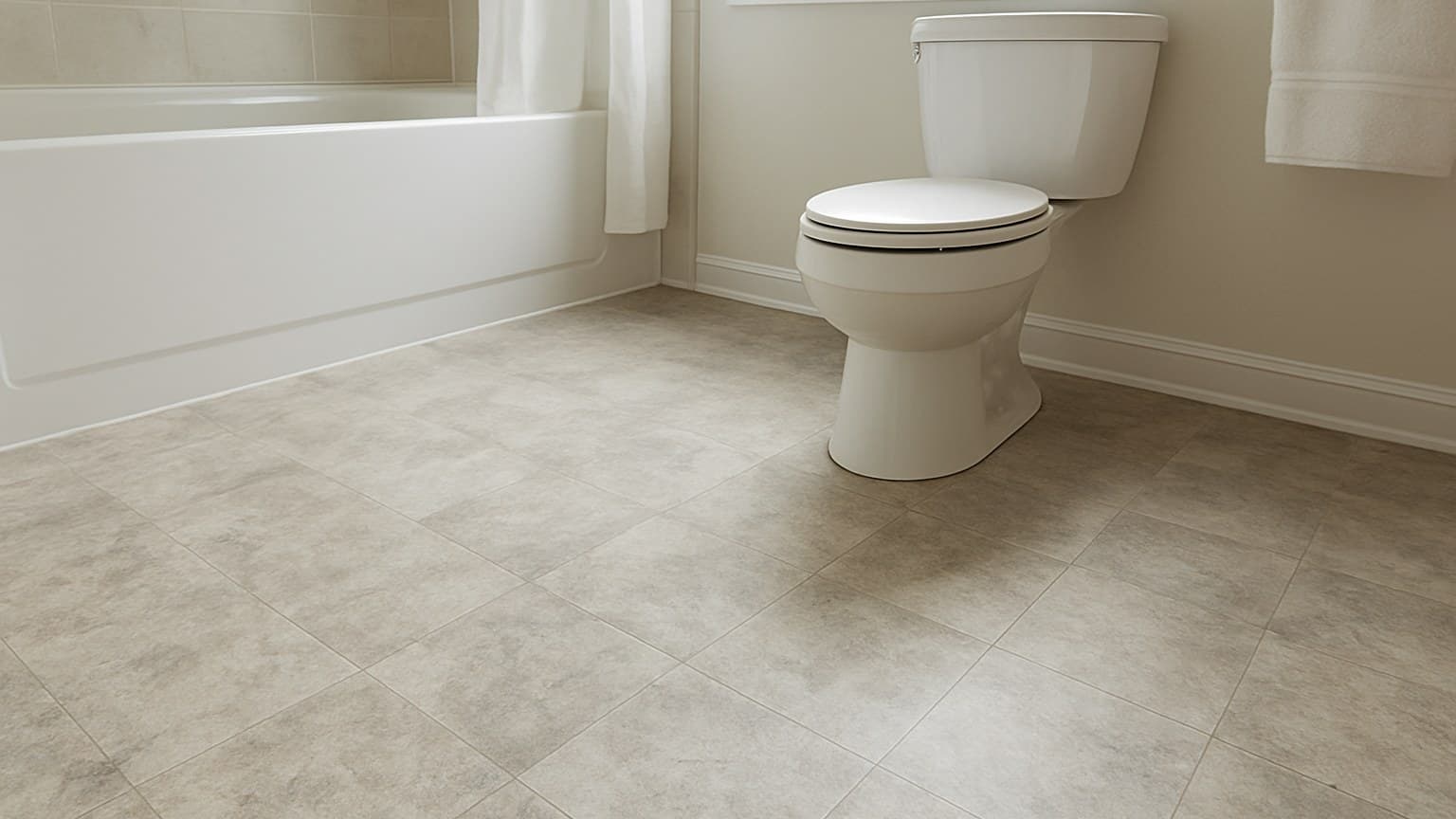
Vinyl sheet flooring still beats LVP (luxury vinyl plank) in small wet rooms, where one near-seamless sheet gives water far fewer paths down to the subfloor than clicked-together plank. The trouble is that plank gets all the hype, so people pay more for a worse answer in a tiny bathroom. This guide breaks down the 7 jobs where sheet still wins, plus the 2 where it loses to plank. The word "luxury" in that name is mostly marketing, and it's worth knowing what luxury vinyl actually means before you pay a premium for it.
Key takeaways
- Sheet vinyl's real edge is seams: one near-seamless sheet gives water far fewer paths to the subfloor than luxury vinyl plank's (LVP) clicked-together plank joints and perimeter gap.
- Best fits: small full baths, laundry rooms, powder rooms, mudrooms, rentals, tight kitchens, and slab-level basement baths.
- It loses in two places: big open rooms (rolls top out around 12 ft wide, so you get visible seams) and resale-sensitive nicer homes, where buyers read LVP or tile as the upgrade.
- Cost runs cheap: basic material roughly $0.70-$1.50 per sq ft, premium fiberglass-backed $1.50-$3, pro labor about $1-$3 per sq ft; basements and stairs cost more.
- A small square bath or laundry in one piece is a realistic DIY; big rooms with seams, tricky cuts, and glue-down are worth hiring out.
Does Anyone Still Use Sheet Vinyl? Yes, in the Rooms LVP Struggles With
Sheet vinyl is far from dead. Its real edge is going down as a near-seamless sheet in small wet rooms, exactly the spots where a floating LVP floor fails first.
The build is simple. It's a solid plastic (PVC) sheet with a printed look under a clear wear layer, sold off big rolls, usually 6 feet and 12 feet wide. Manufacturers build it either as backed sheet (a cushioned layer under the printed wear surface) or unbacked sheet, and ASTM (American Society for Testing and Materials) sets a separate performance spec for each: ASTM F1303 covers backed vinyl sheet flooring, and ASTM F1913 covers vinyl sheet flooring without backing. A small room gets covered in one piece, and most of it prints a wood or tile look now, not the old fake brick. If a convincing tile print is what you're after, dedicated vinyl tile products take that look even further, down to grout-line detailing.
Keep the waterproof claim honest with yourself. The sheet surface sheds water, but water still reaches the subfloor at joints and edges. Sheet vinyl has far fewer joints than clicked LVP, so it has far fewer places to leak. If you want the full rundown on where each type fits, the five types of vinyl flooring walks through sheet, LVP, LVT (luxury vinyl tile), SPC (stone plastic composite), and WPC (wood plastic composite).
In the wet-room floors I've had to go back and fix, the failure was almost always at a seam or the wall edge, not out in the middle of a plank. Fewer seams, fewer headaches.
How water reaches the subfloor under one continuous sheet versus clicked LVP planks. Not drawn to scale.
1. A Small Full Bathroom
This is the hero case for sheet vinyl. One sheet covers a 5-by-8 bath with a single seam at the doorway, so tub and shower splash has almost nowhere to creep in.
Floating LVP in that same tiny bath puts clicked seams right in the splash zone. It also leaves an open expansion gap under the toilet and vanity, which is where water tends to run and sit. Even fully waterproof plank still depends on those seams staying sealed, so it's worth knowing what waterproof vinyl plank really covers before you buy.
Being waterproof doesn't seal the edges for you. You still caulk the perimeter and seal around the toilet flange. Skip that and even sheet vinyl will let water under at the wall.
2. The Laundry Room
In a laundry room, a hose leak or an overflow is a when, not an if. A continuous sheet keeps a slow drip sitting on top long enough for you to catch it, instead of wicking into the subfloor through seams.
Most laundry rooms are small and close to square, so a single-piece install goes fast and cheap. I did a laundry room off a kitchen in Kettering last year where the washer had already soaked out the old floor. One sheet, caulked edges, done in a morning.
Heavy pedestals and front-loaders sit flat on a glued or loose-lay sheet. They won't shift and pop seams the way those point loads can work open a floating floor over time.
3. A Powder Room or Half Bath
The powder room is the smallest and cheapest floor in the house to redo. A remnant off the end of a roll often covers one for very little money.
It's an easy weekend DIY: one piece, a few cuts around the toilet and vanity, and you're done in an afternoon. No special tools beyond a sharp utility knife and a straightedge.
There are no grout lines to scrub, either. A guest bath still looks clean with a quick wipe, which matters in the one room visitors actually use.
4. Mudroom and Back Entry
Salt, slush, grit, and dripping boots are hard on any floor. Sheet vinyl wipes clean and has no grout joints to trap melt and road grime.
A continuous surface also handles standing snowmelt better than a floor with lots of seams. In an Ohio winter, that back entry takes a beating from November to March.
One caveat: tracked-in grit can dull and scratch the wear layer over the years. That's fine for a utility entry. It's less fine for a showpiece front hall you want to stay sharp.
5. A Rental Unit or Quick Flip
For a rental, sheet vinyl is about as cheap as a water-resistant floor gets, it lays fast, and it pulls up easy between tenants. Just remember the surface sheds water better than the seams do, so caulking the edges still matters. That combination is hard to beat when you're watching turnover cost.
When a sheet gets beat up, you redo the whole room for a little money instead of hunting down matching planks that may be discontinued. Landlords I work with like that part.
That tradeoff has a life-cycle side to it too. The Environmental Protection Agency's (EPA) WARM model, which tracks the greenhouse-gas footprint of building materials from manufacture through disposal, counts real savings when old vinyl gets recycled instead of landfilled. A rental floor that gets torn out and replaced more often than a homeowner's floor racks up more of that manufacturing footprint over the years, even though each individual sheet is cheap. The fix isn't switching materials, it's asking your installer or hauler to recycle the old sheet instead of dumping it, which is where most of that footprint gets clawed back.
LVP costs more and gives a rental a resale polish you don't need. Save the better-looking luxury vinyl plank for a unit you're actually putting on the market.
6. A Tight Galley or Apartment Kitchen
A small kitchen footprint often needs no seam at all, so the whole sink splash zone stays one sealed surface. That's the exact spot where a leaky dishwasher or a dropped glass of water does its damage.
It's also softer and warmer underfoot than tile. Your legs notice that when you're standing at the counter cooking for an hour.
One caveat: a dropped cast-iron pan can gouge sheet vinyl. It's fine for a budget or rental kitchen, but think harder about LVP or tile in a big custom kitchen you plan to keep for 15 years.
7. A Basement Bath or Slab-Level Room
Over concrete, check the slab for moisture and for flatness before you order anything. A high moisture reading or a wavy, dished slab changes the whole plan no matter which floor you pick, so that check comes first every time.
Once the slab checks out, glued or loose-lay sheet vinyl handles a cool slab well. Fewer seams means less worry about slab moisture finding its way up through joints.
This is one case where I'd rather lay sheet than a floating floor. A floating plank sitting on a cold, slightly damp slab is where I see the most trouble over the long haul, so a glued-down continuous sheet takes a real worry off the table. If you're weighing options for a basement specifically, our broader vinyl flooring buyers guide covers what else decides whether that floor lasts.
The 2 Jobs Where Sheet Vinyl Loses to LVP
Sheet vinyl falls apart as a choice in two places: big open rooms and nicer homes you're staging to sell.
Rolls top out around 12 feet wide. A big great room or open living space forces a seam you'll see, and a wide roll is miserable to wrestle into place on your own. Sheet also shows dents and reads flat over a large area, so it starts to look cheap the bigger the room gets. Here LVP wins cleanly, and I'd point you to a good vinyl plank instead.
Laminate is the other contender for that same big room. It usually gives a more convincing wood-grain look than LVP for less money, but its core isn't built to take standing water the way LVP's is, so it's the wrong call near a kitchen sink, an entry, or any room with real moisture risk.
The other loss is resale. In a higher-end home, buyers read sheet vinyl as builder-grade, while LVP or tile reads as an upgrade and holds value better. If you're selling in a nicer bracket, that perception costs you more than the floor saved.
Spend up on plank for both cases. The small wet rooms are where sheet earns its keep. The showcase rooms are not.
What Sheet Vinyl Costs, and When to DIY vs Hire
Costs split into material and labor, so skip the single flat number. On the jobs I've priced, basic felt-backed sheet material runs roughly $0.70-$1.50 per square foot, premium fiberglass-backed material about $1.50-$3, and professional labor usually $1-$3 per square foot. Those numbers move with your region and installer, and basements, stairs, and big rooms that need seams all add labor.
| Line item | Cost per sq ft |
|---|---|
| Basic felt-backed material | $0.70-$1.50 |
| Premium fiberglass-backed material | $1.50-$3 |
| Professional labor | $1-$3 |
Typical per-square-foot cost ranges for vinyl sheet flooring materials and professional labor.
Let's run real numbers on a real room. Take a 40-square-foot bath. Basic material at $0.70-$1.50 is $28-$60. Pro labor at $1-$3 is $40-$120. Installed, you're looking at roughly $68-$180 for that floor, and a DIY job drops the labor out of it entirely.
Be straight with yourself on DIY. A small, mostly square bath or laundry in one piece is a realistic weekend job. Large rooms with seams, lots of tricky cuts, or glue-down over a big area are where hiring out pays off, because a botched seam or a bubble in the glue is a redo, not a touch-up. You can see how the install and price stack up against plank in LVP flooring cost breakdown.
Before you lay anything, deal with the subfloor. Most sheet vinyl wants a smooth, flat subfloor or a thin underlayment over it, and the product's own instructions set which. A rough or uneven subfloor telegraphs right through the thin sheet, so every seam, nail head, and dip shows once the light hits it.