
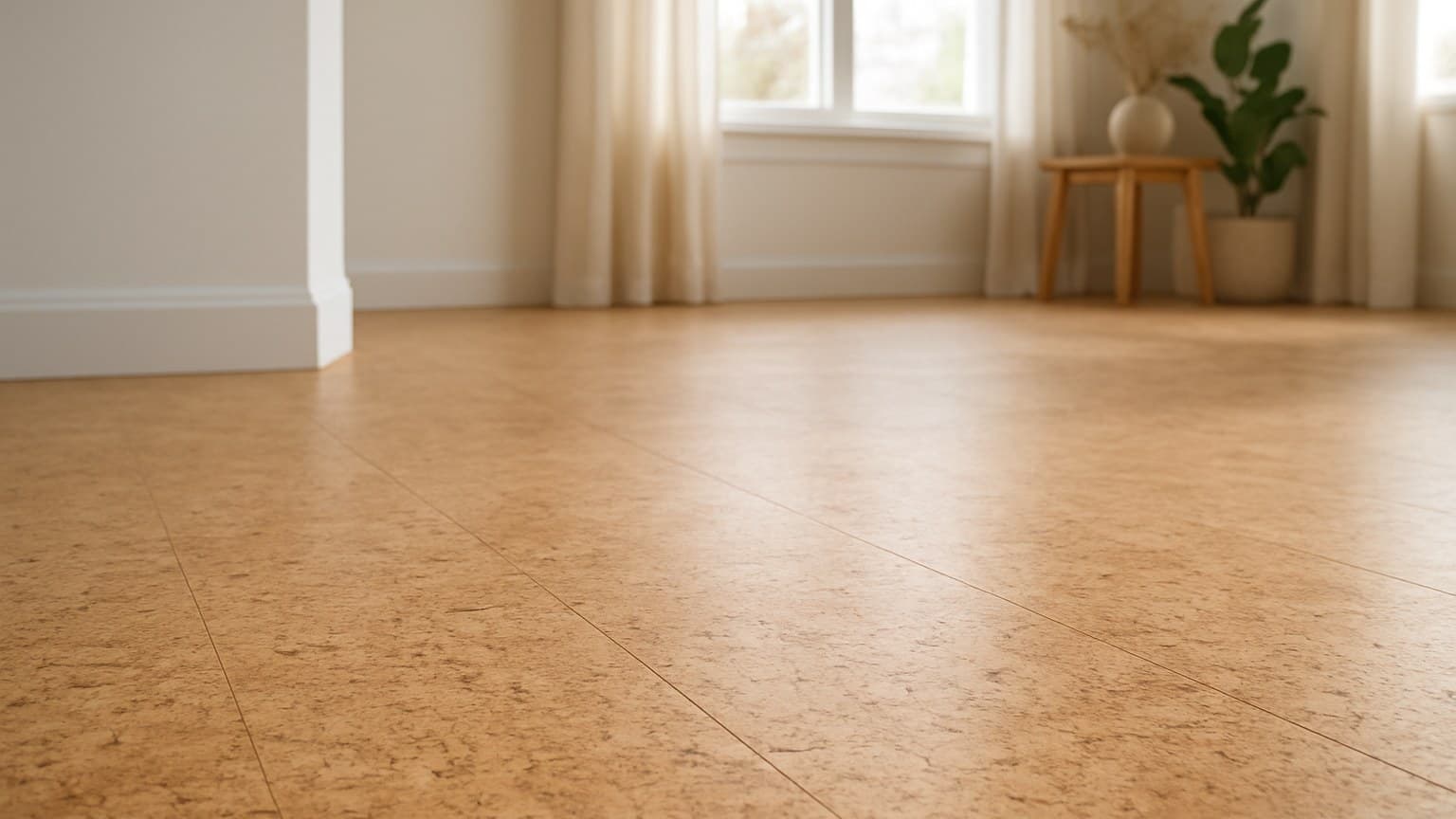
Waterproof cork flooring sounds simple until the fine print shows the word points at a hidden core, not the cork itself. I've torn out "waterproof" cork floors that swelled at the seams inside a year. These nine things decide whether yours actually holds up to water.
Key takeaways
- "Waterproof" printed on a cork box almost always means a vinyl or stone-polymer (SPC) core underneath, not the cork layer itself. Raw, natural cork is only water-resistant.
- Water almost never comes through the plank face. It gets in at the seams and edges, so sealed joints matter more than glue-down alone.
- Only a true waterproof-core (SPC) plank belongs in a full bathroom. Sealed glue-down cork handles a kitchen far better than it handles a bathroom.
- Cork materials run roughly $4.59-$6.89 per sq ft (icorkfloor listings); glue-down costs more in labor than floating click-lock.
- ASTM F3008 is the spec that defines what a "cork floor tile" even is. Check it instead of trusting the word "waterproof" on the box.
The Short Answer: Raw Cork Is Water-Resistant, Not Waterproof
Natural cork resists water for a while because of suberin, the natural wax in the bark that makes cork springy and a little water-shy. But water-resistant is not waterproof. Leave standing water on raw cork and it swells. That same vulnerability shows up on a cork coaster left under a sweating glass overnight, which is why it helps to know how to clean cork coasters without stripping that protective wax.
When a box says "waterproof," it is almost never talking about the cork. It usually means a vinyl or stone-polymer core glued under a thin cork top layer. The word on the box describes the core hiding under the cork, not the cork you can see.
Here's the part most guides skip: survival comes down to the core material and the sealed seams together, not glue-down by itself. In the cork floors I get called back to fix, it's almost always the same spot, an HDF edge or a cork seam that swelled because water sat there overnight, not a core that gave out on its own. The nine factors below are what separate a cork floor that shrugs off spills from one that peels and swells.
1. What "Waterproof" on the Box Actually Means
A waterproof claim on cork is a lab test on the core, not a promise about your finished floor. The maker drops a sample of the core in water and measures how much it swells. A stone-polymer (SPC) or vinyl core can pass that test. A cork veneer and your installed seams are a different story.
So split the claim in two. A waterproof core can sit in water and not grow. Water-resistant seams and edges are a separate promise, and that's exactly where real floors leak.
Read the spec sheet, not the front label. Find which layer the waterproof rating is tied to before you buy. It also helps to know there's a real industry standard behind the term "cork floor tile": according to ASTM International, its F3008 standard was introduced specifically to "specify cork floor tile requirements" for the resilient flooring category, the first dedicated spec of its kind, so a serious product will reference that standard instead of just shouting "waterproof." No raw or solid cork is sold as truly waterproof. The honest word for it is water-resistant.
2. Natural vs Engineered (HDF) vs Waterproof-Core (SPC): Know Which You're Buying
There are three cork formats, and they behave differently around water.
Solid or natural cork is cork all the way through. It comes from the bark of the cork oak tree, which, per EPA research, can be harvested every 9 to 11 years without felling the tree, a renewable cycle the tree can sustain over a lifespan of roughly 100 to 120 years. It's water-resistant only, best kept out of standing water, and a sealed glue-down install helps it hold up. That same raw bark turns up in cork-soled shoes, which call for a careful cork shoe cleaning routine to avoid that same swelling.
Engineered cork sits a cork layer over an HDF core. HDF means high-density fiberboard, basically pressed wood fiber. It clicks together and looks modern, but that fiberboard core is the first thing to swell when water sits on it. This is often sold as cork laminate flooring, and the HDF core is the trap, because it looks just as rigid and finished as a waterproof plank.
Waterproof-core cork puts a cork top over an SPC core. SPC means stone-polymer composite, a dense plastic-and-stone core that shrugs off standing water. It's the only cork core I'd trust in a true wet room, and even then only with sealed seams.
| Format | Core | Water rating | Wet-room safe? |
|---|---|---|---|
| Solid / natural cork | Cork all the way through | Water-resistant only | No standing water; sealed glue-down helps |
| Engineered cork | HDF (high-density fiberboard) | Water-resistant surface, swell-prone core | Not for bathrooms or wet basements |
| Waterproof-core cork | SPC (stone-polymer composite) | Waterproof core, seams still vulnerable | Yes, with sealed seams |
How each of the three cork formats handles water, and which rooms each one belongs in.
3. The Seams Are Where Water Wins, Not the Plank Surface
Even a waterproof SPC plank lets water reach the subfloor through open click joints and plank edges. The face of the plank is the easy part. The joint line is the battle.
A sealed, tight seam beads a spill so you can wipe it up. An open hairline gap wicks water straight down into the joint. A tight factory bevel looks clean, but in a bathroom or laundry it still needs a sealed finish carried across the joint to keep water out of the core edge.
The timing matters too. A spill you wipe up in a minute is a non-event. Water that sits and wicks down a seam overnight is what rots the subfloor and swells the edge. Treat the seams as the real waterproofing job. That's the question most guides leave unanswered when they argue glue-down versus core.
4. Glue-Down vs Click-Lock: Which Keeps Water Out
Glue-down bonds each plank to the subfloor and can be sealed into a near-continuous surface, which is why it's long been the bathroom-ready method for tile cork. Click-lock floats over the subfloor and leans on tight joints plus the core to keep water out. A waterproof SPC click plank is the newer route. Both still live or die by their sealed edges.
Here's the honest DIY line. Click-lock cork is realistic for most handy homeowners. Glue-down is fussier, and a bad glue bed shows up as lifting edges fast, so glue-down, stairs, and any big open-plan or wet-room job are usually worth hiring out. If you want the glue method done right, read how to glue down cork flooring without the edges lifting before you open a bucket of adhesive.
If you're leaning toward the traditional glued tile look, the sizing and layout matter, and cork floor tiles are worth a closer look on their own.
5. Sealing With Polyurethane: What It Does and Doesn't Cover
A water-based polyurethane topcoat seals the surface and the seams, and that film is what actually keeps spills out of natural and glue-down cork. Polyurethane is just a clear, tough liquid finish that dries into a protective skin.
There are two kinds of finish to keep straight. A factory finish comes cured on the plank. A site-applied sealer goes on after install. Either way, the reseal schedule is set by that product's finish, not by a rule of thumb online. Some floors want a fresh coat in a few years, some go much longer.
One honest limit: sealant protects the top and the edges, and nothing more. It does nothing for water pushing up from a wet subfloor. And the cleaner you use can strip the seal you paid for, so match your routine to the finish. How to clean cork flooring the right way breaks it down by finish, and if you were planning to reach for vinegar, check first whether you can clean cork with vinegar, because acid eats some finishes.
6. Subfloor Flatness and Moisture: The Prep That Decides the Warranty
A floating floor only lasts as long as the subfloor under it, and most makers tie their warranty to two things you can check in an afternoon: flatness and moisture.
Run a straightedge across the floor to find the high spots and low spots. A high spot rocks the plank and stresses the seam over time. A low spot leaves the plank unsupported, so the joints flex and open. Both chew up the seam line, which is exactly where water gets in.
Then test the slab or subfloor for moisture before a single plank goes down, basements most of all. A waterproof core is not a vapor barrier. Lay one over a wet, untested slab and you can grow mold underneath a floor that never swelled a bit on top.
Leave the required expansion gap around the whole room. The gap is non-negotiable, but the exact size comes from that product's own instructions, not a universal number, so look it up for what you bought.
7. The Room Decides: Bathroom, Kitchen, Basement, and Laundry
The same box of cork can be a smart floor in one room and a soggy, swollen mess in another within a year.
In a full bathroom, only a true waterproof-core SPC plank with sealed seams belongs, and I'd still keep it clear of a shower splash zone. This is the one room where natural and HDF-core cork just don't belong.
A kitchen is far more forgiving. Sealed glue-down cork handles a kitchen well, because spills get wiped up and water rarely sits for hours. Cork takes a kitchen much better than it takes a bathroom.
A basement is all about the slab. Test moisture first, give it a vapor barrier if the product calls for one, and remember a waterproof plank floating over a damp slab still traps moisture beneath it.
Laundry rooms and mudrooms sit between a kitchen and a bath. Use a waterproof core, seal the seams, and plan for the occasional overflow rather than hoping it never happens.
8. What Waterproof Cork Actually Costs: Materials vs Labor
Cork materials run roughly $4.59 to $6.89 per square foot based on current icorkfloor listings, with waterproof SPC-core planks landing toward the top of that range. Labor is separate, varies by region and installer, and the install method moves it the most.
| Cost piece | Floating click-lock | Glue-down |
|---|---|---|
| Materials (icorkfloor listings) | $4.59-$6.89 /sq ft | $4.59-$6.89 /sq ft |
| Labor (general estimate, varies by region) | roughly $2-$4 /sq ft | roughly $3-$6 /sq ft |
| Where it climbs | Stairs, small cut-up rooms | Bathrooms, basements, big open plans |
Waterproof-cork material and install-labor ranges per square foot, split so you can see where the money actually goes. Labor figures are general estimates and will vary by market and installer, get a local quote before budgeting.
Glue-down costs more in labor than floating click-lock, because it's slower and the prep has to be near perfect. Basements and stairs cost more than an open room no matter which method you pick, since there's more cutting, more edges, and more that can go wrong at the seams. For the bigger-picture spend and whether cork earns its price, our cork flooring pros, cons, and cost verdict lays out the trade-offs.
9. DIY or Hire It Out: The Call That Protects the Seams
The install you choose decides who should be holding the trowel. Click-lock waterproof cork over a flat, dry, tested subfloor is a real DIY job for a careful homeowner. Glue-down, wet rooms, stairs, and big open-plan transitions are where I tell people to hire a pro.
The reason is the seams again. A floating floor forgives a lot, but a glued seam that lifts, or an expansion gap done wrong across a kitchen-to-hall transition, shows up fast and costs more to fix than it would have to do right.
I had a customer chase the cheapest bid from three of us and take someone else's. Six months later she called me to fix the lippage and the gaps, and the repair plus the redo cost more than my first number. The lesson isn't "always hire." It's to match the installer to the job, because on cork, a rushed seam or an unsealed edge is almost always the actual point of failure, not the core itself. I've catalogued the most common versions of this exact problem in my rundown of cork flooring failures I see most on the job.