
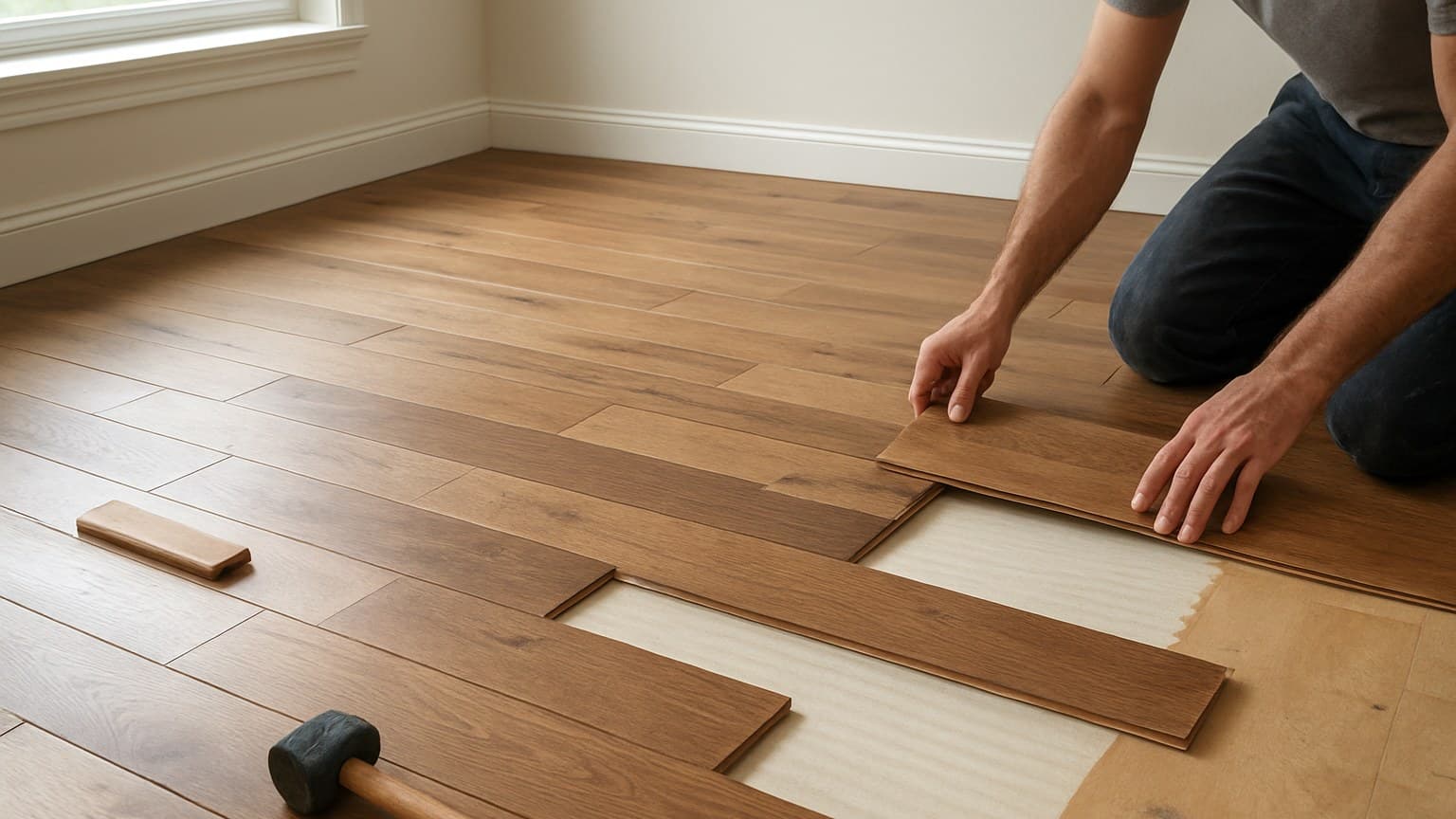
The word "waterproof" on a box of engineered hardwood sells a lot of floors, but I pulled up a "waterproof" engineered floor in a rental I redid for the Bennetts in Tulsa last winter, and it had failed anyway. The label describes one layer and stays quiet about the parts that actually let water in. Here are seven things about waterproof engineered hardwood the marketing skips until the floor is already down.
Key takeaways
- "Waterproof" on engineered wood almost always means the core, not the seams; most failures I see start at the edges and click joints, not the plank face.
- The water protection is time-capped. Many lines market a 24-hour or 100-hour water test, but that is not vinyl's flood claim, and standing water still wins eventually.
- The real edge over vinyl is refinishing: an engineered floor with a 2mm-plus veneer can be sanded once or twice, while worn vinyl gets thrown in the dumpster.
- Keep it out of full bathrooms and damp below-grade basements. It earns its keep in kitchens, dining rooms, and living rooms.
- Before you buy, check veneer thickness, ply count, the finish, and exactly what the warranty voids, because wet subfloors and bathrooms often void it.
Truth #1: A "Waterproof Core" Is Not a Waterproof Seam
Is engineered hardwood waterproof? No single plank is. The core can shrug off water while the seams and edges stay the real weak spot.
"Waterproof core" means the center layer of the board, usually HDF (high-density fiberboard, which is compressed wood fibers) or SPC (stone plastic composite, a mix of limestone powder and plastic), won't swell if water reaches it. That's a different promise from water staying out in the first place. The core can be rock solid and the floor can still fail, because water rarely attacks the middle of a board.
On that Bennett tear-out in Tulsa, the swelling and the black staining had started right at the click joints and the bevel edges. A bevel edge is the small angled groove pressed into the edge of each plank so the seams look defined. Water sat in that groove, wicked down into the seam, and lifted the veneer from the sides. The face of the plank looked fine right up until the edges were ruined.
Hold onto that gap between core and seam. Every other truth on this list comes straight out of it.
Truth #2: Read the Water Test, Not the Word "Waterproof"
The honest spec isn't the word on the box. It's the water-test hours printed on that exact product's own sheet.
Here's what the three big terms actually mean the first time you meet them. Water-resistant means the floor survives a spill for a limited time if you wipe it up. Waterproof core means the center layer won't swell if water gets to it. Flood-proof, or "100% waterproof," means it survives standing water for as long as you like, and a real-wood veneer can't do that.
This is the tension the category won't say out loud. A line may advertise a 24-hour or a 100-hour water test, while vinyl and tile claim far more. That gap is the whole point. A wood floor that brags about surviving 100 hours of surface water is telling you, quietly, that it isn't built for a flood.
| Term | What it means | The honest read |
|---|---|---|
| Water-resistant | Resists a surface spill for a limited time if you wipe it up | Most engineered wood; the real number is the water-test hours on that specific line |
| Waterproof core | The board's center (HDF or SPC) won't swell if water reaches it | A claim about one layer, not about the seams or the veneer on top |
| 100% waterproof / flood-proof | Survives standing water indefinitely | Realistic only for tile with sealed grout, not for a wood-veneer floor |
Source: the NWFA's official definition of real wood flooring, checked against the water-test wording printed on individual product spec sheets
What each moisture label promises versus what it can actually back up on a wood-veneer floor.
According to the National Wood Flooring Association's (NWFA) Homeowner's Handbook to Real Wood Floors, real wood flooring is defined as a product with a genuine wood wear surface. That matters here: if the top is real wood, no honest maker can call it truly flood-proof. If you want the look with a factory finish already baked on, that's worth understanding before you shop, and a pre-finished hardwood flooring breakdown covers how those coatings behave.
Truth #3: Solid Hardwood Is Never Waterproof, Only Engineered Is
There's no waterproof solid hardwood. The whole "waterproof wood" conversation only applies to engineered, and that's because of how it's built.
Solid wood is one thick piece. It swells and shrinks with moisture across its whole body, so it can't go below grade or straight over concrete without trouble. That movement is exactly what water makes worse.
Engineered flooring is built in layers. Its plywood-style or SPC core cross-locks the way the board wants to move, so it stays put where solid would cup or gap. That stability is the reason engineered wood earns a spot in a kitchen or a basement at all. It isn't magic, it's construction.
If you want the full tradeoff beyond water, from stability to feel underfoot, our guide on solid versus engineered hardwood walks through the rest.
Truth #4: You Can Still Refinish It, the One Thing Vinyl Can't Do
Here's the real edge engineered wood has over vinyl. Scratch or dull an engineered floor with enough veneer and you can sand it back to new. Do the same to vinyl or laminate and you throw it in the dumpster.
This is a spec, not a vibe. Many quality engineered lines list a veneer, the thin real-wood top layer, around 2mm thick on their spec sheets, which is generally thick enough to take a light sanding. Thinner than that and the sander cuts straight through the wood into the plywood or plastic core, and then the floor is done. Brands like Johnson Hardwood publish that veneer number right on their spec sheets, so working through a Johnson Hardwood flooring guide is a solid way to see how those numbers stack up before you buy.
I check remaining thickness at the edges before I ever put a sander down. I once watched a solid oak floor sand down to the tongue in one corner on what the owner swore was its fourth or fifth refinish. It looked fine on top with almost nothing left underneath. The same caution goes double for a thin engineered veneer, where you have far less room to work with.
| Floor | Refinishes | Why |
|---|---|---|
| Solid hardwood (3/4 in) | Roughly 4-6 times over decades | Thick solid wear layer above the tongue |
| Engineered with a veneer around 2mm | About 1-2 light sandings | Real-wood top thick enough to qualify for the NWFA Engineered Refinishable Program |
| Engineered, under 2mm veneer (many budget lines) | Usually zero | Sanding cuts through to the plywood or SPC core |
| Luxury vinyl or laminate | Never | It's a printed image layer; damage means full replacement |
Source: the NWFA Engineered Refinishable Program, which sets the veneer thickness a floor needs to qualify for a sand-and-refinish
Refinishing headroom by floor type, keyed to how much real wood sits above the core.
The NWFA's Engineered Refinishable Program exists specifically to recognize manufacturers whose engineered lines carry enough veneer to be sanded and refinished like solid wood, not just labeled "real wood" on the box. The long-term math changes once you see that. A floor you can refinish once or twice can outlast two or three vinyl replacements. NWFA's own life-cycle cost analysis (LCCA) materials make the same point: because a refinishable engineered floor can be renewed rather than torn out, its effective cost per year of use often ends up lower than flooring that has to be replaced outright. That's the case for spending more up front on a thicker veneer. Of course, that upfront number varies widely by species and grade, and hardwood flooring prices guide breaks down what you'd pay at retailers like Floor & Decor before you factor in any refinishing savings.
Truth #5: The Warranty Voids Easier Than You Think
The water warranty on most engineered lines is loaded with conditions. The two that bite hardest are subfloor moisture and the room you put it in.
The common ways people void it are predictable once you've read a few warranties. Letting water stand past the tested hours. Installing in a full bathroom when the sheet says not to. Skipping the moisture and flatness checks on the subfloor. Using an underlayment the maker didn't approve.
Nearly every floating floor needs an expansion gap around the edges and a moisture check before the first plank goes down. A moisture check means testing how much water is coming up out of the subfloor, usually with a meter, which is a small tool that reads moisture without cutting into anything. That prep is what keeps the maker's warranty valid, not the plank you picked. I've seen good floors fail over a wet slab that a five-minute test would have caught.
Do the prep and you keep the coverage. Our guide on installing hardwood flooring the right way lays out exactly which steps keep the warranty alive.
Truth #6: In the Wettest Rooms, Vinyl, Laminate or Tile Still Win
For rooms that see standing water, LVP (luxury vinyl plank) and sealed wood-look tile beat engineered wood. That's not a knock on the wood. It's picking the right tool for the room.
Here's the tradeoff worth knowing before you choose. LVP tolerates water far better and is the safe pick for a full bath or a laundry room. Laminate often shows a more realistic wood print and costs less, but it swells fastest at the edges when water sits, so it's the worst of the three near a tub. Tile with sealed grout is the only true standing-water floor of the group.
On cost, split it out so you know where the money goes. Materials run about $1-5 per square foot for LVP, $1-4 for laminate, $3-9 for engineered wood, and $2-7 for wood-look tile. Labor for a floating floor usually adds $2-5 per square foot in an open room. Glue-down, tile, stairs, and basements all cost more: a basement job means extra moisture testing and prep, and stairs are slow, fussy cut work that eats hours. For the full picture on the wood side, hardwood flooring cost guide breaks material and labor down room by room.
Engineered wood earns its keep in kitchens, dining rooms, and living rooms, where spills happen but water doesn't pool. Keep it out of full bathrooms and damp below-grade basements, and let vinyl or tile take those.
Truth #7: Check the Spec Sheet Before You Fall for the Photo
Before you buy, four numbers on the spec sheet tell you more than any showroom sample: veneer thickness, ply count, the finish, and what the warranty voids. If a factory-applied finish is what you're after, best prefinished hardwood flooring guide rounds up the lines that hold up best under that spec sheet test.
Veneer thickness decides whether you can ever refinish. Many quality engineered lines list a veneer around 2mm thick on their spec sheet, thick enough to take a light sanding, so check the actual number on the sheet in front of you before you buy. Ply count is how many layers make up the core, and more plies generally means a flatter, more stable board over concrete. The finish is the factory coating on top, often a UV-cured aluminum oxide, which just means a scratch-resistant coat hardened under ultraviolet light at the factory. And the warranty section tells you the rooms and conditions that void the coverage before you ever open a box.
One more thing the photo won't tell you: wider boards move more with moisture, so a wide plank in a damp room needs an even better subfloor. If you're drawn to the look, wide plank hardwood flooring guide covers what those extra inches ask of your prep.