Floor and Decor engineered hardwood trips buyers up because the same rack holds a floor you can sand and refinish and one you never can, at prices that look almost identical. Pick the wrong SKU, the store's code for one specific product listing, and you find out years later. Here is how to read those racks.
Key takeaways
- Floor & Decor sells engineered hardwood across roughly three price tiers; the number that decides quality is the veneer (wear layer) thickness, and it changes SKU to SKU, so read the spec sheet, not the display.
- Thin-veneer entry SKUs (often under 1mm) can't be sanded and refinished later; mid and premium lines with a thicker veneer usually can be refinished once, which is where the extra money actually goes.
- Expect materials around $3-9 per square foot at Floor & Decor and pro labor around $3-6 per square foot; a 1,000 sq ft open room lands roughly $6,000-15,000 installed, with stairs and basements costing more.
- Floor & Decor usually beats LL Flooring and local yards on price and stock, but you do your own spec homework; a local supplier often trades higher price for hand-holding and matched product.
- Click-lock engineered planks over a flat, dry subfloor are realistic DIY; glue-down, stairs, and basement moisture transitions are where hiring a pro pays off.
The Short Answer: Which Floor & Decor Tier Is Worth Buying
For most homes, the mid tier is the sweet spot. It gives you a real wood floor with enough veneer on top to survive a family, without paying premium money for wear layer you may never use. The premium tier is worth it only if you genuinely want the option to sand and refinish the floor down the road. The cheapest thin-veneer SKUs are fine for a rental, a closet, or a low-traffic bedroom, but I would not put them under a busy kitchen or a house full of dogs and kids.
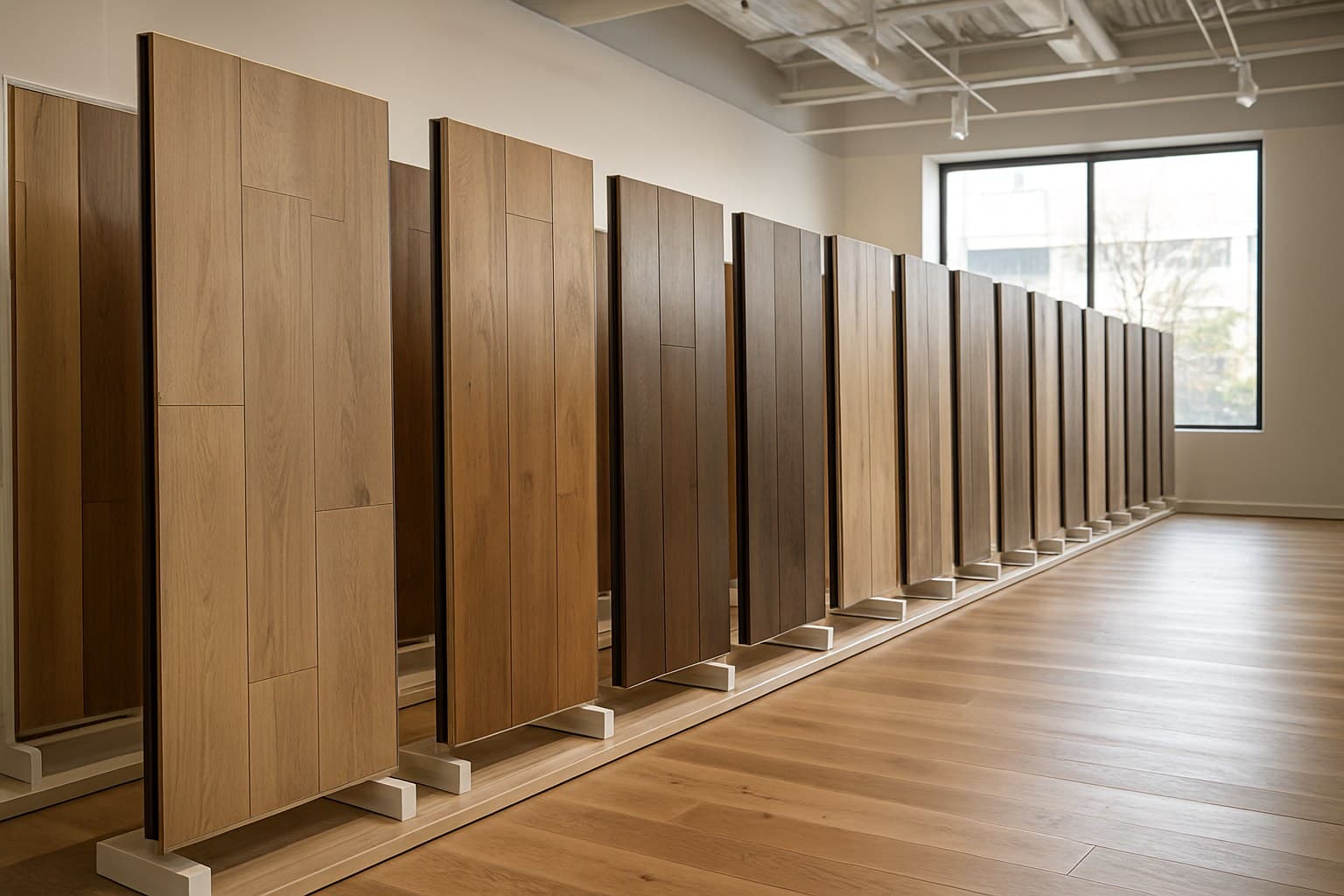
The one spec that separates these tiers is the veneer, also called the wear layer. That is the actual hardwood you see and walk on, and its thickness decides whether the floor can ever be refinished. Everything else, color, finish, plank width, is a preference. Veneer is the money question. If wide-format planks are what you're after, that width brings its own checklist worth working through, covered in checklist for 12 inch wide engineered hardwood.
Floor & Decor is right for a price-driven buyer who is willing to read a spec sheet. You get warehouse pricing and deep stock, but nobody is going to walk you through matching a product to your room. If you want a supplier to hold your hand and own the outcome, a local yard is a better fit, and I will get into why below.
One warning that holds for the whole article: specs change SKU to SKU. Confirm the veneer thickness, the core type, and the warranty on the product's own sheet, not on the display sign or the sample board. That's also why I never trust a single sample board in the showroom, ordering a real set to compare at home matters more, something I detail in how to order engineered hardwood samples.
What Floor & Decor Actually Sells Under "Engineered Hardwood"
Floor & Decor does not sell one engineered hardwood. It stocks a stack of different lines at once, heavy on oak, plus some water-resistant engineered collections, grouped loosely by price. So "is Floor & Decor engineered hardwood good" is the wrong question. The right one is which SKU, and which tier. If oak isn't your style, birch is the other domestic species worth a close look before you commit, and I cover what to check in birch engineered hardwood facts to check.
First, keep your categories straight in the aisle. Real engineered hardwood is a thin slice of actual wood over a plywood-style or fiber core. It is not the luxury vinyl plank (LVP) or the laminate sitting two aisles over, even though the displays look similar and the price tags overlap. If you are weighing wood against vinyl for a specific room, I break that down in 9 facts that settle engineered hardwood vs LVP, because the choice usually comes down to moisture, not looks.
The store-brand nature cuts both ways. You get big-box pricing and enough stock to floor a whole house from one dye lot, which matters more than people think. But you are the one evaluating the product. There is no salesperson cross-checking the core against your slab.
How the tiers break down
I think of the lineup in three buckets, and they track veneer thickness and core type more than anything else. Entry SKUs run a thin veneer, often under a millimeter, over a fiber or thin plywood core. Mid lines step up to a thicker veneer over a multi-ply core. Premium lines carry the thickest veneer and a heavier multi-ply base. The color and texture options overlap across all three, which is exactly why people buy down a tier by accident.
Where the budget SKUs make sense
The cheap lines are not junk. They are just built for a job. I have used entry-tier engineered oak in rental units and low-traffic guest rooms where the floor needs to look good and get replaced in ten years, not refinished. In that spot it is smart money. The mistake is putting that same plank in a main hallway and expecting it to sand out in year eight. It cannot, because there is not enough wood on top. If your whole goal is spending less without buying a downgraded floor, I walk through the tells in 7 ways to tell a real discount engineered hardwood bargain from a downgraded one.
Wear Layer, Veneer, and Core: The Specs That Decide Quality
On engineered hardwood, the wear layer is the real wood veneer on top, and its thickness caps how many times, if ever, you can refinish the floor. According to the National Wood Flooring Association's Refinishable program guidance, a veneer generally needs to be about 2mm or thicker to qualify for at least one light refinish; anything thinner usually cannot be sanded at all, because sanding cuts through the wood into the core. That is the whole ballgame, and it is a spec you look up per product, not a brand-wide promise.
The core matters too, just for a different reason. As the NWFA's homeowner guidance on real wood floors explains, a plywood-style core is cross-layered, so it stays flatter and more stable over concrete and below grade than solid wood. That is why engineered goes in basements where I would not put solid hardwood. A fiber or HDF core, short for high-density fiberboard, a pressed-wood panel, is fine above grade in dry rooms but I trust it less over a slab. And if a line is marketed as water-resistant, read that carefully: a water-resistant core does not mean the seams and edges are waterproof. Standing water finds the joints between planks, and that is where failures start, not in the middle of a board. If you actually need a floor rated for standing water rather than just occasional splashes, it's worth comparing dedicated waterproof engineered hardwood options before you settle for a water-resistant SKU.
Here is how the tiers generally shake out. Treat every number as a verify-per-SKU range, because these move around within the store.
| Tier | Example tier profile | Veneer (wear layer) | Core | Refinish? | Best for |
|---|---|---|---|---|---|
| Entry | Typical entry-tier red oak line | ~0.6mm (verify per SKU) | HDF/fiber or thin ply | No | rentals, low-traffic rooms |
| Mid | Typical mid-tier hickory line | ~1.5mm (verify per SKU) | multi-ply | Usually once, lightly | most family homes |
| Premium | Typical premium French oak line | ~3mm (verify per SKU) | thicker multi-ply | Typically once | long-term, refinish-later floors |
Source: the spec sheets I pull off Floor & Decor's own SKU pages before I quote a job
Figures are illustrative tier ranges, not verified specs for any single current product, always confirm the exact wear-layer thickness, core type, and warranty on that SKU's own spec sheet before you buy.
That table is where the tier system earns its keep. Two planks can look identical on the sample rack and be a full tier apart in what they can survive. The veneer line is the one you photograph off the spec sheet before you buy.
Floor & Decor vs LL Flooring vs a Local Supplier
I have bought engineered hardwood from all three, and they are not competing on the same thing. Floor & Decor usually wins on price and on in-stock quantity. LL Flooring lands in the middle. A local supplier costs the most but often carries the day on matched product and on someone actually owning a mistake.
| Source | Price | Stock | Service | Best for |
|---|---|---|---|---|
| Floor & Decor | Lowest | Deep, warehouse volume | Self-serve, read your own specs | price-driven buyers who do the homework |
| LL Flooring | Mid | Good, some house lines | Some guidance | buyers wanting a middle ground |
| Local supplier | Highest | Narrower, order-in | Hands-on, matched product | buyers who want someone to own the outcome |
Source: what I've actually paid
Here is the honest read on the risk. At Floor & Decor, if you buy the wrong tier, that is on you. At a good local yard, if the product cups or the color is off, you have a name and a person who ordered it, and that is worth real money on a big job.
Now the worry you see all over Reddit: is Floor & Decor engineered hardwood actually good, or does it fail? In my experience the quality is fine when you buy the right tier and check the veneer. The bad stories trace back to one of two things, a thin-veneer entry SKU asked to do a mid-tier job, or subfloor prep that got skipped. The plank rarely fails on its own. If you want the flip side, the specific red flags that mark a line worth skipping are in 7 engineered hardwood warning signs and the brands to avoid, and if you are ranking makers head to head, 7 best engineered hardwood flooring brands, ranked by the numbers covers who does what well.
What Engineered Wood Flooring Costs at Floor & Decor
Split the money into two lines, always: material and labor. At Floor & Decor, materials run roughly $3-9 per square foot depending on tier. Entry oak sits near the bottom, premium lines near the top. Professional labor runs roughly $3-6 per square foot for a straightforward install, and it climbs from there when the room fights you.
Engineered wood flooring cost per square foot
Materials and labor by the square foot are in the table above. The chart below turns those same rates into what a full 1,000 square foot job actually totals by tier, so you can see the real spread before you get a quote.
| Line item | $/sq ft |
|---|---|
| Materials (entry tier) | $3-5 |
| Materials (mid tier) | $5-7 |
| Materials (premium tier) | $7-9 |
| Labor (open room) | $3-5 |
| Labor (stairs/basement) | $5-8 |
Installed totals in dollars for a 1,000 square foot job, combining the material and labor rates from the table above by tier. Treat these as starting ranges to confirm with local quotes.
Installing 1,000 square feet: a worked example
Say you are flooring 1,000 square feet of open, above-grade living space with a mid-tier plank. The arithmetic is simple: material times area, plus labor times area, plus the extras.
Materials at $6 per square foot land near $6,000. Labor for an open room at $4 per square foot adds about $4,000. Then figure underlayment, transition strips, and trim, which on a job that size runs a few hundred to around a thousand dollars depending on how many doorways and rooms you are tying together. That puts the mid-tier job somewhere around $10,000-11,000 installed.
Swing to an entry plank installed cheaply and you can get near the $6,000 end. Go premium with more prep and you push past $15,000. So a realistic installed range for 1,000 square feet is roughly $6,000-15,000, and that is a starting point, not a quote. For a deeper breakdown of what drives those numbers, engineered hardwood flooring cost: 7 numbers to check before you sign a 2026 quote is where I lay out the line items.
One more thing the per-foot number hides: basements and stairs cost more than open rooms. A basement means moisture prep over the slab and slower work in tighter space. Stairs are pure hand-labor, each tread cut and wrapped one at a time, so the per-foot labor easily doubles.
On DIY savings, be honest with yourself before you skip the labor line. Click-lock engineered planks over a flat, dry subfloor are a realistic weekend job for a careful homeowner, and that can wipe out most of the labor cost. But before you snap a single plank, follow the NWFA's installation guidelines: check the subfloor for flatness and run a moisture check over any concrete. I once let a customer in Tulsa, on a rental flip with a tight deadline, talk me out of a moisture test to save an afternoon. The floor cupped before the season was out and I relaid it on my own dime. That is the day the test stopped being optional for me. Glue-down installs, stairs, and big open-plan moisture transitions are where I tell people to hire out, because the failure cost is higher than the labor you would save.
Which Tier for Which Room and Buyer
The verdict comes down to matching the veneer to how hard the room gets used and how long you plan to keep the floor.
Buy the entry tier if you are flooring a rental, a spare bedroom, a home office, or a closet, and you are comfortable replacing rather than refinishing when it wears. It looks like wood, it costs the least, and in a low-traffic room it will hold up for years.
Buy the mid tier for the main living areas of a normal family home, the great room, hallways, bedrooms above grade. This is where most buyers should land. You get a veneer thick enough for one light refinish and a multi-ply core that behaves over most subfloors. If you are still deciding between solid and engineered in the first place, or which species fits each of those rooms, this guide to solid vs. engineered hardwood floors walks through that room-by-room call.
Buy the premium tier if this is a forever floor and you want the refinish option locked in, or if you are drawn to a heavily textured look like hand-scraped engineered hardwood where a thicker veneer carries the texture better. It is also the tier I lean toward over a basement slab, paired with the right moisture prep, because the heavier core stays flatter down there.
As for who should buy at Floor & Decor at all: if you will read the spec sheet and check your own subfloor, the value is hard to beat. If you want a person to own the result, pay the local premium and sleep better.