
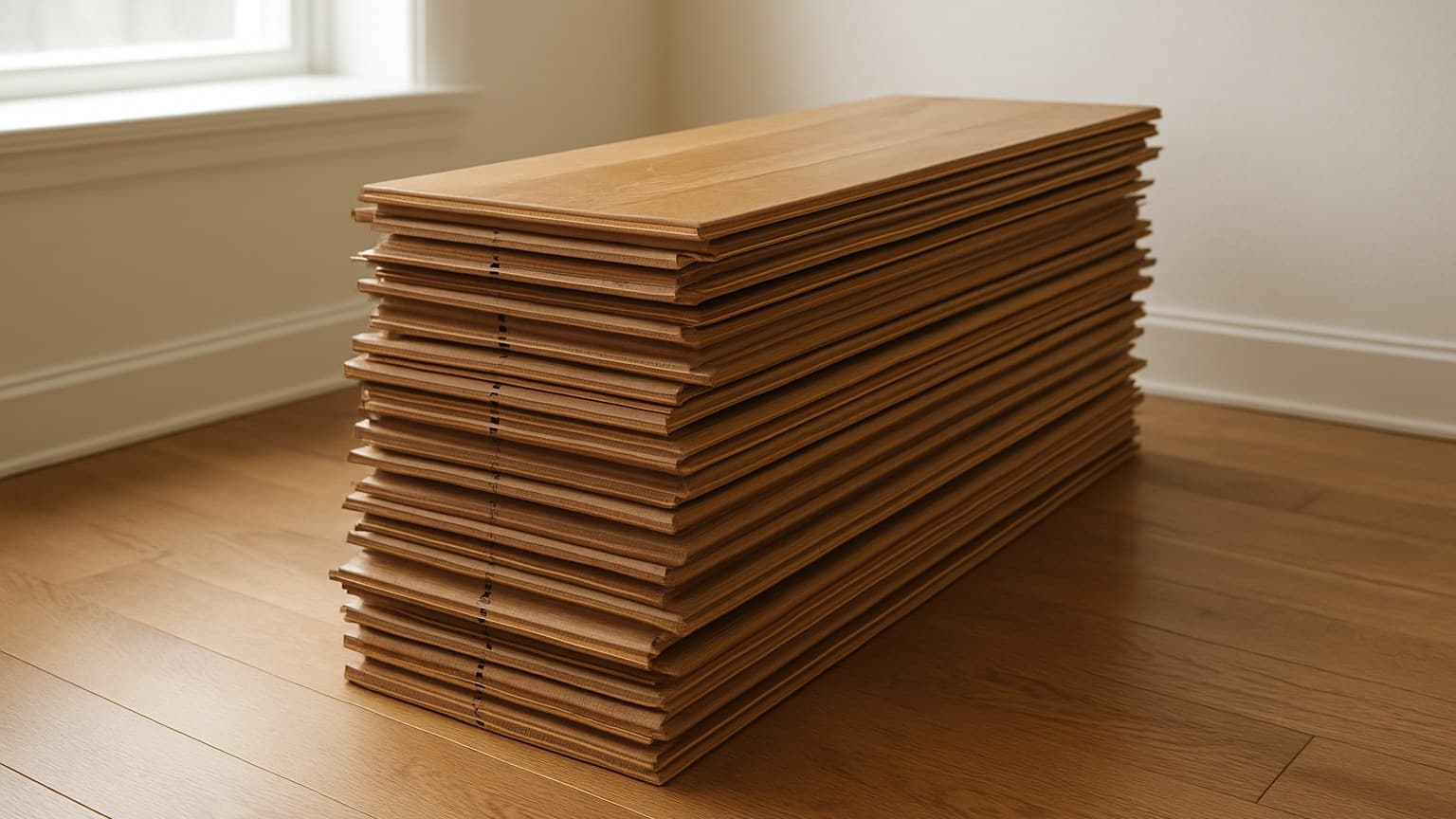
Last month, a homeowner named Denise in Columbus, Ohio called me before she signed up for a big-box hardwood sale, wanting to know if 40% off was a real deal or just a marked-up price tag. I walked her listing the same way I read a job sheet, and found the tell in three words she'd skimmed right past. A hardwood flooring sale can save you real money, or stick you with a floor you can't match later, the label on the deal tells you which, if you know how to read it.
Key takeaways
- 'Overstock' usually means you can reorder more; 'liquidation,' 'closeout,' and 'discontinued' usually mean you can't, so buy extra up front.
- A real discount shows the original price and a specific reason for the markdown; a vague 'SALE PRICE' with no original is often a fake MSRP.
- On sale, solid red oak or hickory in character grade runs about $3-6 per square foot for materials, before $3-6 per square foot in labor.
- Buy an extra 5-10% for waste plus a spare box or two for future repairs, because a discontinued lot you can't rematch is the real risk.
- The cheapest floor isn't always the cheapest to own: cost-per-year over 20-plus years often favors a better floor that lasts.
What a "Hardwood Flooring Sale" Actually Means
A sale price can be honest overstock the store simply over-ordered, or it can be a discontinued or damaged lot dressed up with a made-up "original" price. The label on the deal tells you which, if you know what the words mean.
Here's the plain-English version. "Overstock" means the seller bought too much of a line they still carry, so you can usually reorder more. "Clearance" means they're pushing slow movers out, and it may or may not come back. "Closeout" and "liquidation" mean the line or the whole warehouse is being cleared, so what's on the floor is likely all there is. "Discontinued" means it isn't made anymore, full stop.
The question that changes everything is this: can you reorder the exact same floor later? If a box comes up short mid-install, or a plank gets wrecked in year six, that answer decides whether you have a quick fix or a real problem.
| Term | What it really means | Reorder risk | Watch for |
|---|---|---|---|
| Overstock | Seller ordered too much of a current line | Low, usually still made | Confirm it's the same run before you buy short |
| Clearance | Store clearing slow movers | Medium, may or may not restock | Ask if it's being dropped |
| Closeout | That line is being retired | High, won't be restocked | Buy all the extra you'll ever need now |
| Liquidation | Warehouse or vendor clearing everything | High, often gone for good | No reorders, sometimes no returns |
| Discontinued | No longer manufactured | Highest, can't match later | One damaged plank in year six is a real problem |
Sale-word meanings and the reorder risk each one carries.
If the deal you're looking at is specifically a closeout, it's worth reading the clearance hardwood flooring breakdown before you commit, because closeout lots have their own rules.
How to Spot a Real Discount, Not a Marked-Up MSRP
A genuine deal shows you the original price, sometimes listed as MSRP, short for manufacturer's suggested retail price, and gives a specific reason for the cut. A fake one shows a permanent "SALE PRICE" tag with nothing to compare it against.
Watch for three things:
- No original price shown at all, just the sale number.
- A round percent off that never seems to change, which usually means the "sale" price is really just the regular price.
- An MSRP set so high that no store ever actually charged it, which makes any markdown look bigger than it really is.
The fix is simple: stop judging by the size of the percent off and judge by price per square foot instead. A fake MSRP can make 60% off look amazing, but if the real number lands at $8 a square foot for a plain red oak, it's not a deal. That same math gets trickier once you move past the common species, so before a steep percentage off talks you into anything, check what real per-square-foot ranges look like for exotic hardwood flooring.
Before you get excited, check these five things:
- The original price is actually shown, not just the sale number.
- There's a real reason for the markdown, like overstock or a retired line.
- The per-square-foot price beats the going rate for that species.
- You can confirm whether more can be reordered later.
- The grade matches the price, character wood should cost less than select, not the same.
Free samples and price-match promises are fine to take. Just know they prove nothing about whether the base price was ever real.
The Discontinued-Lot Trap That Costs You Later
Boxes milled in the same production run share color and grain, so they blend into one another. A batch made months later, or a different line entirely, can shift shade and gloss just enough to catch your eye under the wrong light. That shift shows up fastest on pale finishes, which is exactly why light hardwood floors reveal mismatched batches that a darker wood would easily hide.
That's why a discontinued lot is the real danger in any hardwood flooring sale. If a box runs short during install, or a plank gets gouged years down the road, there's nothing left to match it to. You're stuck cutting a patch from a closet or living with a plank that doesn't quite belong.
Protect yourself up front. Buy 5-10% extra for cutting waste, plus a spare box or two for future repairs. Keep your clean offcuts, and write down the run or lot number printed on the box. On a closeout job for Ray in Dayton, Ohio, I over-ordered a full extra box, and it paid off two years later when a repair patch from a different batch showed up lighter under the same window light, right next to planks from the original run. Same product line, different lot, and the mismatch was obvious the moment the sun hit it.
Price Per Square Foot by Species and Grade
Here's a materials-only benchmark so you can judge any sale number against real ranges. These are the wood and box costs, not the install.
The species you'll see most on sale are red oak, white oak, hickory, maple, and American cherry. Prices swing by region, grade, and how much stock the store is dumping, so treat these as a starting range to check against local quotes, not a fixed number.
| Species | Common grade | Sale price | Typical retail |
|---|---|---|---|
| Red oak | #1 common / character | $3-5 | $4-7 |
| White oak | Select | $5-8 | $7-11 |
| Hickory | Character | $4-6 | $6-9 |
| Maple | Select | $4-7 | $6-10 |
| American cherry | Select | $6-9 | $8-12 |
Materials-only price per square foot, sale versus typical retail, by species and grade.
Labor adds about $3-6 per square foot on top, more if there's tricky prep, stairs, or a basement involved. A low material price never includes install, so add it in before you compare deals.
One more thing for anyone searching "solid hardwood flooring sale": solid wood usually costs more than a thin engineered plank, so compare like with like. If you're eyeing a pricier species, the walnut hardwood flooring cost breakdown and the bamboo versus hardwood comparison show how those numbers shift. Because a national range can hide a lot of local variation, cross-check it against a current price sheet from an NWFA member retailer near you before you decide a specific tag is or isn't a real discount.
Grades Decoded So You Don't Overpay for Flaws
Grade is just how clean the wood looks, and it's the honest reason a price can be genuinely low. Clear and select grades are the cleanest and lightest, with few knots and even color. Number 1 common, number 2 common, character, cabin, and utility grades show more knots, color streaks, and shorter boards.
A lower grade is not defective. It's a look, and it's fine flooring. Character grade in particular has more knots and swirl, which many people actually want.
The trap is paying a clear or select price for character wood. Before you celebrate a discount, match the grade to the price. If the tag says select money but the boards are full of knots and streaks, the "sale" is really just retail for a lower grade.
If you're after knots and movement on purpose, character grade paired with a hand-scraped hardwood look gets you there for less than chasing a rustic-looking premium line.
Solid vs. Engineered: Which Is Worth Buying on Sale
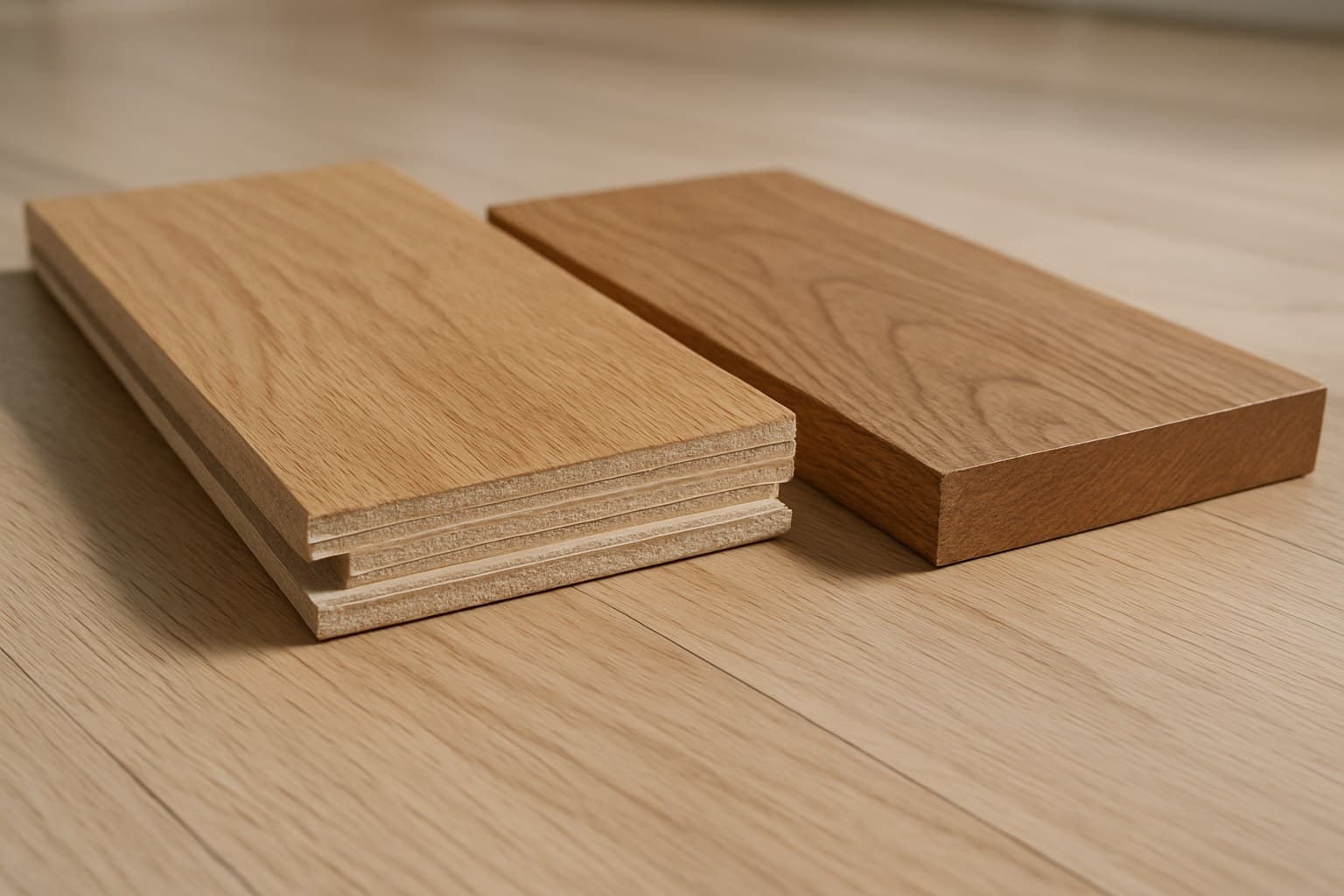
The real tradeoff is refinishing versus stability. Solid hardwood can be sanded and refinished more times over its life. Engineered wood, built on a plywood-style core, holds up better over concrete and below grade, where solid usually isn't recommended.
On an engineered sale, the number that actually matters is the veneer thickness, sometimes called the wear layer. That's the real wood on top before you hit the plywood core. The maker publishes it, and it caps how many times you can refinish, if ever. A cheap engineered plank with a paper-thin veneer can't be sanded at all, so a rock-bottom price there may mean a one-life floor. If the box on the sale rack says Pergo, check the Pergo hardwood guide first, since some of their lines are laminate rather than real wood and the wear-layer math above doesn't even apply.
Don't let a low price talk you into solid over a basement slab. I steered a customer in Toledo away from a solid oak sale for her basement rec room, because the sticker never decides it, the moisture reading does. If the numbers say the slab is wet, the right call is engineered or a different material, no matter how good the deal looks.
For the full picture, read the solid versus engineered guide, and if you're leaning toward a floating floor, whether click-lock engineered is worth it.
Is Cheap Sale Flooring Worth It? The Cost-Per-Year Math
The cheapest floor isn't always the cheapest to own. To see the truth, use life-cycle cost analysis (LCCA), a framework the National Wood Flooring Association (NWFA) uses to help flooring buyers weigh what a floor costs per year they actually keep it, not just the day they buy it.
The formula is plain:
cost per year = (materials + labor) divided by how many years the floor realistically lasts
Now a real example. Say a bargain engineered plank runs $3 a square foot in materials plus $4 in labor, so $7 installed. If the thin veneer means it looks tired and gets replaced in 10 years, that's $0.70 per square foot per year.
Compare that to a solid red oak at $6 in materials plus $5 in labor, so $11 installed. Sand and refinish it a couple of times and it lasts 30 years, which works out to about $0.37 per square foot per year.
| Floor | Materials | Labor | Installed | Years | Cost per year |
|---|---|---|---|---|---|
| Thin engineered on sale | $3 | $4 | $7 | 10 | $0.70 / sq ft |
| Solid red oak | $6 | $5 | $11 | 30 | $0.37 / sq ft |
Source: life-cycle cost math run against real installed prices, the way NWFA describes it
This cost-per-year math walks through the same LCCA framework NWFA's sales sheet gives member retailers to use at the counter with a customer. Ask your dealer to run it with the manufacturer's actual installed price and the warranty-backed lifespan for the specific SKU you're looking at, those two inputs are what change the answer, and they vary by product, region, and installer.
Life-cycle cost of two floors using the cost-per-year formula, materials and labor split out.
The pricier floor costs almost half as much per year of use. That doesn't mean skip every sale. It means a sale is only a deal if the floor lasts long enough to earn it back. A great price on a floor you'll rip out in a decade isn't a bargain, it's a down payment on doing the job twice.
Where to Actually Shop a Hardwood Flooring Sale
Where you shop changes what kind of sale you're getting, so it's worth matching the venue to what you actually need.
- Independent local dealers tend to run the most honest overstock and clearance sales, because they're clearing their own showroom, not staging a promotion. They're also your best shot at negotiating (see the FAQ below) and at getting a straight answer on whether a lot can be reordered.
- Big-box home improvement stores run frequent, deeply advertised sales, but the "original" price is often the weakest of any channel, verify per-square-foot cost against the ranges above rather than trusting the percent off.
- Outlet and liquidation warehouses carry genuine closeout and discontinued lots at the steepest discounts, but with the least reorder ability and the fewest guarantees. These are the venues where buying all the extra material you'll ever need, up front, matters most.
- Online retailers let you compare price per square foot across regions in minutes, which is useful for sanity-checking a local tag, but always order a physical sample first since lot-to-lot color shift is exactly the risk this article covers above.
None of these is automatically the "best" sale; each is a different trade between price, reorder risk, and how much you can verify before you buy.