
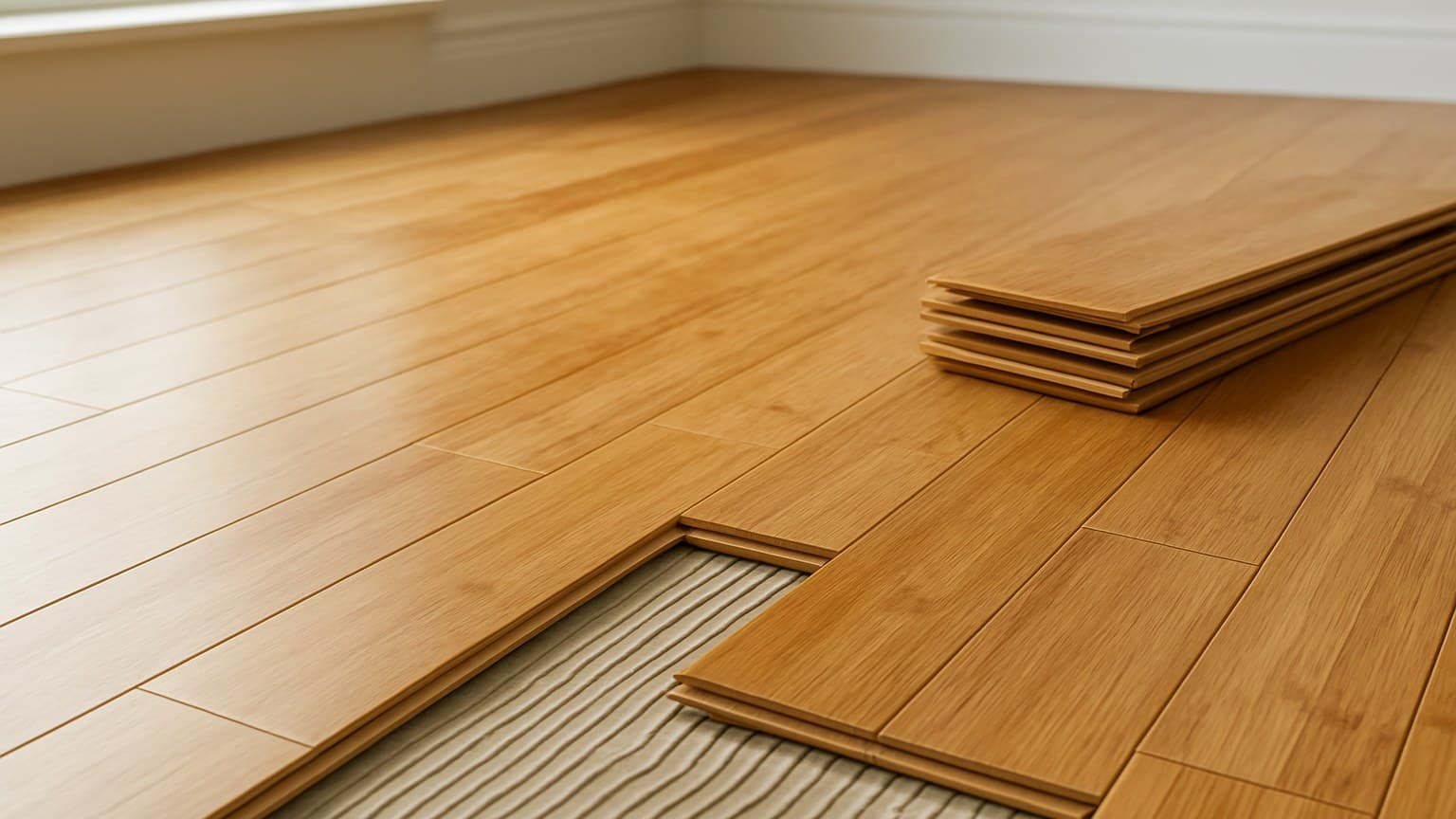
In a Fort Collins ranch I gutted this year, the homeowner had two quotes on the desk, strand-woven bamboo and white oak, and no clue why one website called bamboo harder than oak while another called it soft. Both sites were right. The whole bamboo flooring vs hardwood fight comes down to construction, not the name on the box.
Key takeaways
- Construction decides hardness, not the word bamboo: strand-woven bamboo can test 3,000+ on the Janka scale, but carbonized bamboo drops near 1,000, while red and white oak sit around 1,290-1,360.
- Bamboo usually wins on material cost ($2-7 per sq ft vs $4-12 for solid oak), but labor is similar for both, and basement or stair jobs cost more than open rooms.
- Both floors cup and gap when the slab isn't moisture-tested first, the failure is the subfloor, not the species.
- Solid oak refinishes the most times and holds resale value best, strand-woven bamboo is dense and brutal to sand, and carbonized color goes all the way through so a sand-through shows.
- Click-lock bamboo or engineered wood is realistic DIY, but nail-down solid and glue-down should go to a pro.
The Short Answer: Bamboo or Hardwood for Your Room
If you want the verdict before the details: pick strand-woven bamboo for a hard-wear, pet-heavy home on a tight budget, and pick solid or engineered oak when resale and a long refinishing life matter more to you than the sticker price.
Neither one wins as a whole category. Anyone who tells you bamboo flatly beats hardwood, or the other way around, is usually selling the one they stock.
The thing that sinks either floor is the same: a subfloor nobody moisture-tested or leveled before the planks went down. Skip that check and even top-grade oak will cup on you. Species picks the price tag; subfloor prep decides whether the floor survives.
Know What You're Comparing: Bamboo Types vs Oak Types
Before you can compare hardness or price, you have to know that "bamboo" and "hardwood" each split into very different products. Lumping them together is where the confusing numbers come from. Step past the usual oak-versus-maple comparison and the hardwood side splits even further into exotic hardwood flooring species, each with its own hardness and price swings that muddy the numbers just as much as bamboo does.
Bamboo: Strand-Woven, Natural, and Carbonized
Bamboo is a grass, not a tree, and how the factory processes it changes everything. Carbonizing it under heat and pressure darkens the strands and softens the wood, while leaving it natural keeps the color pale and the Janka number higher, a tradeoff worth weighing if you're leaning toward light hardwood floors instead of the deeper carbonized look.
- Strand-woven bamboo is shredded into strands, soaked in glue, and pressed under heavy heat and pressure. That squeezing is what makes it the toughest bamboo by a wide margin.
- Natural bamboo is the pale, uncarbonized version. It sits in the middle for hardness.
- Carbonized bamboo is baked longer to turn it that caramel-brown color. The baking that darkens it also weakens it. A darker carbonized bamboo is almost always a softer bamboo.
Hardwood: Solid vs Engineered Oak
Oak splits two ways too. Solid oak is one plank of real wood top to bottom, which is why you can sand it many times. Engineered oak is a thin slice of real oak, called a veneer, glued over a plywood-style core. That core is more stable over concrete and below grade, which is why I steer people toward engineered, not solid, in basements. If you want the full breakdown of that choice, I wrote a longer piece on what to put under hardwood flooring that covers the base under both. For the fuller decision tree, solid versus engineered plus matching wood species to the room, my guide to hardwood floors: solid vs. engineered and species walks through it room by room.
Durability and Janka Hardness: Why Every Site Gives a Different Number
The reason one page says bamboo is 1,400 and another says 5,000 is that they are testing different products and calling them the same word. Reconcile the numbers by exact construction, not by "bamboo" or "wood."
Janka is the standard test for how hard a surface resists a dent. Strand-woven tests around 3,000 and up. Carbonized bamboo can fall near 1,000. Oak sits around 1,290 to 1,360. The range is real, it's just not random.
Two things to keep in mind. Janka only measures dent resistance, not scratch resistance or finish wear, and finish wear is where both floors get ugly first. Also, that giant number on a marketing page is usually the brand's single toughest SKU, not the floor in the box you're about to carry home.
| Product type | Janka range | Note |
|---|---|---|
| Strand-woven bamboo | ~3,000-5,000+ | Bamboo shredded and pressed; hardest form, varies by brand and SKU |
| Natural (uncarbonized) bamboo | ~1,300-1,400 | Pale color; middle of the pack |
| Carbonized bamboo | ~1,000-1,400 | Baked darker, softer; the price of that color |
| Solid red oak | 1,290 | The common benchmark other floors get compared to |
| Solid white oak | 1,360 | Slightly harder than red oak |
| Engineered oak | ~1,290-1,360 | Surface hardness matches the oak veneer used |
Source: the published Janka hardness values for oak and each bamboo construction
Note: Oak Janka figures reflect widely cited industry benchmarks. Bamboo figures vary by brand and are typically self-reported by manufacturers such as Cali Bamboo and Teragren, which is a big part of why published bamboo hardness numbers swing so widely from site to site, treat any single bamboo Janka number as brand-specific, not category-wide.
Janka dent-resistance values by exact product type, showing why one bamboo tests far harder than another.
What Each Floor Really Costs: Materials, Labor, and the Long Game
Split every quote into materials and labor, because a single flat "per square foot" number hides where your money goes.
Bamboo materials usually run cheaper than oak. But labor lands in a similar spot for both, because the install method drives labor far more than the species does. A click-lock floor you snap together costs less to lay than a nail-down or glue-down floor, whether the plank is bamboo or oak.
Two more things move the total. Basement and stair jobs cost more than open rooms for either floor, so a whole-house quote is never one flat rate. And for the real cost of ownership, look past the sticker. According to the National Wood Flooring Association's 75-year Life Cycle Cost Analysis, which compares total ownership cost across 18 flooring types, a cheap floor you end up replacing more than once can cost more over its lifetime than a pricier one you refinish and keep in place.
| Line item | $ per sq ft |
|---|---|
| Labor: click-lock (DIY-able) | 3-5 |
| Bamboo material | 2-7 |
| Strand-woven bamboo material | 3-8 |
| Labor: nail or glue (pro) | 4-8 |
| Engineered oak material | 3-10 |
| Solid oak material | 4-12 |
Material and labor cost ranges per square foot; labor is set by install method, not by whether the plank is bamboo or oak.
For a species-level look at how oak pricing compares to a pricier wood, see what walnut hardwood flooring actually costs.
Moisture, Wet Rooms, and the Subfloor Test Both Floors Need
Here's the callback that changed how I work. On a kitchen job for a homeowner named Renee in Loveland, she talked me out of a moisture test to save an afternoon, and I let her. The floor cupped before the season was out, and I relaid it on my own dime rather than argue about whose call it was. Bamboo and hardwood punish a skipped test the same way.
So before any plank goes down, do two checks. First, flatness: lay a long straightedge across the floor and flag any dip past roughly 3/16 inch over 10 feet, the subfloor flatness tolerance published in the National Wood Flooring Association's installation guidelines. Second, moisture: test the slab with a meter, a handheld tool that reads how much water is trapped in the concrete or wood. A dry-looking slab can still be wet enough to ruin a floor.
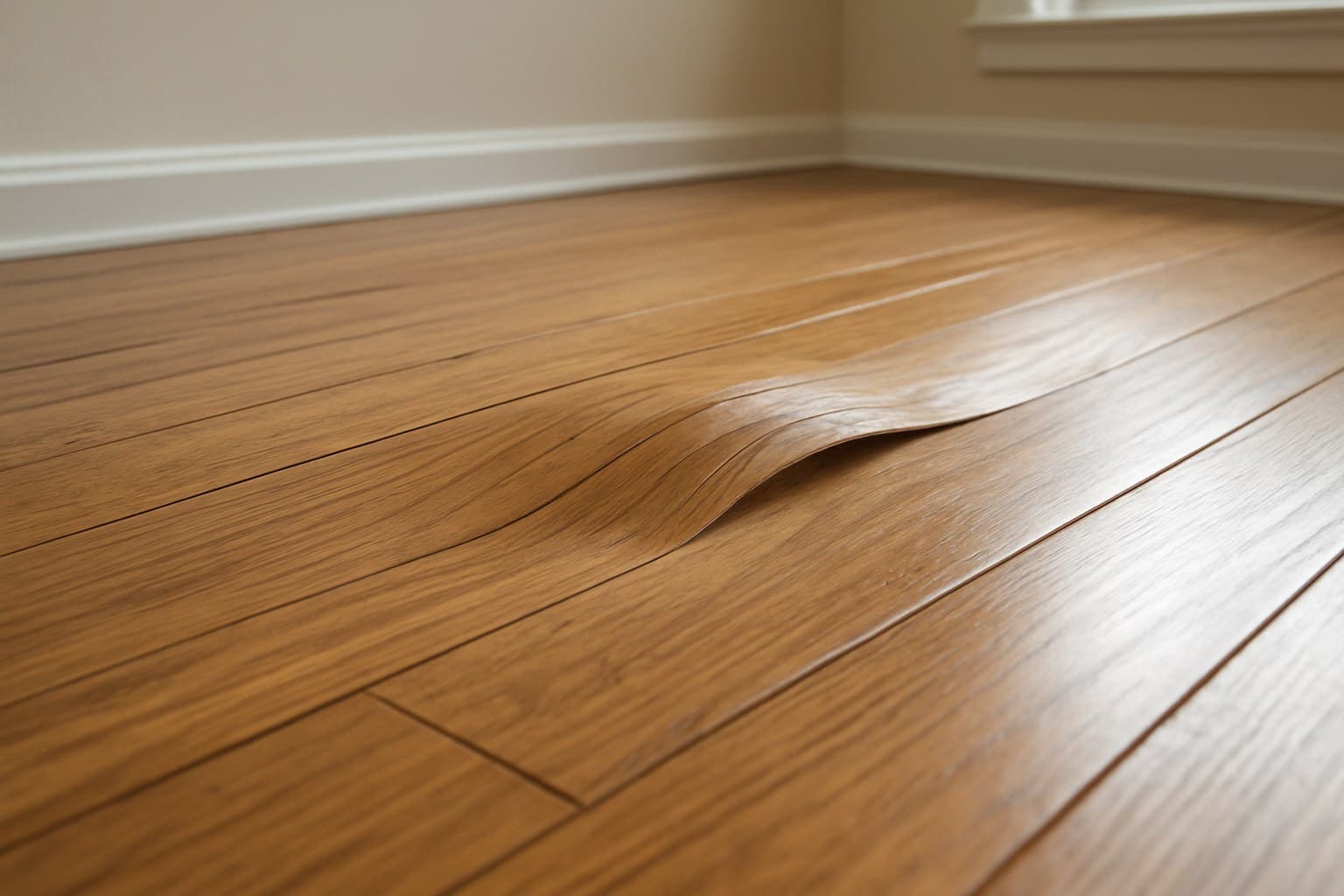
In kitchens and baths, neither floor loves standing water, and the failure almost always starts at the seams and edges, not the plank face. That's the trap in "waterproof core" claims. The core can shrug off water while the joints between planks still swell and lift. A waterproof middle does not save a vulnerable seam.
For radiant heat, check the specific product's own rating rather than a rule of thumb. Thinner strand-woven and engineered planks generally handle floor heat better than thick solid boards, but the box's sheet is what governs.
Installation, Refinishing, and How Long Each Lasts
DIY or Hire It Out
Click-lock bamboo or engineered wood, the kind where planks snap together and float over the subfloor, is realistic for most handy homeowners. Nail-down solid and glue-down floors are where I'd hire a pro, and stairs are a hard no for DIY every time. Steps eat material, punish small mistakes, and are the fastest way to turn a savings project into a callback. If a click-lock plank like Pergo has you wondering whether it's genuine hardwood or something else, my guide on Pergo hardwood: is it real wood? sorts out what's actually inside the box.
Refinishing and Real Lifespan
This is where solid oak pulls ahead. Solid oak sands many times over its life. Engineered oak sands maybe once or twice, depending on the veneer thickness the maker publishes, so check that number before you count on it. Strand-woven bamboo is so dense it's brutal to sand, which is a blessing and a curse: hard to dent, hard to refinish.
Carbonized bamboo has one quirk in its favor. The color runs all the way through the plank, so a deep sanding does not expose raw pale wood underneath. But a sand-through still shows as a dull, flat patch where the finish is gone.
Don't trust a flat "lasts 25 years" claim. What ends a floor is worn-through finish and water damage, not the calendar. A cared-for floor outlives a neglected one of the same species by decades.
Sustainability, VOCs, and Resale Value
Bamboo has one green claim that genuinely holds up: it regrows in about 3 to 7 years, while an oak tree takes decades. That's a real difference in how fast the raw material comes back.
But the eco label on the box ignores the glue. Strand-woven bamboo is mostly adhesive holding those strands together, and EPA research on flooring materials has flagged formaldehyde-based adhesives in some imported bamboo flooring as an indoor air quality concern. Look for real certifications, and know each one certifies a different thing. FloorScore and CARB Phase 2 (from the California Air Resources Board) speak to indoor air quality and how much the floor off-gasses. FSC (the Forest Stewardship Council) speaks to responsible sourcing, not air. One does not stand in for the other. If low emissions are your priority, my guide to non-toxic hardwood flooring explains why "formaldehyde-free" on a label rarely means what buyers think, and the sustainable hardwood flooring piece covers what those eco stamps actually promise.
On resale, hardwood still wins. Appraisers and buyers recognize and reward solid oak. Bamboo is less understood by the market, so even a great bamboo floor tends to read as a neutral, not a selling point.