
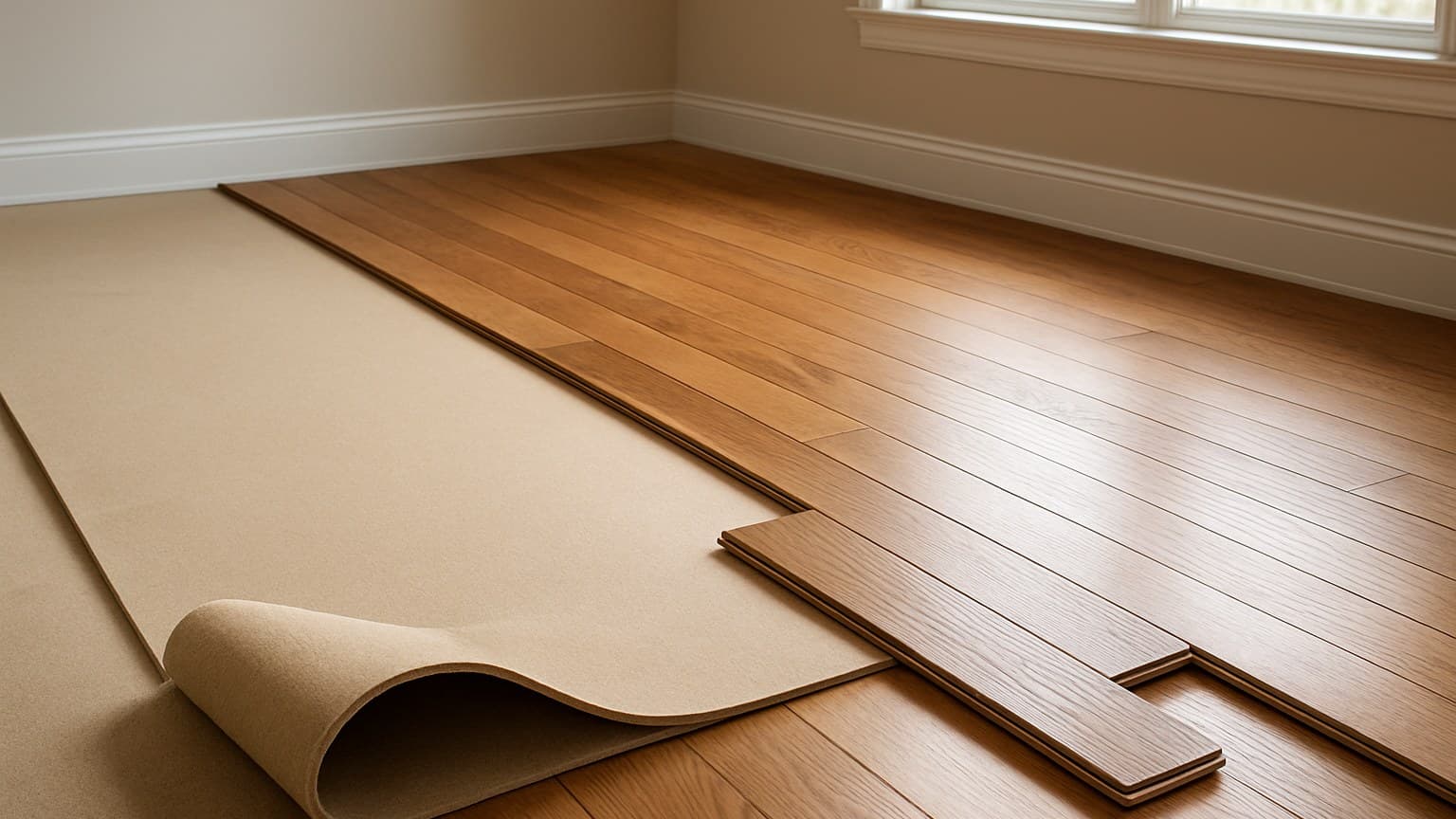
Last month I pulled up a customer's failed hardwood job in Dayton, Ohio, and found 1/4-inch foam padding stapled under nail-down solid oak, the wrong underlayment for that install method. What goes under hardwood changes with how the floor is fastened, what sits below it, and how much moisture is coming up through the subfloor. Guess wrong and the floor squeaks, cups, or the manufacturer flat-out denies the warranty claim.
Key takeaways
- Install method decides first: nail-down solid wants 15 lb felt or rosin paper, floating engineered wants foam, cork, or rubber, and glue-down engineered usually needs only the adhesive plus a moisture system, not a separate pad.
- Concrete always needs moisture handling. Test before you install (NWFA points to an in-situ RH probe, commonly a 75% RH ceiling, or a calcium chloride test around 3 lbs per 1,000 sq ft in 24 hours) and add a 6-mil poly vapor barrier or a rated system.
- Never put foam padding under nailed 3/4" hardwood. Stores push it, but it lets the floor move and squeak; felt or rosin paper is the correct slip sheet.
- Materials run roughly: rosin paper $0.05-0.15, 15 lb felt $0.10-0.30, foam $0.30-0.60, cork $0.75-2.00, and rubber $1.50-3.00 per sq ft. Labor is separate, and basement or stair jobs cost more than open rooms.
Start Here: 3 Things That Decide What Goes Under Hardwood
What goes under hardwood depends on your install method first, your subfloor second, and moisture always. Nail everything else to those three answers.
The order matters because each one rules something out. The install method, whether you nail down, float, or glue down, throws out most of your options right away. The subfloor, plywood or OSB (oriented strand board, a common pressed-wood panel) versus a concrete slab, narrows what's left. Then a moisture test settles the last question: do you need a vapor barrier, or not?
So before you buy a single roll of anything, answer three questions. How is the floor being fastened, nail-down, floating, or glue-down? What are you fastening it over, wood or concrete? And have you tested the moisture yet? Concrete always gets a test, no exceptions. Denser species like Brazilian cherry or tigerwood tend to push that first answer toward glue-down or nail-down rather than floating, which is one more reason it helps to know what sets exotic hardwood flooring apart before you settle on a method.
Two words show up over and over in this article. NWFA is the National Wood Flooring Association, and its install guidelines are what I lean on below. "Underlayment" means the thin layer between your subfloor and your flooring. That's a separate thing from a vapor barrier, which is a sheet or coating that blocks moisture. People mix those two up constantly, and it causes real problems.
There's no single "best" layer. That's why the rest of this is a selector, not a product list. On a job in Springfield, Missouri, I found the real problem wasn't the plank at all, it was a slab that felt dry to the hand but read 80% RH on the meter, and a hump in the subfloor I'd talked myself into ignoring.
Underlayment by Install Method: Nail-Down, Floating, and Glue-Down
Your install method is the biggest fork in the road, so start here.
Nail-Down Solid Hardwood
Under nailed 3/4 inch solid hardwood, you want 15 lb felt or rosin paper, and nothing thick. This is a slip sheet. A slip sheet is a thin layer that lets the wood move a hair without rubbing on the subfloor, which quiets minor squeaks and slows small vapor movement. It's not a real moisture barrier, so don't treat it like one. If you haven't settled on solid over engineered yet, it's worth working through how to choose solid vs engineered hardwood before you commit to this install method.
Don't put foam under nailed solid hardwood. Stores push it because it's cheap and they have it in stock, but foam lets a nailed floor bounce and move, and that's how you get squeaks and loose boards. According to NWFA's Installation Guidelines, felt or rosin paper, not foam, is the correct slip sheet under nail-down solid hardwood, full stop. That same cheap-and-in-stock logic shows up on the flooring itself, where clearance hardwood flooring is often just leftover overstock rather than defective material, so a low price alone shouldn't scare you off.
Staple-Down Solid or Engineered Floors
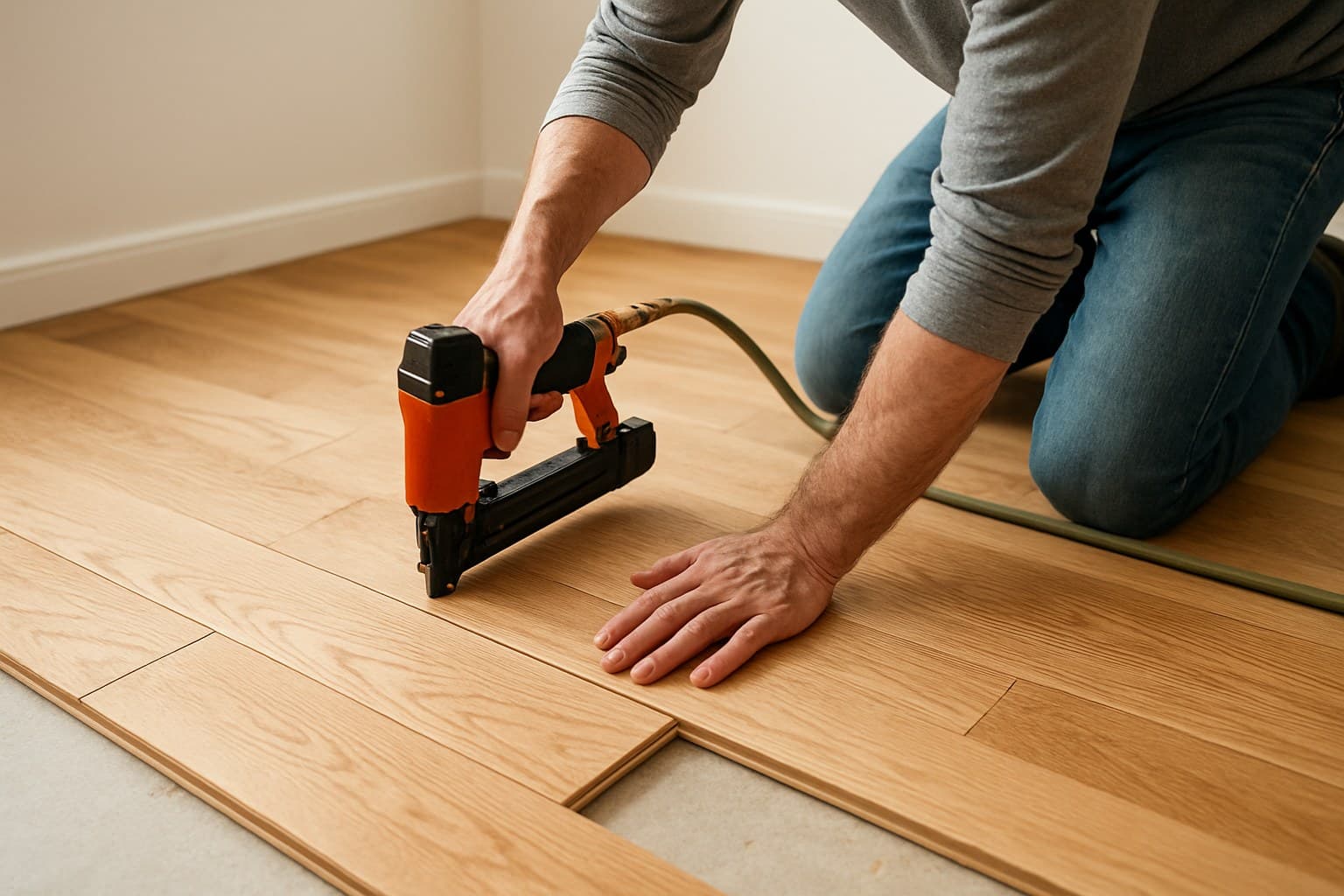
Staple-down is its own install method, not a footnote to nail-down. A pneumatic stapler drives narrow-crown staples through the tongue instead of using cleats, and it's the common method for 5/16 to 1/2 inch solid strip and a lot of tongue-and-groove engineered product over a wood subfloor. The underlayment rule underneath it is the same one as nail-down: 15 lb felt or rosin paper as a slip sheet, never foam. Foam still lets the plank flex against the fastener the same way it does with cleats, and that flex is what turns into squeaks and staples working loose over time. None of that changes whether the strip you're stapling down is select or cabin grade, though it's worth understanding how the different grades of hardwood flooring are actually defined before you order material.
Floating Engineered Floors
A floating floor isn't fastened down at all, so it needs a pad underneath: foam, cork, or rubber. That layer cushions the floor, adds sound control, and, if you buy a version with a moisture film attached, blocks vapor coming up from below. Pergo's floating floors are a common example of this setup, though it's worth checking is Pergo hardwood actually real wood before you assume it performs like solid plank.
This is also where a click-lock engineered floor lives, and it's the most realistic hardwood install for a DIYer. If you're weighing engineered against a natural product, the bamboo versus hardwood tradeoff is worth reading before you commit to a species.
Glue-Down Engineered Floors
Glue-down usually needs no separate pad at all. The trowel-applied adhesive is what bonds the plank to the subfloor, and many quality adhesives include a moisture-control membrane rated to a specific relative humidity (RH) level in the slab. Add a foam pad under glued planks and you break the bond, so don't. Just read the adhesive's data sheet and match its rated RH ceiling to your slab test. While you're on that data sheet, check the VOC and formaldehyde disclosures too, since a non-toxic hardwood flooring claim on the adhesive label doesn't always mean what buyers assume it means.
Felt vs Rosin vs Foam vs Cork vs Rubber: What Each Layer Actually Does
Here's every common layer side by side, with what it actually does for the money.
| Material | Thickness | Moisture protection | Best for | Cost per sq ft (materials) |
|---|---|---|---|---|
| Rosin paper | very thin | almost none | slip sheet under nail-down solid | $0.05-0.15 |
| 15 lb felt | ~1 mm | slows minor vapor, not a barrier | nail-down solid | $0.10-0.30 |
| Foam | 2-3 mm | film versions add a vapor barrier | floating engineered | $0.30-0.60 |
| Cork | 3-6 mm | none on its own | floating engineered, sound control | $0.75-2.00 |
| Rubber | 2-5 mm | dense but not a rated barrier | sound control under floating floors | $1.50-3.00 |
Source: Manufacturer spec sheets for the felt, cork, and rubber rolls I stock for jobs
Note: prices are approximate market ranges for materials only; exact costs vary by brand, region, and retailer.
Materials-only pricing; labor is quoted separately and is not included here.
Two arguments come up every time, so let me settle them. Rosin versus felt: rosin paper gives almost no moisture protection and is really just a slip sheet, while 15 lb felt slows minor vapor. NWFA treats both as acceptable slip sheets under nail-down solid, not as vapor barriers. Neither one saves you over a wet slab.
The other one is rubber. Dense rubber resists moisture well, and salespeople will tell you it doubles as a vapor barrier. It doesn't. It's not a rated barrier, so over concrete you still add a 6-mil poly sheet or a rated system underneath it.
Moisture Testing and Vapor Barriers Over Concrete
Concrete always needs a test before hardwood goes down, because a slab that feels bone dry can still push vapor up for years. That vapor is what cups boards and pops glue lines months after a clean-looking install.
The Moisture Numbers NWFA Points To
According to NWFA's Concrete Subfloors guidelines, two ASTM test methods are the industry standard before installing hardwood over a slab: in-situ RH probes (ASTM F2170) and calcium chloride testing (ASTM F1869).
| Test | What it measures | Threshold |
|---|---|---|
| In-situ RH probe (ASTM F2170) | humidity deep inside the slab | commonly a 75% RH ceiling, set by the product |
| Calcium chloride (ASTM F1869) | moisture leaving the slab surface | around 3 lbs per 1,000 sq ft in 24 hours for many wood systems |
| Pin/pinless meter on wood subfloor | moisture in plywood or OSB | within 2-4% of the flooring's own reading |
Source: NWFA moisture-testing thresholds and the ASTM methods they reference
Thresholds are set by each flooring or adhesive maker; confirm the exact limit on your product's data sheet.
Two names there are worth spelling out. ASTM is the American Society for Testing and Materials, which writes the test methods the industry agrees on. The in-situ RH probe (F2170) drops a sensor into a drilled hole to read the humidity inside the slab, and many wood systems cap it near 75% RH. The calcium chloride test (F1869) measures how much moisture leaves the surface, often limited to about 3 lbs per 1,000 sq ft in 24 hours. A meter is just a handheld gauge that reads moisture in wood, and you use it to check that your subfloor and your planks are close before you install.
A Worked Moisture Test Example
Say you've got a 500 sq ft slab. You drill the probe holes, wait the equilibration period ASTM F2170 calls for, and read 80% RH. That's over the common 75% ceiling. So you don't install yet. You either add a rated moisture-control system, a 6-mil poly sheet or a liquid membrane troweled on the slab, or you let the slab dry and retest. Laying wood over that reading is how you buy yourself a callback.
One more note on marketing. "Waterproof core" language belongs to vinyl, not hardwood, and even there the core is not the seams. On concrete, what protects your wood is a rated vapor barrier with an actual RH number, not a slogan on a box.
And acclimation, the trade term for letting new wood planks sit in the room so they adjust to its temperature and humidity before install, only counts after the slab passes. Letting wood adjust to the room over a wet slab is meaningless, because the slab keeps feeding moisture into the boards the whole time.
Flatness Is a Separate Problem: Self-Leveling Underlayment for Uneven Concrete
A slab can pass its RH test clean and still fail you on flatness. That hump I ignored on the Springfield job is the example: dry enough by the numbers, but uneven enough to rock a glue-down plank or gap a click-lock seam once weight sits on it. Moisture and flatness are two different failures with two different fixes, and testing only one leaves the other one to find you later.
The fix for an uneven slab isn't a thicker pad, it's a cementitious self-leveling underlayment troweled or poured over the concrete to true it up before anything else goes down. NWFA has run a session specifically on the value of self-leveling underlayment for hardwood installs, precisely because this step gets skipped so often, installers see a passing moisture reading and treat that as the all-clear on the whole slab, flatness included. Check your slab against the flooring manufacturer's allowed variance under a straightedge, and level it first if it's out of spec, before you worry about which vapor barrier or pad goes on top.
The Underlayment Decision Matrix (Install Method x Subfloor x Moisture)
Cross-reference your install method with your subfloor and you land on exactly what to put under.
| Install method | Over plywood / OSB | Over concrete slab |
|---|---|---|
| Nail-down solid | 15 lb felt or rosin paper slip sheet; never foam | not direct; build a plywood subfloor with 6-mil poly under it first, then felt |
| Staple-down solid/engineered | 15 lb felt or rosin paper slip sheet; never foam | not direct; same as nail-down, build a plywood subfloor with 6-mil poly under it first, then felt |
| Floating engineered | foam, cork, or rubber pad; film version if any moisture | pad with attached vapor film, or 6-mil poly, only after the slab passes its test |
| Glue-down engineered | adhesive only, no separate pad | moisture-control adhesive or membrane rated to your slab's RH; no pad |
Source: How I match NWFA guidance to the subfloors I actually meet on jobs
Read your own row and you have your answer. Concrete never lets you skip the moisture step, and nail-down and staple-down solid never want foam. Those rules alone prevent a lot of the failures I get called back to fix.
Sources
- NWFA Installation Guidelines (PDF)
- NWFA Concrete Subfloors Guidelines (PDF)
- NWFA Session: Wood Floor Installations, Adhesives & Moisture Barriers (Bona)
- NWFA Session: The Value of Self-Leveling Underlayments for Hardwood Flooring (Sika)
- NWFA Tech Talk Tuesday: Moisture Vapor Mitigation and Sound Abatement (Bostik)