When I redid the oak floors for a homeowner in Dayton, Ohio last month, the quote sheet had five separate lines before a single board went down. Installed hardwood runs about $8 to $15 per square foot for mid-range oak, climbing toward $25 for walnut, exotics, or a herringbone layout, and removal, subfloor leveling, and finishing each add their own line on top of that number. That gap between the per-foot price and the final bill is where most budgets blow up.
Key takeaways
- Installed hardwood runs about $8-15 per sq ft for mid-range oak, up to $25 for walnut, exotics, or herringbone; materials are $3-14 and labor $3-8.
- A 1,000 sq ft job typically lands at $8,000-15,000 installed; 1,200 sq ft runs about $9,600-18,000.
- Removal ($1-3/sq ft), subfloor prep ($1-4/sq ft), and site-finishing ($2-5/sq ft) are separate line items that wreck most budgets.
- Stairs are priced per step ($40-75), and basements need engineered wood plus a moisture check, so both cost more per foot than an open bedroom.
- The math: area x (materials + labor) + removal + prep + trim, then add 5-10% for waste (15%+ for herringbone).
Hardwood Flooring Cost in 2026: The Quick Answer
Installed, plan on about $8 to $15 per square foot for mid-range oak, climbing to around $25 for walnut, exotics, or a fancy pattern like herringbone. That installed number splits into two parts: materials at $3 to $14 per square foot and labor at $3 to $8 per square foot for a standard nail-down. Removal and subfloor prep are separate lines on top of that. If red oak is the species you keep circling back to, my red oak prefinished hardwood flooring guide prices out that exact product line.
Anchor it to a whole house and a typical 1,000 square foot main floor runs $8,000 to $15,000 installed. I break down that whole-house math further, including every line item that gets you there, in my hardwood floor installation cost guide.
If you've been searching, you've probably seen one site quote $7 to $15 and another $6 to $25. Both are right. The low end is basic engineered wood or plain oak in a wide-open room with almost no cuts. The high end is walnut, an exotic species, or a herringbone layout in a chopped-up space full of closets and doorways. Same "hardwood," very different job.
Hardwood Flooring Cost Per Square Foot: Materials vs Labor
The per-square-foot price is really four numbers stacked together: materials, labor, removal, and subfloor prep. Splitting them is the only way to know what a quote is actually charging you for.
Labor swings mostly on the install method. A nail-down over a plywood subfloor is the cheapest way to lay wood. Glue-down or a floating floor over concrete takes more time and more product, so labor runs higher.
Here's where a flat per-foot rate lies to you: cut-heavy rooms. I used to quote by the square foot until a job packed with closets, doorways, and a bay window ate a whole extra day. The open middle of a room is never where the time goes, so now I count those cut-up areas separately on every bid.
| Line item | Low $/sq ft | High $/sq ft |
|---|---|---|
| Materials, engineered | $3 | $8 |
| Materials, solid hardwood | $5 | $14 |
| Labor, nail-down | $3 | $6 |
| Labor, glue-down or floating | $4 | $8 |
| Old floor removal & haul-off | $1 | $3 |
| Subfloor prep & leveling | $1 | $4 |
Source: the per-foot line items I break out on my own install bids
Use these six lines to check whether a quote is quietly bundling removal and subfloor prep into one vague number.
Line them up side by side and you can see where a bid actually goes, from the smallest removal charge up to the priciest line, the wood itself. The chart below shows how those four pieces stack against each other.
For material-only shopping, my full hardwood flooring prices guide breaks the product side down further.
Solid vs Engineered vs Wood Species: How Your Choice Moves the Price
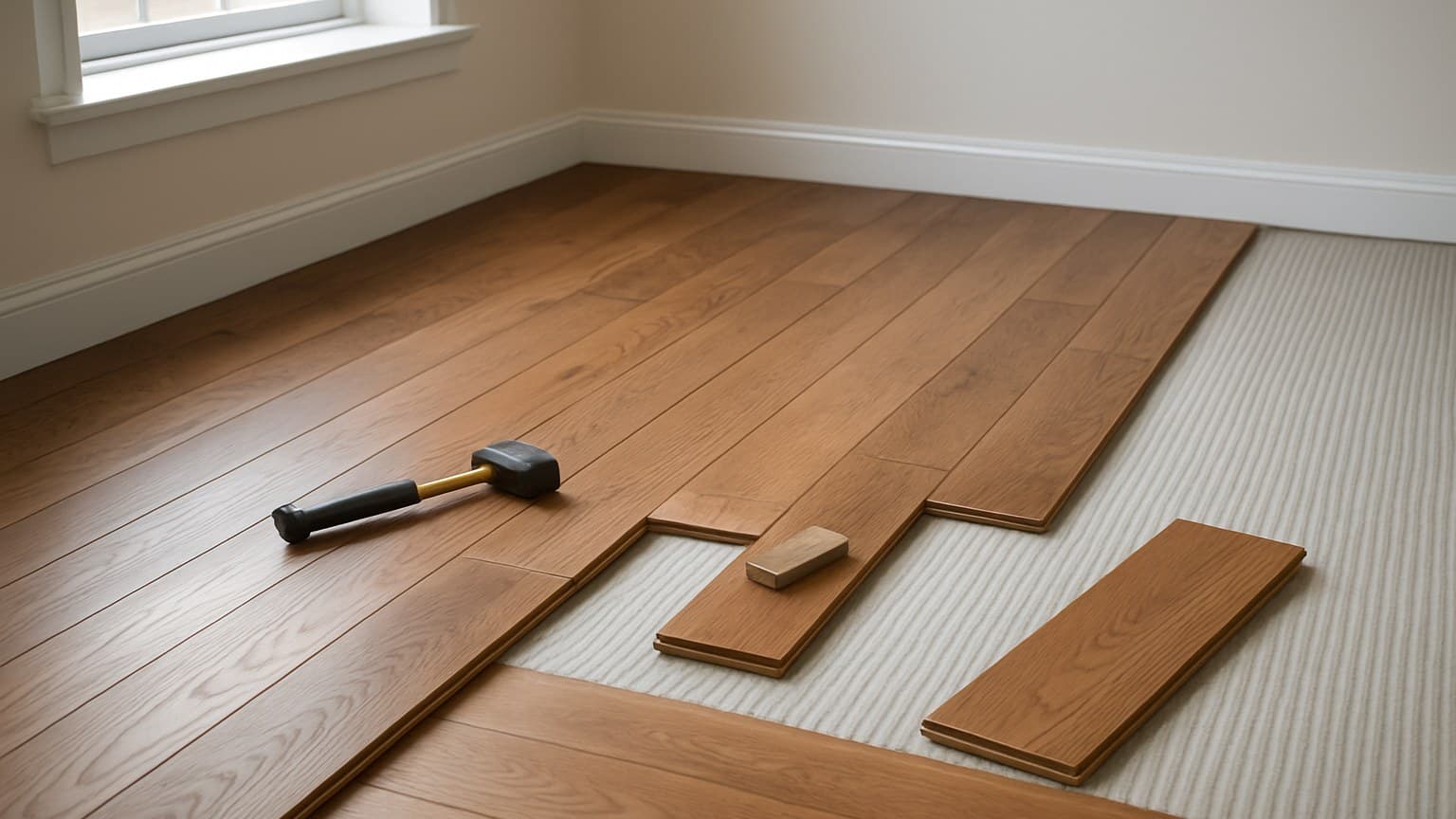
Engineered wood costs less in materials, and its plywood-style core stays stable over concrete and below grade, where solid usually isn't recommended. Solid's edge is refinishing: you can sand it several times over its life, while engineered's thin veneer caps how often, if at all. So the choice is driven by where the floor's going as much as by looks. If you're still torn on which category and species fit your subfloor and room, my solid vs. engineered hardwood guide walks through that decision in more depth.
Species is the biggest material-price lever. Oak sits at the low end. Walnut and exotics like Brazilian cherry sit at the top, and their higher Janka hardness, the wear-resistance scale the National Wood Flooring Association (NWFA) uses to compare how species hold up to scratches and dents, is part of what you're paying for.
Finish matters too. Prefinished planks show up sanded and coated, so you skip the on-site finishing charge. Raw wood finished in place adds a sanding-and-coating step, which is real labor and dust.
Grade is the lever hiding inside each of those species ranges. Select or clear grade, boards cut for uniform color and few knots, prices toward the top of a species' band. Character or rustic grade, with more knots, mineral streaks, and color variation, prices toward the bottom of that same band. Two oak quotes can both say "oak" and still land $3-4 a foot apart because one spec'd clear and the other spec'd character, even before you factor in finish or install method.
| Species | Low $/sq ft | High $/sq ft |
|---|---|---|
| Engineered (basic) | $3 | $8 |
| Red/white oak | $5 | $10 |
| Maple | $6 | $11 |
| Hickory | $6 | $12 |
| Walnut | $8 | $14 |
| Exotic (Brazilian cherry) | $8 | $14 |
Source: supplier price sheets I buy from, with Janka hardness numbers from the NWFA
Compare these ranges against your own quote's material line before you sign off on a species upgrade, and ask which grade the quote assumes, since that alone can slide the number from one end of the row to the other.
Weighing raw versus factory-coated planks? My prefinished hardwood flooring guide walks that decision in detail.
How Much Does Hardwood Flooring Cost by Square Footage (500-2,500 Sq Ft)
The Cost Formula, Every Variable Named
The math is simple once you name the parts:
Total = area x (materials + labor) + removal + prep + trim, then add 5-10% for waste (15%+ for herringbone or chevron).
- Area is the room's square footage.
- Materials is your per-foot wood price ($3-14).
- Labor is your per-foot install rate ($3-8).
- Removal, prep, and trim are the extra lines (covered below).
- Waste covers cutting and bad boards. Straight-lay runs 5-10%; angled patterns need 15% or more.
Worked example, 1,200 square feet of oak: 1,200 x ($6 material + $5 labor) = $13,200. Add roughly $2,400 for removal, subfloor prep, and trim. Add 8% waste on the wood, about $600. You land near $16,200 installed.
Whole-House Totals Table
| House size | Low (installed) | High (installed) | Notes |
|---|---|---|---|
| 500 sq ft | $4,000 | $7,500 | Small room or entry; per foot runs high on tiny jobs |
| 1,000 sq ft | $8,000 | $15,000 | Main floor of a small home |
| 1,200 sq ft | $9,600 | $18,000 | Typical single level |
| 1,500 sq ft | $12,000 | $22,500 | Larger main floor |
| 2,000 sq ft | $16,000 | $30,000 | Most of a whole house |
| 2,500 sq ft | $20,000 | $37,500 | Full house; add stair premiums |
Source: the square-foot math I quote every job with, run across five house sizes
Match the size closest to your own home, then budget higher if the layout is choppy or the job includes a basement or stairs.
For a closer look at the labor side, see my guide to installing hardwood flooring.
Room-by-Room: Why Bedrooms, Stairs, and Basements Price Differently
The same wood costs different money depending on the room. An open bedroom is the cheapest per foot: long straight runs, few cuts, simple nail-down over a wood subfloor.
Stairs are the opposite. Every tread (the part you step on) and riser (the vertical face) is hand-cut and hand-fit, so installers price them per step, usually $40 to $75 each. A single staircase can add more than a whole bedroom.
Basements cost more too, and not because of the wood. They sit below grade, so they need engineered planks and a moisture check before anything goes down. That prep, plus the moisture control, pushes the per-foot cost above an open room upstairs. Given those moisture headaches, plenty of homeowners skip solid wood in basements altogether and turn to vinyl instead, whose long-term durability there gets its own breakdown in my guide to vinyl flooring lifespan.
| Area | Added cost |
|---|---|
| Open bedroom | Base rate, cheapest per sq ft |
| Living room / hallway | Base rate plus doorway and transition cuts |
| Stairs | $40-75 per step, labor-heavy |
| Basement (below grade) | Engineered plus moisture test plus prep, highest prep cost |
How each room type moves the per-square-foot price on a typical job.
Going below grade? My waterproof engineered hardwood guide covers the products built for basements.
The Extra Costs That Blindside People
These are the lines that turn a tidy per-foot quote into a much bigger bill. None of them are optional, and most get buried or left off the first estimate.
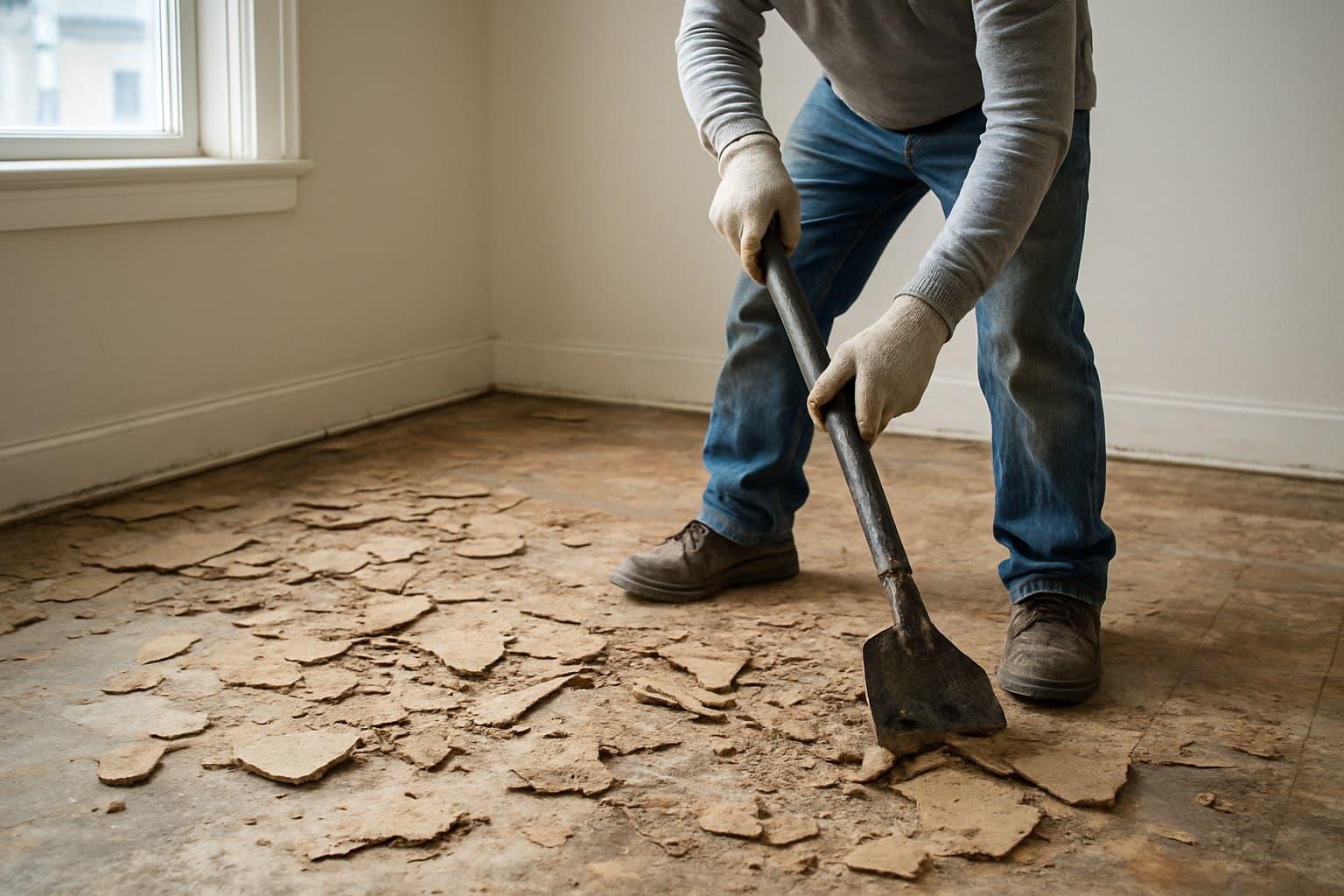
- Old floor removal and haul-off: $1-3 per sq ft. Ripping out carpet, tack strip, and old glue, then paying to dump it.
- Subfloor prep and leveling: $1-4 per sq ft. Flatness and a moisture reading come before a single plank. On most floating floors, the maker's warranty requires the subfloor to be flat and dry, that's the condition, not the plank you picked. Skip it and the floor telegraphs every dip.
- Site-finishing raw wood: $2-5 per sq ft. Sanding and coating in place, if you didn't buy prefinished.
- Stairs: $40-75 per step, priced separately from the field.
- Waste: 5-10% on straight layouts, 15% or more on herringbone or chevron.
Add these up and a floor quoted at "$8 a foot" can land closer to $13 or $14 installed. That's not a bait-and-switch, it's the real job.