
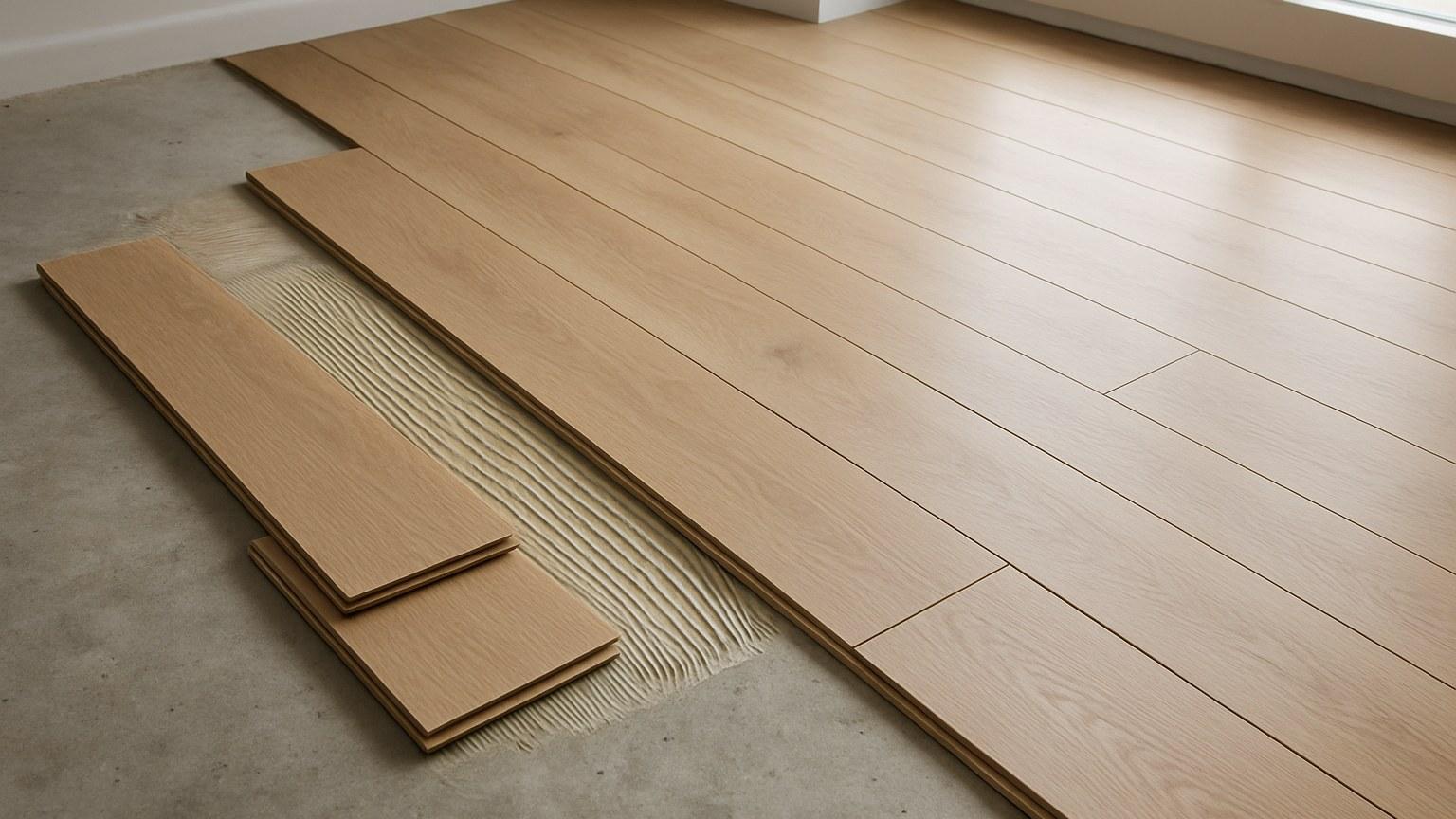
Flooring installation cost is three numbers stacked: material per square foot, labor per square foot, and prep or old-floor removal per square foot. No single national figure tells you much on its own, because those three layers swing with your material, your city, and what sits under the old floor. Stack them yourself and a flat contractor quote stops being a mystery you have to take on faith.
Key takeaways
- Every installed floor is three layers stacked: material $/sq ft + labor $/sq ft + prep and removal $/sq ft.
- Flooring installation labor averages about $54 per hour, according to TaskRabbit, and climbs in higher-cost metros.
- Old carpet removal and disposal runs roughly $1.37-$2.49 per sq ft all-in, per Dropcurb and Homewyse.
- Subfloor repair on the existing deck runs $2-$10 per sq ft, per LXHausys; full replacement $3-$10, per Blockrenovation.
- Click-lock laminate and LVP (luxury vinyl plank) are realistic DIY jobs that cut the labor layer; glue-down, stairs, and big open-plan transitions are worth hiring out.
What Flooring Installation Costs Per Square Foot
An installed floor is three layers of cost: the material you pick, the labor to lay it, and the prep and removal to get the room ready. Add those three per-square-foot numbers, multiply by the room, and you get your actual total. That's also why two bids for the "same" floor can land hundreds of dollars apart.
Here's the formula in plain words: total = (material per sq ft + labor per sq ft + prep and removal per sq ft) times the room's square footage.
Say you want click-lock laminate in a 200 square foot bedroom. Material runs about $2-$4 a foot, labor about $2-$3, and pulling out old carpet with prep runs roughly $1.37-$2.49, per Dropcurb and Homewyse. Add those and you're at about $5.37-$9.49 a foot, so the room lands around $1,074 to $1,898.
| Component | Detail |
|---|---|
| Formula | Total = (material $/sq ft + labor $/sq ft + prep & removal $/sq ft) x room sq ft |
| Material (click-lock laminate) | $2-$4 per sq ft |
| Labor | $2-$3 per sq ft |
| Prep + old carpet removal | $1.37-$2.49 per sq ft |
| Per-sq-ft total | ~$5.37-$9.49 per sq ft |
| 200 sq ft room | ~$1,074-$1,898 |
The three-layer install formula worked end to end for a 200 square foot room.
Now the part most quotes hide: when one bid comes in low and another high, it's rarely about the plank itself. One assumed a bare, flat subfloor and a simple straight layout. The other built in carpet tear-out, floor leveling, and a pattern that slows every cut. Same floor, different jobs.
And the per-foot number isn't flat across the house. Basements and stairs cost more per square foot than an open room on one level, because the cuts are tighter and the moisture risk is higher.
Cost by Material Type
Material is the layer you control most, and it sets the floor under everything else. The table below shows typical installed ranges per square foot, split material versus labor, from the cheapest carpet up through stone.
| Material | Material cost | Labor cost | Installed total | Note |
|---|---|---|---|---|
| Carpet | $1-$3 | $0.50-$1.50 | $1.50-$4.50 | Cheapest to install; stretch-in over pad |
| Laminate | $2-$4 | $2-$3 | $4-$7 | Click-lock, DIY-friendly |
| Vinyl / LVP | $2-$5 | $2-$3 | $4-$8 | Click floats; glue-down costs more labor |
| Engineered hardwood | $3-$8 | $3-$5 | $6-$13 | Nail, glue, or float by product |
| Solid hardwood | $4-$10 | $4-$8 | $8-$18 | Site-finish adds labor and days |
| Tile | $2-$8 | $5-$10 | $7-$18 | Labor-heavy; pattern adds more |
| Cork | $3-$7 | $2-$4 | $5-$11 | Click or glue-down |
| Stone / marble | $5-$15 | $7-$15 | $12-$30 | Highest labor; heavy and brittle |
Typical installed cost per square foot by material, split into material and labor.
Notice where the labor sits. Tile, site-finished hardwood, and stone carry heavy labor because every piece is cut, set, and leveled by hand. Click-lock laminate and LVP (luxury vinyl plank) float together fast, so their labor stays light. That split is the difference between a floor you could lay yourself and one you really shouldn't.
Laminate stays steady at about $4-$7 a foot installed, which matches what I quote and what the fuller laminate flooring cost breakdown lays out line by line.
Budget vs. Premium Grades Within One Material
The ranges above are wide for a reason: one material is really several price bands. A builder-grade laminate at the bottom of that $2-$4 is a thin plank with a weak wear layer. A premium plank at the top has a denser core and a tougher surface rated for busier rooms.
The same split runs through LVP, carpet, and hardwood. If you're shopping the low end, it helps to know what the cheap price actually buys before you commit, which is exactly what Cheap Laminate Flooring: What the Low Price Really Buys You walks through. Pay for the grade the room's traffic calls for, not the cheapest box on the shelf.
Labor Cost and Why Your City Changes the Number
Labor is usually $2-$3 per square foot on a floating floor, and more when the install is glued, nailed, or set in mortar. Handypeople and small crews often quote by the hour instead, and flooring help averages about $54 per hour according to TaskRabbit.
Most dedicated flooring installers quote by the foot, because they know how fast their crew moves. A general handyperson is more likely to quote by the hour. Either way, ask which one you're getting so you can compare apples to apples.
Your city moves that number more than any other guide admits. High-cost metros and dense urban areas run above the ranges here; smaller towns run below. To read your own local rate, call two or three installers for a per-foot price on the same simple room and see where they cluster. That cluster is your real labor layer, not a national average.
What does the labor dollar actually buy? Layout and squaring the first row, cuts around door jambs and cabinet toes, transitions between rooms, and the quiet prep most homeowners never see. Skip the pro and you cut this layer out, which is why DIY tempts so many people.
Subfloor Prep, Old-Floor Removal, and the Fees That Blow Up a Bid
This is the third layer, and it's where a clean-looking quote turns ugly. Removal, disposal, and subfloor work each carry their own per-square-foot cost, and they stack on top of material and labor.
| Item | Range per sq ft | Source |
|---|---|---|
| Disposal only | $0.40-$0.50 | Angi |
| Carpet removal, all-in (labor, materials, disposal) | $1.37-$2.49 | Dropcurb, Homewyse |
| Glued-down carpet removal | $3-$5 | Angi |
| Subfloor repair (existing deck) | $2-$10 | LXHausys |
| Subfloor replacement (remove plus new) | $3-$10 | Blockrenovation, Dropcurb |
Prep and removal line items per square foot, as reported by the named cost sources.
Before any of that spending, two checks decide whether the floor lasts: is the subfloor flat, and is it dry? On a floating floor especially, the manufacturer's warranty quietly hinges on the prep under the plank, not the plank itself. I've seen a good floor fail because the deck was never leveled, and a cheap floor hold up for years because the prep was done right.
Flatness means no high or low spots past what the product's instructions allow. Moisture means testing the slab or wood deck with a meter, not eyeballing it. Skip either and you're buying a repair, not a floor.
The add-ons most guides skip belong here too: underlayment and vapor barrier where the product calls for them, moving furniture, and permits in the rare jobs that need them. Glued-down carpet removal is a rough surprise on a bid, running $3-$5 a foot per Angi because every scrap and the old pad have to be scraped off the deck. Basements and stairs push all of this higher than an open room.
Room Type and Pattern: Where the Price Jumps
Not all square footage costs the same. Kitchens and baths run higher because the installer cuts the floor around cabinet toes, toilet flanges, and tight corners, and every cut is slow. Stairs are the biggest per-unit jump on any job.
Pattern raises labor fast. A herringbone layout runs about $12-$14 per square foot according to TileForeman, because every piece is angled and fitted. Diagonal and other patterns also push your waste and overage higher, so you buy more material than the room measures.
Stairs deserve their own line. Carpet treads run about $8-$20 per tread in material according to Oak Valley Designs, before labor. On wood or vinyl stairs, each tread needs a nosing, the rounded trim piece that caps and protects the front edge of the step. I've learned not to trust a plank's click system alone on that stair nosing, so on every tread I glue the floor down and set a proper nosing piece. A nosing that works loose on a stair is a fall risk, and no floating lock was built to hold there.
Moisture rooms need the right material, not the cheapest box. Before you put laminate in a bathroom, read the laminate bathroom flooring factors that decide if it survives, and know the gap between a real waterproof claim and marketing with the water-resistant laminate guide. Most failures start at the seams and edges, not the plank surface.
Big-Brand Installers vs. Local Pros: What Changes the Bill
National names like Empire Today and Express Flooring sell a bundled, all-in quote: an in-home measure, one number that folds material, labor, removal, and prep together, and often a promo price. It's convenient, and for a busy household the single number can be worth it.
An independent store or a local installer is more likely to itemize: material on one line, labor on another, prep and removal on their own. That itemized sheet is harder to read at a glance but much easier to check and to negotiate.
On either kind of bid, confirm three things. Is the installer licensed where your area requires it? Is there a written scope that names the exact material and layout? And who handles tear-out, disposal, and furniture moving, you or them? Those three answers are where most disputes start.
An itemized quote protects you more than a flat all-in number, because you can see which layer is driving the price and push back on the one that looks high. When you're ready to put the numbers together for your own house, the full flooring estimate walkthrough shows how to total material, labor, and prep for the whole job.
DIY or Hire: Which Install Layer You Can Cut
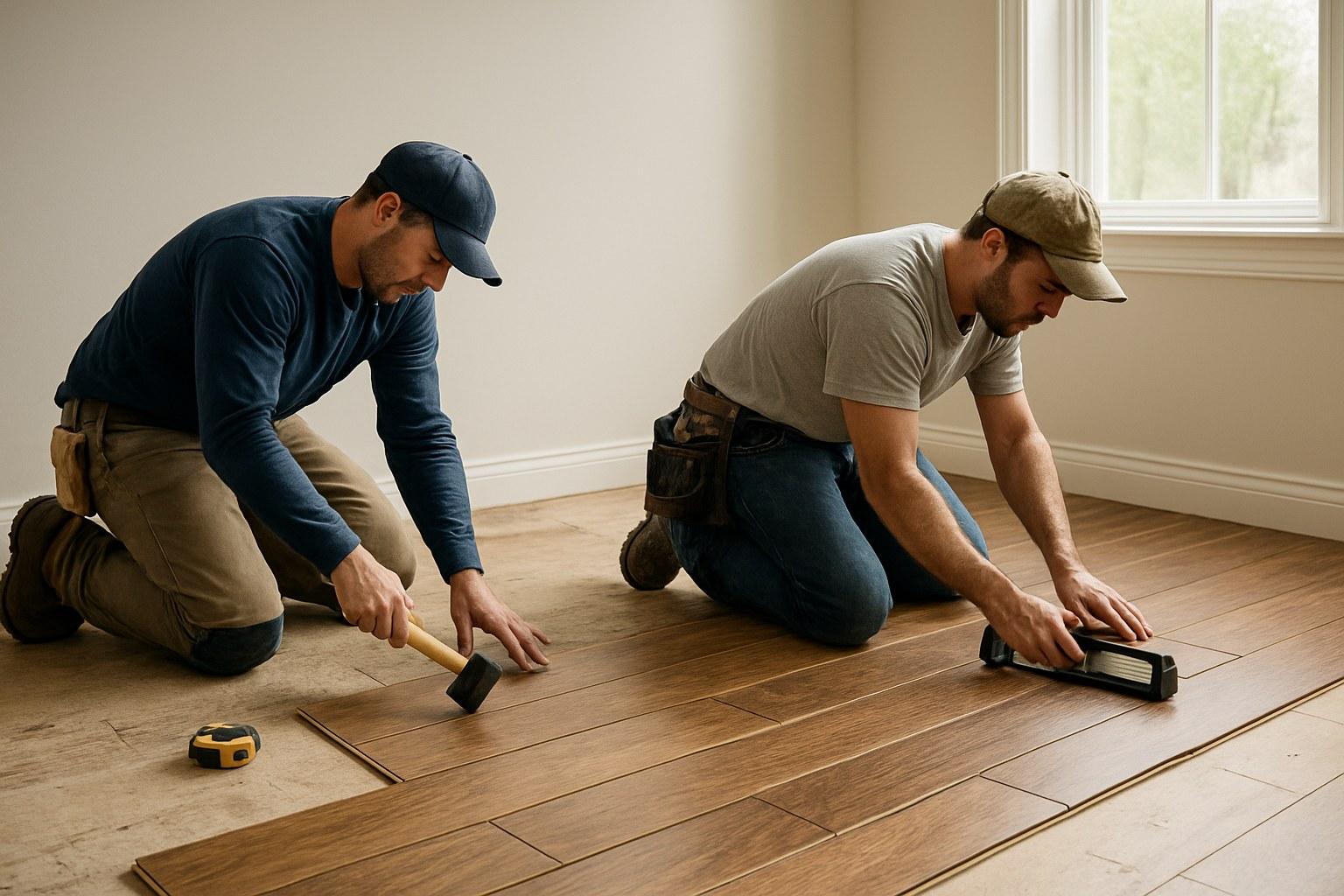
The one layer you can actually remove is labor, and only on the right kind of floor. Click-lock laminate and LVP are realistic DIY jobs for a patient homeowner with a flat, dry subfloor, and doing it yourself cuts that $2-$3 a foot out entirely. Before you commit to laminate for the whole project, it helps to check which rooms laminate flooring actually works in.
Glue-down floors, stairs, and big open-plan rooms with moisture transitions are a different story. Glue-down leaves no room for error, stairs carry a safety risk if the nosing is wrong, and a large floating floor across several rooms needs the expansion gaps and transitions handled right or it buckles. Those are the jobs worth hiring out.
If you're torn between the two floors most DIYers consider, the full LVP vs laminate comparison lays out the real tradeoff: laminate's lower cost and sharper wood look against LVP's better tolerance for water.
Sources
- NWFA Life Cycle Cost Analysis fact sheet
- NWFA Life Cycle Cost Analysis overview
- NWFA 2023 Life Cycle Cost study
- TCNA (Tile Council of North America): Tile, The Natural Choice (2021)
- Carpet and Rug Institute: Carpet Is a Cost-Effective Flooring Choice