
A flooring estimate is five numbers stacked: your room's square footage, times the material price per square foot, plus waste, plus labor, plus prep. Most guides hand you the first two and stop there. Leave out waste or prep, and the real bill lands hundreds over the number you planned for.
Key takeaways
- A flooring estimate is five numbers stacked: square footage, then material price per sq ft, plus a waste allowance, plus labor, plus prep.
- Waste isn't one flat rule. thefloorproject.com uses about 7-15% for hardwood and 5-15% for laminate and LVT (luxury vinyl tile); floordaddy.com applies a flat 10-15% to everything.
- Laminate basic install labor runs $6.91-$11.81 per sq ft, per homewyse.com's 2026 figures, and that's before material.
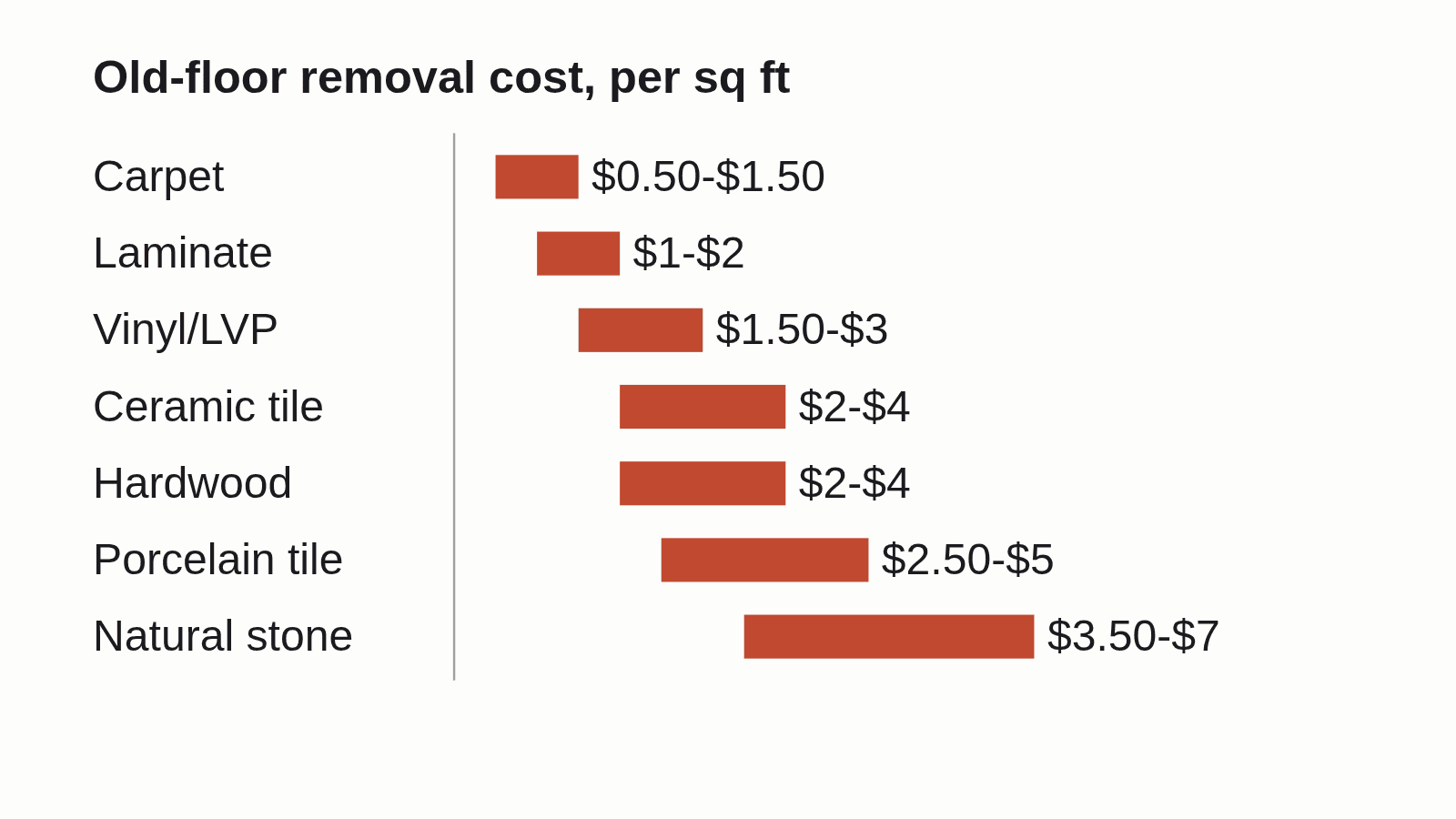
- Pulling the old floor adds $0.50-$1.50 per sq ft for carpet up to $3.50-$7 for natural stone, according to projectcalcs.com.
- Buy material by the carton (around 20 sq ft each), so always round your waste-adjusted square footage up to the next full carton.
How to Calculate a Flooring Estimate
Stack five numbers and you have your estimate: square footage x material price per square foot, plus waste, plus labor, plus prep. That's the whole formula. Everything else is just filling in the blanks for your room.
What each of those five numbers means:
- Square footage is your room's floor area. Length times width.
- Material price per square foot is what the flooring itself costs, before anyone installs it.
- Waste is the extra you buy on top of the room size to cover cuts, bad planks, and a few spares.
- Labor is what the installer charges to lay it, also priced per square foot.
- Prep is tearing out the old floor and fixing the subfloor underneath.
Most of these ride on square footage: material, labor, and prep all scale up as the room gets bigger. A few costs are one-time adds instead, like a disposal fee for the old floor or a transition strip at a doorway. Those don't multiply by room size, so pencil them in separately.
Skip waste, labor, and prep, and a modest room can run several hundred dollars over what a plain square-footage-times-material-price quote promised. The worked example below carries one real 150-square-foot room through all five numbers so you can see exactly where that gap lands.
Is a Flooring Estimate Always Per Square Foot?
Mostly, but not entirely. Material, labor, and subfloor prep are quoted per square foot because they grow with the room. The one-time items don't: hauling the old floor to the dump is often a flat fee or a separate per-square-foot removal charge, and a transition strip is priced each.
So when a contractor gives you one blended "per square foot" number, ask what's inside it. Sometimes it's material plus labor only, and removal and prep are a separate line you haven't seen yet.
Measuring Your Room's Square Footage
Measure the longest wall and the widest wall, then multiply. A 10-foot by 15-foot room is 150 square feet. For an L-shaped room, split it into two rectangles, figure each one, and add them together.
One thing I'd budget for while you're measuring: transitions where one run meets another. Early on I ran a single floating laminate floor straight through a wide doorway between two big rooms, no break. By the next summer the whole span had pushed up into a ridge you could feel through your socks. Now I break long runs with a transition at the doorway, and I tell homeowners to leave a line in the estimate for that strip.
Flooring Material Costs by Type
Material-only prices climb in a fairly predictable order, cheapest to priciest: carpet, then vinyl sheet, then LVT/LVP (luxury vinyl tile and plank), then laminate, then engineered or solid hardwood. Material-only prices typically climb in that order, with carpet cheapest and hardwood priciest, though exact bands vary by source and grade, material only, before anyone installs it. Laminate's exact spot within that order comes down to a handful of specific factors an installer actually bids on, which the laminate flooring cost guide breaks out one by one.
Treat those as starting bands, not a quote, because price swings hard by grade inside each one. A builder-grade laminate sits near the bottom of that $2-$8 band; a thick premium plank sits near the top, and both get sold under the same name. The move is to get a real per-square-foot quote for the exact product you want, then drop that number into the worked example below.
Two things worth knowing here. These are material-only numbers, not installed. The step most guides skip is adding labor on top, which we do in the next sections. And the two most common mid-budget picks, laminate and LVP (luxury vinyl plank), trade off against each other: laminate usually gives a more realistic wood look for less money, while LVP tolerates water better. If you're deciding between them, the 9 differences between LVP and laminate lay out which one wins for your room.
Within laminate alone, price ranges wide. You can read what a rock-bottom plank actually buys you in the cheap laminate flooring breakdown, or what the higher tier gets you in the luxury laminate flooring guide.
How Much Extra to Buy: Waste Allowance by Material
You always buy more flooring than the room measures. The extra covers saw cuts, the occasional cracked or off-color plank, and a few spare boards for a repair down the road. Neglect it and when install day comes you're down a plank because the dye lot has sold out.
How much extra is where guides disagree. thefloorproject.com sets waste by material: about 7-15% for hardwood and 5-15% for laminate and LVT (luxury vinyl tile). floordaddy.com keeps it simple with a flat 10-15% on everything, regardless of material.
Both work. The flat rule is easier; the by-material rule is tighter if you want to save a little on an easy room. What pushes you to the high end is the same no matter which rule you use: diagonal or herringbone layouts, patterned carpet like Berber that has to match across seams, and busy rooms with lots of cuts around cabinets and door jambs.
| Material | Waste to add | Notes |
|---|---|---|
| Hardwood (solid/engineered) | 7-15% | Higher end for mixed board lengths and busy rooms |
| Laminate | 5-15% | Higher end for diagonal or herringbone layouts |
| LVT / LVP | 5-15% | Higher end for many cuts around cabinets and jambs |
| Carpet (patterned/Berber) | up to 10% | Pattern matching drives the overage |
| Flat rule, any material | 10-15% | Simpler single rule some estimators use |
Waste percentages to add on top of your room's square footage, by material. Ranges from thefloorproject.com and floordaddy.com.
One last step: plank and tile sell by the carton, usually around 20 square feet a box. So take your waste-adjusted number and round it up to the next full carton. You can't buy 8.25 boxes.
Worked Example: A 150 sq ft Room, Start to Total
Here's the whole thing carried through on a 10-foot by 15-foot room, with laminate as the example material. This is roughly what a flooring estimate calculator runs in the background, done by hand so you can see every line.
Start with 150 square feet. Add 10% waste and you're buying 165. Divide by 20 square feet a carton and you get 8.25, which rounds up to 9 cartons. Then the money lines stack on top.
| Line | Math | Amount |
|---|---|---|
| Square footage | 10 ft x 15 ft | 150 sq ft |
| Add waste (10%) | 150 x 1.10 | 165 sq ft to buy |
| Cartons needed (~20 sq ft each) | 165 / 20 = 8.25, round up | 9 cartons |
| Material | your price per sq ft x 165 | fill in your material price |
| Labor (laminate basic install) | $6.91-$11.81 x 150 | $1,036-$1,772 |
| Prep: remove old laminate | $1-$2 x 150 | $150-$300 |
| Estimate total | material + labor + prep | material + $1,186-$2,072 |
Every line in a 150-square-foot laminate estimate, from measurement to total. Labor from homewyse.com; removal from projectcalcs.com.
So before you've even picked your laminate, this room costs $1,186 to $2,072 in labor and old-floor removal. Add material on top: at, say, $2 a square foot you'd pay $330 for 165 feet, landing the all-in estimate around $1,516 to $2,402.
Swap in your own numbers. Change the room size at the top, change the waste percent if your layout is fussy, and drop your quoted material price into the material line. The structure stays the same for any room and any material.
Labor and Installation Cost Factors
Labor is the line that varies most, which is why two bids for the same floor can look nothing alike. General flooring install labor runs $0.60-$4 per square foot according to bestcompany.com. For a specific job like laminate basic install, homewyse.com's 2026 figures put it at $6.91-$11.81 per square foot. Quotes for that same job vary by installer, and that spread comes down to region, crew, and what the installer bundles into the quote, so ask for a written breakdown before you compare two bids.
| Scope | Cost per sq ft | Source |
|---|---|---|
| General flooring install labor | $0.60-$4.00 | bestcompany.com |
| Laminate basic install labor (2026) | $6.91-$11.81 | homewyse.com |
Per-square-foot labor ranges for flooring install.
Those two ranges don't contradict each other; they measure different things. The general number is a broad average across all flooring. The laminate figure is a fuller install line for one material. What moves it inside the range is your region, the floor layout (diagonal runs and lots of small rooms cost more than one open rectangle), the subfloor condition, and stairs, which are slow and priced separately. For the full reasons the same job gets quoted so differently, the laminate floor installation cost breakdown walks through it.
Where you buy matters too. Big-box install pricing from the home centers often bundles underlayment, removal, and a service fee differently than a local installer does. Compare the line items, not just the headline per-square-foot number, or you'll pick the "cheaper" bid and pay more.
On the DIY question: click-lock laminate and LVP in a plain rectangular room are realistic for a careful homeowner, and that's where you cut the labor line entirely. Glue-down floors, stairs, and big open-plan runs that cross a moisture transition are where I'd tell you to hire a pro. Those are the jobs that come back to me when someone tried to save the labor. Before any of that, it's worth confirming the room is even a good fit for laminate in the first place, which the laminate flooring room guide sorts out room by room.
The Hidden Costs: Subfloor Prep, Underlayment, and Old-Floor Removal
These are the costs other guides name but never price, and they're what turns your tidy estimate into the actual bid. Two big ones: tearing out the old floor and fixing the subfloor underneath.
Old-floor removal is priced by what's coming up, from $0.50-$1.50 per square foot for carpet up to $3.50-$7 for natural stone, according to projectcalcs.com's flooring removal cost estimates.
| Material | Removal cost per sq ft |
|---|---|
| Carpet | $0.50-$1.50 |
| Laminate | $1-$2 |
| Vinyl / LVP | $1.50-$3 |
| Ceramic tile | $2-$4 |
| Hardwood | $2-$4 |
| Porcelain tile | $2.50-$5 |
| Natural stone | $3.50-$7 |
Source: projectcalcs.com's flooring removal cost estimates
Then there's the subfloor itself. Repairing or re-leveling it runs about $2-$10 per square foot, a range reported by lxhausys.com, blockrenovation.com, and dropcurb.com. That's a wide spread because a quick patch and a full self-leveling pour are different jobs.
The section heading also promises underlayment, and this guide's research didn't turn up a published per-square-foot range for it, so I won't invent one. What drives the price is the type: a basic foam pad costs less than a combination foam-and-vapor-barrier mat, and which one you need depends on what's under your subfloor. A slab or a crawl space usually calls for the vapor-barrier version, while a dry wood subfloor over a vented crawl space often doesn't need one. Thickness and brand move the price too, so ask your installer or supplier for a per-square-foot quote on the exact underlayment they're using before you add it to your total.
This is where prep money earns its keep. On most floating floors the finished product only lasts as long as what's under it. A manufacturer's warranty depends more on the subfloor being flat and dry than on which plank you bought. A hump or a wet slab is what cups the floor and cracks the seams later, so a flat, dry subfloor decides whether the whole thing holds.
One more line to ask about: disposal. Hauling the torn-out material away is often a separate charge, sometimes a flat dumpster fee, sometimes its own per-square-foot number. It's easy to miss until it shows up on the final invoice.
Sources
- NWFA 2022 Education & Training Catalog
- NWFA Certified Sales Advisor certification
- NWFA Plank Tank contest winner announcement
- NWFA Job Site Checklist
- NWFA Life Cycle Cost Analysis
- Projectcalcs.com's flooring removal cost estimates