
Every flooring calculator runs the same three steps: multiply length by width for square feet, pad that by 5-10% for waste, then divide by your box's coverage and multiply by the price per square foot. You can do the whole thing on the back of an envelope. Get it wrong in either direction and you pay for it, either running short mid-job and chasing a matching batch, or buying boxes you never open.
Key takeaways
- The math behind every flooring calculator: length x width gives square feet, add 5-10% for waste, divide by the box's coverage, then round up.
- A 12x12 room is 144 square feet; add 10% waste and you order for about 159 square feet.
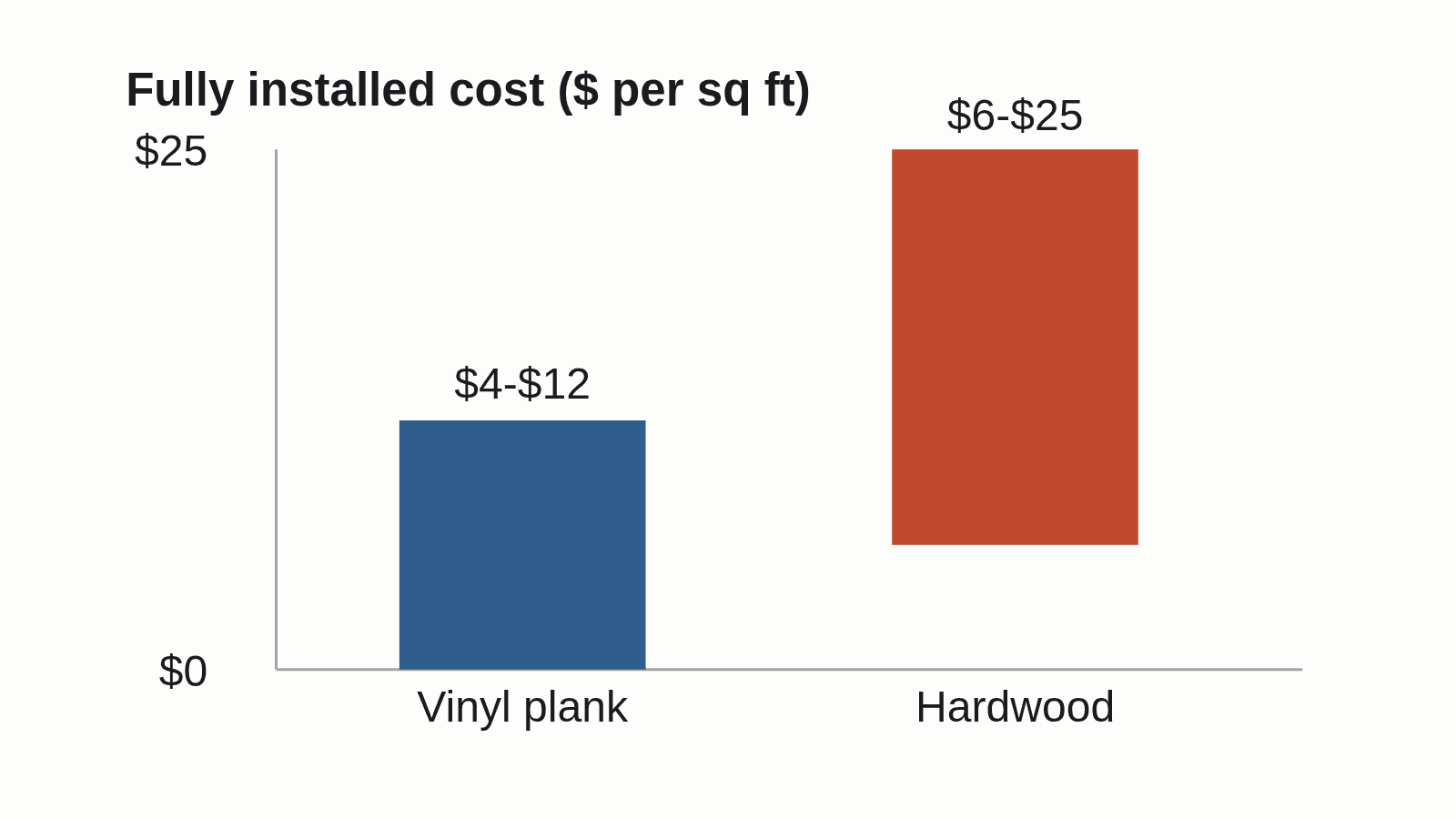
- Installed vinyl plank runs about $4-$12 per square foot (rightstepflooringnc.com); hardwood runs $6-$25 per square foot (hallmarkfloors.com).
- Measure odd-shaped rooms by splitting them into rectangles and adding each one up, and measure at the widest points.
- Always round boxes up and buy from one dye lot; ordering the exact square footage leaves no room for cuts or a bad plank.
What a Flooring Calculator Does, and the Math Behind It
A flooring calculator turns your room size into square feet, pads that number for waste, then converts it into boxes and a dollar total. A tool like CalcuFloor runs this automatically, but it's the same three multiplications you can do yourself in a minute with a calculator and a tape measure.
Here is the full math with every piece named:
- Length (feet) x width (feet) = square feet
- Square feet x (1 + waste %) = amount to order
- Amount to order / box coverage (square feet per box, printed on the product) = boxes, rounded up
- Finished square feet x price per square foot = cost
Why bother knowing the math instead of trusting a widget? Because the two numbers that swing the whole result come off the product you pick, not off some national average.
Order short and you risk a delay plus a mismatched dye lot, that's the batch number printed on the box that shows which production run made that color, and color can shift a shade between runs. Order way over and you've thrown money at boxes you'll never open. The waste padding is the part that protects you from the first problem without creating the second.
So before you run any of this, grab two figures off the specific product: how many square feet one box covers, and the price per square foot. Those are never universal numbers.
Step 1: Measure the Room, Odd Shapes and Multiple Rooms Included
Measure length and width in feet at the widest points, and run your tape into closets, doorways, and any nook the floor will cover. The floor goes under all of it, so your measurement has to include all of it.
Round each measurement up to the nearest few inches. Measure to the wall itself, not to the face of the baseboard, or you'll come up short once the trim comes off.
Breaking an Odd-Shaped Room Into Rectangles
An L-shaped or odd room is just two or three rectangles pretending to be hard. Split the floor into simple boxes, measure each one, and write the numbers down to add later.
A main floor plus a bump-out for a bay window is one big rectangle and one small one. Measure them separately. You'll multiply and total them in the next step.
Measuring Several Rooms at Once
Measure each room on its own, then total the square footage only when every room is getting the same product from the same dye lot. If the hallway and the bedroom share one floor, they share one order.
If two rooms get different floors, they're two separate calculations. Don't lump them.
Step 2: Convert to Square Feet, Add Waste, and Count Boxes
Multiply length x width for each rectangle and add them up for your total square feet. A 12x12 room is 144 square feet.
Now add a waste factor. Around 5% covers a plain rectangular room laid straight. Push it closer to 10% when you've got lots of cuts, angles, or a diagonal or herringbone layout, because every angled cut leaves a scrap you can't reuse.
To get boxes, divide your padded square footage by the product's box coverage (often around 20 square feet) and always round up to the next whole box. A result of 10.2 boxes means you buy 11. Some calculators instead use Somerset's method, which counts planks by how many fit across the room's width rather than starting from total square footage, it's a different route to the same box count, so round up the same way no matter which method you use.
One more thing for anyone shopping odd units: 1 square yard equals 9 square feet, and 1 square meter is about 10.76 square feet. If a product is priced by the square meter, divide your square feet by 10.76.
| Room (ft) | Square feet | With 10% waste | Boxes (20 sq ft each) |
|---|---|---|---|
| 10 x 10 | 100 | 110 | 6 |
| 12 x 12 | 144 | 159 | 8 |
| 12 x 15 | 180 | 198 | 10 |
| 15 x 20 | 300 | 330 | 17 |
Room size run through to square feet, padded 10% for waste, then divided by a 20-square-foot box and rounded up.
Step 3: Multiply Square Feet by Cost Per Material
Multiply your finished square footage by the material's price per square foot. The formula never changes from one floor to the next. Only the price does. When vinyl plank shows up tagged as a "wholesale" price, it pays to check that number against our wholesale vinyl plank flooring guide before you drop it into the formula.
Vinyl Flooring Cost Per Square Foot
Vinyl plank (LVP) runs about $4-$12 per square foot fully installed, according to rightstepflooringnc.com, with labor ranging roughly $2-$10 per square foot depending on how complex the job is, per the same source. That labor figure is lowest for a flat, open room, a basement subfloor that needs leveling or a stairway will run higher since both take extra time. The rest of the spread comes down to the plank's quality and how much prep your subfloor needs. Breaking that $4-$12 range down into its material and labor pieces is the whole focus of our LVP flooring cost per square foot breakdown.
For the full picture split by subfloor, stairs, and basement premiums, see what vinyl plank installation really costs per square foot. If budget is driving the whole project, timing a vinyl flooring sale can pull the per-square-foot price down a dollar or two.
Hardwood Flooring Cost Per Square Foot
Hardwood runs about $6-$25 per square foot installed, with labor at $3-$10 per square foot, according to hallmarkfloors.com. That huge spread is mostly species and grade, with a plain domestic oak sitting near the bottom and a wide, long-plank exotic near the top, and a basement or stair job pushes labor toward the top of that range no matter the species.
Laminate runs about $3-$8 per square foot installed, with labor making up roughly $2-$4 of that, according to homewyse.com. Tile costs more: figures from homewyse.com and taskrabbit.com put installed tile at about $5-$15 per square foot, with labor alone running $4-$10 of that spread, since setting and grouting tile takes more time than clicking a plank into place. Bamboo and engineered wood each have their own per-square-foot price too, drop that product's real number into the same formula instead of guessing, because the figure swings hard by product.
| Material | Labor only | Fully installed | Realistic DIY? |
|---|---|---|---|
| Vinyl plank (LVP) | $2-$10 | $4-$12 | Yes, click-lock |
| Laminate | $2-$4 | $3-$8 | Yes, click-lock |
| Tile | $4-$10 | $5-$15 | Usually hire |
| Hardwood | $3-$10 | $6-$25 | Usually hire |
On the DIY question: click-lock LVP is realistic for a steady DIYer, since the labor is your own time. Glue-down, stairs, and big open-plan floors with a moisture transition are where paid labor earns its money, and I'd hire those out before I'd risk them. Which install method makes sense also depends on where the floor is going, since a basement run and a bedroom run don't face the same moisture and wear demands, a point covered in more depth in our guide to what makes vinyl flooring last.
Worked Example: A 12x15 Room From Tape Measure to Final Cost
Say you've got a 12 by 15 bedroom with a small closet. Here's every step on one room.
Measure: 12 ft x 15 ft = 180 square feet. The floor runs into a 3x4 closet, which adds 12 square feet, for 192 square feet total.
Add 10% waste for a straightforward straight lay: 192 x 1.10 = about 211 square feet to order.
Count boxes at roughly 20 square feet each: 211 / 20 = 10.55, which rounds up to 11 boxes.
Now cost. Installed prices are quoted per finished square foot, so you multiply the 192, not the padded 211. At vinyl's $4-$12 that's roughly $770-$2,300. At hardwood's $6-$25 it's roughly $1,150-$4,800 for the same room, using the ranges from rightstepflooringnc.com and hallmarkfloors.com. The planks you order cover 211; the floor you pay to install covers 192. If you want that vinyl range broken down further by material grade and labor complexity, our LVP flooring cost guide walks through the full material-plus-labor math per square foot.
Common Mistakes That Skew Your Estimate
Ordering the exact square footage with no waste is the one that bites hardest. One bad cut or a warped plank and you're short, often forced into a different dye lot to finish.
Rounding boxes down is the same trap in disguise. A calculator reading 10.2 boxes means buy 11, not 10.
Mixing dye lots sneaks up on people who buy in two trips. Order all your boxes together and check the lot number printed on each one, because two lots of the "same" color can read differently under daylight.
Then there's the expansion gap. I set a run of rigid plank snug against the trim next to a slider that caught hard afternoon sun. First hot stretch of the year, those seams lifted and peaked right where the light hit. Now I leave the gap the maker calls for at every wall, no exceptions, and more so near glass.
Last one: measuring over the baseboards, or skipping the closets and doorways the floor actually runs through. Before you order, make sure you added 5-10% waste (more for diagonal or patterned layouts), rounded your boxes up, pulled every box from one dye lot ordered together, left the maker's expansion gap at every wall, and counted the closets, nooks, and doorways. Miss any one of those and the number on your receipt won't match the floor on the ground.