
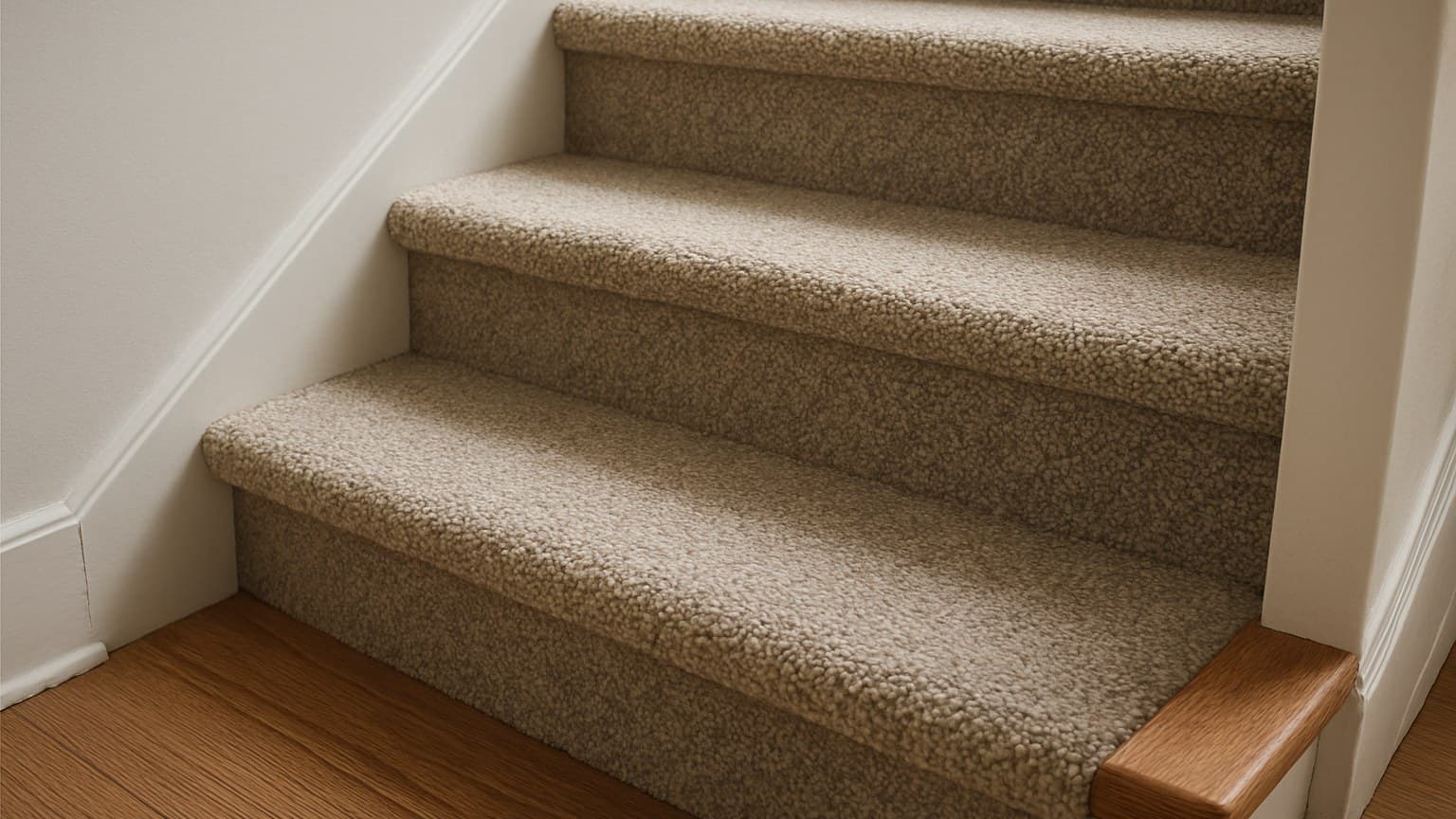
Stair carpet fails in ways flat-room carpet never does, the sample that feels plush in a showroom behaves nothing like it does bent over a step edge. What hides wear in a hallway can go bald at the nose in one season. Here's how to choose it and put it down so it grips and lasts.
Key takeaways
- Choose low pile (under 1/2 inch, ideally around 3/8 inch) and high density so the carpet grips underfoot and doesn't flex over the step edge.
- Solution-dyed nylon (color baked into the fiber, so it won't bleach out) is the most wear-resistant mainstream fiber for stairs; skip soft, thick plush.
- Use a firm, low-profile pad, 7/16 inch or thinner, rated for stairs. A thick soft pad lets the carpet roll over the nose and is a real trip hazard.
- The waterfall method is faster and cheaper; the French cap (Hollywood) wraps the carpet tight to the tread nose and wears better on busy stairs.
- Budget roughly $30 to $75 per step installed for standard stairs; open-sided or curved stairs and tight basement runs cost more per step.
Why Stairs Fail First: It's Always the Nose
Stairs wear out at the nosing, the rounded front lip of each step, long before the flat part of the tread does. That single edge takes the full push of every step, so the whole staircase gets judged by its most-beaten inch.
Last spring I pulled a six-year-old carpet off a fourteen-step staircase. The centers of the treads still had full, springy pile. But every nose was worn down to the pale backing, and two of them had frayed into loose strings you could catch a heel on. The carpet wasn't cheap. It just wasn't built for the one job stairs demand.
Three things cause that. Edge wear at the nose from constant abrasion. A runner or loose section that shifts underfoot. And a soft pad that lets the carpet fold over the lip instead of backing it firmly.
Stairs are the highest-fall-risk spot in most homes, so every choice below is really a fall-prevention choice too. A carpet that shifts or rolls at the nose is a trip waiting to happen.
Pick a Fiber That Grips and Wears
Out of every stair job I've done, solution-dyed nylon is the fiber I reach for first. Solution-dyed means the color is baked into the fiber as it's made, so it won't bleach out from sun or cleaners, and nylon takes a beating and springs back better than the cheaper options. Carpet Exchange's guide to choosing carpet for stairs points to nylon for the same reason, citing its durability under the repeated flexing stairs put a carpet through.
Triexta is the softer runner-up. It's close to nylon on wear, feels plush, and shrugs off spills, which makes removing stains from carpet easier on stairs used by kids and pets.
Polyester is the budget pick, and it shows. It feels soft off the roll but mats down and goes bald at the nose sooner than the others. It's fine for a lightly used guest staircase, not a main run.
Wool is the premium choice. It looks and wears beautifully, and it belongs in formal or period homes where the budget can carry it.
Polypropylene is the one fiber I haven't put on the recommended list above, and I want to be upfront about why. It's the cheapest of the bunch, and it's the fiber behind most inexpensive Berber and other tight-loop carpets, which sounds like a good match for stairs since loop pile is one of the styles I recommend below. The catch is that polypropylene fibers don't have much resilience: once they get crushed flat at the nose, they tend to stay crushed instead of springing back the way nylon does. I've pulled it off stairs after a few years looking permanently flattened at every edge, even though the flat sections were fine. It's worth considering if the staircase sees light traffic and the budget is tight, but for a busy family stairway I still reach for solution-dyed nylon first.
One trick that costs nothing: color hides wear. A mid-tone or flecked carpet masks crushed noses and traffic lanes far better than a solid dark or a solid light. On a busy staircase, that alone buys you a couple more good-looking years.
| Fiber | Wear | Grip | Cost tier | Best for |
|---|---|---|---|---|
| Solution-dyed nylon | Excellent, best crush recovery | Good in low, dense pile | $$-$$$ | Busy family stairs |
| Triexta | Very good, softer feel | Good | $$ | Stairs with kids and spills |
| Wool | Very good, premium look | Good | $$$$ | Formal or period homes |
| Polyester | Fair, mats and shows edge wear soonest | Fair | $ | Low-traffic or budget jobs |
| Polypropylene | Fair, crushes at the nose and doesn't spring back | Good in tight loop/Berber | $ | Light-traffic stairs on a tight budget |
Source: General flooring-trade knowledge; fiber traits per manufacturer spec sheets Fiber traits pulled from manufacturer spec sheets; wear and grip ratings based on what I've seen hold up on stairs I've installed. How the main stair carpet fibers compare on wear, grip, cost, and best use.
Pile Height and Density: The Non-Negotiables
Keep the pile under 1/2 inch, ideally around 3/8 inch, so your foot lands on a firm surface that won't roll over the front edge. Carpet Exchange's stair-carpet buying guide makes the same call, recommending a low pile so the carpet won't fold loosely over the nose. This is why low pile carpet is the default for steps, not the fluffy stuff people love in bedrooms.
Density matters as much as height. Density just means how tightly the fibers are packed. Face weight, measured in ounces per square yard, is the number on the label that hints at it, but your hands tell you more.
Here's the field test I use on every sample: bend it face-out over your hand, tight, like it's wrapping a stair nose. If the backing grins through at the fold and you can see gaps between the tufts, it's too loose. On a step edge that gap becomes a wear line, then a bald spot.
You want low pile, packed dense, firm and not springy underfoot. Plush and high pile feel wonderful on a showroom floor and fail fast on stairs because there's nothing solid under your foot at the exact spot that takes the most force.
Best Pile Styles for Stairs (and What to Avoid)
Grab a dense textured cut pile or a small, tight loop. Both give you grip and hide wear. Cut pile means the fiber loops are sheared open at the top; textured versions have twisted, uneven tufts that scatter light and mask footprints and traffic lanes.
Small, tight loop, often sold as Berber, is a looped pile where the fibers stay as little uncut loops. It's firm and durable. The catch: big loops can snag a pet's claw or a heel, so on stairs pick a low, tight loop, not a chunky one.
Cut-and-loop patterns are a solid middle ground. They mix cut and looped tufts into a texture that hides worn spots well.
Skip saxony and plush. Saxony is a smooth, formal cut pile that shows every footprint and mats down at the nose. Skip shag too. Long fibers crush flat and let your foot slide on the edge, which is the last thing you want on a stairway.
Backing and Padding: What's Under the Carpet Decides the Nose
The pad makes or breaks a stair job. Use a firm, low-profile pad rated for stairs, 7/16 inch or thinner. A thick, soft pad feels great in a bedroom but on stairs it lets the carpet fold over the lip, and that fold is both the wear point and the trip hazard.
The carpet's own backing counts too. A stiff, stable backing holds its shape around the nose instead of stretching loose over time. Floppy backing is what starts shifting a few months in.
Before anyone loads a staple gun, check the treads themselves. They need to be solid and square. A loose tread that flexes, or a cupped one that's high on the edges, telegraphs straight through the carpet and you'll feel it with every step. I once let a homeowner talk me out of a moisture check to save an afternoon on a different job, and I relaid that floor on my own dime when it cupped. I don't skip the boring checks anymore, stairs included. Tighten squeaky treads and shim anything that rocks first.
The pad-density point beginners miss: a thin pad can still be too soft. Firmness matters more than thickness on stairs. If you want to match cushion to each room in the house properly, our step-by-step way to choose carpet, pile, and padding by room walks through it.
Runner vs. Full Wall-to-Wall Coverage
Full wall-to-wall coverage is the safer, more sure-footed choice. A bound runner looks better and shows off nice wood but leaves slick edges. That's the real trade.
Full coverage carpets the entire tread, so every part of your foot lands on grip. It also hides worn or mismatched wood underneath. You pay for more carpet, and the labor is moderate.
A runner is a center strip that leaves the wood on each side exposed. It uses less carpet, but the finish work costs more, and those bare wood edges stay slippery. Because a runner only holds down the middle, secure fastening matters even more, and the edges need to be bound so they don't fray or lift underfoot. Binding just means the cut edge is wrapped with a tape or stitched border. Direct Carpet's stair runner collection shows the range of bound edges, widths, and border styles available if a runner is the look you want.
My verdict by use: full coverage for busy family stairs, a bound runner where the traffic is lighter and you want the wood to show.
| Option | Grip | Look | Edge risk | Cost |
|---|---|---|---|---|
| Full wall-to-wall | Whole tread covered, most sure-footed | Uniform, hides worn treads | Low | More carpet, moderate labor |
| Bound runner | Center only, wood edges stay slick | Shows off the stair, decorative border | Higher if not fastened tight | Less carpet, more finish work |
Source: General flooring-trade knowledge Numbers below come from stairs I've measured and installed over the years. Full coverage versus a bound runner on stairs, by grip, look, edge risk, and cost.
Waterfall vs. French Cap: How the Carpet Wraps the Step
The waterfall method is faster and cheaper. The French cap wears better on busy stairs. Both refer to how the carpet handles the front edge.
Waterfall runs the carpet straight down over the nose and lets it fall to the back of the next tread without wrapping the lip. It's quicker, uses a bit less material, and looks fine, but the carpet isn't pulled tight into the shape of the step, so the nose takes more flex.
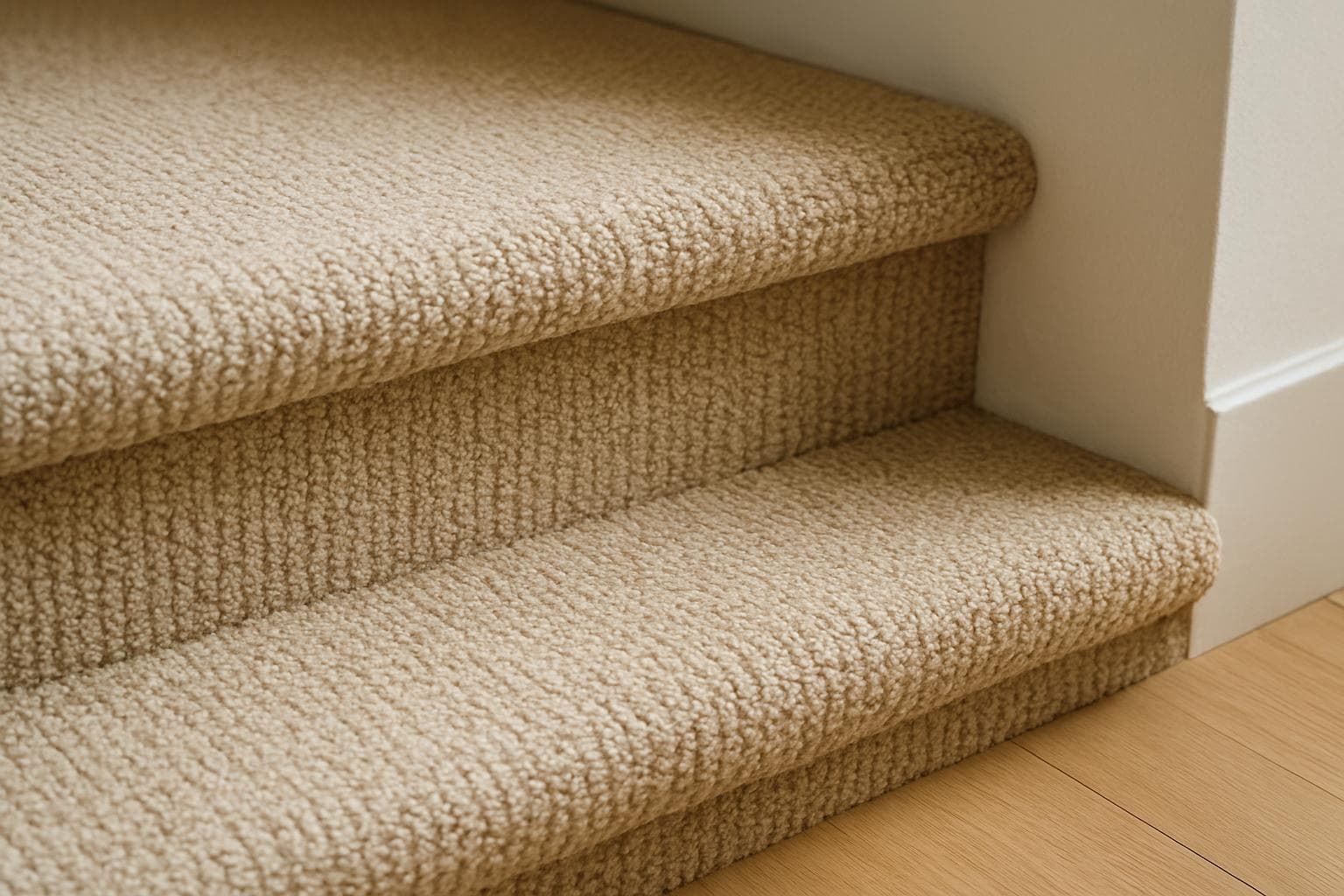
The French cap, also called the Hollywood, wraps the carpet snug around the nose and staples it tight underneath the lip. It hugs the step, so there's no loose fold to wear or trip on. It takes more time and skill, and it's what I use on any staircase that gets daily traffic.
Carpet grips better than bare wood or vinyl plank on stairs, which is its main safety edge over vinyl plank on stairs. Whichever wrap you choose, the same carpet installation rules about tight seams and firm fastening still apply, just on a tougher, more cut-heavy surface.
What It Costs, and Whether to DIY
Budget roughly $30 to $75 per step installed for a standard, closed staircase. Open-sided, curved, and tight basement stairs cost more per step because they eat labor. The figures below come from my own written estimates and job invoices, not a published industry average, which is also why the ranges are wide, regional labor rates and each carpet's price point move the number more than anything else.
The split matters. On a plain boxed staircase, the carpet and pad run about $10 to $25 a step, and labor is most of the rest. The number climbs when the shape gets complicated, because a stair guy prices time, not just square footage. I learned to count cut-heavy work separately after a job full of odd angles ate a whole extra day past my flat-rate quote.
| Stair type | Materials per step | Labor per step | Installed per step |
|---|---|---|---|
| Standard closed (boxed) stairs | $10-$25 | $20-$50 | $30-$75 |
| One open side | $15-$30 | $35-$65 | $50-$95 |
| Curved or winder steps | $15-$35 | $50-$100 | $65-$135 |
| Basement stairs (steep, tight) | $10-$25 | $30-$60 | $40-$85 |
Source: Ranges from flooring-trade cost knowledge; figures vary by region and product Ranges pulled from my own quotes and invoices; cost varies by region and product. Estimated per-step stair carpet costs, split into materials and labor, by stair type.
On DIY: a straight, closed staircase with a simple waterfall runner is doable for a handy person who owns or rents a knee kicker and a hammer stapler, and who's patient with cuts. Where I'd hire out is full-tread French cap work, any open-sided or curved staircase, and basement runs that are steep and awkward. The tools and the wrapping technique are where beginners lose a weekend and still get a loose nose.
If you're carpeting stairs as part of a larger job, our breakdown of carpet replacement cost by room and fiber shows where the rest of the money goes so the stair number fits your whole budget.