Installed carpet runs about $3 to $7 per square foot for carpet, pad, and labor combined in a typical open room. NerdWallet puts the national average for a 330 square foot living room near $1,800, which is a good whole-job number to keep in your head. The wide swing you'll see between contractor bids on that same room comes down to what each one quietly folds into, or leaves out of, that per-foot price.
Key takeaways
- Installed carpet (carpet + pad + labor) typically runs about $3 to $7 per square foot; a 330 sq ft living room lands near $1,800 on average, per NerdWallet.
- Labor alone is usually $0.50 to $1.50 per square foot; the rest of any quote is material grade, pad, and add-ons.
- A 10x12 room (120 sq ft) runs roughly $360 to $840 installed; carpeting 1,000 sq ft runs roughly $3,000 to $7,000.
- Ranges disagree online because sources mix square feet with square yards, quote different fiber grades, and bundle or exclude old-carpet removal.
- Real carpet lifespan is about 5 to 15+ years depending on fiber and traffic, not the 3-5 years some pages claim.
The short answer: what carpet replacement really costs
For a normal open room, installed carpet, meaning the carpet, the pad, and the labor together, runs about $3 to $7 per square foot. NerdWallet puts the national average for a 330 square foot living room near $1,800, which is a good whole-job number to keep in your head.
Here's how that splits. Labor alone is usually $0.50 to $1.50 per square foot. Everything above that is the carpet grade and the pad you pick. Most pads sold today are rebond padding, foam made by shredding and gluing together scraps of recycled foam into a bonded sheet. The thicker the rebond, the more cushion you feel underfoot, and the more it costs.
One thing I've learned quoting jobs: the open middle of a room is never where the time goes. It's the closets, the doorways, and the spots where carpet has to turn a corner or die into a threshold. I started counting those cut-heavy areas separately after a house full of little rooms ate an extra day I'd priced as flat.
That's also why three premiums show up early. Stairs cost more per square foot than any flat floor, since each step needs its own cut and wrap and the wrong pile can turn slick underfoot — our guide to carpeting stairs safely covers how to pick and install it so it won't slip or wear out. A single small room often runs high per foot too because the fussy cutting doesn't shrink just because the room did, and basement carpet jobs cost more than open rooms upstairs, since the concrete slab needs a moisture check and often extra subfloor prep before pad and carpet ever go down.
| Line item | Cost per sq ft | Notes |
|---|---|---|
| Carpet (material only) | $1.00 - $8.00 | Depends heavily on fiber; wool sits at the top |
| Padding / cushion | $0.30 - $1.00 | Thicker rebond costs more |
| Labor (install) | $0.50 - $1.50 | Stairs and small rooms run higher |
| Blended "installed" total | $3.00 - $7.00 | Typical mid-grade whole-room average |
Cost by room size: from a 10x12 bedroom to a whole 1,000 sq ft
Sizing your own room is simple: length times width gives you square feet, then multiply by the $3 to $7 installed range. A 10x12 bedroom is 120 square feet, so figure roughly $360 to $840 installed. Carpeting a full 1,000 square feet lands around $3,000 to $7,000.
One warning before you compare that to a bid. Add about 5 to 10 percent extra material for cuts and seams, and more if the room is angled, has a bay window, or breaks into odd corners. So when a contractor's tape measures higher than yours, that overage is usually why, not padding on the price.
Small single rooms also tend to carry a minimum job charge. A crew won't drive out, move furniture, and seam a 100 square foot closet for the same per-foot rate they'd give a big open floor, so the little job looks worse per square foot. Stairs get hit with that same math even harder, since crews usually charge per step instead of by square footage rather than one big open-floor rate.
| Room | Square feet | Installed range |
|---|---|---|
| 10x12 bedroom | 120 | $360 - $840 |
| 12x12 room | 144 | $430 - $1,010 |
| Living room (avg) | 330 | $1,000 - $2,300 (~$1,800 avg) |
| Whole home | 1,000 | $3,000 - $7,000 |
| Source: Calculated from $3-$7/sq ft blended installed range; 330 sq ft anchor from NerdWallet |
Cost by carpet fiber: polyester, nylon, triexta, and wool
Most of the swing in a carpet quote lives in the fiber, so this is the line item to understand first. Material-only prices run from about $1 a square foot for the cheap stuff up past $12 for wool.
The tradeoff in plain terms: olefin (also called polypropylene) and polyester are the cheapest, but they flatten and mat faster where feet keep landing. Nylon costs more and holds its shape far longer in halls and on stairs, and weighing that against your traffic, budget, and pets is really the whole question our best carpet for stairs guide works through. Triexta, sold most often as SmartStrand, resists stains well, which is why I steer families with kids and pets toward it. Wool is the softest and the priciest, and it's a natural fiber that behaves differently underfoot.
One term worth knowing: solution-dyed. It means the color is baked into the fiber as it's made, instead of dyed onto the surface after. That fights fading and even survives some bleach spills, so it's worth asking for in a sunny room or a pet household. If stains are your real worry, removing stains from carpet covers what actually lifts them once they happen.
Don't pick on price alone. A cheap fiber in the wrong room is a callback waiting to happen, and for high-traffic paths a denser, lower-profile carpet wears better, which is the whole case for low pile carpet in halls and stairs. For matching each fiber to a room's traffic and moisture, lean on the step-by-step carpet selection guide.
| Fiber | Cost per sq ft | Best for |
|---|---|---|
| Olefin / polypropylene | $1.00 - $3.00 | Basements, budget, low traffic |
| Polyester (PET) | $1.00 - $3.00 | Bedrooms, budget-friendly softness |
| Nylon | $2.00 - $5.00 | Halls, stairs, high traffic |
| Triexta (SmartStrand) | $2.50 - $5.00 | Kids and pets, stain resistance |
| Wool | $5.00 - $12.00 | Premium, natural fiber rooms |
Why online carpet cost ranges disagree so much
The numbers swing from $2 to $11 a square foot for a few specific reasons, and once you know them, most of the confusion clears. It's rarely that one site is wrong. They're just measuring different things and not telling you.
Square yard vs. square foot: the unit trap
Carpet is one of the last materials still sold by the square yard in a lot of stores, and one square yard is nine square feet. So a price that looks like $27 is really $3 a square foot once you divide by nine. Any time a quote feels wildly high or suspiciously low, check the unit first. Mixing yards and feet is a common way a comparison goes sideways.
What "installed" does and doesn't include
"Installed" is not a standard word. On one bid it means carpet, pad, and labor. On the next it also includes tearing out and hauling away your old carpet. On a third it quietly excludes that removal, which is a real cost the crew will add later.
The fix is simple: convert every quote to price per square foot, then ask each contractor in writing exactly what's bundled before you compare. Two bids only mean something when they cover the same work.
A worked example: how waste factor moves the per-foot price
Here's where a chunk of that $2-to-$11 spread actually comes from, worked out with real numbers instead of a general "it depends." Take the 330 square foot living room used earlier in this guide. Measured wall to wall, that's 330 square feet of floor. But carpet ships off a roll, not as a custom-cut shape, so every seam, closet jog, and out-of-square wall means you buy more material than the bare floor number.
For a plain rectangular room, installers commonly add a 5 percent waste factor for cuts and seams. Run the math: 330 sq ft x 1.05 = about 347 sq ft of carpet you're actually billed for, not 330. At a $5/sq ft blended installed rate, that's roughly $1,735, versus $1,650 if someone priced it straight against the bare 330 sq ft floor area, an $85 gap before the carpet grade, pad, or labor rate changes at all.
Now add the bay window and angled wall flagged earlier in this guide. Irregular rooms commonly need a 15 to 20 percent waste factor instead of 5, because the extra cuts around the angle and the window nook get thrown away as scrap. Run the same 330 sq ft room at 15 percent: 330 x 1.15 = about 380 sq ft billed. At the same $5/sq ft, that's about $1,900, already roughly $250 higher than the flat-rectangle version, with the fiber, pad, and labor rate held identical the whole time. That's a large piece of the mechanism behind "why did my quote come in so much higher than the guide I read": two contractors can agree on every per-foot input and still land a few hundred dollars apart, purely because one measured a squarer room than the other.
| Source type | Quoted range | Likely reason |
|---|---|---|
| Low-end guide | $2 - $8/sq ft | Builder-grade fiber, thin pad, removal excluded |
| High-end guide | $3 - $11/sq ft | Premium fiber, upgraded pad, removal bundled |
| Mid-grade calculator | $4.50 - $8/sq ft | Nylon or triexta, install included |
| Regional example (Miami) | ~$3 - $4/sq ft | Local labor rates, basic grade |
Why published carpet prices per square foot disagree, by type of source.
Hidden fees that turn a low quote into a high bill
The carpet-and-pad number is almost never the final number. These are the add-ons that ride on top, and they're where a cheap-looking bid catches people:
- Old carpet removal and disposal. Often $1 to $2 per square foot, sometimes a flat per-room fee. This is the one most likely to be excluded from a low quote.
- Subfloor repair. Squeaky or soft spots, water-damaged plywood, or a floor that's out of flat get fixed before the carpet goes down. You won't know the cost until the old carpet is up.
- Furniture moving. Some crews include a room or two; some charge, especially for heavy pieces.
- Stairs. These carry the biggest per-unit premium in carpet work. Expect a per-step charge, commonly a few dollars each and climbing into the double digits per step for wrapped or upholstered stairs, because every tread and riser is a hand-fit cut.
- New trim and transition strips. The metal or wood pieces where carpet meets tile, wood, or a doorway add up across a whole house.
Before any of this, a real installer checks two things you can't skip: is the subfloor flat, and is it dry. A hump you talk yourself into ignoring telegraphs through carpet as a lump you'll feel with a sock foot, and moisture under carpet grows problems you don't see until they smell. Those checks decide whether the price on the bid is the price you actually pay.
DIY vs. hiring: is installing carpet yourself worth it?
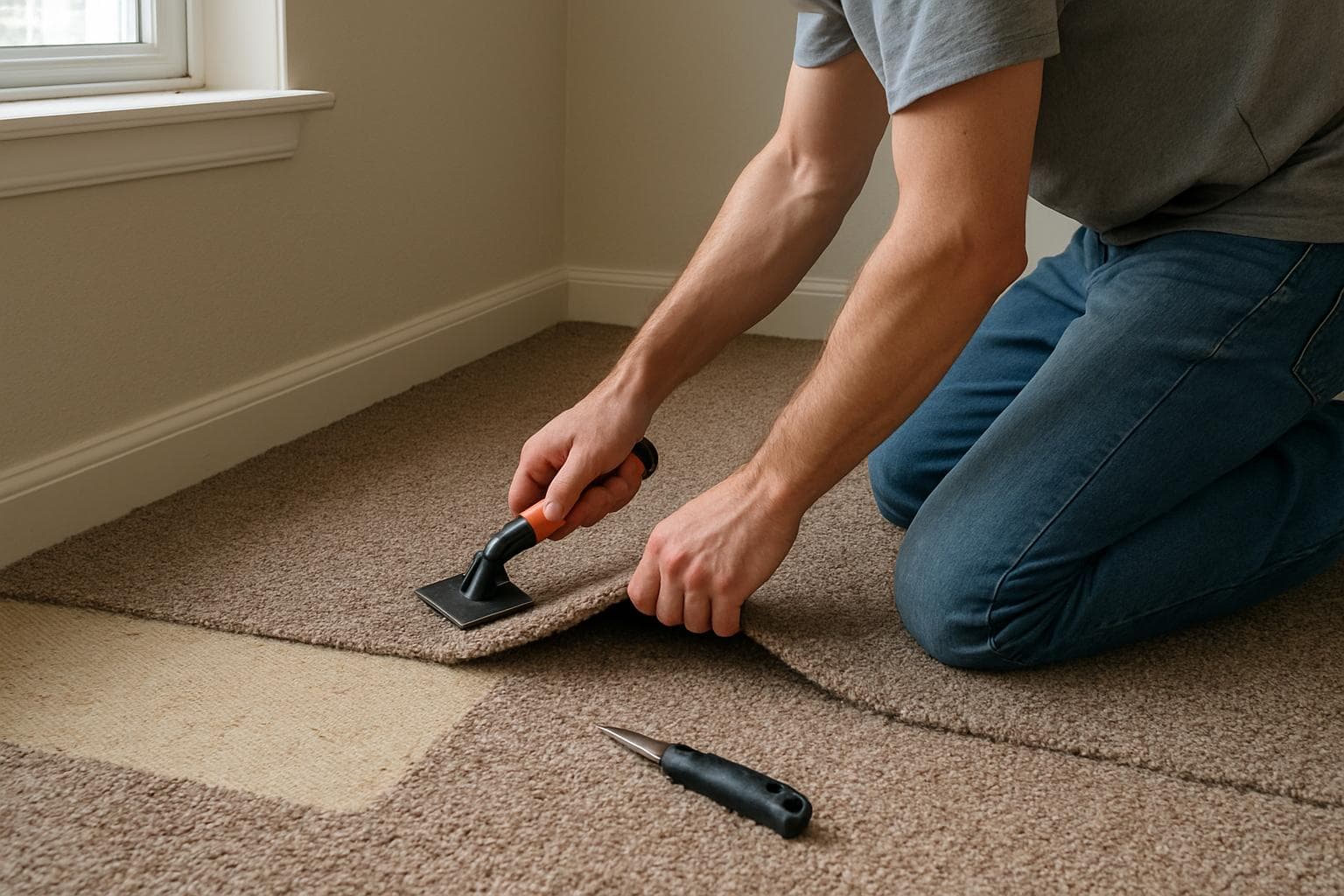
For most people, no. Carpet is the flooring I steer DIYers away from more than any other. Click-lock vinyl plank is doable in a weekend, but wall-to-wall carpet needs a power stretcher to pull it tight and a hot iron with seam tape to join pieces without a visible ridge. Skip the stretcher and the carpet ripples within a year.
Where DIY can pay off is a small, square, single room with no seams, over a pad you can staple down, using a rental knee kicker. There you save the labor, which is $0.50 to $1.50 a square foot. On stairs, big open floors, or anything with seams, the tool rental plus the risk of a botched seam usually erases the savings — and stairs come with their own pricing quirks worth checking, which our breakdown of stair carpet quote costs walks through line by line.
If you do want to understand the full process before deciding, carpet installation walkthrough lays out each step so you can judge honestly where your comfort ends. Weigh that against a couple of local pro bids, the same way you would for vinyl plank installation cost if you were comparing surfaces, and the right call is usually obvious once the seams enter the picture.