
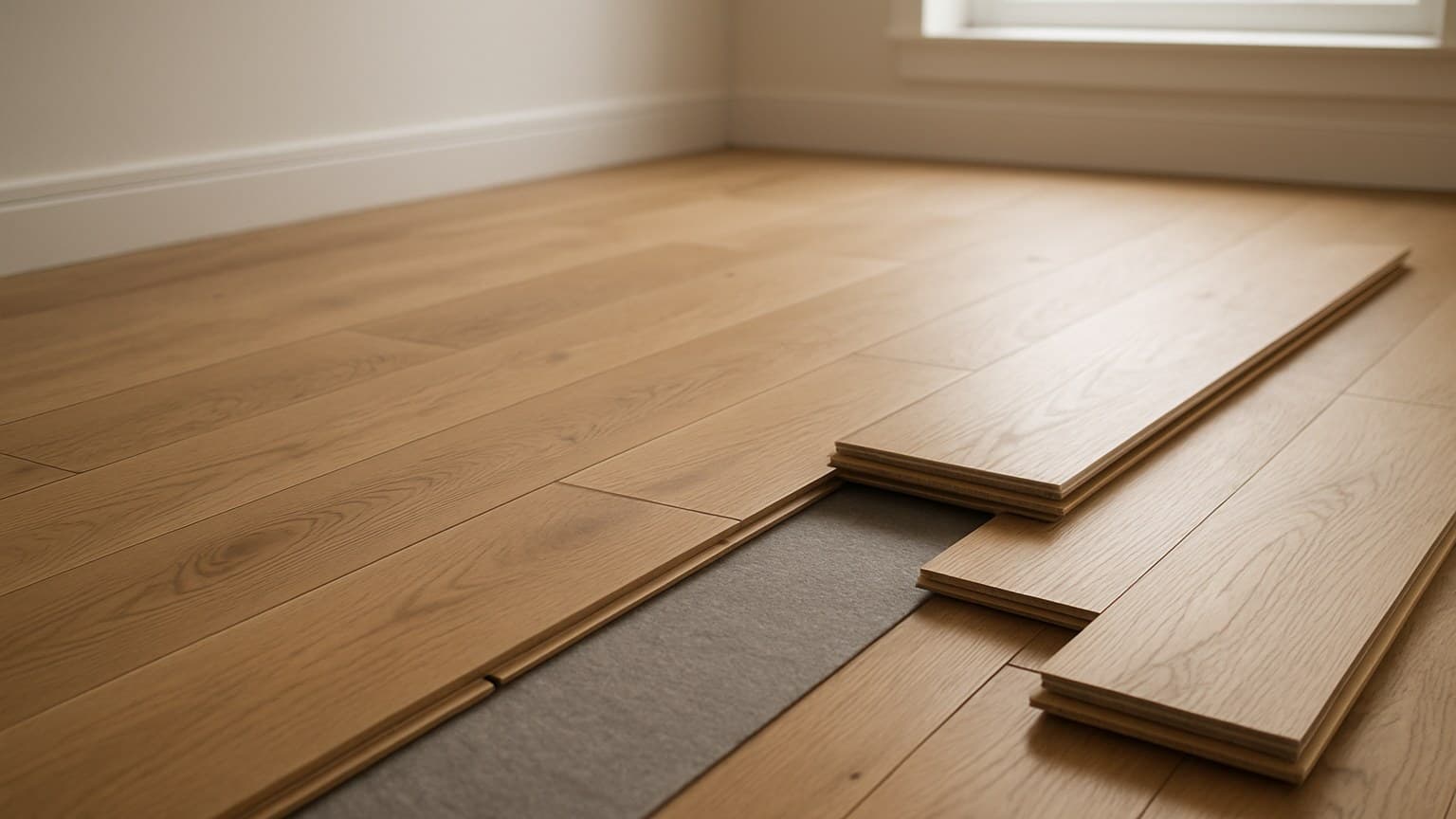
Installed engineered hardwood runs about $7 to $22 per square foot, and that gap is wide enough that two honest bids on the same room can land thousands apart. That spread rarely means someone is cheating you. It usually means each installer priced a different tier, budget, mid, or premium, and below you'll learn to read which one you're looking at. Big-box retailers like Floor & Decor sell across that same range, so it's worth knowing what to check in Floor & Decor's engineered hardwood lineup before you buy.
Key takeaways
- Installed cost runs roughly $7-11/sqft budget, $10-15 mid, and $15-22 premium, split close to half material and half labor.
- Labor alone swings by method: floating click-lock ~$3-5, nail-down ~$4-6, glue-down ~$5-8, and herringbone ~$8-12/sqft.
- A 1,500 sqft floor lands near $12,000 budget, $18,000 mid, and $27,000 premium, fully installed.
- Subfloor leveling, old-floor removal and haul-away, and stairs are the hidden line items that separate an honest quote from a lowball.
- Engineered installs cheaper than solid because it comes pre-finished, so there's no on-site sanding and finishing labor.
Two Quotes, Thousands Apart: Which Tier Each One Assumed
On an 1,100 square foot living-and-dining room I bid in Fort Collins, the homeowners, the Delgados, showed me two other quotes that sat about $6,000 apart. Neither installer was crooked. One priced a thin big-box floating floor, the other priced a thick sawn-veneer glue-down. Same room, two different floors, two different jobs.
That's the trap with this search. Read every "$7 to $18 per square foot" number online as one blur, and you'll never know if your quote is fair. So do one thing first: decide whether you're buying budget, mid, or premium. Lock that in, and every number in this guide reads clean. If Somerset is the brand on your shortlist, it's worth checking which of Somerset engineered hardwood's tier claims actually hold up before you lock in a number.
What separates those tiers is what's inside the plank. Budget planks use a thin wood veneer over an HDF core (HDF is a dense fiberboard body). Mid and premium planks use a thicker wood veneer over a cross-layered plywood core, which holds up better over concrete, in wider and longer boards with a nicer finish. Veneer thickness decides whether a floor can ever be sanded and refinished, a distinction the NWFA's Life Cycle Cost Analysis points to as a key driver of a floor's cost over its lifespan, since a refinishable floor can avoid a full replacement, and it varies by product, so check the specific line's own spec sheet rather than trusting a category rule. That refinishing question is really the crux of engineered hardwood vs solid hardwood, so it's worth settling before you buy either one.
If you're still choosing a line, sort that out with the 7 best engineered hardwood flooring brands ranked by the numbers first. This page stays on what installation costs.

Material Cost by Tier: Budget, Mid, and Premium
Material alone runs roughly $3 to $16 per square foot, and where you land is set by veneer thickness, core, and board size. Here's how the three tiers break down.
| Tier | Material per sq ft | What you get |
|---|---|---|
| Budget | $3-6 | Thin veneer, HDF core, narrow big-box planks, prefinished |
| Mid | $6-10 | Thicker veneer, plywood core, wider planks, better finish |
| Premium | $10-16 | Thick sawn veneer, wire-brushed or oiled, long wide boards, refinishable |
Material-only price bands by tier, before labor or add-ons.
What each tier actually gets you
Budget planks look fine the day they go down. The veneer is thin, the core is fiberboard, and the boards are narrow because narrow hides a cheaper mill. Mid-tier is where most homeowners land: a plywood core that stays flat over a slab, a real wear layer, and planks wide enough to look current. Premium buys you a thick sawn veneer, a hand-worked finish like wire-brushed (a lightly textured surface) or oiled, and long boards that make a room read custom.
When a cheap plank costs more later
A low sticker often means a veneer too thin to ever sand back. When that floor scuffs through or a seam swells, you don't refinish it, you replace it. The cheap plank can end up costing you a second full install down the road. If you're chasing a deal, learn how to tell a real discount engineered hardwood bargain from a downgraded one before you buy on price alone.
Material is only half the job. The same plank installs at very different totals depending on method, which is the next section.
Labor Cost by Installation Method (Float, Nail, Glue, Herringbone)
Before you weigh install methods, check the subfloor first, the NWFA's installation guidelines call for confirming subfloor flatness and moisture content before any engineered floor goes down: a straightedge for humps and dips, a moisture meter (a small tool that reads how much water is in the material) for the slab or wood. Every method below assumes that's already done. Labor is where two quotes really split, because the install method changes the hours and the mess. Floating a click-lock floor is fast; gluing planks to concrete or laying a herringbone pattern is slow.
| Method | Labor per sq ft | Notes |
|---|---|---|
| Floating (click-lock) | $3-5 | Fastest, DIY-friendly, needs a flat subfloor |
| Nail / staple down | $4-6 | Wood subfloor only |
| Glue-down | $5-8 | Best over concrete, most labor and prep |
| Herringbone / chevron | $8-12 | Slow layout, high waste overage |
Source: what I bid per square foot for each install method on residential jobs
Labor-only rates by install method for residential engineered hardwood.
Cost to install engineered wood flooring per square foot
Add material to labor and the cost to install engineered wood flooring per square foot lands near $7 to $11 installed for budget, $10 to $15 for mid, and $15 to $22 for premium. Glue-down runs high because it's slow, messy, and needs moisture prep on the slab. Patterns like herringbone spike both labor and waste, since angled cuts throw away more plank, so budget a bigger overage.
Where DIY saves and where it backfires
Click-lock floating over a flat, dry subfloor is a realistic weekend job for a careful DIYer, and skipping labor is where you save the most. Where DIY backfires: glue-down, stairs, and big open-plan floors that cross from one room's subfloor to another. Those need moisture control, clean transitions, and a feel for expansion gaps, and a mistake there is expensive to pull back up. If it's glue or stairs, I'd hire it out.
Total Installed Cost by Room Size (Budget vs Mid vs Premium)
Multiply your finished square footage by the installed rate for your tier, using about $8 per square foot for budget, $12 for mid, and $18 for premium. Here's how that lands across common room sizes.
| Room size | Budget | Mid | Premium |
|---|---|---|---|
| 400 sq ft | $3,200 | $4,800 | $7,200 |
| 1,000 sq ft | $8,000 | $12,000 | $18,000 |
| 1,200 sq ft | $9,600 | $14,400 | $21,600 |
| 1,500 sq ft | $12,000 | $18,000 | $27,000 |
| 2,500 sq ft | $20,000 | $30,000 | $45,000 |
Source: my installed bids combined with current retail material bands
Total installed cost (material plus labor) by room size and tier, before add-ons.
The formula, worked once
The math is just: installed price per square foot times finished square footage. Take a 1,500 square foot floor at the mid rate: 1,500 times $12 equals $18,000, roughly half material and half labor. Swap in the budget rate and it's $12,000; the premium rate makes it $27,000.
Why the same room size gives three different totals
That $12k to $27k spread on one 1,500 square foot floor is exactly why two honest quotes come in thousands apart. One priced a budget floating floor, the other a premium glue-down. Read the tier, and the gap makes sense.
One warning the table can't show: it assumes an open room. Basement jobs run higher per square foot than an open room of the same size because slabs need moisture prep, and stairs cost more too. Size alone doesn't set the price.
Here's that same tier breakdown lined up visually, so you can see the gap between budget and premium at a glance.
Hidden Costs That Blow the Budget
The line items that turn a clean quote into a surprise are the ones you can't see until the old floor comes up. Old-floor removal, subfloor leveling, a vapor barrier, stairs, and transitions all add up, and a lowball quote often just leaves them out.
| Item | Material | Labor |
|---|---|---|
| Old floor removal & haul-away | n/a | $1-2/sq ft plus dump fees |
| Subfloor leveling / repair | $0.50-1.50/sq ft (compound) | $1-2/sq ft |
| Vapor barrier / underlayment | $0.30-0.80/sq ft | usually included |
| Stairs | plank cost | $40-75 per step |
| Transitions / thresholds | $15-40 each | $50-100 each |
Source: the add-on line items I itemize on my own quotes
Common add-on costs split into material and labor.
Before any plank goes down, two checks matter: subfloor flatness and moisture. I run a straightedge across the floor to find humps and dips, and I check the slab or wood with a moisture meter (a small tool that reads how much water is in the material). The callbacks I've had traced back to a slab that felt dry to the hand but wasn't, or a hump I talked myself into ignoring. Skip these and the floor telegraphs every flaw, and the maker's warranty won't cover a failure these checks were supposed to catch.
My rule of thumb: set aside 10 to 15 percent of the job as a contingency for the subfloor you can't see until the old floor is up. If you don't need it, great. If you do, you're not stalled mid-job. And remember, engineered installs cheaper than solid because it comes prefinished, so there's no on-site sanding and finishing labor to pay for. If you're still weighing engineered against a plank alternative, the 9 facts that settle engineered hardwood vs LVP is the useful next read, since it compares the two on cost and where each one actually holds up.