
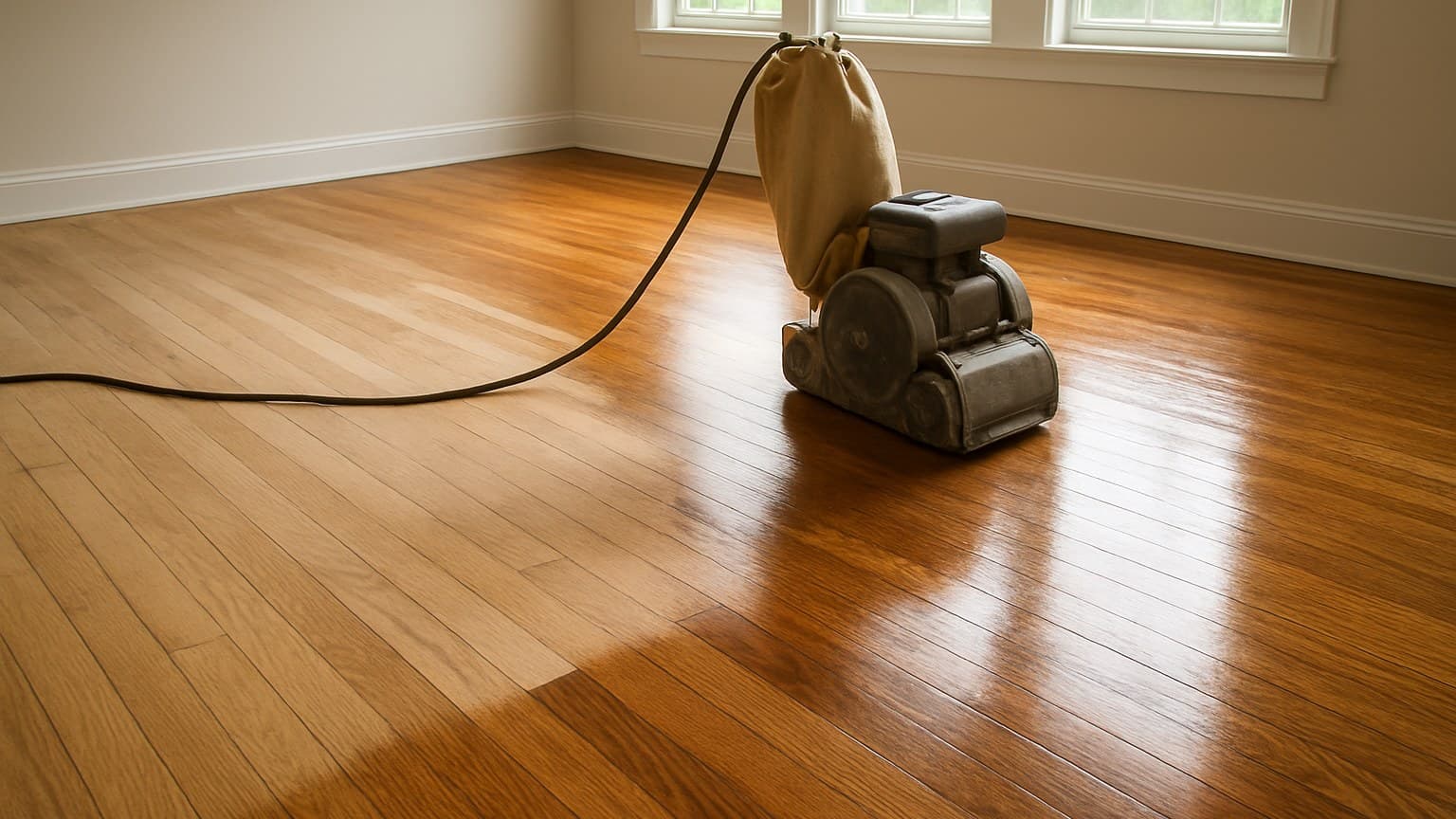
Get two contractor bids for the same 300-square-foot oak living room, and it's common to see one come back at $1,200 and the other at $2,100. Most hardwood refinishing runs $3 to $8 per square foot, and the gap between quotes comes down to what each contractor counts, not shady pricing. Learn those pieces and you can price your own floor with confidence.
Key takeaways
- Most refinishing jobs run about $3-$8 per square foot; a single room lands around $800-$3,200 and a 1,000 sq ft floor around $3,000-$8,000.
- Labor is the bulk of the bill, up to roughly 80%, and species, board repairs, staining, and dust control are what move your number most.
- Refinishing (about $3-$8/sq ft) is almost always cheaper than replacing (roughly $8-$15+ per sq ft installed) when the wood is sound.
- Solid wood can be sanded and refinished several times over a building's life (per the NWFA), so refinishing usually wins long-term; a thin engineered veneer often can't be sanded at all.
- Get 2-3 itemized quotes. The fees contractors disagree on most, furniture moving, carpet removal, and dust containment, are where regional variance hides.
What It Costs to Refinish Hardwood Floors: The Quick Answer
Most refinishing jobs run about $3 to $8 per square foot total. Labor can account for as much as 80% of that, which works out to roughly $2.40 to $6.40 per square foot for labor (sanding, edging, coating) and $0.60 to $1.60 per square foot for materials (sandpaper, stain, finish). A single room usually lands between $800 and $3,200, and a whole project often falls near $1,800 to $6,000, depending on how much floor you have.
No guide gives you one flat number. Two of the most-cited contractor pricing aggregators don't even agree on the base range: HomeAdvisor puts it at $3 to $8 per square foot, and Angi puts it at $4 to $8. Both track real, checkable homeowner-reported project costs, and that small gap between two credible sources tells you to shop, not to trust a single figure you read once.
Labor is the biggest slice of the bill. On a typical $3 to $8 per square foot job, labor can run as much as $2.40 to $6.40 per square foot, while materials, sandpaper, stain, and finish, run about $0.60 to $1.60 per square foot. Sanding, edging, and coating are slow, skilled work, and that's where the money goes.
Four things set your price: how many square feet you have, your wood species, how much repair the floor needs, and the finish you pick. Everything else is a smaller add-on. The rest of this article hands you the arithmetic to price your own floor, not just a range to squint at.
Cost by Square Footage
Bigger floors cost more in total but less per square foot, because the fixed setup costs get spread out. Here's what the common sizes run.
| Floor size | Typical refinishing cost |
|---|---|
| 40 sq ft (closet) | $120 - $320 |
| 100 sq ft (small room) | $300 - $800 |
| 400 sq ft (large room) | $1,200 - $3,200 |
| 1,000 sq ft | $3,000 - $8,000 |
| 2,000 sq ft | $6,000 - $16,000 |
Total refinishing cost by floor size, showing the low and high of each range.
Small rooms cost more per foot because setup, sanding-machine time, and the fiddly bits eat labor no matter how little floor is there. That's the lesson that reset how I quote. I used to price flat by the square foot until a job full of closets, doorways, and a bay window ate a whole extra day. Now I count the cut-heavy spots separately, because the open middle of a room is never where the time goes.
Stairs, chopped-up rooms, and basement floors all price higher per foot than one open room upstairs. Basements cost more because of tighter access and the extra moisture checks the job needs before refinishing can start.
Cost by Wood Species
Your species matters because hard, dense woods dull sanding belts faster and need slower, more careful passes. Slower passes mean more labor, and labor is where the money is.
| Species | Cost per sq ft | Note |
|---|---|---|
| Oak (red or white) | $3 - $5 | Most common; sands predictably |
| Cherry | $3 - $5 | Can blotch and darken with age |
| Pine | $4 - $7 | Soft; dents and sands unevenly |
| Bamboo | $2 - $6 | Varies a lot by product |
| Maple | $6 - $8 | Dense; slower sanding, more labor |
| Mahogany | $6 - $8 | Hard, dense, higher labor |
| Engineered | $3 - $5 | Only if the veneer is thick enough to sand |
Per-square-foot refinishing cost by wood species, with why each one prices where it does.
Price isn't the only species issue. Some woods blotch or shift color when you sand and re-coat them, which is a quality problem, not just a cost one. If you have Brazilian cherry, read up on why Brazilian cherry floors keep getting darker before you pick a finish, because that color shift keeps going long after the crew leaves.
Engineered wood sits near oak on price, but its thin wear layer (the real-wood top slice, called the veneer) decides whether you can refinish at all. More on that below. If you're still weighing solid against engineered for the room, our guide to picking solid vs. engineered hardwood floors breaks down that choice by species and room fit.
Cost by Floor Condition and Repairs
This is the line item that makes two quotes swing the most, because contractors judge damage differently. Get this part clear before you compare prices.
First, know whether you even need a full sand. A floor that just lost its shine but has no bare spots or damage may only need a recoat, sometimes called a buff-and-coat, at about $1 to $2 per square foot. That skips the heavy sanding and saves real money. If you're not sure which category your floor falls into, whether to refinish or just recoat walks through the checks that make that call for you.
A full sand-and-refinish is the bigger job. On top of it, repairs add up fast:
- Replacing damaged boards runs about $6 to $12 per square foot for the affected area.
- Subfloor repair runs about $3 to $10 per square foot.
- Spot and section repairs run anywhere from $100 to $1,000 or more, depending on size.
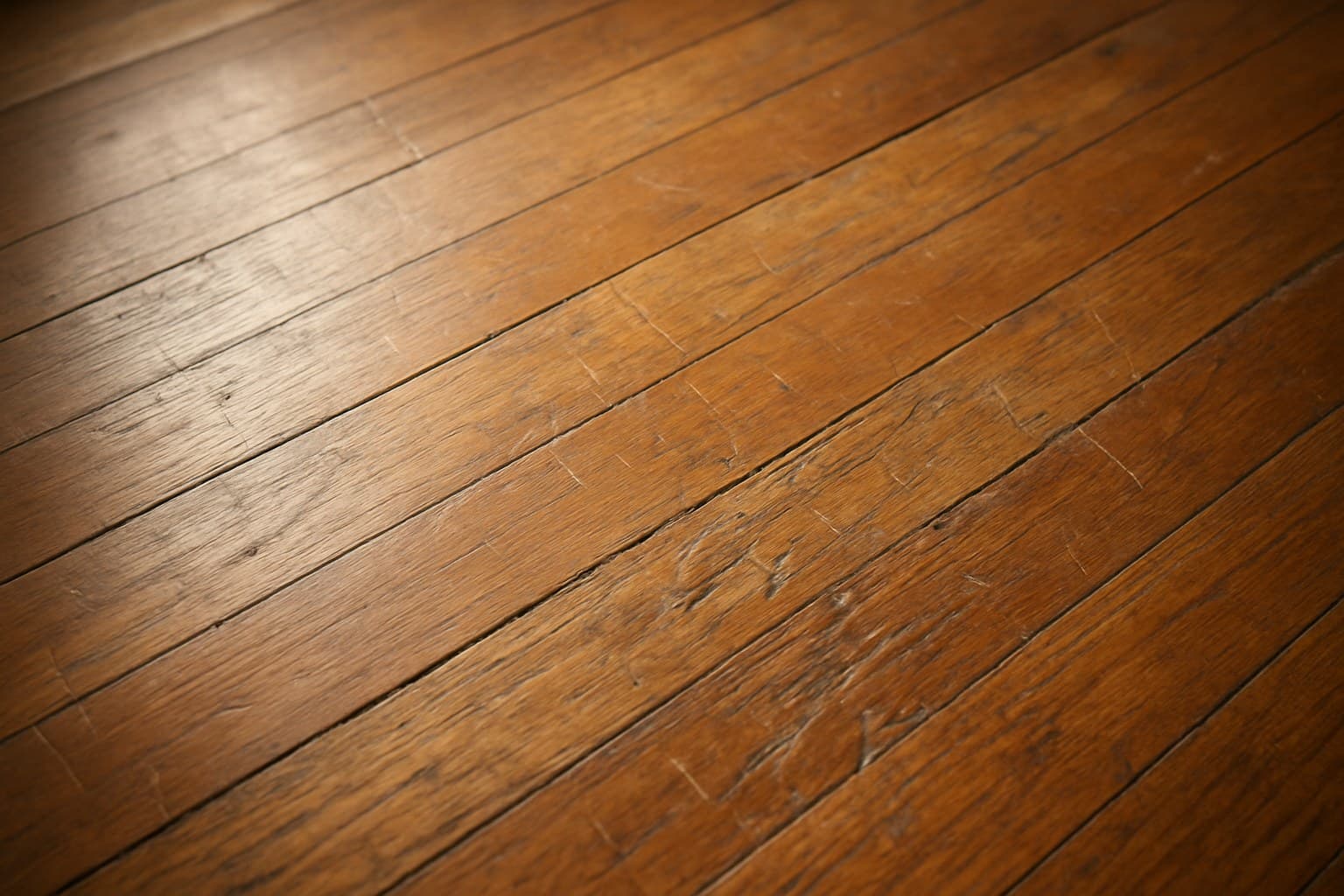
Water, pet, and gap damage all fall here. Cupped, stained, or splitting boards have to be fixed before any finish goes down, and no honest crew coats over them.
One check I always do on an older solid floor: I measure the remaining wood at the edges first. A floor can look perfect on top with almost nothing left to sand. I once had a customer who wanted solid oak sanded a fourth or fifth time, and it took down to the tongue in one corner before I caught it. That risk lines up with the NWFA's own life-cycle guidance: solid wood floors can only be sanded and refinished a limited number of times before the wear layer runs out, and the tongue is usually the thinnest point, so it's the first place a sanding will expose it. If you plan to refinish hardwood floors yourself, that edge check is step one, not an afterthought.
Finish Options and What They Add
Your finish changes both the material cost and how long the crew is in your house, because coats and cure time drive downtime. Here's how the common options compare.
| Finish | Material | Note |
|---|---|---|
| Oil-based polyurethane | $20 - $50/gal | Ambers over time; strong fumes; slower cure |
| Water-based polyurethane | $30 - $55/gal | Stays clear; faster cure; low odor |
| Wax / hardwax oil (e.g. Rubio Monocoat) | $35 - $55/gal | Matte look; easy to spot-repair |
| Stain (add-on to any finish) | $1 - $3/sq ft | Adds a labor step and dry time |
Finish material costs and the trade-offs that come with each type.
Oil-based poly is the cheapest per gallon, but it turns yellow-gold over the years and cures slowly with heavy fumes. Water-based poly costs a bit more, stays clear, and cures faster with far less smell. Hardwax oil like Rubio Monocoat gives a low, matte look and lets you spot-fix a scuff without recoating the whole room.
Finish choice hits labor, not just material. More coats and longer cure times mean more days before you can walk on it or move furniture back. Some areas restrict high-VOC (fume-heavy) oil-based finishes. That single rule is one reason two quotes for "the same job" can land apart.
Build Your Own Estimate: The Refinishing Math
Here's the formula in plain words:
(base sand-and-finish rate x square feet) + species adder + repairs + stain or finish upgrade + add-ons
Plug in real numbers. Use a base of $3 to $5 per square foot for standard oak with a basic finish. Add the species number from the table above if you have a dense wood, add your repair costs, and add stain if you want it. Add-ons cover furniture moving, carpet tear-out, and dust containment.
Here's one worked all the way through: a 300 sq ft living room in red oak, water-based poly, a little board repair, no stain, and the contractor moves the furniture.
| Line item | Math | Amount |
|---|---|---|
| Base sand + water-poly finish | $4/sq ft x 300 | $1,200 |
| Species adder (red oak, standard) | included in base | $0 |
| Light board repair (a few boards) | flat | $150 |
| Stain | none | $0 |
| Furniture moving | flat | $150 |
| Subtotal | $1,500 | |
| Tax + contingency (about 10%) | $150 | |
| Estimated total | $1,650 |
Source: how I build a sand-and-finish quote room by room before I bid it
A worked estimate for a 300 sq ft red oak living room with water-based finish and light repair.
That lands at about $5.50 per square foot, right inside the normal $3 to $8 band. Keep a little contingency in your head, because surprises show up once sanding starts and the old finish comes off. A soft spot or a hidden stain can turn a clean job into a repair line you didn't quote.
Refinish or Replace: Which One Wins
Refinishing almost always wins on price when the wood is sound. Refinishing runs about $3 to $8 per square foot; replacing runs roughly $8 to $15 or more per square foot installed once you add tear-out, new material, and labor. If your boards are solid, sanding them back is the cheaper call by a wide margin.
The math flips only when the wood itself is done. If boards are rotted, badly water-damaged, or already sanded so thin there's nothing left to take off, you're buying new floor. You can see the full picture of what new hardwood costs installed and what installing new hardwood actually involves before you commit.
There's a long-game reason refinishing usually wins, too. According to the National Wood Flooring Association's Life Cycle Cost Analysis, solid wood floors can be sanded and refinished multiple times over the life of a building. That's the value: one floor, refreshed again and again. A thin engineered veneer often can't be sanded even once, which caps how long that floor lasts. If you're weighing a floor with a factory finish, our guide to prefinished hardwood flooring covers how those wear layers hold up.
What Refinishing It Yourself Actually Costs
If you skip the contractor and do the sanding and coating yourself, you're paying for equipment rental and materials only, no labor markup. For a typical 300 sq ft room in solid oak, expect roughly this:
| DIY line item | Typical cost |
|---|---|
| Drum sander + edger rental (1-2 days) | $100 - $150 |
| Sandpaper (multiple grits) | $50 - $80 |
| Wood filler and prep supplies | $10 - $20 |
| Water-based polyurethane (2 coats) | $60 - $90 |
| Applicators, tack cloths, painter's tape | $20 - $30 |
| Estimated DIY total (materials + rental only) | $240 - $370 |
A materials-and-rental-only DIY estimate for a 300 sq ft solid oak room.
That works out to roughly $0.80 to $1.25 per square foot, well under the $3 to $8 per square foot a contractor charges for the same room, mainly because you're supplying your own labor and taking on the risk of sanding mistakes yourself. A gouge from an unfamiliar drum sander or a blotchy stain job can turn that savings into a repair bill, which is the real trade-off behind the lower number.
Whichever way you lean, get 2 to 3 itemized quotes. The fees contractors disagree on most, furniture moving, carpet removal, and dust containment, are exactly where regional differences hide.
If you're leaning toward doing it yourself, read how to refinish hardwood floors yourself next, since it walks the sanding and coating steps that decide whether a DIY job looks pro or blotchy.