
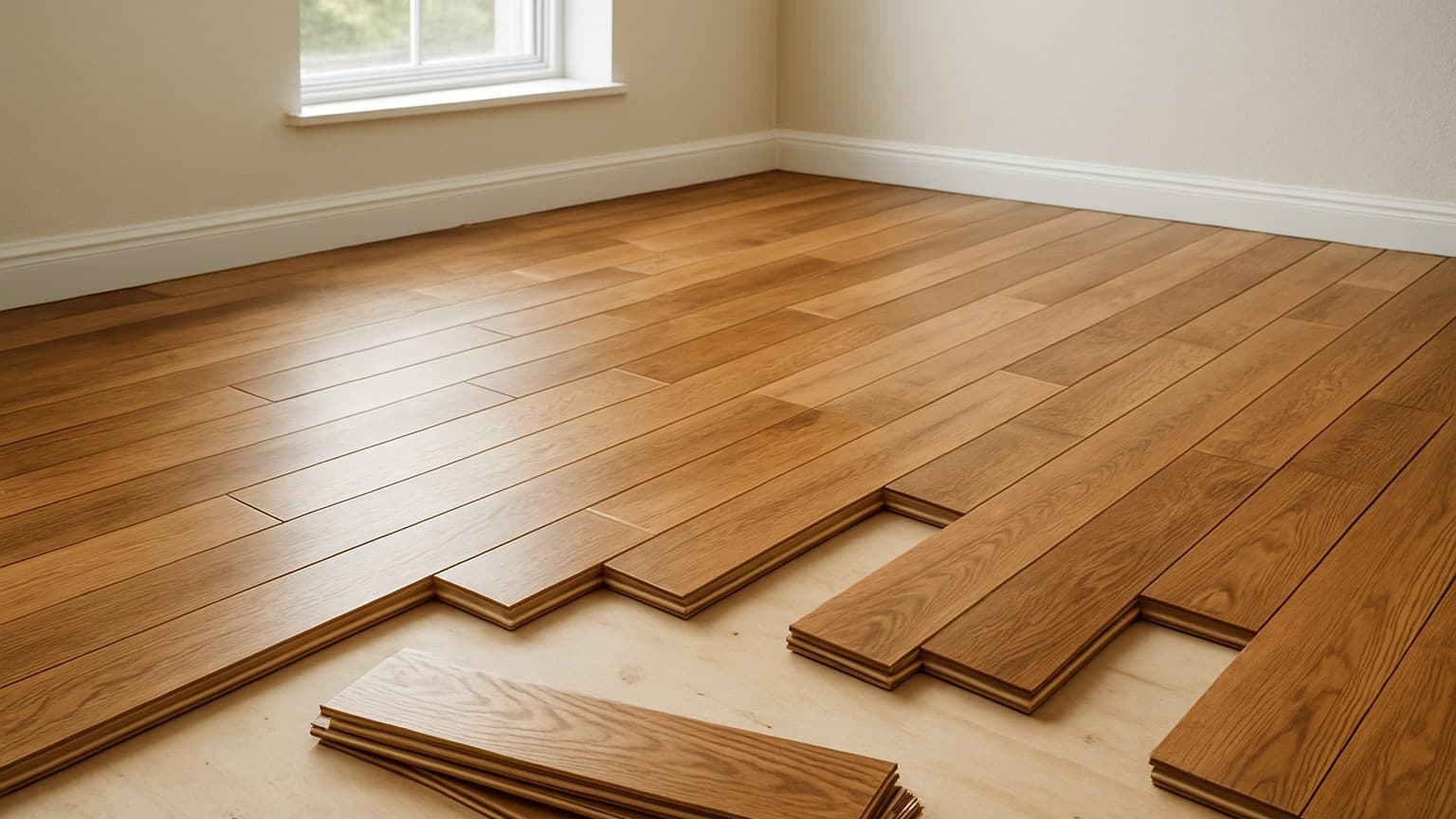
Rosa in Sacramento called me after three online calculators gave her three different numbers for her 12x12 dining room, because per-square-foot rates online ignore what small rooms really get charged. A hardwood floor in a room that size runs roughly $865 to $3,600 installed, depending on the wood and how much work the old floor needs. Minimum fees and the waste you order both hit a 144 sq ft floor harder than a whole house. Here's the math, line by line, so you can build your own total.
Key takeaways
- A 12x12 room is 144 sq ft, but you order about 158-166 sq ft once you add a 10-15% waste factor for cuts and mistakes.
- Real totals run roughly $865-$1,300 budget, $1,440-$2,160 mid, and $2,300-$3,600 premium, split fairly evenly between materials and labor.
- Small rooms cost more per square foot than open floors because many installers charge a minimum job fee, and basement or stair work costs more than an open room.
- Per NWFA lifecycle data, solid wood runs about $8.92 installed and $1.01 per year over ~75 years, while engineered runs about $7.92 installed and $1.05 per year over ~25 years.
- Subfloor flatness and a moisture check come before any planks go down; skipping them is how a cheap job turns into a cupped, relaid one.
The Short Answer for a 12x12 Room
A hardwood floor in a 12x12 room runs roughly $865 to $1,300 on a budget job, $1,440 to $2,160 mid-range, and $2,300 to $3,600 for premium wood, all-in for the full 144 square feet including both materials and labor.
Those are room totals, not per-square-foot rates. Which tier you land in depends mostly on two things: the wood you pick and how much work the old floor and subfloor need before anything new goes down.
Money splits close to 50/50 between materials and labor across all three tiers. A small room like this often prices out higher per square foot than a whole-house job, because many crews charge a minimum floor fee no matter how little square footage they're covering.
Want your own number instead of a range? The worked math below builds it one line at a time.
The Formula: How to Build Your Own 144 Sq Ft Number
Here's the whole thing in one line:
(144 sq ft x waste factor) x material rate + (144 x labor rate) + prep + removal + finishing = your total.
The waste factor trips people up, so let's be plain about it. You never order exactly 144 square feet. According to the NWFA's installation guidelines, you should order roughly 10 to 15% extra for cut-off ends, mistakes, and a few spare boards to stash for future repairs. That turns 144 into about 158 to 166 square feet ordered. On the jobs I run I use 12% as my default.
Prep, old-floor removal, and finishing are separate line items people forget when they read a single per-foot rate. Site-finished floors add a sand-and-finish charge that prefinished floors skip entirely.
One rule before any of this: the subfloor has to be flat and the moisture checked first. That's not a line you get to delete to hit a budget. Skip it and the floor you paid for can cup on you within a season.
Here's a full mid-tier example worked end to end:
- Room area: 12 ft x 12 ft = 144 sq ft
- Waste factor: 144 x 1.12 = about 161 sq ft to order
- Material: 161 sq ft x $6/sq ft = about $966
- Labor: 144 sq ft x $5/sq ft = $720
- Old carpet removal and haul-away: about $150
- Minor subfloor prep and leveling: about $150
- Worked mid example total: roughly $1,986
Note: The waste-allowance math above follows NWFA installation guidelines; the per-square-foot rates in this example are the mid-tier figures I quote on residential jobs.
Line-Item Cost Breakdown for 144 Sq Ft
The gap between a budget floor and a premium one is almost all in the wood and the prep, not the labor rate. Here is how each tier lays out when you split materials from labor for the full 144 square feet.
| Tier | Material (144 sq ft) | Labor (144 sq ft) | Total |
|---|---|---|---|
| Budget (engineered, entry oak) | $430-$720 | $430-$580 | $865-$1,300 |
| Mid (solid oak or better engineered) | $720-$1,150 | $720-$1,010 | $1,440-$2,160 |
| Premium (hickory/walnut, character grade, pattern) | $1,150-$2,020 | $1,150-$1,580 | $2,300-$3,600 |
Source: I built these three tiers from the $6-$25/sq ft total range the ranking cost guides cite, run against 144 sq ft with a 12% waste add
On the jobs I quote around Sacramento, installed hardwood runs $6 to $25 per square foot, and that range maps almost exactly onto the totals above: the low end lands near $865 and the top end near $3,600. If you want the fuller national picture beyond my local numbers, hardwood floor installation cost breakdown walks through how those per-square-foot rates shift by region and wood type.
One thing the table hides: an unfinished, site-finished floor adds a sand-and-finish line on top of the material and labor shown. Prefinished floors come sealed from the factory, so they skip that charge but usually cost a little more per board.
Solid vs. Engineered in a Room This Size
For a 12x12 room the real tradeoff is simple: solid wood can be sanded and refinished several times over its life, while engineered wood is far more stable over concrete and below grade. Solid isn't a per-foot upgrade you buy, it's a decision about where the room sits and how long you want it to last — and if that room is a bedroom, it's worth knowing whether hardwood in bedrooms actually boosts resale value before you pick a tier.
In dollars for 144 square feet, engineered runs roughly $1,150 to $2,600 installed, and solid runs about $1,300 to $3,600. The overlap in the middle is real, so the choice usually comes down to the room, not the price tag.
| Factor | Solid | Engineered |
|---|---|---|
| Typical installed cost, 144 sq ft | $1,300-$3,600 | $1,150-$2,600 |
| Refinishing | Several times over its life | Limited by veneer thickness, sometimes none |
| Below grade / over concrete | Generally not recommended | More stable, often the safer pick |
| Reference service life | ~75 years | ~25 years |
Source: Service-life figures come from the NWFA Life Cycle Cost Analysis; the installed-cost columns are my own 144 sq ft tiers from the table above
According to the National Wood Flooring Association's Life Cycle Cost Analysis, solid wood flooring carries a reference service life of about 75 years, compared to roughly 25 years for engineered wood; the installed-cost columns above are my own 144 sq ft price tiers, not NWFA figures.
If your 12x12 is a basement or sits on a slab, the moisture reading off the concrete makes the call, not the wood. I've steered plenty of people off solid down there, and off both materials when the numbers came back too high. For the full species-and-subfloor rundown, see our breakdown on how to pick solid vs. engineered hardwood.
What Moves the Number: Species, Grade, and Plank Width
Three things swing your material cost more than anything else: the species, the grade, and the plank width.
Species sets the base price. Red oak is the value anchor most floors get measured against. Hardness matters too. Janka is just a dent-resistance score, higher means the wood shrugs off dogs, chairs, and dropped pans better. Hickory sits near the top of that hardness scale, and if you're weighing it in a wider format, wide plank hickory flooring cost and grades guide breaks down what that combination does to price and movement. Here's how the common choices stack up.
| Species | Janka | Relative cost |
|---|---|---|
| Red oak | 1290 | Value anchor |
| White oak | 1360 | Slightly above red oak |
| Hickory | 1820 | Higher |
| Maple | 1450 | Mid |
| Walnut | 1010 | Premium (soft but pricey) |
Source: the cost column reflects what these species run on the jobs I quote
Notice walnut: it's one of the softest on the list but one of the priciest, because you pay for the color and grain, not the toughness.
Grade is the next lever. Select grade is the cleanest, most uniform boards with the fewest knots, common grade shows more color variation and small knots, and character grade leans into knots and streaks on purpose. Moving from common up to select can add a couple dollars a square foot on the same species.
Plank width moves both price and waste. Wider boards usually cost more per square foot, and in a small 12x12 room they can bump your waste factor higher because you get fewer usable cuts out of each board. If you're eyeing a wider look, 12 inch wide plank flooring and the rundown on extra wide plank flooring both cover what that width does to cost and install. It's also worth reading the downsides of wide plank flooring before you commit in a room this size.
The Small-Room Premium Nobody Quotes
A 12x12 room almost always costs more per square foot than an open floor, and here's why: many installers won't fire up a crew for 144 square feet without a minimum job fee. That flat charge gets spread over a small area, so your per-foot number climbs.
Removal and moving matter too. Hauling out old carpet, shifting furniture, and working around a closet or a transition to the next room all add real dollars that a bare per-foot rate never shows. A basement or a stair job costs more than an open 12x12, because of the extra moisture control down low and the slow, fussy cutting on treads.
Here's what to budget for beyond the material and labor rate:
- Minimum job or floor fee if the room is under the installer's threshold
- Old floor removal and haul-away
- Moving furniture and any appliances out of the room
- A closet, doorway, or transition strip to the next floor
- Basement or stair premium for moisture control and extra cutting
- The 10 to 15% waste you actually order and pay for
- The moisture and flatness check before install
That last line is the one people try to cut, and it's the one I won't. Dana in Elk Grove talked me out of a moisture test to save an afternoon, and I let her. The floor cupped before the season was out, and I relaid it on my own dime. That's the day the test stopped being optional on my jobs.
DIY or Hire It Out?
For a flat, above-grade 12x12 room with a click-lock engineered floor, DIY is realistic for most handy homeowners, and it wipes out the labor half of the total, roughly $430 to $1,010 in that mid tier. You still buy the wood, the underlayment, and a rental saw.
Where I'd tell you to hire out: glue-down floors, stairs, and any room with a moisture question or a slab underneath. Those are where a bad call gets expensive fast, and where a crew's minimum fee is money well spent. Nail-down solid over a plywood subfloor sits in between, doable if you own or rent a flooring nailer and have leveled the subfloor first.
If you're still weighing whether a wide-plank look is even worth chasing in a small room, our take on whether wide plank floors are still in style is the useful next read, because width drives both the price and the install difficulty you just saw here.