
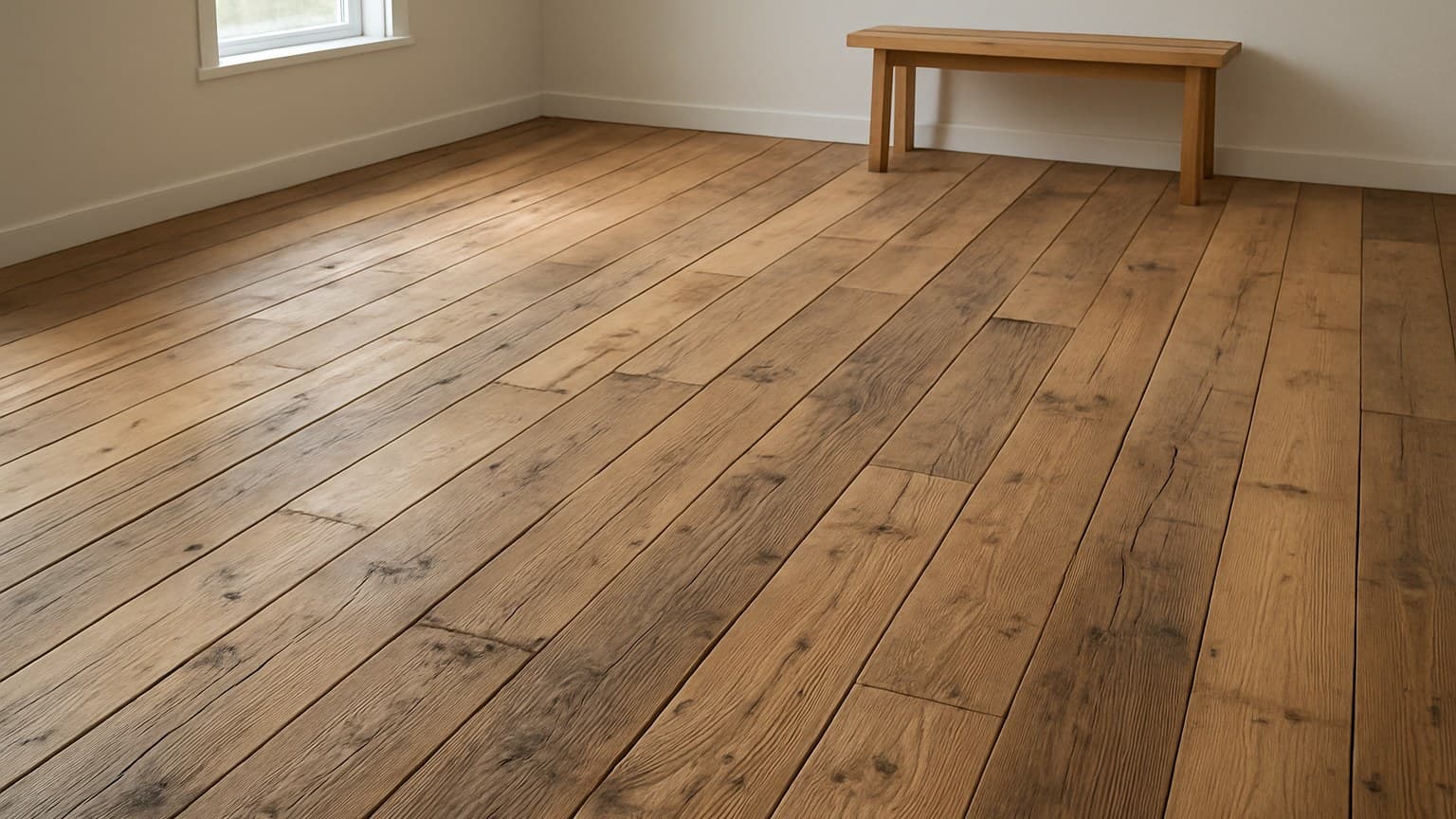
Last fall a homeowner I'll call Denise in Nashville, Tennessee called me after her new reclaimed oak floor started cupping in the dining room, the supplier had sold her distressed new lumber dressed up as reclaimed, and by the time I got there the boards were already nailed down and her leverage to argue was gone. Had her floor been reclaimed cherry instead of oak, she'd have been fighting a second battle too, since Brazilian cherry hardwood flooring comes with its own well-known darkening and blotching quirks on top of any authenticity questions. Every check that matters belongs before your deposit clears, not after the pallet lands in your driveway. Get it wrong and you pay old-growth prices, the premium buyers pay for wood cut from slow-growing, tight-grained mature trees, for a machine-dented fake.
Key takeaways
- Real reclaimed wood comes with kiln-dry and pest-treatment (debugging) paperwork; if a supplier can't produce it, walk away.
- Confirm moisture content with a meter on delivery: wide plank should read within about 2% of your subfloor and land near 6-9% for most US interiors.
- NWFA/NOFMA mill certification and an EPD (Environmental Product Declaration) are the only third-party proof that the reclaimed claim and the milling are legit.
- Reclaimed wide plank runs roughly $8-$25+ per sq ft for materials plus $3-$8 per sq ft for labor, and more for herringbone patterns, stairs, or basements.
- Distressed new wood gets sold as 'reclaimed' all the time; original-face saw marks, real nail holes, and patina that runs deep are how you tell by eye.
What a Real Reclaimed Claim Has to Prove
A real reclaimed claim proves three things on paper: where the wood came from, that it was dried and de-bugged (heat-treated to kill any insects hiding deep in the wood), and that a third party checked the milling. Everything below is how you force those proofs out of a supplier before you pay.
The risks you're paying to avoid are the ones you can't see. Old-growth timber pulled from a barn can still carry live borers or larvae deep in the board. Some reclaimers fill cracks and checks with resin or formaldehyde-based filler and never mention it. And a board that was never dried right will cup or gap once your heat kicks on.
Then there's the fake. Plenty of "reclaimed" wide plank is just new lumber run through a distressing machine, dinged up on a line, and sold at a reclaimed price. Authentic reclaimed shows old-growth tight grain, real service wear, and marks that don't repeat, and that repetition gets even easier to spot on wider boards, which matters if you're already leaning toward extra wide plank flooring for the room. The knock-off shows the same dent in the same spot every few feet.
The picture below is what I look at with my own eyes before any paperwork even comes out.
Not to scale. The point is what your eye should catch, not the size of the marks.
Verification happens before the deposit, because once wide plank is glued or nailed, you own it. The four checks that follow are sourcing, kiln-dry plus pest paperwork, moisture on delivery, and mill certification. If the look itself is what you're still deciding on, that's a separate question you can settle in are wide plank floors still in style?.
Step 1: Verify the Sourcing Claim
Ask exactly where each batch came from, and expect a specific answer. A real reclaimer names the building and the region: a tobacco barn in Kentucky, a textile mill in the Carolinas, a factory teardown in a named town. They can usually show salvage photos or a record of the job.
The story to distrust is the recycled one. If the same "century-old barn wood" line appears on every product page with no building named, you're reading marketing, not sourcing.
Sourcing isn't only a marketing question, either, it's a legal one. The Lacey Act is the federal law that governs the legal sourcing and import of wood into the US, and it requires an accurate declaration of species and country of origin for covered wood products entering the country. Salvage records, FSC chain-of-custody, and mill certification (covered below) all speak to whether the wood is what the supplier says it is, but none of them are the same as Lacey Act compliance. If any part of a lot was imported at any point in its history, ask directly whether that material is Lacey Act compliant and whether the supplier can produce the import declaration. Domestic salvage pulled straight out of a US barn or mill won't carry that same paperwork, but a supplier should still know which category your wood falls into and answer without hesitating.
The question to ask: "What structure did this lot come out of, can you document it, and, if any of it crossed a border, is it Lacey Act compliant?"
Walk away when you see uniform boards with distress marks that repeat and no salvage paperwork behind them, or when a supplier can't give a straight answer about Lacey Act compliance on imported material. That pattern points straight at distressed new wood wearing a reclaimed price tag.
Step 2: Demand Kiln-Dry and Debugging (Pest) Paperwork
Get the drying and pest-treatment records in writing before you pay. A surface treatment alone won't reach borers living deep in old timber. Kiln-drying is heat that does two jobs at once: it stabilizes old wood so it stops moving, and it cooks out any insects or larvae inside. In the trade that second part is called debugging.
Ask for the kiln schedule or a heat-treatment certificate that shows the core temperature and how long the wood was held there. A borer sitting an inch into a thick plank doesn't die from a quick surface pass.
This is also where filler matters. Old boards have cracks and checks that get filled, so ask what goes in them and whether it's a low-VOC product, formaldehyde-based fillers and finishes are exactly the kind of indoor air quality risk the EPA has studied. VOCs are the fumes a finish or filler can give off indoors.
The question to ask: "Can you send the kiln-dry and pest-treatment records for this lot?"
Walk away from a supplier who tells you interior wide plank is "air-dried, no kiln needed," or who can't produce any treatment record at all.
| Document to get in writing | Why it matters |
|---|---|
| Kiln-dry / heat-treatment record | Proves the wood was dried and debugged, not just air-dried |
| Pest treatment certificate | Confirms borers and larvae were killed to core temperature |
| Salvage / sourcing record | Backs the reclaimed claim with a real building |
| Filler / finish product sheet | Shows resin fill and finish VOC content |
Source: The records I ask every reclaimer to hand over before I'll book an install date
Keep this checklist next to your quote, if a supplier can't produce all four documents on request, that's your signal to walk.
Step 3: Confirm Moisture Content on Delivery
Read the moisture yourself the day it's delivered, on several boards, before you accept the pallet. A moisture meter is a handheld tool that reads how wet the wood is, and every nailed or floating floor's warranty quietly hinges on this number being right.
Don't check one board and call it done. Pull boards from different bundles and compare them against the subfloor reading in the same room. Wide plank has more width to move, and boards in the 12 inch wide plank flooring range move the most of all, so a mismatch shows up fast as gaps or cupping.
Then acclimate. That means leaving the boards in the room to adjust to its air before install, and the exact number of days comes from the maker's own sheet, not a number someone repeated online. Some products want days in the room; a few say none. The box governs.
I learned the cost of skipping this the hard way on a job in Asheville, North Carolina. The homeowner, whom I'll call Carla, talked me out of the moisture test to save an afternoon, and I let her. The floor cupped before the season was out, and I relaid it myself rather than argue about whose call it had been, work that ran close to what a cost to refinish hardwood floors job would have billed her if I hadn't absorbed the labor. That test hasn't been optional for me since.
The question to ask: "What moisture content will these read on delivery, and what's your acclimation spec?"
Walk away when boards read several points off the subfloor, or the supplier shrugs at the numbers.
| Check | Target | Red flag |
|---|---|---|
| Finished board reading, most US interiors | about 6-9% | Above 10% or wildly varied board to board |
| Board vs. subfloor difference (wide plank) | within about 2% | More than 2-3% apart |
| Acclimation in the room | per the maker's sheet | Supplier says none needed for solid wide plank |
Source: NWFA installation guidelines on acclimation
Moisture targets to confirm before you accept delivery, based on general acclimation best practices.
Step 4: Read the Mill Certification and EPD Docs
Certification is what turns "trust me" into a document you can hold. NWFA (National Wood Flooring Association) and NOFMA mill certification is a third-party check that the milling, grading, and moisture meet a real standard, mills like Carlisle Wide Plank Floors and Heppner Hardwoods have earned this certification, according to NWFA's own certification announcements, something a plain product-catalog page never cites.
According to NWFA's own Environmental Product Declarations for solid and engineered wood flooring, an EPD (Environmental Product Declaration) is a verified sheet that backs the sustainability story with actual data instead of a vague "eco-friendly" line. Where it applies, FSC (Forest Stewardship Council) chain-of-custody paperwork tracks the wood back through every hand that touched it.
One hands you paper; the other hands you adjectives.
The question to ask: "Is this a certified mill, and can you provide the EPD or FSC documentation?"
Walk away when "sustainable" and "certified" sit on the website with no file behind either word.
What Reclaimed Wide Plank Actually Costs
Reclaimed wide plank runs roughly $8-$25+ per square foot for materials, plus $3-$8 per square foot for standard labor. It sits well above new wood on both lines, so expect a split bill, never one flat number. If reclaimed isn't a fit for your budget, our guide to choosing solid vs engineered hardwood floors walks through the standard alternatives and species options.
Here's a worked example using the ranges above. A 300 square foot room in reclaimed oak at $12 materials plus $5 labor lands around $5,100 before any pattern or stair work. That's $3,600 in materials and $1,500 in labor.
The premiums stack fast. Herringbone or chevron layouts, stairs, and basement jobs all cost more than an open room, because of the extra cutting on patterns and the slab moisture prep a basement needs. Species drives the material price too: heart pine and chestnut run higher than mixed oak, and denser old-growth stock gives you more refinishing life down the road. If hickory is on your shortlist, our breakdown of wide plank hickory flooring cost and grades covers how much it moves compared to oak.
| Room size | Materials cost | Labor cost | Total estimate |
|---|---|---|---|
| 200 sq ft | $1,600-$5,000 | $600-$1,600 | $2,200-$6,600 |
| 300 sq ft | $2,400-$7,500 | $900-$2,400 | $3,300-$9,900 |
| 500 sq ft | $4,000-$12,500 | $1,500-$4,000 | $5,500-$16,500 |
Cost ranges per square foot for reclaimed wide plank, split into labor bars and materials bars.
Before you sign off on the price, weigh the trade-offs that come with any wide board, laid out in what are the downsides of wide plank flooring? so the movement and prep don't surprise you after the invoice.
Sources
- NWFA Environmental Product Declaration for Solid Wood Flooring
- NWFA Environmental Product Declaration for Engineered Wood Flooring
- NWFA/NOFMA Mill Certification Announcement: Carlisle Wide Plank Floors
- NWFA/NOFMA Mill Certification Announcement: Heppner Hardwoods Inc.
- EPA Research Abstract on Formaldehyde and Indoor Air Quality