
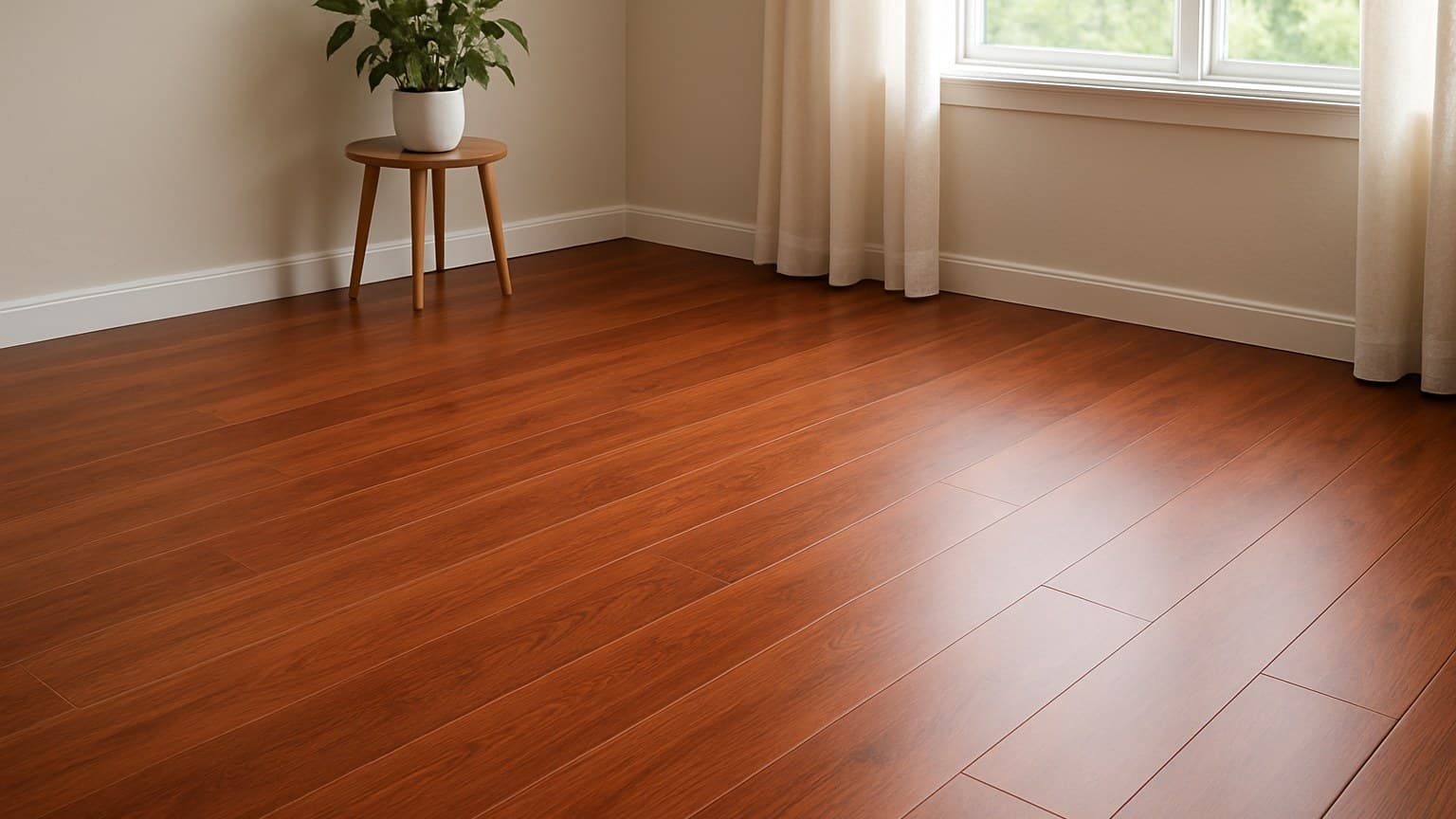
When Carla in Dayton, Ohio called me back three weeks after her hallway install, she was ready to blame cherry laminate for looking "off." It wasn't the color. She'd picked a red-leaning shade that fought her gray cabinets, and paired it with an AC rating too soft for a hallway that took daily hits from three kids and a dog. Get those two calls right and cherry still looks sharp.
Key takeaways
- Pick the shade by your room's light and cabinet undertone first: dark cherry in a dim north room reads cave-like, and red cherry fights cool gray cabinets.
- For a normal home, AC3 covers bedrooms and living rooms; step up to AC4 for hallways, kitchens, kids and dogs. AC5 is commercial-grade and usually a waste of money at home.
- Only buy laminate labeled CARB2 / TSCA Title VI compliant, and ideally NALFA-certified, so formaldehyde emissions stay in check.
- Cherry laminate materials run about $1.50-$4.00 per sq ft, with floating install labor another $2-$5 per sq ft; stairs and below-grade rooms cost more.
- The laminate plank surface resists spills, but water still gets in at the seams, so keep cherry laminate out of bathrooms and basements.
Start Here: Is Cherry Laminate Still Worth Buying in 2026?
Cherry is not dead. What looks dated is the specific cherry that flooded builder homes in the early 2000s: bright orange-red, high gloss, so shiny it showed every footprint. That look aged badly. The wood tone did not.
The cherry laminate that ages well today leans browner and drops the shine. A matte or low-satin finish keeps the warmth people love about cherry without the glossy sheen that reads "2004 spec house." Same color family, different result.
Think of this as five decisions in order, not a spec sheet. Shade first, then the AC rating for your traffic, then the emissions label, then a real brand-and-price comparison, and last the subfloor prep that decides whether any of it lasts. Skip one and that's usually where the regret starts. The color is rarely the problem; the wrong shade or a top layer too soft for the room is.
Step 1: Match the Cherry Shade to Your Room's Light and Cabinets
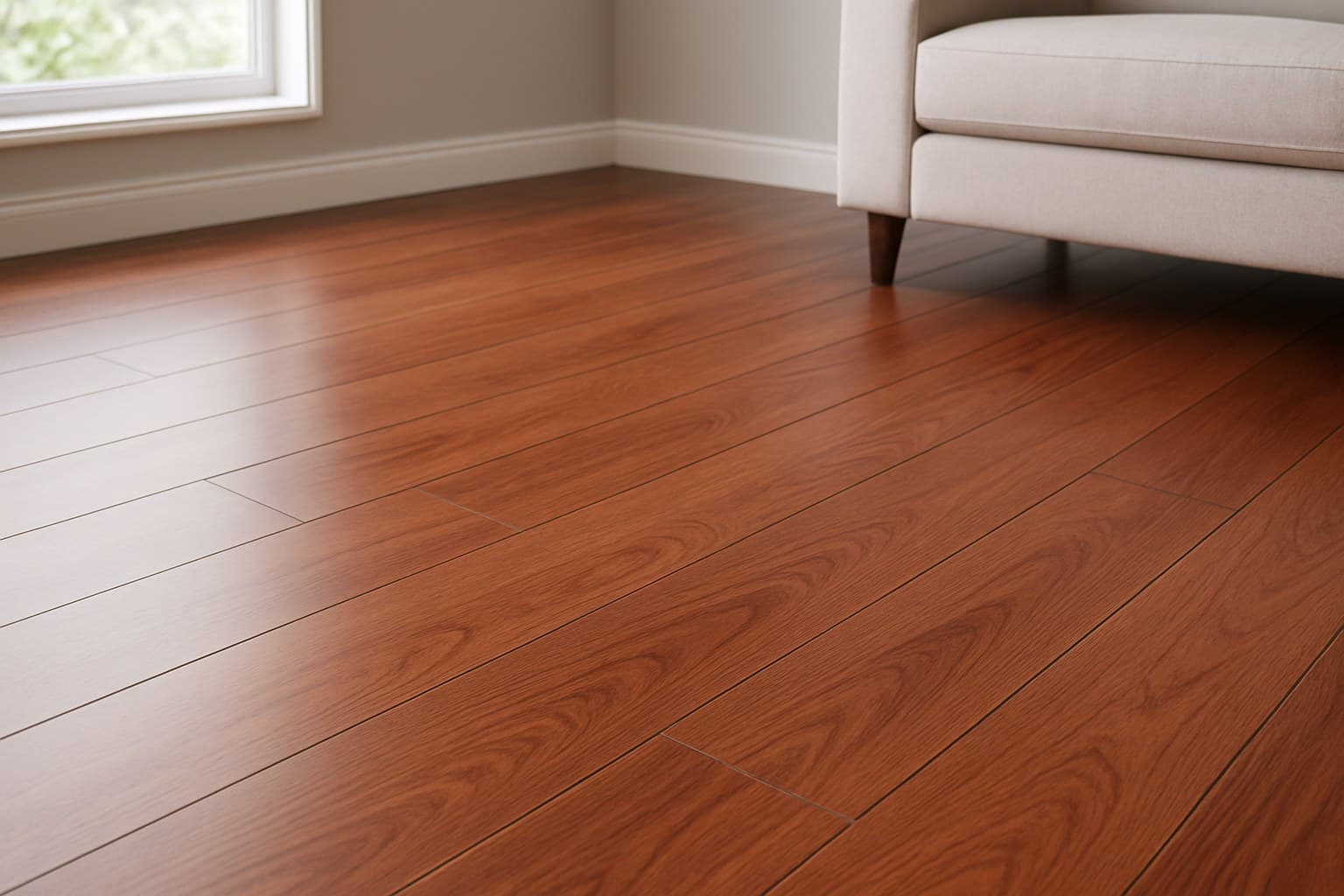
Match the shade to your room's daylight and your cabinet undertone first. That single call decides whether cherry looks rich or looks like a mistake. If you're weighing real wood instead of a laminate print, the same undertone logic guides choosing solid versus engineered hardwood for your room.
Undertone is just which way the color leans. Cherry can lean red, amber, or brown, and that lean either agrees or fights with your cabinets and trim. A warm red-amber cherry sits nicely next to oak, cream, and warm-white trim. Put that same red cherry against cool gray or blue-white cabinets and the tones clash, the floor can read almost pink. In a gray-and-white kitchen, choose a brown-leaning cherry so nothing fights. The same undertone logic applies if you're weighing hardwood oak flooring options instead, since oak swings just as easily between warm and cool depending on the stain.
Room light matters just as much. Dark and near-black cherry drinks up light, so in a dim, north-facing room it can make the whole space feel like a cave. A bright, south-facing room can carry that same dark plank and have it read rich instead of heavy.
The one test that actually predicts the match: get a full plank sample, lay it flat on the floor in that exact room, and look at it in that room's own daylight at a few times of day. Don't judge it held up vertically under showroom lights. Store lighting is built to flatter, and it lies about undertone every time.
If you like the look but want more water tolerance, the vinyl version is worth a look too; here's how well hickory vinyl plank actually mimics real wood, and the same printing tricks apply to cherry. And if it's the deep, exotic red you're really after, know that real Brazilian cherry hardwood keeps darkening after install, which a laminate print holds steady instead.
Not to scale; the swatches are a shade guide, not the exact colors.
Step 2: Read the AC Rating and Wear Layer Against Your Traffic
The AC rating is the number that tells you how tough the surface is, and matching it to your traffic matters more than the color for how long the floor looks new. According to NALFA, the North American Laminate Flooring Association, AC stands for the abrasion rating that classifies laminate flooring from AC1 up to AC5 based on how well the surface resists wear. For homes you'll see AC3, AC4, and AC5.
What actually fights scratches is the clear top layer, usually packed with aluminum oxide, a very hard mineral baked into the surface. A higher AC number generally means a tougher, more scratch-resistant top. It says nothing about water, and nothing about the color underneath.
Here is how the ratings map to real rooms.
| AC rating | Rated for | Best rooms |
|---|---|---|
| AC3 | General residential | Bedrooms, living rooms, light-traffic homes |
| AC4 | Heavy residential / light commercial | Hallways, kitchens, homes with kids and pets |
| AC5 | General commercial | Overkill for most homes, and it costs more |
Source: the NALFA AC abrasion rating scale
Where each AC rating belongs in a normal home, based on the NALFA abrasion scale.
For most houses, AC3 is fine in bedrooms and living rooms, and AC4 is the safe pick for a hallway, a kitchen, or a house with a dog and kids. AC5 is built for stores and offices. You can buy it for a home, but you're paying for wear you'll never use up.
One warning on marketing: when a box says "lifetime residential wear," that promise always belongs to one specific product line, like Shaw Repel or a given Pergo series, never to laminate as a whole. Read whose warranty it is. If you want the full rundown on AC ratings and core types across every color, see which rooms laminate flooring actually works in.
Step 3: Check Formaldehyde Compliance Before You Buy
Buy only cherry laminate that shows CARB2 and TSCA Title VI compliance on the box. This is the step people skip, and after the 2015 laminate emissions scandal, it's the one I never skip.
Laminate's core is HDF, a dense board made from wood fibers glued together with resins. Those resins can give off formaldehyde, a gas you don't want a lot of indoors. The rules exist to keep that in check. CARB2 is the California Air Resources Board Phase 2 standard, and TSCA Title VI is the federal formaldehyde-emission rule for composite wood products sold in the US, administered by the EPA, see the EPA's Formaldehyde Emission Standards Q&A for the underlying rule. Both cap how much formaldehyde the board can release.
According to NALFA's laminate flooring FAQs, NALFA certification is a bonus on top of that: it's an independent program that tests laminate against a set of performance and emissions standards, so a NALFA-certified plank has been checked by a third party, not just the maker's own lab.
Practical rule: if a cheap import can't show CARB2 or TSCA Title VI compliance, walk away. It's not worth the gamble. When you do buy, keep the label or spec sheet stapled to your receipt. Here's what to look for on the box before it goes in the cart:
- TSCA Title VI compliant (the federal EPA rule)
- CARB2 (California Phase 2) compliant
- NALFA-certified is a nice extra, not a must
- Keep the label filed with your receipt
Step 4: Compare Named Brands on Price and Specs
Here's what a single store's product page won't give you: a straight cross-brand comparison. Cherry laminate lines differ on AC rating, thickness, warranty, and price, and knowing what actually differs beats trusting whichever line is on the end-cap display.
| Line | AC rating | Thickness | Wear warranty | Rough price/sq ft |
|---|---|---|---|---|
| Pergo Portfolio + WetProtect | AC4 | ~10mm | Up to lifetime residential | $2.60-$3.50 |
| Mohawk RevWood | AC3-AC4 | 7-10mm | Limited lifetime residential | $2.30-$3.80 |
| Shaw Repel | AC4 | ~7mm | Lifetime residential | $2.00-$3.20 |
| Home Decorators Collection | AC3-AC4 | 7-12mm | Limited lifetime residential | $1.30-$2.50 |
Source: the published spec sheets for Pergo Portfolio, Mohawk RevWood, Shaw Repel and Home Decorators Collection laminate
Note: figures are approximate, compiled from typical publicly listed retailer and manufacturer pricing, and can vary by region, retailer, and current promotions.
Cherry laminate lines compared on the specs that most often differ; treat the numbers as a starting point rather than a quote.
A few things to read off that. These are approximate shelf and online-quote figures that shift by retailer and region, so confirm current pricing and specs locally before you budget. Thicker planks in the 10-12mm range feel more solid and quiet underfoot than a 7mm board, and you pay for that. If a stiff, planted feel matters to you, spend up on thickness.
On water: Pergo WetProtect and Shaw Repel are surface treatments that help the plank face shrug off spills, and both back that with their own warranty terms tied to those named lines. But that protects the top and edges of the board, not the seams between planks. The wood core still swells if water sits and works its way in. That's exactly why Step 5 matters, and why I keep cherry laminate out of bathrooms. For a bathroom that still needs that cherry warmth, cherry vinyl flooring handles standing water at the seams in a way no laminate surface treatment can match.
I'm not crowning a winner here. Home Decorators Collection is the value play, Pergo and Shaw lean into water-resistant surfaces, and Mohawk RevWood spans a wide range of thicknesses and prices. Pick by the specs your room needs.
Step 5: Flatten and Moisture-Test the Subfloor Before a Floating Install
A floating laminate floor only lasts as long as the prep beneath it. The maker's warranty quietly hinges on subfloor flatness and moisture, not on which cherry plank you chose. Get this wrong and even a great floor telegraphs it back at you within a season. The same prep rules govern engineered flooring installation prep, so don't skip them just because click-lock feels sturdier than laminate.
Flatness first. Lay a long straightedge, at least 6 to 8 feet, across the subfloor and drag it around. Most laminate makers want the floor flat within a small tolerance over that span, and the exact number is printed in that product's own install guide, so look it up. Dips get filled with leveling compound; high spots get ground or sanded down. Planks bridging a dip will flex, click apart, and creak.
Then moisture. On concrete, that means a moisture test before anything goes down, because a slab that reads too wet will push moisture up into the laminate for years. Over a crawlspace, check the wood subfloor with a meter, a small tool that reads how much moisture is in the material. If the readings run high, you fix the source before you lay a single plank.
I learned that the hard way on a job for Diane in Toledo. She talked me into skipping the moisture test to save an afternoon, and I let her. The floor cupped before the season was out, and I pulled it up and relaid it on my own dime rather than argue about whose call it was. That's the day I stopped treating the test as optional. Twenty minutes then would have saved a weekend later.
What Cherry Laminate Actually Costs
Cherry laminate is one of the cheaper ways to get a warm wood look, and splitting the cost into materials and labor keeps the budget honest. Materials run roughly $1.50 to $4.00 per square foot, driven by thickness, AC rating, and whether it has a water-resistant surface. A floating install adds about $2 to $5 per square foot in labor. Bamboo vinyl flooring lands in roughly that same materials range if you want more water tolerance for the money.
So a straightforward 300-square-foot living room lands around $450 to $1,200 in materials plus $600 to $1,500 in labor. Open rooms are the cheap scenario. Stairs cost more because each step is cut, wrapped, and trimmed by hand, so installers price stairs per step, not per square foot. Below-grade rooms like basements cost more too, since the moisture testing and any slab prep add labor before the flooring even starts, and honestly a basement is where I often steer people away from laminate entirely.
If you'd rather put in real wood than a print, weigh the route of sanding and finishing unfinished hardwood on site against these numbers; it costs more up front but refinishes for decades. If a wider board profile is part of what's pulling you toward real wood, maple wide plank flooring's real tradeoffs are worth knowing before you commit to that look.
DIY or Hire: Where the Line Really Is
Click-lock cherry laminate in a normal rectangular room is a realistic weekend DIY for most handy homeowners. The planks snap together, you rent a saw, and the biggest skill is patience with the subfloor prep in Step 5.
Where I'd hire out: stairs, because each tread has to be cut and wrapped clean and it's slow, fussy work; and any large open-plan floor with moisture transitions between rooms, where getting the expansion gaps and layout right across a big span is easy to botch. If your floor plan flows kitchen to living to hall in one continuous run over a slab, a pro earns their fee.
Whichever way you go, remember the expansion gap. Almost every floating floor needs a small gap around the whole perimeter so the floor can move with the seasons, and the exact size is set by that product's instructions, not a number off a forum. Skip the gap and the floor buckles at the walls.