
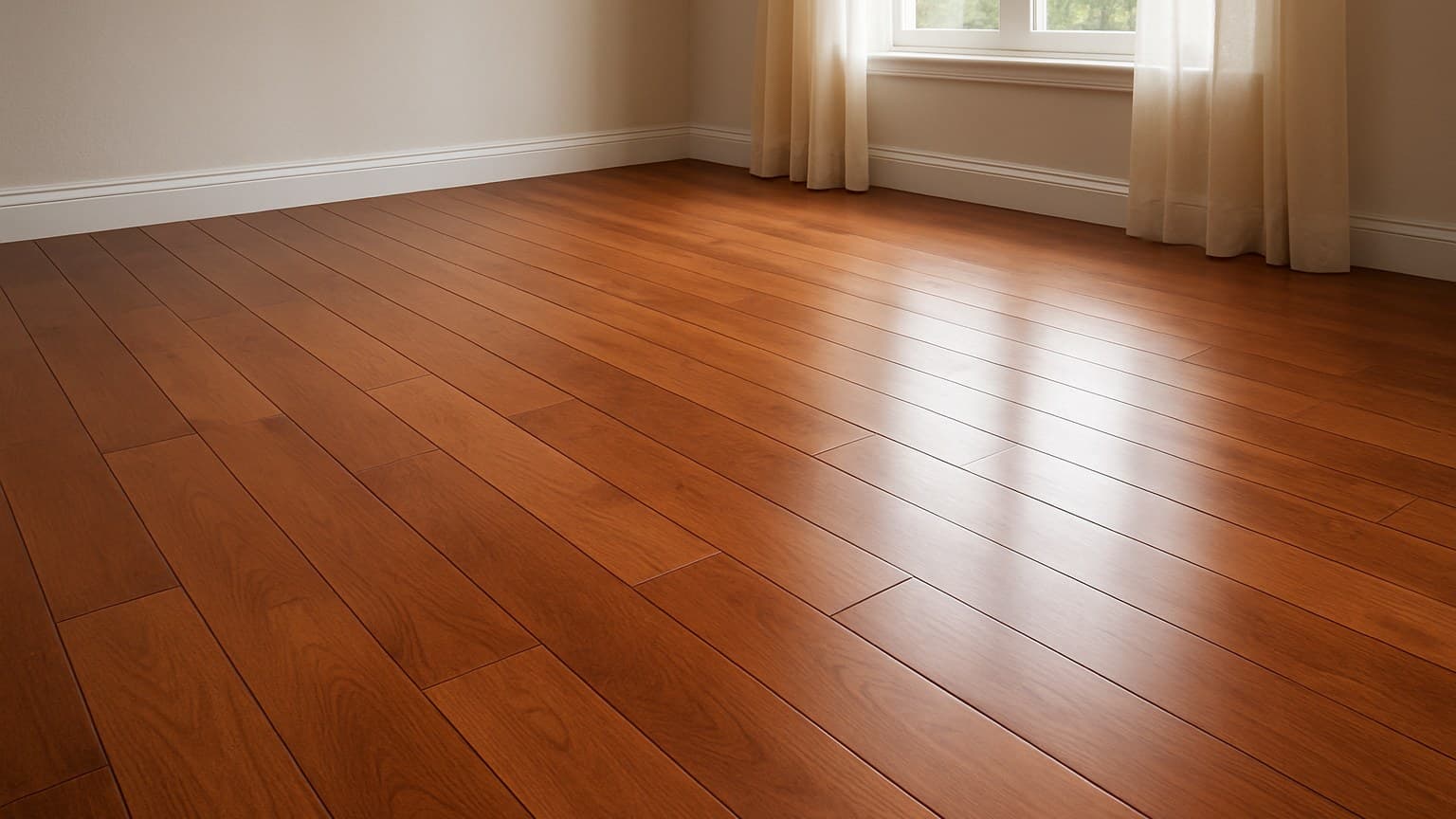
On a job in Sacramento, my client Dana Ruiz wanted cherry hardwood run through her sunroom before her in-laws visited for the holidays. She loved the color on the showroom sample, but her room sits in full sun most of the day and her retriever treats the floor like a chew toy. Cherry is softer than most people expect and never stops changing shade, so the plank that shines in a bedroom fights you in a mudroom. This walks you through five quick checks that tell you which room you actually have.
Key takeaways
- American cherry rates about 950 on the Janka hardness scale, softer than red oak (1290) and hard maple (1450), so it dents easier under heavy traffic and pet claws.
- Cherry darkens and turns amber under sunlight, and rugs leave pale ghost patches, so rotate them through the first year.
- Reddish heartwood cherry resists rot better than pale sapwood, but no cherry floor is waterproof, test subfloor moisture before you install.
- Budget roughly $4-11 per sq ft for material depending on grade, plus about $3-6 per sq ft for labor, with stairs and basements costing more than open rooms.
- Cherry usually costs more per foot than red oak, and engineered cherry is the safer pick over concrete or below grade.
Start Here: The 60-Second Cherry Verdict
American cherry (the domestic wood, Prunus serotina) suits low-to-medium traffic rooms with steady light and adults or older kids. It is a poor fit for a mudroom, a sun-blasted great room where the rugs never move, or a house full of big dogs. For those tougher rooms, a waterproof plank like Dusk Cherry LifeProof vinyl flooring gets you the same warm tone without the risk.
Here is the honest frame: cherry is a softer domestic hardwood that keeps darkening for years. The decision isn't whether cherry is a "good" floor. It's whether cherry matches how your room actually gets used.
At a glance: softer than oak, a wood that ambers with light over time, best in living rooms, dining rooms, and bedrooms, risky in wet zones and high-claw households. For a similarly warm look at a gentler price point, pine hardwood flooring options are worth considering instead.
The five steps below check that fit one at a time: sunlight, your household, the subfloor, grade and cut, then price. Each ends in a clear go or no-go.
One thing from the field: when a cherry job goes sideways, it is almost always because the room was wrong for the wood, not because the plank was bad. Get the room right and cherry rewards you.
Step 1: Read the Sunlight in Your Room
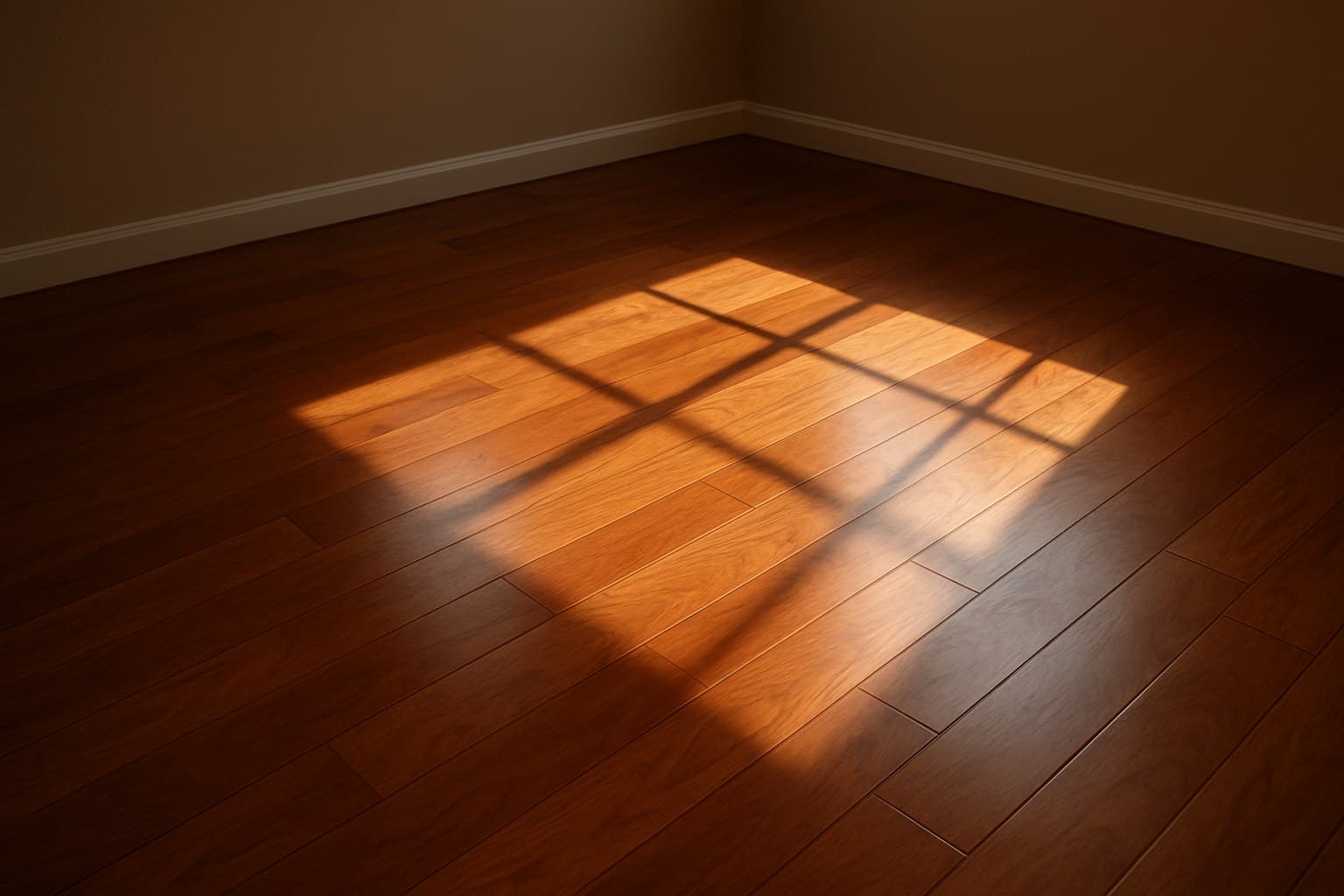
Cherry does not hold still. It warms from a pink-tan when new toward a deep red-brown as ultraviolet light hits it, and that change keeps going through the first year and beyond. Leave a rug or a couch parked in one spot and you get a pale patch when you finally move it. That square isn't a flaw. It's the one place the sun never reached.
Go: a room with fairly even light, or one where you will commit to rotating rugs through the first year. No-go: a bright room where the furniture never moves, unless you are fine with uneven tone forever.
My tip from real jobs: every couple of months in year one, spin the rugs and nudge the furniture a few feet. It lets the whole floor darken together instead of in blotches.
If you want to see how far this color shift can go, Brazilian cherry ambers far harder and faster than the American wood. That guide walks through taming the blotches on the extreme end.
Step 2: Match Cherry to Your Household (Kids, Pets, Dents)
Cherry is soft, and here is the number behind that word. The Janka scale measures how much force a wood takes before it dents. The NWFA's Homeowners Handbook to Real Wood Floors lists cherry in its domestic species hardness comparison as softer than red oak, hard maple, and hickory, and cross-referencing that ranking against published Janka hardness databases puts American cherry at roughly 950 lbf, the figure used throughout this article's table and chart below.
On the floor, that roughly 950 rating means dropped pans, chair legs, and dog claws leave marks more easily than they would on oak or maple. It isn't fragile, but it shows life. If dent resistance matters more than color depth, it's worth reading this guide to acacia flooring before you commit to a species.
Go: adults, older kids, and small or calm pets. No-go: large dogs, furniture that gets dragged, or a busy entry door. For those, step up to maple or hickory, which take a beating far better.
One more lever: a Character grade with more natural marks hides small dings, while a clean Select floor shows every scuff. More on that in Step 4.
| Species | Janka rating | On the floor |
|---|---|---|
| American cherry | ~950 | Dents easily, warm look, low-traffic rooms |
| Black walnut | ~1010 | Similar softness, darker, hides marks well |
| Red oak | ~1290 | Solid all-rounder, resists dents better |
| Hard maple | ~1450 | Hard and pale, good for busy rooms |
| Hickory | ~1820 | Toughest here, best for pets and traffic |
Source: Janka hardness ratings published by the USDA Forest Products Laboratory
Step 3: Test Your Subfloor, Then Choose Solid or Engineered
Before you talk material at all, two checks decide how long a cherry floor lasts: flatness and moisture. Run a long straightedge across the subfloor and look for gaps and humps. Then read the subfloor with a moisture meter, which is a small tool that tells you how wet the wood or concrete underneath is. If the meter reads high, you stop and fix that first. On most floating and nailed floors, the maker's own warranty depends directly on these two numbers, flatness and moisture, not on the plank you picked.
Now the moisture point people get wrong. Reddish heartwood cherry, the wood from the middle of the tree, resists rot better than the pale sapwood from the outer edge. That is real, but it does not make a finished floor waterproof. Seams and edges take on water and fail long before the plank face ever does, so cherry is not a wet-room wood no matter which part of the log it came from.
Go/no-go by location: solid cherry is fine on or above ground level over a wood subfloor. Over concrete, in a basement, or anywhere below ground level, solid cherry is a no-go. There, engineered cherry is the answer. Its plywood-style core is built from cross-layered plies that stay stable when a little moisture moves through the slab. The same solid-versus-engineered logic applies well beyond cherry, so it's worth reading this solid vs. engineered hardwood floors guide before you settle on a species for the whole house.
Refinishing capability is the other long-term difference between the two, and it compounds over decades. Solid cherry carries its wear layer through the board's full thickness, so it can typically be sanded down and refinished several times over its life, often somewhere in the four-to-six-refinish range before you're through the usable wood, which is how solid floors routinely outlast a single homeowner. Engineered cherry only has a thin veneer of real cherry over the plywood-style core, so it usually tolerates far fewer passes, often just one to three light sandings, and a thin-veneer product may not take a sanding at all before you hit the core and have to replace rather than refinish. That gap matters as much as the moisture question once you're planning past the first decade: solid cherry above grade can be sanded and refinished repeatedly as it dents and dings, while engineered cherry below grade buys you moisture stability at the cost of a shorter refinishing runway and, likely, a shorter total lifespan before replacement.
I learned the moisture rule the hard way on a job for Renee Castillo in Modesto. She talked me out of a moisture test to save an afternoon, and I let her. The floor cupped before the season was out, and I relaid it on my own dime rather than argue about whose call it was. That is the day I stopped treating the test as optional.
Step 4: Pick Grade and Cut for the Look You Want
Grade is just how much natural variation the boards carry, and it is defined by the official NWFA/NOFMA Unfinished Wood Flooring Grading Standard, jointly maintained by the National Wood Flooring Association (NWFA) and the National Oak Flooring Manufacturers Association (NOFMA). Select and Better is clean and uniform, with even color. #1 and #2 Common show more color swing and small knots. Character grade leans all the way into the natural marks. Want calm and uniform? Go Select and Better. Want warmth and value? #1 or #2 Common gives it. Want a floor that hides small dings? Character grade is your friend, since a scuff just reads as one more mark.
Cut matters too. Plain-sawn shows the wide, wavy grain most people picture when they imagine wood. Rift and quartered gives straighter, calmer lines and costs more because it wastes more of the log.
Width is the last call. Cherry runs from about 4 inches up past 12. Wider planks look great but move more with moisture, which raises the stakes on Step 3. Only lay wide boards over a subfloor you have flattened and moisture-checked.
American Cherry vs Brazilian Cherry: Not the Same Wood
These two get mixed up constantly, and they are not close. American cherry is the soft domestic wood at about 950 Janka. Brazilian cherry, also sold as jatoba, is a dense exotic that rates far higher and ambers much harder and faster. If you are weighing the exotic, read the Brazilian cherry guide for how to handle its color shift. If you want a softer domestic tone at a lower price, stay with American cherry.
Step 5: Price It Out by Grade, Materials vs Labor
There is no single national price for a cherry floor, so build your own from two parts: material by grade and labor. Here is the split I see on residential jobs.
| Grade or type | Material $/sq ft | Labor $/sq ft |
|---|---|---|
| #1 / #2 Common (solid) | $4-6 | $3-5 |
| Character (solid) | $5-7 | $3-5 |
| Select & Better (solid) | $7-10 | $4-6 |
| Engineered cherry | $5-11 | $3-6 |
Source: labor ranges I've quoted on residential cherry jobs
Typical residential cherry flooring cost split into material and installation labor, by grade.
The arithmetic is simple. Total cost equals (square footage times material cost) plus (square footage times labor cost) plus a prep line. Prep covers leveling, underlayment, and hauling out the old floor, and it usually runs about $1-2 per square foot.
Worked example, a 200 square foot living room in Select and Better at $8 material and $5 labor: that is $1,600 for material, $1,000 for install, and roughly $200-400 for prep. Call it about $2,800 to $3,000 all in for that room.
Two things push the number up. Stairs and basements cost more per foot than an open room, because stairs are slow, fiddly work and a basement needs the extra moisture care from Step 3. And engineered cherry adds cost over bare solid stock, though it is money well spent below grade.
On the oak question: cherry runs higher per foot than red oak, both in material and often in labor, because it is a softer wood that installers baby a little. If you are chasing a darker, richer premium look instead, compare the numbers against black walnut before you commit, since walnut hides marks better at a similar softness.
Sources
- NWFA/NOFMA Unfinished Wood Flooring Grading Standard (2018)
- NWFA/NOFMA Factory Finished Wood Flooring Grading Standard (2019 update)
- NWFA Homeowners Handbook to Real Wood Floors
- NWFA Solid Wood Flooring Environmental Product Declaration (EPD)
- NWFA Engineered Wood Flooring Environmental Product Declaration (EPD)