
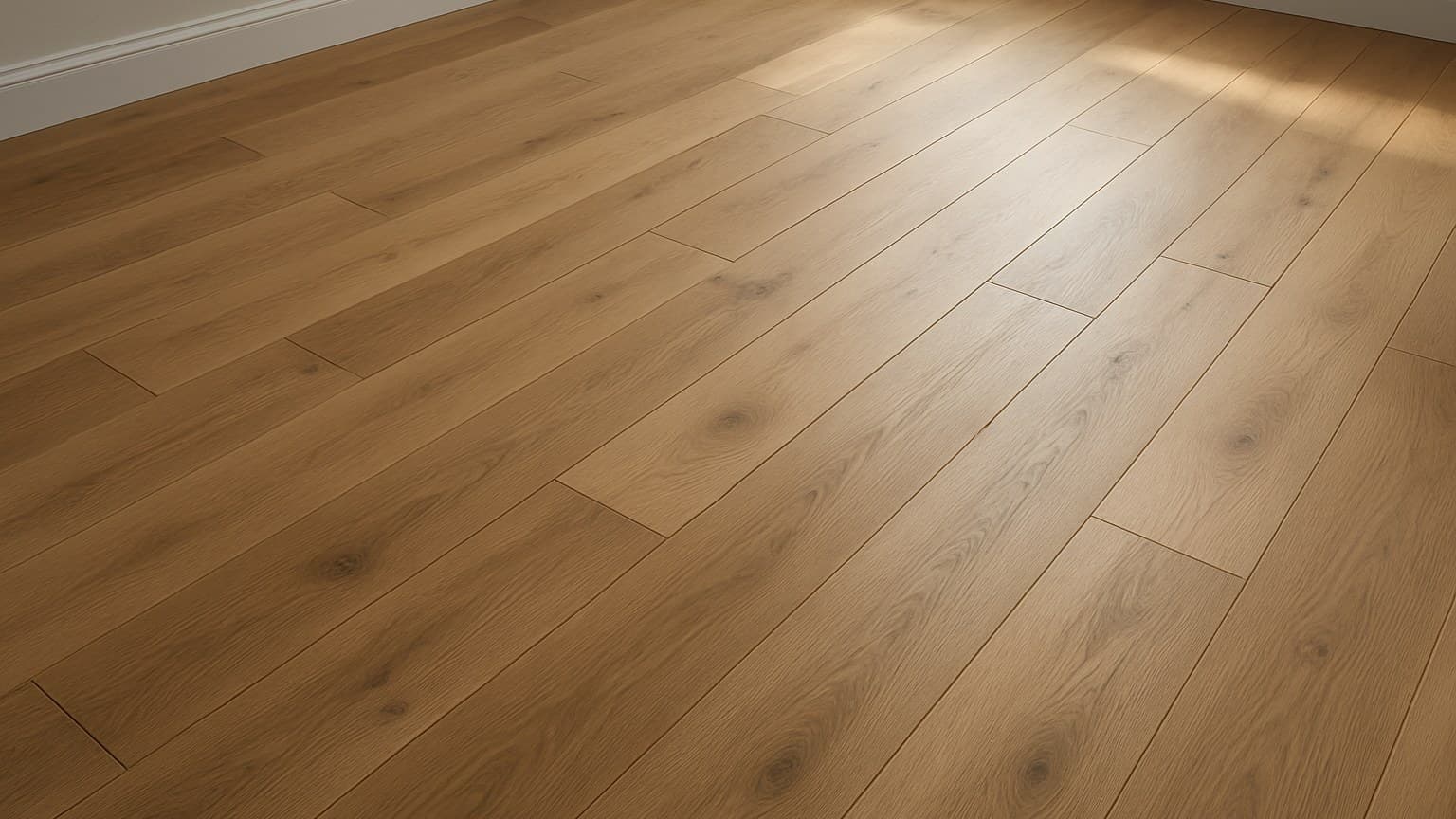
Walk into a flooring store and "engineered wood" means your floor; call a framer and the same phrase means the beam holding up that floor. Engineered wood is any product made by gluing real wood veneers, strands, or fibers back together under heat and pressure, so it holds its shape better than a solid board. Three different products share that one name, and mixing them up is how people buy the wrong thing.
Key takeaways
- Engineered wood is any product that bonds wood veneers, strands, or fibers with adhesive; the EPA's own rules define these products as resin-bound lumber, veneers, or strands.
- The same term covers three very different things: structural framing (LVL, LSL, OSB, I-joists), sheet goods and furniture (plywood, MDF, particleboard, HDF), and engineered hardwood flooring.
- Engineered hardwood flooring runs about $4.50-16 per sq ft in materials, lasts 25-40 years, and refinishes 0-2 times depending on veneer thickness; solid hardwood runs $5-28 and refinishes 4-6 times.
- Engineered hardwood is more dimensionally stable over concrete and below grade than solid wood, but 'stable' is not 'waterproof', and most water damage starts at the seams.
- Click-lock engineered floors are realistic for most DIYers; glue-down, stairs, and big open moisture transitions are worth hiring out.
What "Engineered Wood" Actually Means
Engineered wood is any product that takes real wood, breaks it into veneers, strands, or fibers, and glues it back together with adhesive to make it more stable, cheaper, or stronger than a solid board. Pine is one of the few common species that usually skips this reprocessing entirely and stays sold as plain solid board flooring, a distinction guide to solid pine flooring covers in more detail.
There's a definition for this nobody selling you flooring will cite. According to the EPA's AP-42 emissions guidance for the wood products industry and its related NESHAP (National Emission Standards for Hazardous Air Pollutants) survey documentation, these are resin-bound products made from lumber, veneers, or wood strands pressed for structural or finish use, wood that has been taken apart and reassembled with glue.
So it's still real wood, not plastic and not "fake." Most of any plank or board is wood fiber, with a small share of resin holding it together. The catch is that the phrase gets used for three completely different products, so the words alone tell you almost nothing until you ask which one the person in front of you means.
How It's Made (and Why the Glue Matters)
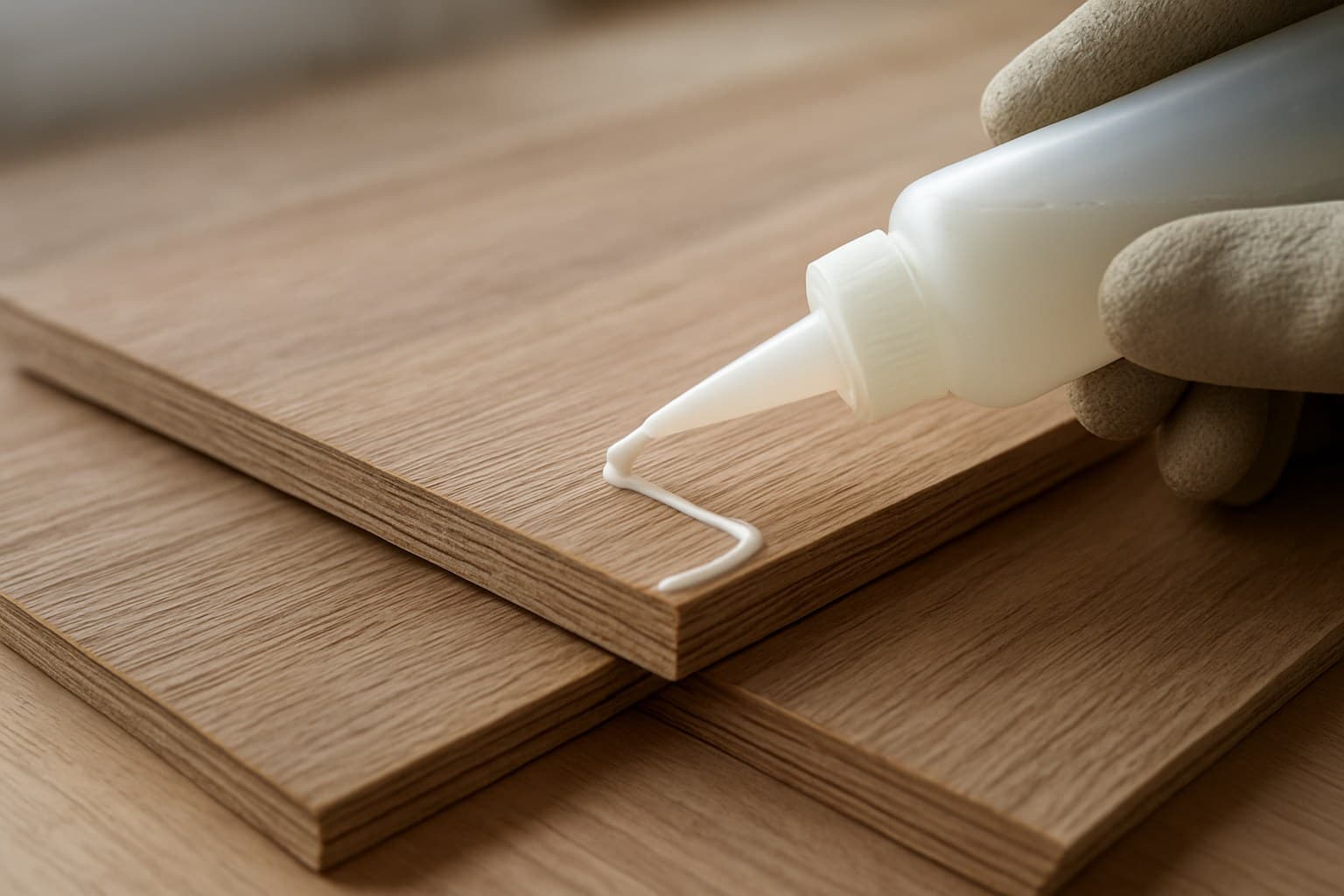
The process is simple to picture. Logs get peeled into thin sheets, shredded into long strands, or ground down into fine fiber. Those pieces are then layered with adhesive and pressed under heat and pressure into a beam, a panel, or a plank.
When you cross-lay the layers at right angles, each layer fights the one next to it. Solid wood swells and shrinks with the seasons, which is what makes it cup or open gaps. Cross-laying cancels most of that movement out. Wide plank solid pine floors feel this seasonal movement especially hard, since every extra inch of board width multiplies the cupping and gapping you're fighting against, a tradeoff our wide plank pine flooring guide covers in depth.
The wood-to-glue ratio is lopsided toward wood. Laminated strand lumber (LSL), one of the framing products, runs about 95% wood fiber and 5% resin, according to M.T. Copeland's engineered-wood product guide. That small share of adhesive is also where formaldehyde and VOC (volatile organic compound, the stuff that off-gasses) concerns come from, more on that below.
The Three Places You'll Meet Engineered Wood
The fastest way to decode the term is to split it by where you actually run into it. Each lane gets judged on a different thing.
Structural framing: LVL, LSL, OSB, I-joists
This is the stuff inside your walls and under your floor. Laminated veneer lumber (LVL), laminated strand lumber (LSL), parallel strand lumber (PSL), and I-joists carry load as beams, headers, and long floor spans. Oriented strand board (OSB) shows up as wall sheathing and subfloor. You judge these on strength and span, not on looks, because they get covered up.
Sheet goods and furniture: plywood, MDF, particleboard, HDF
This is the lane behind your cabinets, bed frames, and shelves. Plywood is cross-laid veneers; its faces are graded A through D plus X, and the knots allowed in the face grow from about 1 inch at the top grade to 2.5 inches as the grade drops, per M.T. Copeland. Medium-density fiberboard (MDF) and high-density fiberboard (HDF) are pressed fine fiber with a smooth, paintable face. Particleboard is the cheapest and the weakest, especially around moisture and screws.
The floor underfoot: engineered hardwood
This is the one most readers came here for. Engineered hardwood is a real hardwood veneer glued over a plywood or HDF core. It looks like a solid wood floor because the top is solid wood, just thinner. The National Wood Flooring Association (NWFA) draws that same line in its official definition of real wood flooring, which classes engineered hardwood as genuine wood flooring specifically because its wear layer is solid wood veneer, the distinction that separates it from laminate or vinyl look-alikes. For the full breakdown, see engineered hardwood flooring guide and how it compares to a plain solid wooden floor.
| Product | Lane | What it is | Judge it on |
|---|---|---|---|
| LVL / LSL / PSL | Structural framing | Veneers or strands glued into beams and headers; LSL ~95% wood, ~5% resin | Load and span; costs about 3x plain dimensional lumber |
| I-joists | Structural framing | An OSB or plywood web between two flange rails | Stiffness over long floor spans |
| OSB | Framing / subfloor | Compressed wood strands in a panel | Sheathing and subfloor strength, not appearance |
| Plywood | Furniture / sheet goods | Cross-laid veneers; faces graded A-D and X | Face grade; knots allowed grow from ~1 in to 2.5 in as grade drops |
| MDF / HDF | Furniture / flooring core | Fine wood fiber pressed with resin | Smooth paintable surface; swells if edges get wet |
| Particleboard | Budget furniture | Coarse wood particles and resin | Lowest cost; weakest with moisture and screws |
| Engineered hardwood | Flooring | Real hardwood veneer over a cross-ply core | Veneer thickness and moisture tolerance |
Source: M.T. Copeland's engineered-wood product guide
What each engineered-wood product is and what to judge it on, grouped by where you'll run into it.
Engineered Wood vs Solid Wood: Cost, Life, and Refinishing
Here's the verdict for the flooring lane: engineered wins on price and on staying flat over concrete, while solid wins on lifespan and on how many times you can sand it back to new. Neither is "better" in the abstract. The room decides. Our guide to picking solid vs. engineered hardwood and the right species walks through that room-by-room decision in more detail.
On cost, I'll split it the way it actually hits your bill. I've been installing and bidding hardwood floors around the Dayton area for more than a decade, so these ranges come from my own invoices, not a brochure. Engineered hardwood materials run about $4.50 to $16 per square foot. Solid runs $5 to $28, with prefinished solid landing around $6 to $12. On the jobs I do, install labor adds roughly $3 to $8 per square foot on top, so an all-in engineered floor usually lands somewhere between about $7.50 and $24 per square foot depending on the product and the room. These swing with your region and species, so treat them as a starting range and confirm with local quotes.
Basements and stairs cost more than an open room. Moisture prep on a slab, extra trim, and the slow cut-and-fit on a staircase all add hours that an open living room doesn't need.
For what it's worth, the NWFA's own Environmental Product Declaration for engineered wood flooring models a 75-year functional lifespan per square meter installed. That's a lifecycle-accounting assumption built for environmental impact math, not a warranty or a guarantee on any specific product, but it's a useful signal of how durable the category is treated when it's installed and maintained well.
| Factor | Engineered hardwood | Solid hardwood |
|---|---|---|
| Materials cost | $4.50-16 / sq ft | $5-28 / sq ft ($6-12 prefinished) |
| Typical lifespan | 25-40 years | Up to 100 years |
| Refinishes | 0-2 (Robbins' engineered line runs ~4 mm veneer; under 2 mm, none) | 4-6 (per Robbins' solid oak line) |
| Over concrete / below grade | More stable; usually fine | Generally not recommended |
Source: Robbins Flooring's solid-versus-engineered comparison
Engineered hardwood versus solid hardwood on cost, lifespan, and refinishing, grouped by what matters most when you're picking between them.
What you can refinish comes down to the veneer on top. Robbins Flooring's engineered hardwood line runs about a 4 mm veneer, and that's enough for one or two light sandings; under 2 mm on a cheaper SKU, I tell people not to sand it at all, you'll go straight through to the core. Robbins' solid oak line can usually be sanded 4 to 6 times over its life.
On DIY versus hiring: click-lock engineered flooring is realistic for most handy homeowners over a flat, dry subfloor, I've walked plenty of first-time DIYers through it on jobsites around the Dayton area. Glue-down, stairs, and big open-plan floors crossing a moisture transition are where I'd hire out, because a mistake there is expensive to undo; I've been the one called in to rip out and redo a glue-down floor a homeowner started solo over a basement slab that hadn't fully cured. If you're also weighing vinyl, LVP vs hardwood comparison runs the same cost-and-moisture math side by side.
Stable Is Not Waterproof, and the Glue Tradeoff
A common mistake is treating "dimensionally stable" as "waterproof." They're not the same. A cross-ply engineered core resists seasonal swelling far better than solid wood, but the top is still real wood, and water doesn't care how stable the core is.
That same stability is also why radiant floor heating is usually a question for engineered hardwood, not solid. Cross-laying the layers fights the warping that happens when the underside of a board runs warmer than the top, which is exactly what a radiant system does day after day, so engineered holds flat where a solid board tends to cup and gap. It's still worth checking the manufacturer's spec sheet for a radiant-heat rating before you buy, since not every core and adhesive is rated to run warm, and it's smart to have the heating system cycle through its full range before installation so the subfloor and planks acclimate first.
Most water damage starts at the seams and edges, not in the middle of a plank. Water creeps into the joints between boards, the veneer swells and lifts, and the edges show it first. A stable core buys you time against humidity swings; it doesn't let you flood the room.
The glue carries the other tradeoff. The resin that makes these products possible is also what off-gasses formaldehyde. If that matters to you, look for products certified to low-emission standards, CARB Phase 2 (California's formaldehyde emission limit for wood panels) and TSCA Title VI (the federal version of that same limit, enforced by the EPA), printed right on the box, and if anyone in the home has a sensitivity, check with a professional before you buy. For a species that reads warmer and shows fewer seams, white oak flooring guide is the useful next read, since white oak's tight grain is one of the better engineered veneers for hiding exactly these joints.
Sources
- EPA AP-42: Wood Products Industry Emission Factors
- EPA NESHAP Information Collection Request Survey Instructions for the Wood Products Industry
- NWFA's Official Definition of Real Wood Flooring
- NWFA Engineered Wood Flooring Environmental Product Declaration (2023)
- NWFA Engineered Wood Flooring Environmental Product Declaration (2025)