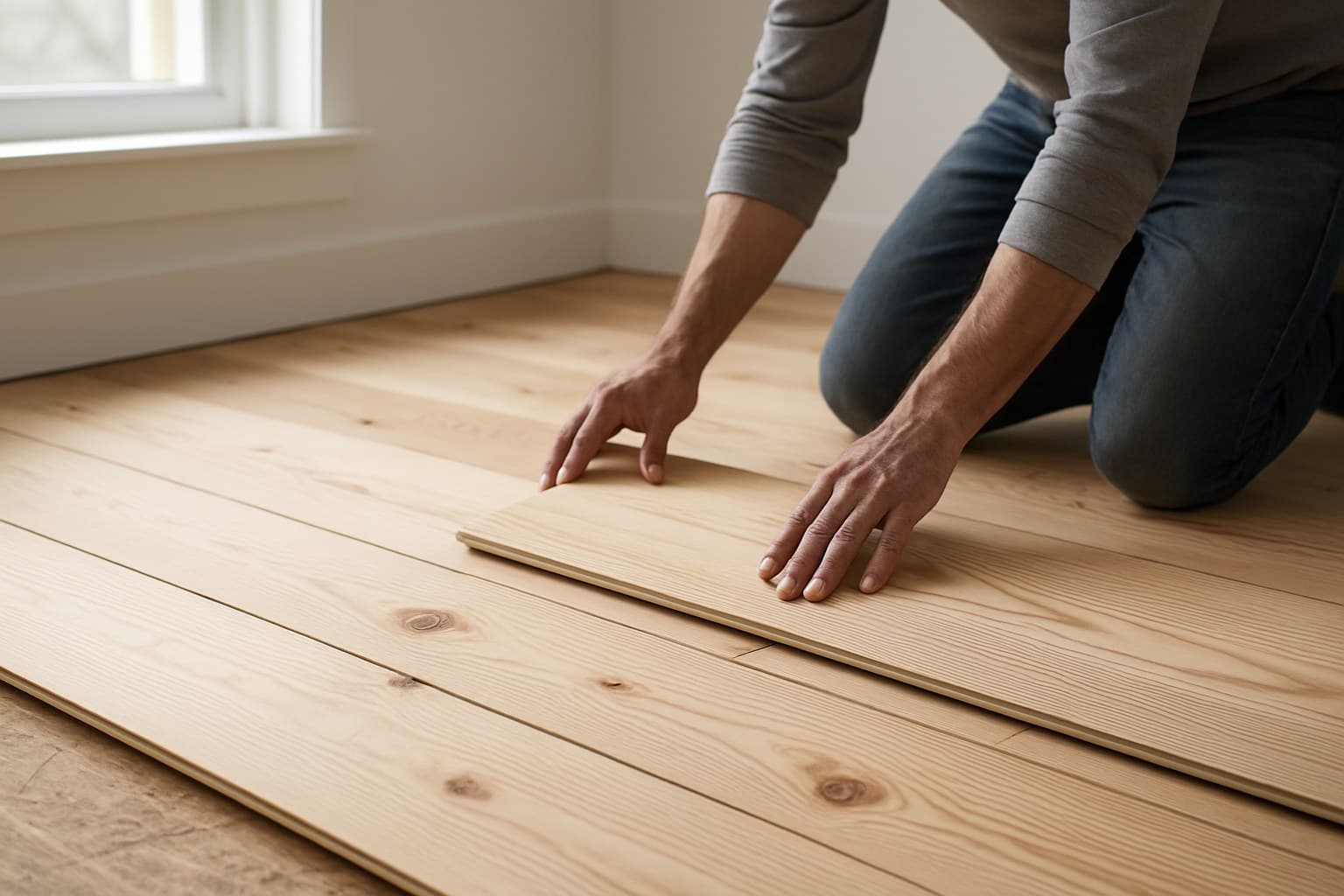
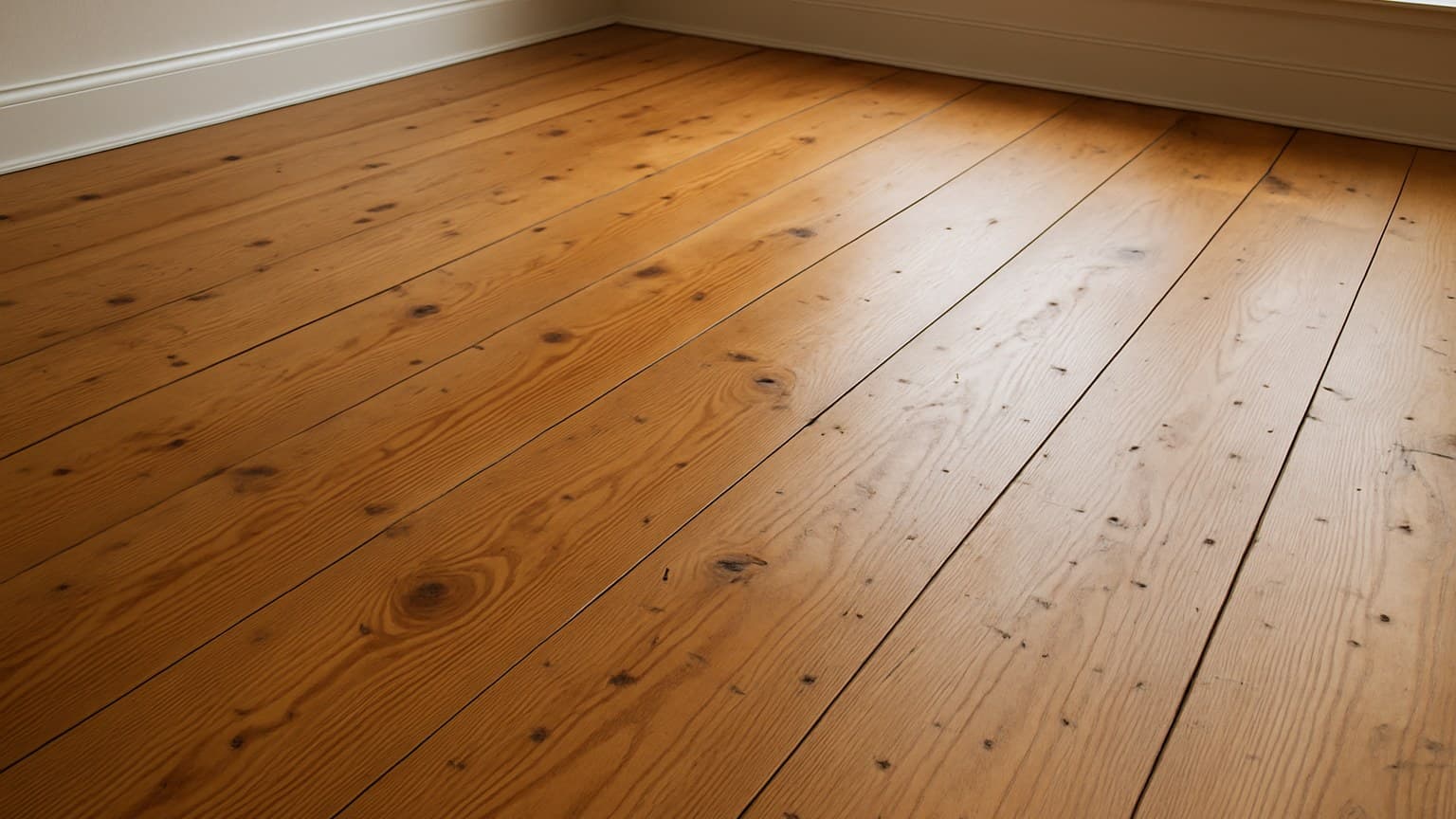
Here's where wide plank pine flooring trips people up: the same softness that gives you that mellow, aged farmhouse floor is the softness that dents the first time you drop a can. Sold as a flaw, it's actually the look you're paying for. Sort out which side of that line your house is on before you spend a dime.
Key takeaways
- Eastern White Pine rates about 380 on the Janka hardness scale versus red oak's 1290, so it will dent. That's physics, not a defect.
- Heart Pine (antique longleaf) is far harder than soft white pine, often cited near 1225, close to oak, if you want pine's look with more toughness.
- Wide plank pine runs roughly $1/sq ft as raw lumber, $10-14/sq ft custom-milled unfinished, and about $4.79-5.19/sq ft for big-box prefinished, before labor.
- Boards 8 inches and wider move more with the seasons, so kiln-dried stock (6-8% moisture), proper acclimation, and a nail-plus-glue install matter far more than with 3-inch strips.
- Over a concrete slab or in a humid climate, engineered wide plank pine stays flatter than solid.
Wide Plank Pine: The Honest Verdict Before You Fall for the Photos
Pine is a soft wood that will dent, so it belongs in character-first homes and lower-traffic rooms. It's the wrong call for anyone who needs a floor that stays flawless. That's the whole verdict in one line. If that verdict steers you toward a vinyl look-alike instead, the LVP colors trending in 2026 breaks down which shades installers are actually seeing spec'd this year.
Who it suits: owners who actually like a floor that shows its age, bedrooms and studies, and period or farmhouse homes where a little wear looks right at home. The dings and the warm honey glow people call "pumpkin pine" aren't the floor failing. They're the reason you picked it. If you're weighing wood underfoot in a bedroom against resale considerations, our look at whether hardwood in bedrooms boosts home value is worth reading before you commit.
Who should skip it: households with big dogs whose nails tap across the boards, folks who track in high heels, and anyone with zero patience for the odd dent or a floor that needs recoating down the road. If you want a floor to look showroom-new in five years, pine will make you miserable. For that same crowd, a well-chosen pine-look vinyl plank can deliver the wide-board character without the dent risk, and our guide on how to choose pine vinyl plank flooring walks through picking one that doesn't look fake or wear out fast.
Here's the useful reframe. If you love the wide-board pine look but the softness scares you, you don't have to give up the look. You step up to Heart Pine, which is far harder than the soft Eastern White most people picture. More on that below, because the word "pine" hides three very different floors.
What "Soft" Really Means: Pine vs Oak on the Hardness Scale
Softness in flooring gets measured by the Janka test, which is just how much force it takes to press a small steel ball halfway into the wood. Higher number, harder floor, harder to dent. That's all it is.
Eastern White Pine lands around 380. Red oak, the wood most floors get compared to, sits at 1290. Soft white pine takes roughly a third the force of oak to leave a mark. That gap is real, and pretending otherwise sets you up for a bad surprise. If you're eyeing an even harder species like maple instead, our maple vinyl plank flooring guide walks through what to check before you buy it as a wood alternative.
But look at where the pines actually spread out. Longleaf Yellow Pine comes in near 870, and antique Heart Pine is often cited around 1225, right on oak's heels. Same family, wildly different toughness. These figures are the standard baseline ratings published in the Wood Database's Janka hardness rankings, the most commonly cited reference for comparing wood species by hardness, though any single board can test a little higher or lower depending on moisture content and where the tree grew. Brazilian cherry sits well above any of these pines on that same scale, and its deep color brings its own headache since it's notorious for shifting tone under UV light, which is exactly what our guide on keeping Brazilian cherry vinyl plank from fading gray walks through if you're weighing that look instead.
| Wood | Janka rating |
|---|---|
| Eastern White Pine | 380 |
| Longleaf Yellow Pine | 870 |
| Heart Pine (antique) | 1225 |
| Red Oak | 1290 |
| Hickory | 1820 |
| Brazilian Cherry | 2350 |
Janka hardness ratings for common pine species compared to red oak, hickory, and Brazilian cherry.
So yes, soft pine dents easier than oak. That's a look decision, not a floor that comes apart. But if softness is a flat no for your house, don't force it. A wood-look surface that shrugs off nails and heels, like the kind covered in our guide to hickory vinyl plank flooring, gives you the grain without the dent worry. If you want the real thing instead of a look-alike, our wide plank hickory flooring cost and grades guide covers a solid wood that's far tougher than pine while still coming in those big, dramatic board widths. Or go the other direction into a truly dense species like Brazilian cherry, which sits at the top of that chart.
Which Pine Are You Actually Buying? Eastern White vs Heart Pine vs Yellow Pine
"Pine" on a price tag can mean three very different floors, and the difference decides both how it wears and what you pay. Get the species straight before you compare quotes, or you'll be comparing a soft board to a hard one and wondering why the numbers don't line up.
Eastern White Pine is the softest and cheapest. It's the classic wide-board look of colonial New England, it's widely stocked, and it dents the easiest of the bunch. This is the floor most people mean when they picture wide plank pine.
Heart Pine, usually longleaf yellow pine, is the dense, historic Southern floor. It's much harder, it costs more, and a lot of it is sold reclaimed, sawn out of old beams and factory timbers. This is the pine to reach for when you want the look with more toughness under it. If dark, rich tones matter more to you than squeezing out extra hardness, our guide to buying wide plank walnut flooring walks through what to check before you commit to that species instead.
Shortleaf Yellow Pine and Ponderosa fall in the middle and show up depending on your region and which mill you're buying from. They're a reasonable compromise on both price and hardness.
The pattern worth remembering: hardness and price both climb as you move from white pine toward heart pine. Pick your species by how much abuse the room takes.
Knotty or Clear? Grades and the Look They Give You
Grade in pine is mostly about knots and color streaks, not strength you'd ever feel underfoot. It sets the look and the price, nothing more.
Knotty grades, often sold under a name like "Original," are loaded with knots for a rustic, aged feel. They cost the least because the mill can use more of each log. If you want that lived-in, been-here-200-years look, this is it.
Clear grades, often sold as something like "Heirloom," pull most of the knots out for a calmer, more refined floor. They cost more because more of the log gets rejected to get those clean boards.
One installer's warning on the knotty stuff: knots are character, but they're also the spots most likely to loosen or check (that's a small split that opens as the wood dries) over time. A very knotty board wants a careful finish and the occasional filled knot to keep it from popping later. If you're buying raw boards and finishing them yourself, our walkthrough on sanding and finishing unfinished hardwood on site covers the same steps that keep a knotty pine floor tight.
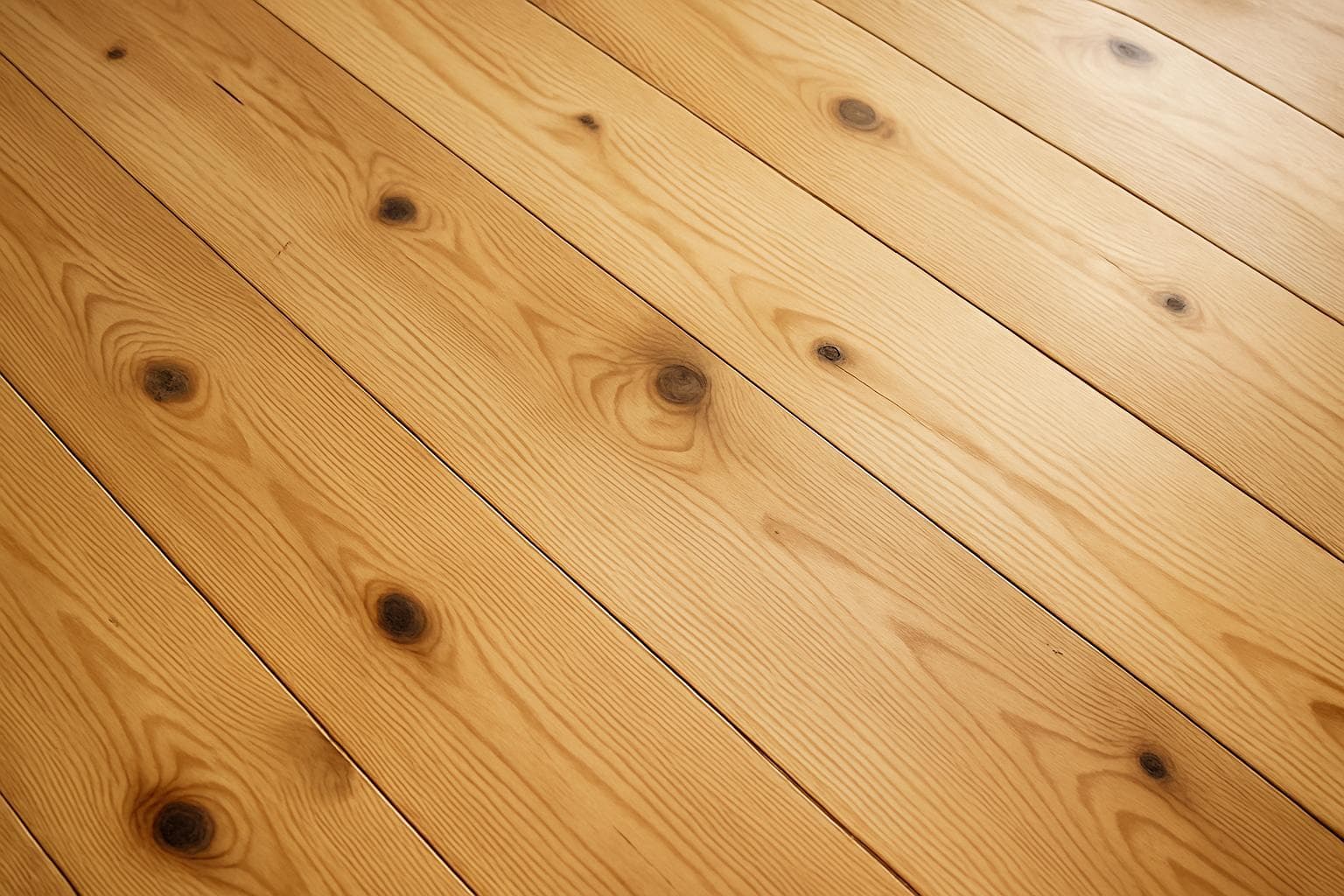
How Wide Can You Really Go? 5-Inch to 20-Inch (and the 36-Inch Myth)
Modern pine stock usually runs in a few width tiers. You'll find boards around 5 1/8 inches, then jumps to 7, 9, and 11 inches, plus random-width runs that mix roughly 7 to 11 inches, or 11 to 20 inches for a truly historic feel.
About those 20 to 36 inch antique boards you read about: they're mostly reclaimed lumber or romanticized history, not something you order off a modern shelf. Plan around 20 inches as your real practical ceiling, and for the deeper reasoning on why boards past that point start fighting you, our guide on how wide plank flooring can get before it cups walks through the cupping math in detail. You won't be disappointed sticking to that range.
The narrower you go, the more stable and the more modern it reads. The wider you go, the more authentic and old-world it looks. Here's how the tiers stack up:
- Around 5 1/8 inch: the narrowest, the most stable, the least "historic."
- 7, 9, and 11 inch: the sweet spot most mills actually keep in stock.
- Random 11 to 20 inch: the authentic wide look, and the boards that move the most with the seasons.
- 20 to 36 inch: reclaimed and romantic, not something in modern production.
Random-width layouts mix board sizes for that old, hand-laid feel. Single-width is tidier and reads more contemporary. Most stock comes 3/4 inch thick with tongue-and-groove edges (the boards lock together with a tongue on one side slotting into a groove on the next).
Here's the catch that the next two sections deal with: wider boards look more authentic, but a wide board also moves a lot more across its face as humidity changes. That's exactly why the install method has to change as the boards get wider.
What Wide Plank Pine Costs: Decoding the $1 to $14 Spread
The price gap on pine looks steep until you realize you're paying for how much work is already done for you. Raw lumber runs about $1 per square foot. Custom-milled unfinished pine lands around $10 to $14. Big-box prefinished sits near $4.79 to $5.19. Same wood, different amount of labor baked in. If you want to see these per-square-foot figures turned into an actual project total, our line-by-line cost breakdown for a 12x12 room walks through the math.
What drives that spread: kiln-drying the boards, milling the tongue-and-groove edges, grade (fewer knots costs more), width and random-width layouts, and factory finish. Adding prefinishing on a custom mill runs roughly another $6 per square foot, which is how you get from the $10 to $14 unfinished number up into the high teens.
| Cost tier | Materials, $/sq ft |
|---|---|
| DIY raw lumber | ~1.00 |
| Big-box prefinished | 4.79 - 5.19 |
| Custom-milled unfinished | 10 - 14 |
| Custom-milled prefinished | 16 - 20 |
Materials only, based on typical pricing for raw lumber, custom-milled, and big-box pine flooring. Labor not included.
The big-box end of that range tracks the prefinished pine stock listed by retailers like The Home Depot and Lowe's, while the custom-milled figures reflect list pricing from specialty wide-plank sawmills such as Carlisle Wide Plank Floors and Hull Forest Products, the kind of suppliers most custom pine jobs actually source from. Shop around and you'll see those numbers shift a little by region and current lumber costs, but they're a real starting point, not a guess.
Material cost per square foot for wide plank pine across four common buying tiers.
Every number above is material only. Installation labor runs separately, and it can easily rival or beat the cost of the wood itself once you factor in nail-down work. That cost climbs further for a basement, a staircase, or a room chopped up with closets and doorways, because those spots are where the cutting and fitting hours pile up, not the open floor. I stopped quoting pine by a flat square-foot rate after a job full of closets, a stair landing, and a bay window ate a whole extra day. The open middle of a room is never where the hours go. Closets, doorways, and stairs are. Basements and staircases cost more than an open bedroom, so get a firm labor quote for your specific layout rather than assuming a flat rate.
To see where these pine numbers land against oak, maple, and the rest, our breakdown of what hardwood costs per square foot installed puts them in context.
Solid vs Engineered Wide Plank Pine: Which Survives Your Climate
Solid pine moves the most with the seasons and belongs above grade in a home with steady indoor humidity, where the floor has room to expand and shrink. Engineered pine puts a real pine wear layer over a stable plywood-style core, so it stays flatter over concrete, in basements, and in climates that swing wet to dry. That's the short version. If a basement or bath rules out both options entirely, it's worth knowing that even a fully waterproof choice can disappoint here, since walnut vinyl plank flooring can look dirty again within an hour of mopping, so the maintenance trade-off doesn't vanish just because the wood does.
Width makes this choice matter more, not less. A 12-inch solid board moves far more across its face than a 3-inch strip, so a wide solid floor can cup or gap noticeably if the conditions aren't right. Engineered earns its keep hardest at the widest sizes, precisely because the core holds the board flat while the pine surface gives you the look.
Refinishing life is the other half of that durability picture, and it's worth weighing against the stability question above. Solid pine typically runs 3/4 inch thick, and per National Wood Flooring Association (NWFA) sand-and-finish guidance, a board that thick can generally handle around 4 to 6 refinishings over its life, each one buying another decade or so before the next recoat. Engineered pine's wear layer is only a thin slice of that same board, so most engineered pine floors tolerate just 1 to 2 light refinishes, and some thin-veneer products can't be sanded at all without cutting through to the core. That's the trade-off in plain terms: engineered survives concrete and humid climates better, but solid outlasts it in total refinish cycles wherever the subfloor and humidity actually allow solid to be installed.
The rule I hold to: over a concrete slab or below grade, engineered is the safer floor. I've steered plenty of people off solid down there after the moisture meter came back higher than the slab felt to the hand. This isn't a pine quirk. It's true of most wood, and the full reasoning lives in our cornerstone guide on choosing solid vs. engineered hardwood by room.
If your pine is going in a first-floor bedroom or study over a wood subfloor, in a house you keep at a stable humidity, solid wide plank is a fine and traditional choice. If it's headed for a basement, a slab, or a humid coastal climate, wide engineered pine is the version that stays flat. For a bathroom or basement where even engineered wood is pushing your luck, dark walnut vinyl plank gets you that same deep, moody color with none of the moisture risk, provided you know how to choose dark walnut vinyl plank that resists scratching, fading, and the cheap look.
Installing Wide Plank Pine: The Prep That Decides Everything
Before a single board goes down, two checks decide whether your floor lasts: how flat the subfloor is and how much moisture is in it. Skip either one on wide boards and you're not looking at a callback, you're looking at a floor that cups or gaps by the next humid season.
Flatness first. Wide planks are less forgiving than narrow strips because a long, wide board bridges a low spot instead of following it, and that gap under the board turns into movement and squeaks. Run a long straightedge across the subfloor in several directions and mark anything that rocks or shows daylight underneath, then fill the lows or sand the highs until it sits tight. A slab that reads flat to your hand can still fail a straightedge, and finding that out after the floor is down is the worst day on the job.
Moisture second. Test the subfloor with a meter, and over concrete test the slab, not just the surface. I once let a customer talk me out of a moisture test to save an afternoon, and that floor cupped before the season was out. I relaid it on my own dime. That's the day the test stopped being optional for me.
A few install rules that matter more on wide pine than on 3-inch strips:
- Kiln-dried stock and acclimation. Wide boards want lumber dried to a low moisture content, commonly 6 to 8 percent, though the exact target and whether you acclimate at all comes off the manufacturer's own sheet, not a rule of thumb. Let the boards adjust to the room's conditions before laying if the maker calls for it.
- Nail plus glue. Wide solid boards hold flatter with both fasteners and adhesive than with nails alone, because the glue fights the cupping that a wide board wants to do. Follow the milling supplier's spec.
- Expansion gap. Leave a gap around the whole perimeter so the floor can move without buckling. The exact size is set by the product's instructions, so look it up rather than guessing.
Honest DIY-versus-hire call: click-together floors are realistic for most handy homeowners, but most wide plank pine is nail-down or glue-down solid, and that's a different animal. Between the flatness prep, the fastening pattern, and the way wide boards punish a mistake, this is a floor I'd hire out unless you've laid nail-down wood before. Stairs and any spot where a slab meets a wood subfloor are where paying a pro clearly pays off.