
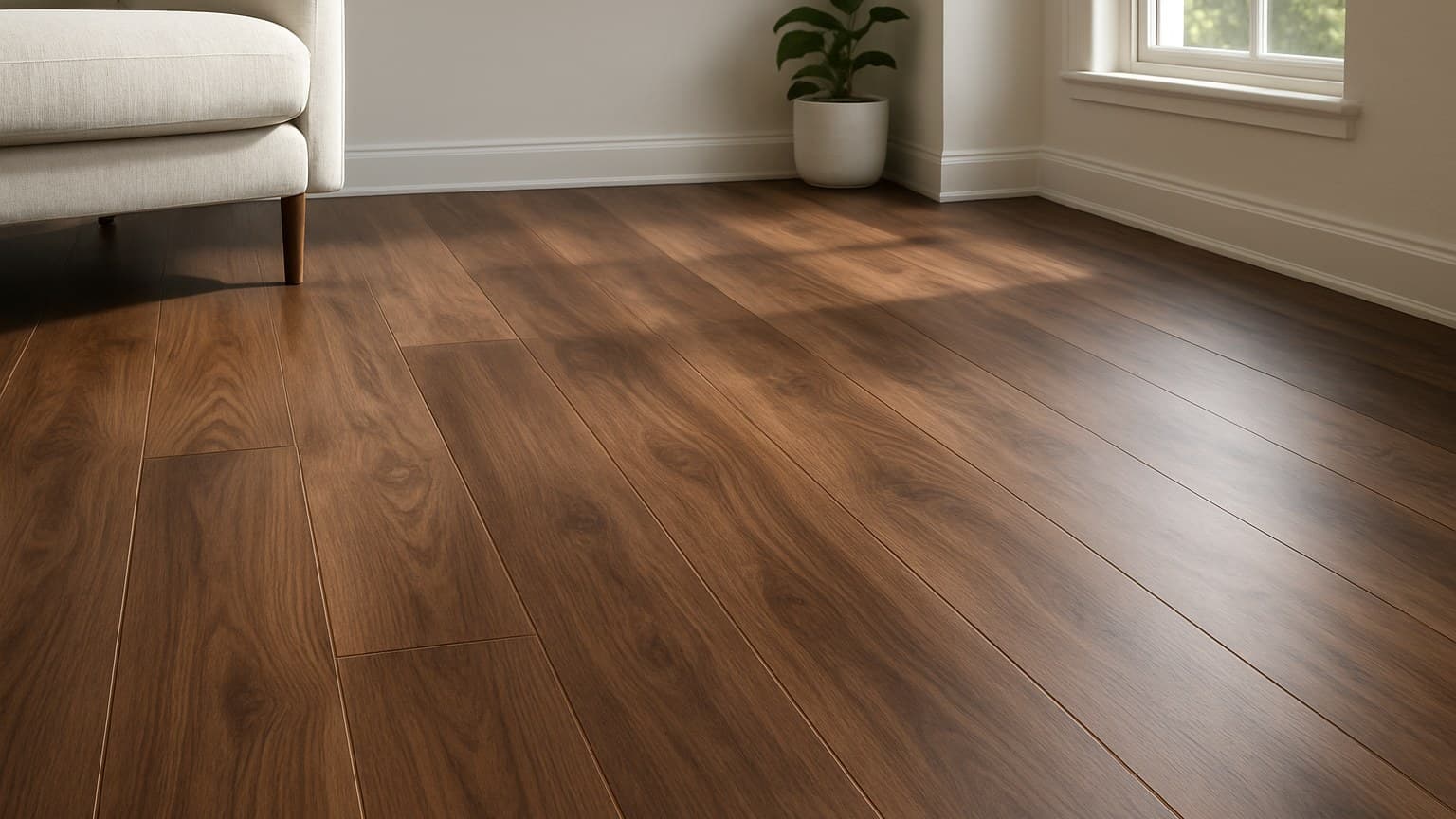
When a homeowner outside Columbus called me three weeks after I installed her dark walnut LVP (luxury vinyl plank) floor, she was mopping every morning and it still looked dusty by noon. The culprit wasn't her mop, it was a choice made back at the store: a glossy finish that catches light and flares up dust on a dark plank. Swap to matte, match the shade to the room's light, and the grubby look stops for good.
Key takeaways
- Dark walnut LVP shows every speck of dust, hair, and scuff. A low-gloss matte finish hides all three far better than gloss or high-shine hand-scraped planks.
- Match the shade to the room's light: dark walnut needs a bright room, and in low light it reads muddy and shows lint all day.
- Most walnut LVP has a waterproof core, but the click seams and beveled edges are only water-resistant, and that groove is exactly where dust and grit collect.
- Budget materials at about $2-7 per sq ft and pro labor at about $2-5 per sq ft; stairs and basements run higher than open rooms.
- Click-lock walnut LVP is a realistic DIY over a flat, dry subfloor; glue-down, stairs, and big moisture transitions are worth hiring out.
Why Your Dark Walnut Floor Looks Dirty an Hour After You Clean It
A homeowner outside Columbus called me back three weeks after I finished her dark walnut LVP. She was mopping every morning and the floor still looked filthy by noon. I got down on my knees, ran a clean white cloth across it, and the cloth came up spotless. The floor was clean. It just didn't look it.
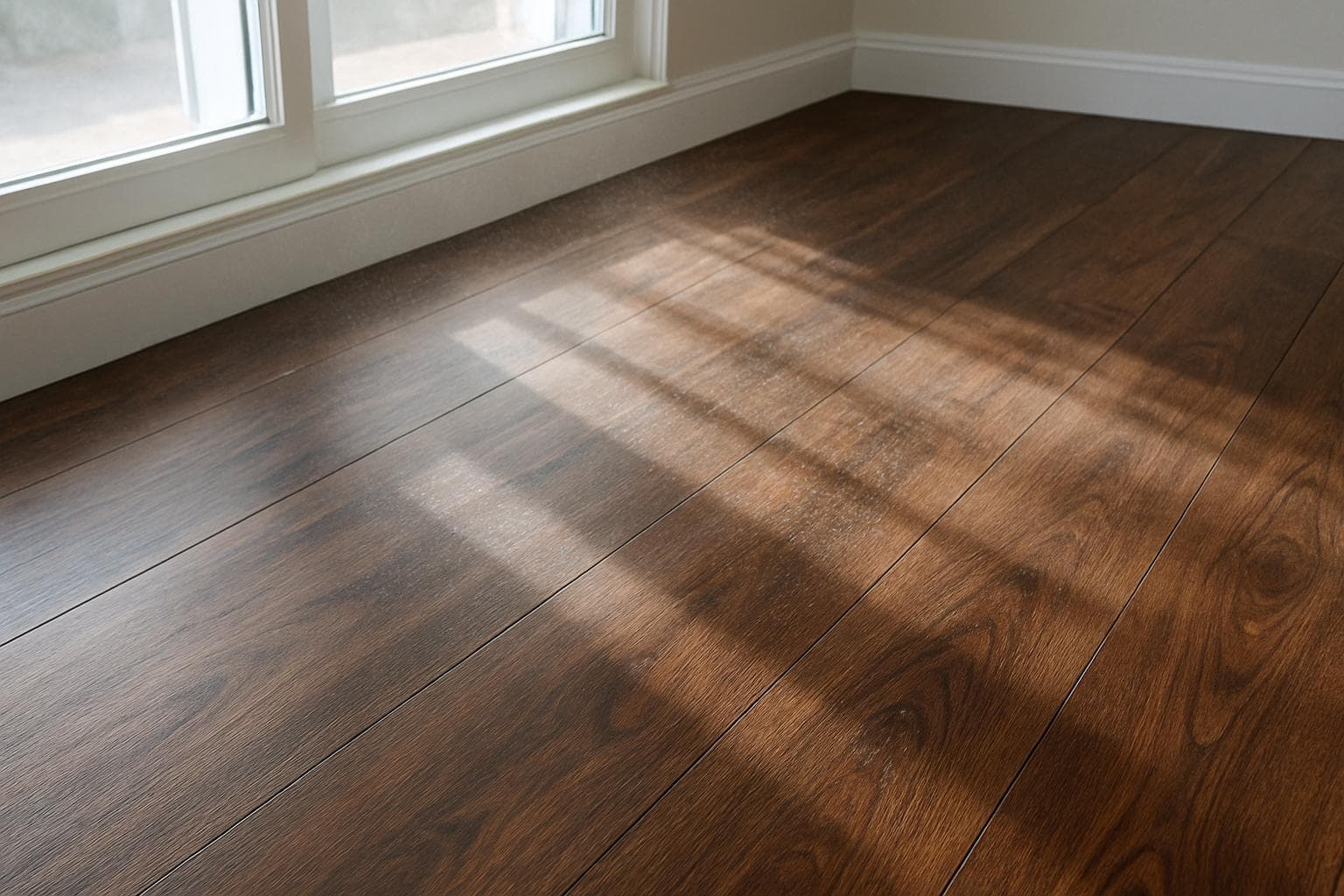
Here's the direct answer: deep walnut tones show off every speck of dust, strand of pet hair, and scuff mark. Pair that color with a glossy finish and the problem doubles, because gloss catches light and makes each speck stand out under it.
That's not a defect and it's not a cleaning problem. It's the shade plus the finish doing exactly what any dark, shiny surface does. Think of black dress pants that show every bit of lint, or a dark granite counter under bright kitchen lights. The floor wasn't dirty. It was a dark, glossy surface putting every speck of dust on display in the window light.
The fix isn't a better mop. It comes down to a handful of choices: the finish sheen, matching the shade to your room's light, how the seams behave, what it costs, how it installs, and how you keep it up. Get those right and you live with the floor happily. Get them wrong and you resent it.
Matte vs Gloss: The Finish Decides Whether You Live With It or Hate It
On dark walnut, a low-gloss matte finish hides dust, hair, and fine scratches better than gloss or high-shine. Pick matte unless your room is genuinely dim and you want the extra light bounce.
The reason is simple. Gloss reflects light, so every dust bunny and scuff catches a highlight and jumps out at you. Matte scatters light instead. It blurs those same specks so they stop reading as dirt from across the room.
Texture matters too. Heavy hand-scraped or deeply embossed planks look great in a showroom, but the grooves grab dust and hold it. On a dark plank that works against you. A light surface texture with a matte sheen is the easiest combination to keep looking clean.
I've tested this side by side more than once. On that Columbus job, I set a Lifeproof matte-finish walnut plank next to a higher-sheen walnut plank from a different retailer's house brand, both close to the same dark tone, and photographed them under the same afternoon window light after three days with no cleaning in between. In the photo, the matte sample barely showed anything; the glossier one already had visible dust flecks catching the light along the plank edges. That's the comparison I still bring up whenever a customer is torn between finishes.
One caution: sheen is a per-product number, not an industry standard. One brand's "matte" is another brand's "low gloss." Don't trust the label alone. Bring a sample home and set it on the floor in the room's real daylight, morning and evening, before you commit.
Light, Medium, or Dark Walnut? Match the Shade to Your Room's Light
Dark walnut needs a genuinely bright room. In low or north light it goes muddy, and every piece of lint shows all day. A light or medium walnut shade stays forgiving in dimmer rooms. If you're weighing walnut against what's actually trending for 2026, the most popular floor color right now breaks down which tones are winning and why.
How room light changes the tone
South-facing rooms and bright, open living spaces can carry a dark walnut and make it look rich instead of murky. North-facing rooms, basements, and interior hallways get far less direct light, and dark planks there read flat and always look slightly dirty. In those spaces a medium walnut is the safer call, and a light walnut is safest of all. When you're weighing those trade-offs, it helps to see which shades hold up long-term across the floor colors that never go out of style.
Pairing walnut with cabinets and trim
Walnut runs warm. Set a warm walnut next to cool gray cabinets or bright white trim and the two can fight each other. Hold the actual sample against your real cabinets and baseboards, not a catalog photo. The undertone is what makes or breaks the room, and you can only judge it in place.
| Shade | Best light | Dust shows | Notes |
|---|---|---|---|
| Light walnut | Any, including north-facing and basements | Low | Forgiving, reads casual and open |
| Medium walnut | Mixed daylight, hallways, most living rooms | Moderate | All-rounder for real homes |
| Dark walnut | Bright, south-facing, well-lit rooms only | High | Dramatic, but demands a matte finish and frequent upkeep |
Source: what I've watched these tones do in north-facing versus south-facing rooms I've fitted
How each walnut shade behaves against room lighting and how much dust it tends to show.
If you have your heart set on the darkest end, read the dark walnut vinyl plank guide before you buy, since it digs into scratch and fade behavior on those deep tones. For the opposite end, the comparison of blonde maple vs blonde oak vinyl plank walks through the lightest, most forgiving looks.
Where Walnut LVP Fails First: The Plank Seams, Not the Surface
Some walnut LVP, like Lifeproof's rigid-core planks sold at Home Depot, comes with a waterproof core. But even on those, the core isn't the weak point. The click seams and beveled edges between planks are only water-resistant, and that's where water, dust, and grit actually get in.
Keep those two claims separate in your head. A waterproof SPC or WPC core (that stands for stone plastic composite or wood plastic composite, the rigid material in the plank body) means the plank itself won't swell if it gets wet. It doesn't mean the floor is sealed. Let water sit on a seam long enough and it can creep down through the joint and reach the subfloor underneath, where you can't see it.
On a dark floor the beveled edge does double duty as a dust trap. That little V-groove between planks collects fine grit, so the seams read as dark lines that look dirty even right after you mop. It's the same reason dark grout in tile always looks like it needs scrubbing.
Plank width plays into this more than most buyers realize. A narrow 5-inch plank needs more rows and more seams to cover the same room than a 7- or 9-inch plank does, so a narrower walnut floor simply has more of those dust-trapping bevels per square foot. If you're already fighting a dark, glossy tone, going with a wider plank is one of the few choices that works in your favor: fewer seams means fewer grooves for dust and water to collect in the first place.
For the full picture of how the wear layer, the core, and the seams work together to decide whether a floor lasts several years or a couple of decades, read the main vinyl flooring buyer's guide. That's the piece that ties all three together.
Walnut LVP vs Real Walnut Hardwood vs Other Wood-Look Vinyl
Bottom line: walnut LVP gives you the dark look for a fraction of hardwood's price and won't fade in sunlight the way real walnut does. The trade-off is you can't refinish it, and it won't add resale value the way solid wood can. If you're weighing whether dark walnut still fits current buyer tastes or if another look is gaining ground faster, it's worth checking the most trending flooring styles before you commit to a shade for the long haul.
Real walnut hardwood is a comparatively soft hardwood. It tends to dent more easily than oak, maple, or hickory, so a dropped pan or a chair leg can leave a mark. And dark wood species shift color under sunlight over the years. I warn every hardwood customer about this. I once pulled an area rug off a dark hardwood floor to find a bright patch underneath that no refinishing could fully even out. LVP's printed layer holds its color better in a sunny room. If real wood still appeals to you despite those trade-offs, it helps to work through choosing solid versus engineered hardwood before you settle on a species for the room.
If you want a wood look that hides dust and wear more easily, oak- and hickory-look vinyl beat dark walnut on that one job. Their tones are lighter and their grain is busier, so specks and scuffs disappear into the pattern instead of standing out. If that hickory look appeals to you, it's worth checking how convincingly hickory vinyl plank flooring mimics the real wood grain before you commit to it for the whole room.
| Option | Refinish | Water | Hides dust | Resale |
|---|---|---|---|---|
| Walnut LVP | No | Core varies by product (e.g., Lifeproof rigid-core is waterproof); seams water-resistant | Poor (dark tone) | Neutral |
| Walnut hardwood | Yes (limited by wear layer) | Poor, not for wet or below-grade rooms | Poor, and fades in sun | Adds value |
| Oak-look LVP | No | Core varies by product (e.g., Lifeproof rigid-core is waterproof); seams water-resistant | Good (lighter, busier grain) | Neutral |
| Hickory-look LVP | No | Core varies by product (e.g., Lifeproof rigid-core is waterproof); seams water-resistant | Very good (high-contrast grain) | Neutral |
Source: sun-fading from the hardwood floors I've pulled up and refinished
How walnut LVP compares with real walnut hardwood and lighter wood-look vinyl on the things buyers ask about most. Since resale value often tips that decision one way or the other, it's worth understanding how much hardwood really adds to resale value before you commit to either material.
Weigh the alternatives directly: the wide plank walnut hardwood guide covers the real-wood route, the wide plank hickory flooring guide shows the busiest dust-hiding grain, and the maple vinyl plank guide covers a lighter, cleaner-looking vinyl. If reclaimed wood is on your list too, knowing how to verify reclaimed wide plank flooring before it's loaded onto the truck will save you from surprises once it's already in your living room.
What Walnut Vinyl Plank Flooring Really Costs
As a general estimate, plan on roughly $2-7 per square foot for the walnut LVP material itself, and about $2-5 per square foot for professional labor in a straightforward open room, though actual figures vary by market, retailer, and installer. There's no single national number worth quoting, because the room decides the labor.
Materials swing with the core and wear layer. Thin builder-grade planks land near the bottom of that range; thicker rigid-core planks with a heavier wear layer sit at the top. Labor swings with the layout. An open living room is fast. A hallway has more cuts. A basement adds moisture prep. Stairs cost the most, and installers price them per step rather than per square foot, commonly in the ballpark of $40-75 or more per step in labor depending on your market, because each tread and riser is hand-cut and wrapped.
| Space | Materials ($/sq ft) | Labor ($/sq ft) | Why it costs more or less |
|---|---|---|---|
| Open living room | $2-7 | $2-4 | Fewest cuts, fastest to lay |
| Hallway | $2-7 | $3-5 | Narrow runs, more cutting and fitting |
| Basement | $2-7 | $3-6 | Moisture checks and prep add labor |
| Stairs | $2-7 | Priced per step, commonly $40-75+ each, varying by market | Every tread and riser is hand-cut and wrapped |
Source: the material-and-labor splits I quote on residential LVP jobs
Estimated material and labor ranges for walnut LVP by space; basement and stair jobs run higher than open rooms.
DIY or Hire: Installing Walnut LVP the Right Way
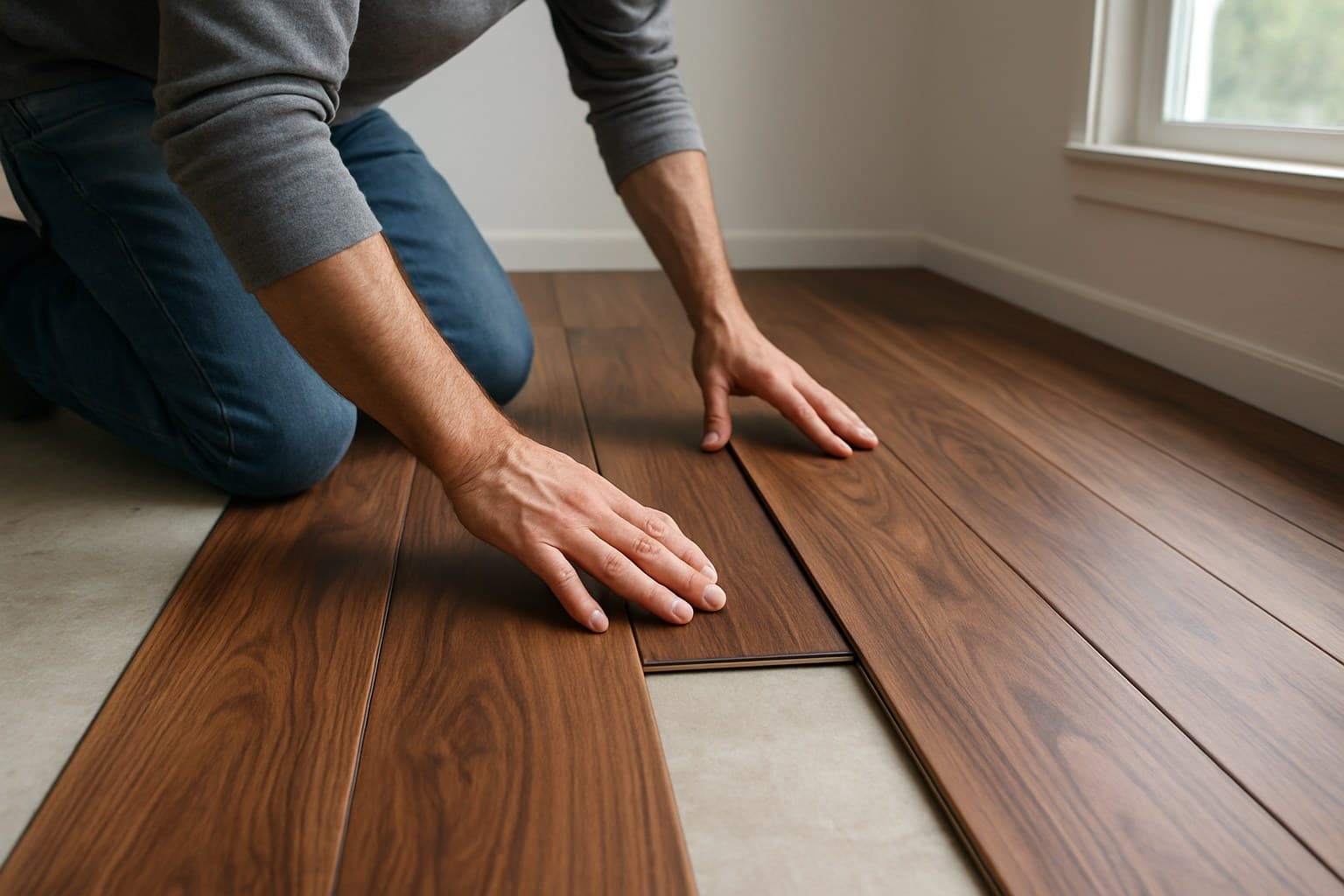
Click-lock walnut LVP is a realistic DIY over a flat, dry subfloor. Glue-down planks, stairs, and big open-plan rooms with moisture transitions are where hiring a pro pays for itself.
Before a single plank goes down, check two things. First, flatness. A long straightedge across the subfloor shows the humps and dips, and a floating floor over an uneven base will flex, tick, and pop the seams apart later. Second, moisture, especially on concrete and in basements. Use a moisture meter, a small tool that reads how damp the slab is, so you're not trusting your hand on a slab that feels fine but isn't. The callbacks I've had came from something under the floor, not the floor itself, a slab that read dry to the touch but not to the meter.
A few more rules that live on the product's own box, not on the internet. Leave an expansion gap around the whole perimeter, and use the size the manufacturer specifies, not a number a stranger quoted you. Some planks want acclimation time in the room before install and some say it's not needed, so follow that specific product's sheet. When it comes to stairs, this is the one job I steer most DIYers away from. Every tread and riser gets hand-cut and wrapped, mistakes show, and a loose stair plank is a safety problem, not just a looks problem.
Keeping a Dark Walnut Floor Looking Clean
A dark walnut floor asks for more upkeep than a lighter one, and no product changes that. What helps most is a soft-bristle broom or a microfiber dust mop used often, since dry dust is what shows first, not spills.
Skip the steam mop and skip drenching the floor. Extra water sits in those beveled seams, which is exactly where you don't want it. A barely damp mop with a cleaner made for LVP is plenty. Put felt pads under furniture legs, and use walk-off mats at the doors to catch grit before it scratches and settles into the grain. Pick the matte finish up front and set your walk-off mats, and the floor stops looking dirty an hour after you clean it.