
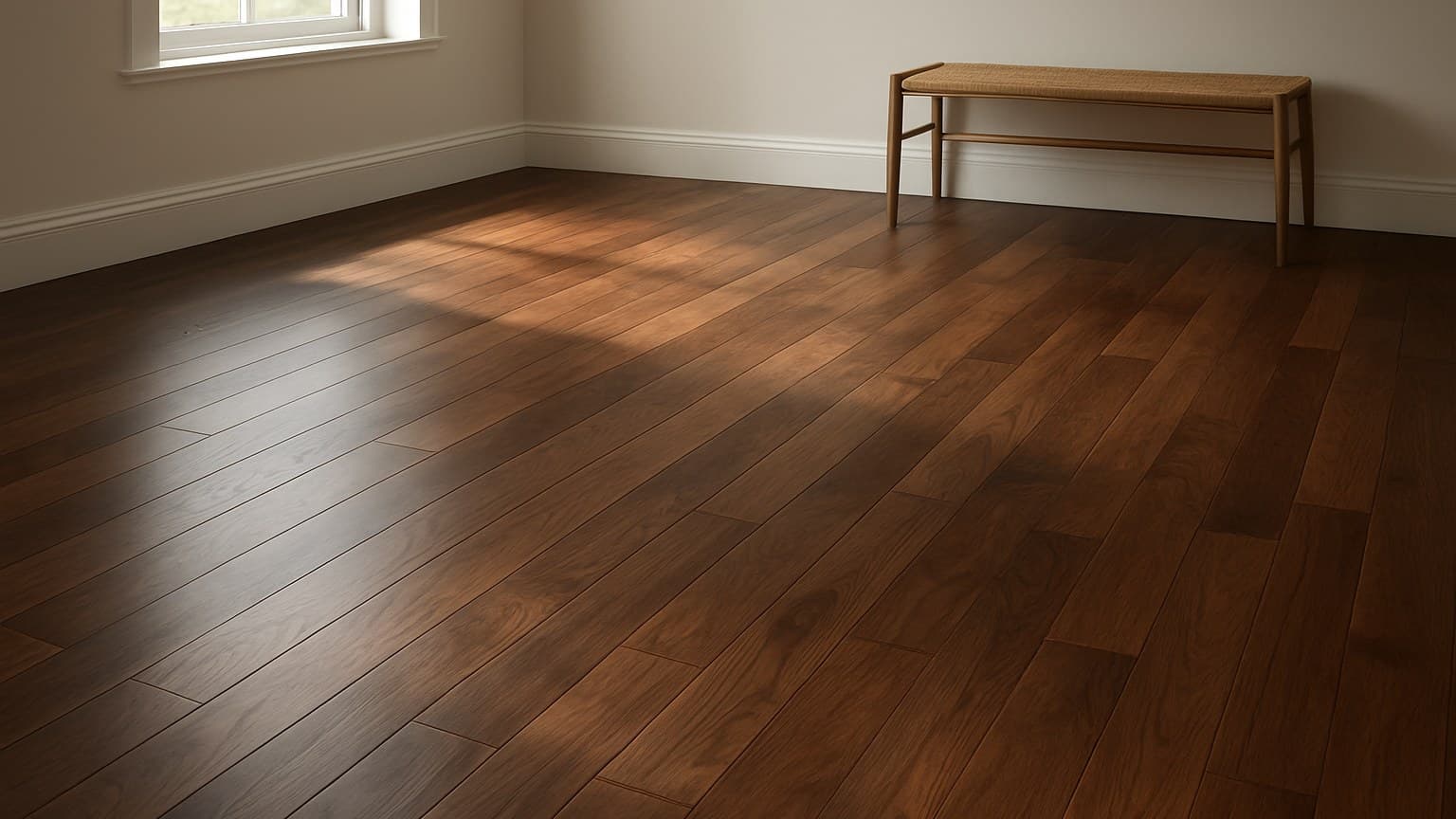
When I pulled up the ruined carpet in Denise Park's Portland dining room, she asked me point blank if black walnut was too soft for her family of four. Here's the direct answer: yes, it holds up fine, it rates about 1010 on the Janka hardness scale, softer than red oak's 1290 but nowhere near fragile. The real risk isn't hardness, it's buying the wrong grade or skipping the placement rules, and that's what nobody spells out for you. If you're benchmarking against the truly hard end of that scale, Brazilian walnut flooring options run dramatically denser than domestic walnut ever will.
Key takeaways
- Black walnut's Janka hardness is about 1010, softer than red oak (1290) and white oak (1360), so it does dent more easily under heels, pets, and dropped pans.
- The softness matters most in busy entryways, kitchens, and pet homes; a Character grade with a matte finish hides dings far better than a Clear grade.
- Materials run roughly $6/sq ft for engineered common grade up to about $32/sq ft for wide-plank Character solid, plus $3-10/sq ft labor depending on prefinished vs site-finished.
- Over concrete or in a basement, engineered black walnut is the safer choice; solid 3/4-inch works above grade and takes more refinish sandings over its life.
Is Black Walnut Tough Enough to Live On? Start With the Number
Yes, black walnut (Juglans nigra) is tough enough for a real home. It rates about 1010 on the Janka hardness scale, the test that measures how well a wood resists a dent, and that puts it below red oak (1290) and white oak (1360). Softer than the usual benchmark, not fragile. If you want to see how a genuinely hard species stacks up before you compare, picking hickory flooring that resists damage is worth a look since it sits well above all three of these on the Janka chart.
Here is the whole lineup so you can place it:
| Wood | Janka (lbf) | vs Black Walnut |
|---|---|---|
| Eastern white pine | ~380 | much softer |
| Black walnut | ~1010 | baseline |
| Red oak | ~1290 | harder |
| White oak | ~1360 | harder |
| Hard (sugar) maple | ~1450 | harder |
| Hickory | ~1820 | much harder |
Source: the Janka hardness figures published in the NWFA wood species data
Note: Janka hardness values are commonly cited industry figures for each species; individual results can vary by wood sample and test method.
Janka dent-resistance ratings for black walnut against the woods buyers usually compare it to.
So the real questions aren't "is walnut hard enough." They're about grade, finish, and where you put it. If denting worries you most, maple flooring is the harder route to look at, but you give up walnut's deep color to get there.
Where Walnut's Softness Actually Shows, and How to Live With It
The softness shows in a few named spots, not across the whole floor. The trouble zones are entryways where grit rides in, kitchen runs by the sink, chair legs that drag, dog nails, and the cast-iron pan you drop once a year. That's where a walnut floor picks up dings first. If those same trouble spots make you nervous, choosing hard maple flooring instead takes those same hits with room to spare.
Everywhere else, it barely matters. Bedrooms, dining rooms, home offices, and low-traffic hallways will look great for decades on walnut. A softer wood in a calm room simply doesn't take the hits that make hardness the deciding factor.
A few defenses actually help. Put felt pads under every chair and table leg. Run rugs or runners through the entry and kitchen traffic lanes. Keep pet nails trimmed. Choose a matte or wire-brushed finish over high gloss, a flat finish scatters light and hides small marks that a mirror shine would spotlight. And pick a busier grade that camouflages wear, covered next.
For perspective: plenty of people happily live on pine flooring, which is far softer than walnut. Softness alone has never been a dealbreaker, it just tells you how careful to be about grade and placement.
Black Walnut Grades, Explained (the NWFA Standard)
According to the NWFA/NOFMA hardwood grading standard, grade is set by how much natural character shows, knots, sapwood (the lighter wood from the outer part of the tree), and color swings. These grade names are defined by the National Wood Flooring Association (NWFA/NOFMA), and most vendor pages skip them entirely, which is how buyers end up paying Clear-grade prices for a look they don't want.
Clear and Select & Better are the cleaner grades. They give you uniform dark heartwood with little character, they cost the most, and small dents stand out worse against that even surface. #1 Common and Character grade brings more knots and color movement, costs less, and hides everyday wear better. That busier grade suits a home with kids, pets, or a well-used front door.
| Grade | Look | Hides wear | Relative price |
|---|---|---|---|
| Clear | Most uniform, minimal character, all heartwood | Poorly | Highest |
| Select & Better | Mostly clean, slight color variation | Fair | High |
| #1 Common / Character | Knots, sapwood, strong color swing | Well | Moderate |
| #2 Common / Rustic | Heaviest character and contrast | Best | Lowest |
Source: the NWFA/NOFMA hardwood grading rules
How black walnut grades compare on appearance, ability to hide wear, and relative cost.
The key point: grade changes look and cost, not durability. Every grade is the same species with the same Janka number. Match the grade to your traffic and how lived-in you want the floor to read.
Solid vs Engineered Black Walnut Hardwood Flooring
The room decides this, not the label on the box. Over a concrete slab or below grade in a basement, engineered black walnut is the stable choice because its cross-layered core resists the cupping that concrete moisture drives into solid boards. Solid 3/4-inch walnut belongs above grade, over a wood subfloor. That same room-by-room logic holds regardless of species, which is why it helps to walk through the broader guide to choosing solid vs engineered hardwood before settling on a product line.
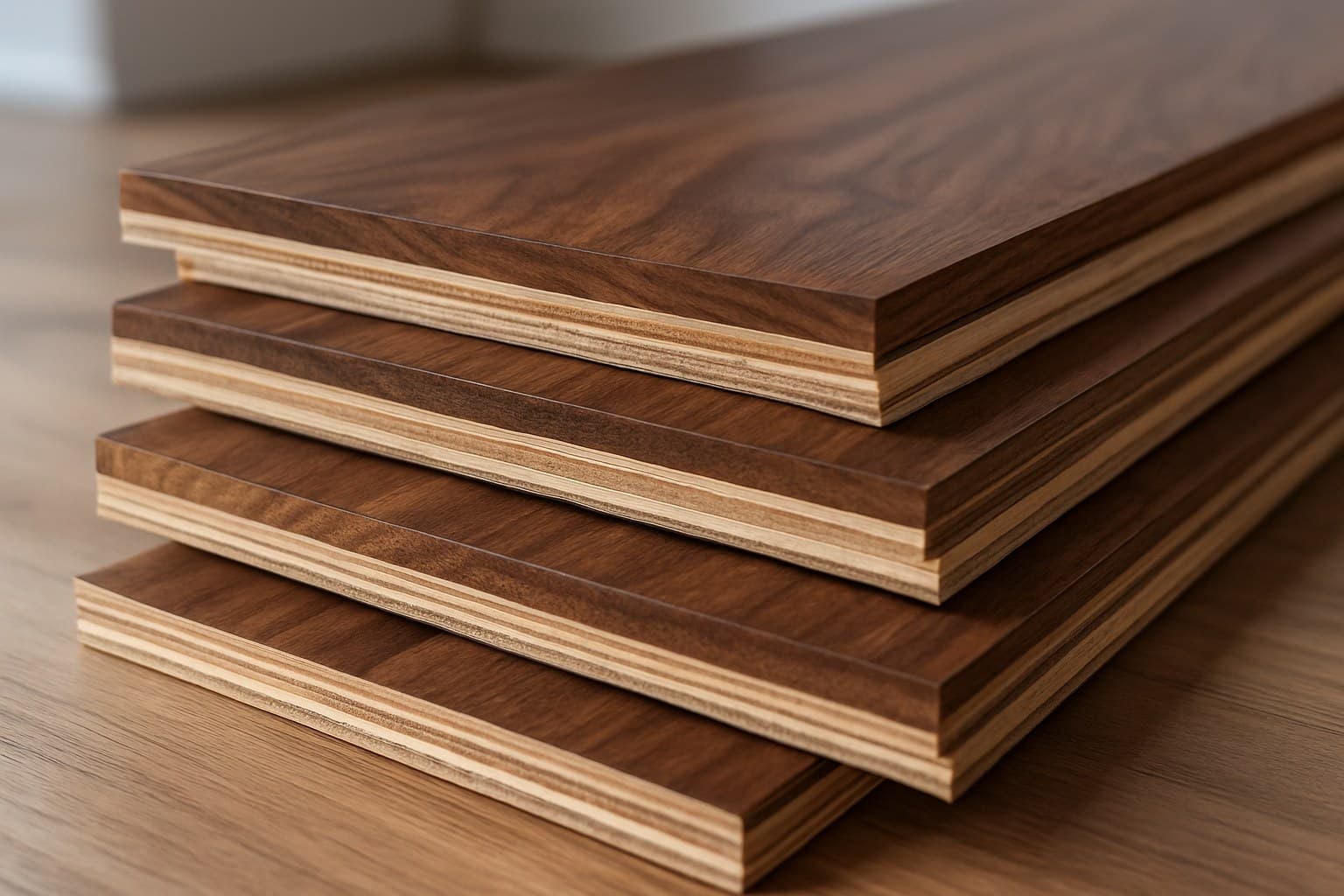
Engineered walnut is still real walnut. The top is a genuine walnut wear layer, commonly running about 2mm to 4mm depending on the manufacturer and SKU, per each product's own spec sheet, glued over a plywood-style core with a balancing layer underneath to keep the plank flat. You see and walk on real wood.
When engineered beats solid (concrete, basements, radiant heat)
Any spot where moisture or heat moves through the subfloor favors engineered: slab-on-grade rooms, basements, and radiant heat systems. The stable core handles swings that would make a solid board cup or gap. I steered the Reyes family off solid walnut for their Cleveland basement more than once, and the moisture readings, not my preference, made the call every time.
Before any install, check the subfloor is flat and run a moisture test. On floating and glue-down jobs, the manufacturer's warranty depends directly on that prep, not on the plank you chose. I once let a customer named Frank in Akron talk me out of a moisture test to save an afternoon; the floor cupped before the season was out and I relaid it on my own dime. The test isn't optional.
How many times can each be refinished?
Solid walnut can be sanded and refinished more times over its life because there's a full 3/4 inch of wood above the tongue. Engineered is capped by its veneer thickness, which the maker publishes per product. A thin 2 mm wear layer may take one light sanding, a thicker 4 mm layer more. So "can I refinish this later" is a spec question you answer off the product sheet, not a blanket yes or no.
What Black Walnut Flooring Really Costs
Materials run from about $6 to $32 per square foot, and that spread is the part vendor pages hide. What moves you along it: engineered versus solid, the grade, plank width, and whether it comes prefinished or gets sanded and finished on site.
| Type | Materials ($/sq ft) | Labor ($/sq ft) |
|---|---|---|
| Engineered prefinished, common grade | $6-11 | $3-6 |
| Solid prefinished, Select & Better | $9-15 | $4-7 |
| Solid unfinished, site-finished | $8-14 | $6-10 |
| Wide plank / Character / rift & quartered | $14-32 | $5-9 |
Black walnut flooring cost split into materials and labor, per square foot, by product type.
Material cost range per square foot by black walnut type; labor is quoted separately above.
Labor is its own line, and it flips in a way people miss. Prefinished planks install cheaper on labor because there's no sanding or finishing on site. Unfinished walnut can cost less as raw wood, but the labor climbs $6 to $10 because someone spends days sanding, staining, and coating in your home.
Why wide plank and site-finished cost more
Wide plank, rift and quartered cuts, and herringbone patterns push both the material and the labor to the top of the range. Wide boards waste more of the log and cost more per foot, and patterns like herringbone mean far more cuts and layout time. Basement and stair jobs also run higher than an open room, because of the extra transitions, cuts, and the moisture prep a slab or stairwell demands.