
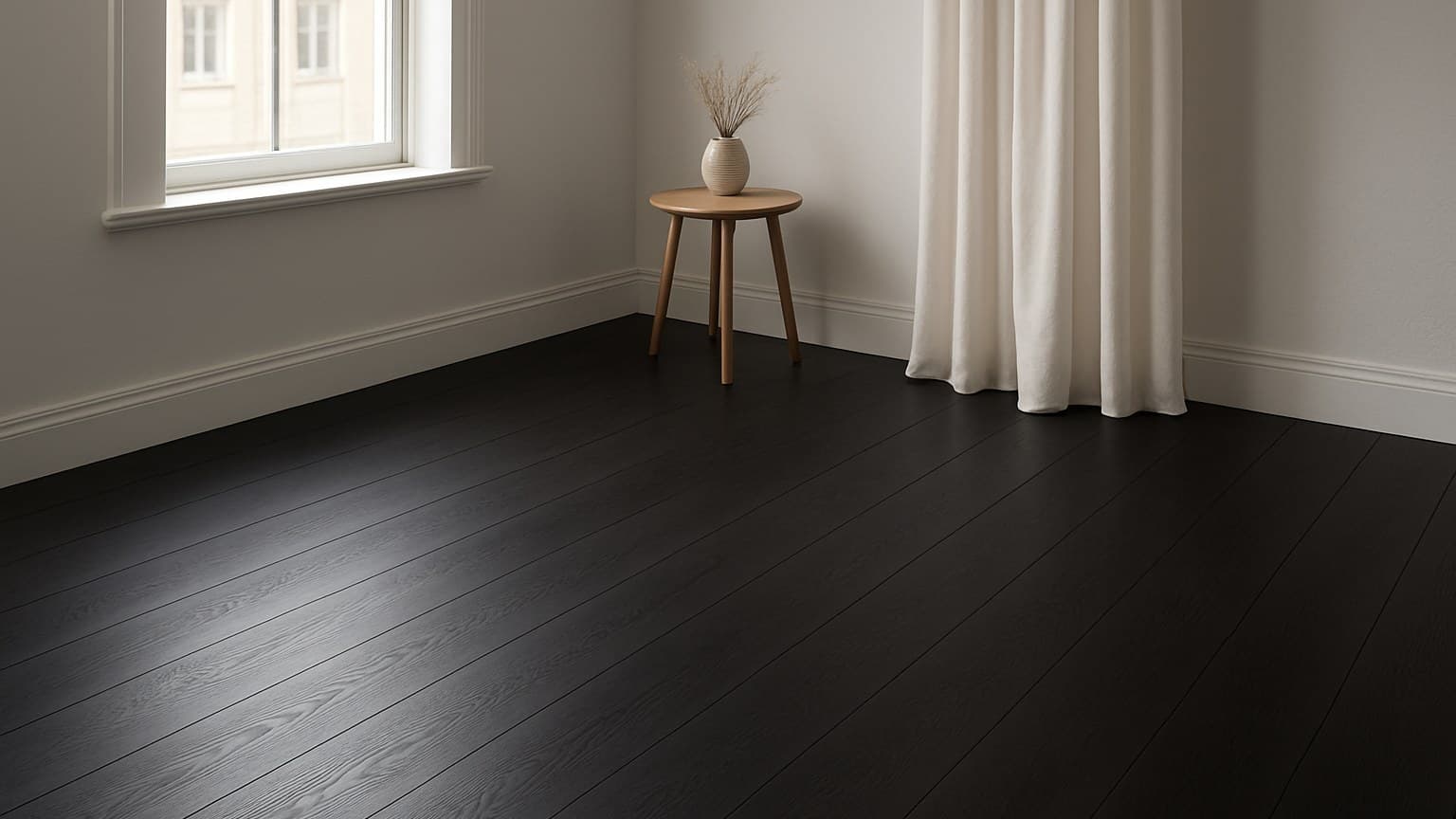
When Maria in Austin asked me to install black engineered hardwood through her open-concept kitchen and living room, she wasn't picturing the dust bunnies she'd be fighting every afternoon. Black engineered hardwood flooring shows scratches and dust faster than any other color, so the wrong texture or sheen turns a great look into a daily chore. Here are the six choices that decide which floor you end up living with.
Key takeaways
- Wire-brushed or hand-scraped texture hides scratches and dust far better than a smooth face; on black floors it's the single biggest lever you have.
- Choose matte or low-gloss sheen. A shiny black floor throws light and shows every footprint, dust speck, and scuff.
- Black is only a stain over a real wood veneer, so grain still matters: open-grain oak camouflages wear, smooth maple exposes it.
- You can only refinish a black floor if the veneer (wear layer) is thick enough; look for a plank in the NWFA Engineered Refinishable Program if refinishing matters to you.
- Expect roughly $4-9 per square foot for materials and $3-6 for labor, with basement and stair jobs costing more than open rooms.
First, Know What "Black" Actually Is on an Engineered Floor
Black is not the wood. It's a stain or a reactive finish sitting on top of a real hardwood veneer, and the wood underneath that color is what actually decides how well the floor hides wear.
Here's the build in plain terms. An engineered plank is a thin slice of real hardwood, called the veneer or wear layer, glued over a plywood-style core of cross-layered wood. According to the National Wood Flooring Association's Homeowners' Handbook to Real Wood Floors, that cross-layered core construction gives engineered planks added dimensional stability, which is why they can go over concrete and below grade in spots where solid wood usually isn't recommended. The color coat rides on the very top. That construction is the whole reason the engineered-versus-solid decision comes down to more than just looks, a comparison I lay out fully in my engineered hardwood vs hardwood guide.
That fact runs through this whole article: on a black floor, every buying choice is really a scratch-and-dust visibility choice. The stain gives you the look, but the texture, the sheen, and the grain under it decide whether you'll see every scuff.
If you want the deeper breakdown of how engineered stacks up against solid wood by room, I cover that in the solid vs. engineered hardwood guide. Here we're staying on what makes black behave.
1. Texture: Wire-Brushed or Hand-Scraped Hides the Most
Texture is the single biggest lever you have on a dark floor. A raised, uneven surface breaks up light, so a scratch line disappears into the grain instead of glowing white against a smooth black face.
Two textures do this best. Wire-brushed means fine grooves have been brushed into the soft parts of the grain, leaving a subtle ridged surface. Hand-scraped means gentle waves were worked across each plank, so the top is never dead flat. Both give a scratch somewhere to hide. If that hand-worked look appeals to you beyond just black floors, my hand-scraped engineered hardwood guide covers what to check before you commit to it.
A smooth, flat black floor does the opposite. It acts like a mirror. Every scratch reads as a bright white line, and every fleck of dust or pet hair sits right on top for you to see.
The tradeoff is honest: heavy texture traps a little more grit and takes slightly longer to vacuum into. But on black, that texture buys you years of hiding wear. I'd take it over a smooth face that shows a scuff the first week. If you want to push that texture even further, my distressed engineered hardwood guide covers how much wear-hiding you gain as the surface gets rougher.
2. Sheen: Go Matte or Low-Gloss, Skip the Shine
Matte and low-gloss are the only sheens that make a black floor livable. Semi-gloss and gloss fight you every single day.
The higher the shine on a dark tone, the more everything pops. Dust, footprints, and dried water spots all show harder as gloss goes up, because a shiny black surface reflects light like glass. Matte scatters that light instead, so the same dust and the same fine scratches mostly vanish.
Don't assume every matte finish is tough, though. A scratch-resistance or waterproof claim only counts if it's printed on that exact product's own spec sheet, like a specific factory aluminum-oxide finish. It's not something all matte floors share, so read the line you're actually buying.
One cleaning note that matters on any dark floor: use a barely damp microfiber and a hardwood-safe cleaner, not a wet mop. A wet mop leaves streaks that show instantly on black.
| Sheen | Dust | Footprints | Fine scratches | Verdict |
|---|---|---|---|---|
| Matte / low-gloss | Barely shows | Rarely | Well hidden | Best pick for dark tones |
| Satin | Shows some | Sometimes | Somewhat visible | Workable with texture |
| Semi-gloss / gloss | Shows a lot | Constantly | Very visible | Avoid on black |
How each sheen level reads on a black-stained floor, from easiest to hardest to keep clean.
3. Veneer Species and Grain: The Wood Under the Stain Still Matters
Because black is only a coating, the grain of the veneer still shows through, and that grain still decides how much wear it hides. Open-grain woods like oak and hickory have a busy, textured pattern that camouflages scuffs. Smooth-grain woods like maple have a tight, even face that leaves a scratch nowhere to hide.
This holds whether you're looking at engineered or solid black hardwood flooring. The species choice drives how forgiving the floor is either way, so a black oak floor and a black maple floor will not age the same, even at the same price.
A busier grain also helps between cleanings, because it breaks up the look of settled dust. On a color that shows everything, that's real day-to-day help.
Grade is the lever that gets skipped in most buying guides, and it works alongside species, not instead of it. Every species is sold across a range of grades, and that grade is a separate spec on the box from the species name. Select or Clear grade boards are sorted for a consistent, fairly uniform face with minimal knots or color streaks, so the surface reads calm and even once it's black. Character or Rustic grade boards from the same species keep the knots, mineral streaks, and natural color swings that milling would otherwise sort out, so the face is busier before the stain ever goes on. That extra busyness works the same way texture does: a knot or a streak under black stain gives a scratch or a dust film somewhere to blend into, the same way a wire-brushed groove does. A Select-grade maple floor and a Character-grade maple floor in the identical black stain will not hide wear the same way, even though the species line on the spec sheet is identical. When you're comparing boards in person or from samples, check the grade name printed on the product, not just the species, since that's the spec that tells you how much natural variation is baked into the face before the color goes on.
If you're trying to match a specific product to a species, my best engineered hardwood flooring picks walk through which lines pair a forgiving grain with a good factory finish.
4. Wear Layer: Enough Wood to Refinish a Black Floor Later
You can sometimes sand and re-stain a black engineered floor, but only if the veneer on top is thick enough. That's a number you look up on the maker's own spec sheet, not a rule of thumb, because engineered veneers run anywhere from paper-thin to a few millimeters.
Refinishability matters more on black than on a light floor, because black shows scratches soonest. One way to spot planks with enough wood on top is to look for a line listed in the National Wood Flooring Association (NWFA) Engineered Refinishable Program, which recognizes engineered products from participating manufacturers that are built with a veneer thick enough to be sanded and refinished at least once.
Here's why I check this first, from my own work. For a customer named Frank in Cleveland, I once sanded his solid oak floor a fourth or fifth time, and one corner went down to the tongue before I caught it. There was nothing left to take off. A thin engineered veneer hits that same wall far faster, so I now measure remaining thickness at the edges before anyone promises a refinish.
Before you buy, pull the spec sheet and check the veneer thickness in millimeters, whether the line is in that NWFA program, the finish warranty term tied to that exact product, and whether the box requires acclimation. Don't judge a bargain by price alone either. A cheap plank is often a downgraded thin-veneer one, and my guide to spotting a real discount engineered hardwood deal shows how to tell the difference.
5. Where a Black Engineered Floor Can Actually Go
Engineered's cross-layered core handles concrete slabs, basements, and many radiant-heat setups where solid wood isn't recommended. But every product sets its own limits, so the install guide for your specific floor is the final word, not a general rule. If moisture is a real concern in that space, my waterproof engineered hardwood guide covers which constructions actually stand up to standing water.
Prep comes before anything else. Check the subfloor for flatness and run a moisture check first, because on a floating floor the manufacturer's warranty depends directly on the prep, not the plank you picked. Skip that and the best floor in the world will telegraph every low spot and gap.
Floating floors also need an expansion gap around the whole perimeter so the floor can move. The exact size is set by the maker, not a universal number, so look it up for your product.
For rooms where real wood is a stretch, like a laundry or a full bath, weigh the water tolerance honestly first. My engineered hardwood vs LVP comparison lays out where vinyl earns its place over wood and where it doesn't.
6. Light and Color: Keep the Dark Room From Feeling Like a Cave
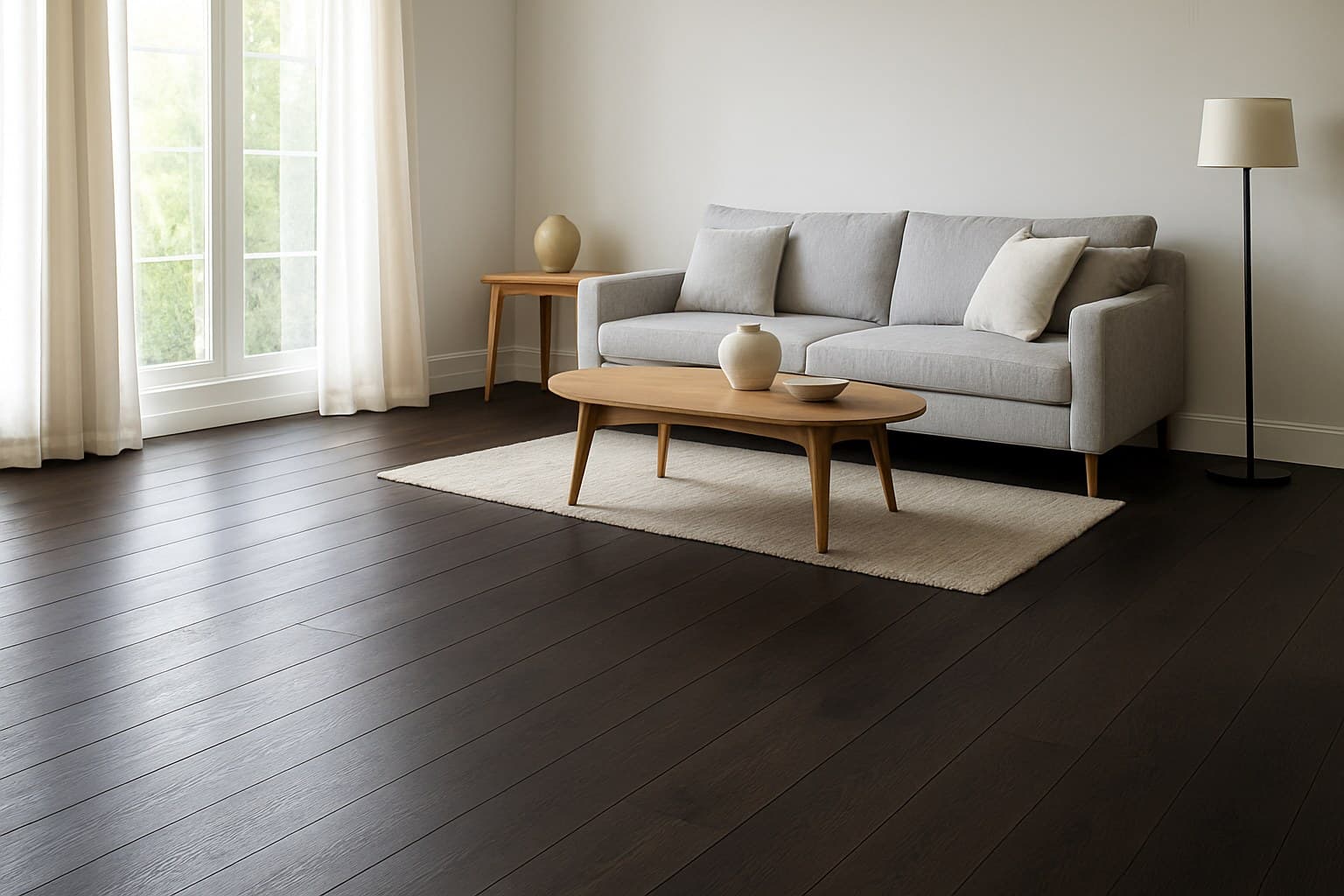
A black floor swallows light, so balance it with what's around it. Light or warm walls, white or pale cabinets, and layered lighting from more than one source keep the room from feeling closed in, especially in a small or north-facing space that already runs dark.
On the "is it in style" question: black reads high-end and current right now, but it's a commitment. Pair it with neutral fixed elements you won't want to rip out later, like simple trim and mid-tone cabinets, so the floor is the bold piece and everything else stays flexible.
Watch sun exposure too. Strong direct sunlight can fade and lighten a dark stain over time, and it makes dust and scratches easier to see in the bright hours. Rugs in the sunniest lanes help on both counts.
What Black Engineered Hardwood Costs
These figures are general industry ranges, not a fixed price, and they can vary significantly by region, retailer, and installer, so treat them as a starting point rather than a quote. Expect roughly $4-9 per square foot for materials and $3-6 per square foot for labor on a straightforward install. Basement and stair jobs run higher, because slabs need more moisture work and stairs are slow, cut-heavy hand work.
The open middle of a room is never where the time goes. I learned to stop quoting a flat rate after a remodel for the Delgado family in Sacramento, where a job full of closets, doorways, and a bay window ate an extra full day, so count the cut-heavy areas separately when you budget.
| Job | Materials (per sq ft) | Labor (per sq ft) | Notes |
|---|---|---|---|
| Open room, ground floor | $4-9 | $3-6 | Simplest layout, fewest cuts |
| Basement over slab | $4-9 | $4-7 | Add moisture barrier and prep |
| Stairs | $4-9 | Higher, priced per step | Slow, hand-cut work |
For a 1,000 square foot open floor, that's about $4,000-9,000 in materials and $3,000-6,000 in labor, so roughly $7,000-15,000 installed before any basement or stair premium.
If you want the full breakdown by species, region, and prep work, read what engineered hardwood flooring really costs before you lock in a budget, because prep is where quotes swing the most.