
In the laminate vs. hardwood choice, hardwood lasts for decades because you can sand and refinish it, while laminate costs far less and resists scratches but swells at the seams when water sits there. Both pass for wood across a room. They fail in completely different ways, so the right pick comes down to your room, not a ranking.
I fit and pull up both for a living. The jobs that come back have taught me what actually holds up and what it costs, so let's get into it.
Key takeaways
- Hardwood runs $6-$25 per square foot installed (hallmarkfloors.com) and sands and refinishes for decades; laminate costs far less but can never be refinished.
- Laminate's aluminum-oxide wear layer shrugs off scratches and dog claws better than most wood finishes, but its wood-fiber core swells if water sits in the seams.
- Across a room many laminates pass for wood; two feet away on your knees, repeating grain and uniform texture give them away.
- Click-lock laminate is a realistic DIY job; nail-down and glue-down hardwood, stairs, and big open rooms are worth hiring out.
- Basements and bathrooms kill solid hardwood; that's where water-resistant laminate or vinyl earns its place.
Laminate vs. Hardwood: The Short Answer and What Each Is Made Of
Hardwood is real wood you can sand flat and refinish again and again. Laminate is a photo of wood under a tough clear coat, and it can never be refinished. That one fact drives most of the decision.
Hardwood comes two ways. Solid hardwood is a plank milled from one species all the way through. Engineered hardwood is a thin layer of real wood bonded over a plywood core, which handles humidity swings better. If you're torn between the two, the solid vs. engineered hardwood guide breaks down which one fits which room.
Laminate is built in layers. The top is a clear aluminum-oxide wear layer that fights scratches. Under that sits a printed photo layer of wood grain, called the decor paper. Below that is the core: high-density fiberboard, which is just pressed wood fibers. That core holds the locking edges and gives the plank its body. A backing layer underneath keeps the plank flat.
Both are proven products. The National Wood Flooring Association, the trade group for real wood floors, has a formal definition of what counts as real wood. The North American Laminate Flooring Association, the laminate industry's group, points out that laminate has been a mainstream floor for more than 30 years. Neither is a gimmick. They just solve different problems.
Durability and Lifespan: What Actually Wrecks Each Floor
Laminate almost never fails from scratches. It fails at the seams when water stands and swells the fiber core. Hardwood scratches and dents, but a sanding erases that. So the floors come back for opposite reasons.
Laminate's aluminum-oxide wear layer is harder than most wood finishes. Dog claws, chair legs, and grit that scratches a wood floor usually leave laminate alone. Makers rate that toughness with an AC rating, AC stands for Abrasion Class, the scale the industry uses to show how well a laminate's wear layer stands up to scuffing and wear. AC3 suits a normal household, and AC4 handles heavier traffic. The trade-off never changes: once that wear layer dulls or rubs through, you can't refinish it. The floor comes up and goes to the dumpster.
Hardwood takes dents and scratches you'll notice year one. But the National Wood Flooring Association notes real wood floors can last well over a hundred years and be repaired and refinished for their whole life. Some brands push durability further with cores engineered to resist wear longer before refinishing is needed. On pure lifespan, hardwood wins outright.
Here's the pattern I see on return visits. The laminate jobs that come back are swollen seams near a dishwasher or an exterior door, where water sat and wicked into the core. The hardwood jobs that come back are pet gouges and scratches, and one pass with a sander makes them disappear. I once set laminate right up under the toe-kick of new cabinets, then the homeowner swapped the dishwasher and found the floating floor had boxed the old one in. Now I think through what might need to come out later before I lock a floating floor around it.
If claws and accidents are your main worry, the best flooring for dogs guide ranks the materials that actually survive a dog.
Cost Breakdown: Price Per Square Foot, Materials vs. Labor
Laminate is cheaper on both the material and the labor. Hardwood runs about $6 to $25 per square foot installed, according to hallmarkfloors.com, while laminate lands well below that all in.
Split hardwood out and the materials run $3 to $15 per square foot with labor at $3 to $10, per hallmarkfloors.com. Laminate's pro labor runs about $2 to $5 per square foot, per manasotaonline.com; laminate material cost rides on the product you pick, so get that number from your own quote. Current 2026 figures from homewyse.com run higher than these, so your quote will swing with the source, the region, and the shop.
| Item | Cost per sq ft |
|---|---|
| Hardwood materials (wood only) | $3-$15 |
| Hardwood labor (install only) | $3-$10 |
| Hardwood installed total | $6-$25 |
| Laminate pro labor | $2-$5 |
Laminate vs. hardwood price ranges per square foot, split by materials, labor, and installed total.
The extras are what blow up a bid: tearing out and hauling the old floor, leveling a wavy subfloor, stairs, and transition strips between rooms. Basements and stairs cost more than an open room, because the cuts are slower and the prep is heavier.
For the full laminate math by room size, see the laminate flooring cost guide, which runs the all-in numbers.
Installation: DIY-Friendly or Pro Required?
Click-lock laminate is a realistic weekend job for a careful DIYer. Hardwood is usually nail-down or glue-down, and that's pro work. The laminate installation guide covers the rules the box leaves out.
Before either floor goes down, two checks come first. One is subfloor flatness. A hump or a dip telegraphs right through a floating floor and makes the seams flex until they fail. Sand down high spots and fill the low ones. Two is subfloor moisture, especially on a concrete slab, where damp coming up from below will wreck wood and swell laminate alike.
Skip that prep and you can lose coverage you paid for, many hardwood and laminate warranties carry a documented subfloor-prep requirement, so check the paperwork before you start. The warranty hinges on the prep, not the plank. The underlayment you choose sits right between those two checks and the finished floor, which is why installing laminate floor underlayment correctly matters for keeping the floor quiet and dry.
For a laminate DIY run, you'll want spacers to hold the expansion gap, a tapping block and pull bar to close the joints, a jamb saw to undercut door casings so planks slide under, and a chalk line. Floating floors need that gap left around the whole perimeter, and the exact size comes from the maker's own sheet, not a number off a forum. Acclimation is the same deal: some products want it, some say skip it, so read that box.
Hire it out for glue-down hardwood, stairs, and big open-plan floors. Stairs are fussy and unforgiving, and long open runs punish small mistakes that a short hallway hides.
Water and Moisture Resistance by Room
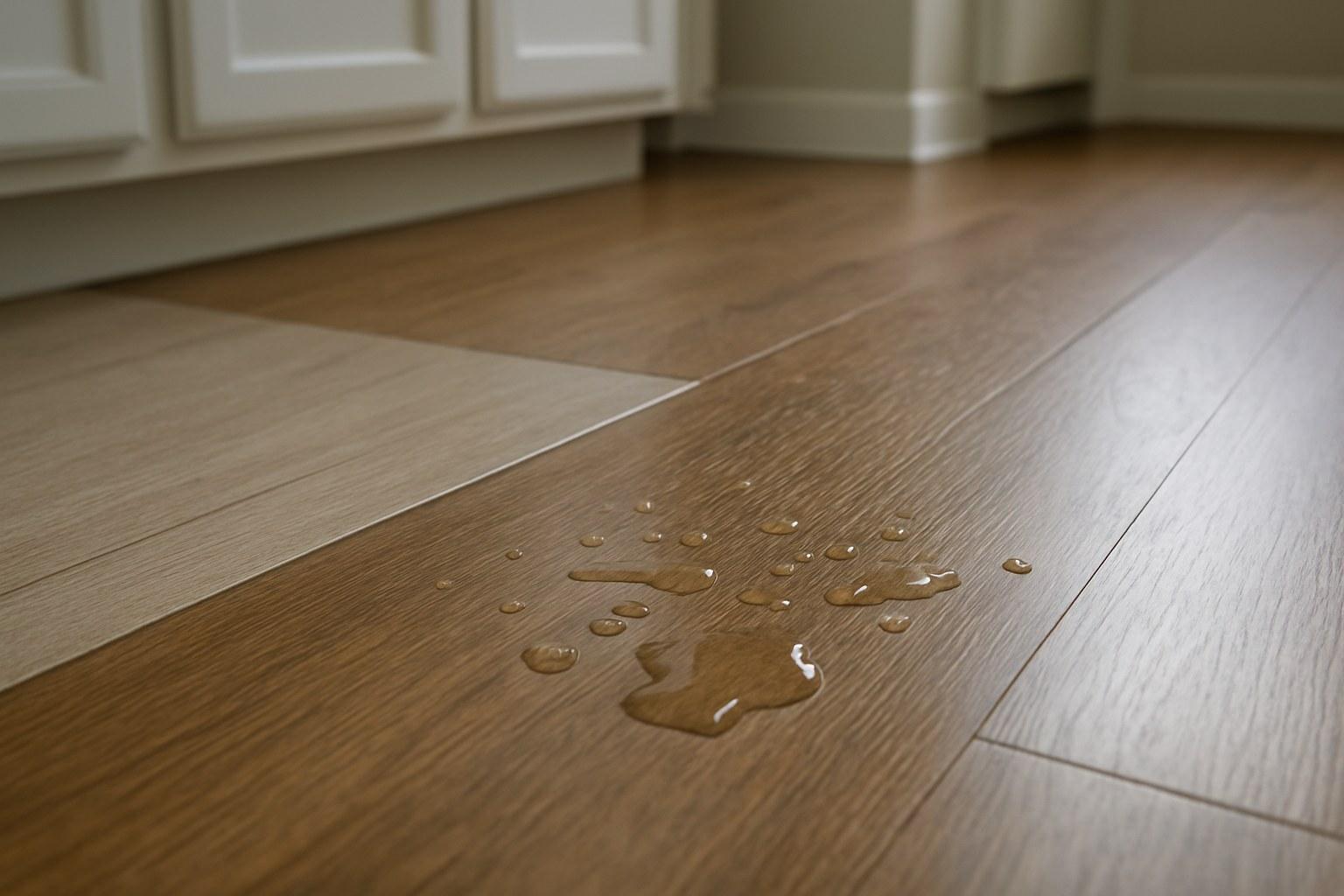
Keep two claims separate. A "waterproof core" means the plank body itself won't swell. It does not mean water can't get in at the seams and edges, which is exactly where failures start. I've encountered many planks with a dry core and a swollen edge through work.
Solid hardwood belongs in dry rooms only. Engineered hardwood tolerates a little more humidity, but it's still wood, and it won't survive a wet basement or a bathroom that sees standing water.
Laminate's fiber core swells if water reaches the edges, so even water-resistant and waterproof laminate lean hard on how well the seams are sealed and how fast you wipe spills. Those terms are not interchangeable, and the fine print differs by product. The water-resistant laminate guide and the waterproof laminate guide both sort what's real from what's marketing.
For room picks: laminate or vinyl over a moisture barrier works for basements. Tile or vinyl is the safe call for a full bathroom. Water-resistant laminate holds up in kitchens and mudrooms where spills get wiped fast. For the wettest rooms, weigh laminate against vinyl plank in the LVP vs. laminate guide, since luxury vinyl plank's (LVP) plastic core tolerates standing water laminate can't.
How to Tell Laminate From Hardwood: Across the Room vs. On Your Knees
Across a room, good laminate passes for wood. Down on your knees two feet away is where it gives itself up.
The tells are the repeat and the texture. A photo layer only has so many unique plank images, so the same knot or grain streak shows up every few boards once you start looking. Real wood never repeats, because every plank is its own tree. Run your hand across it, too. Better laminate embosses texture that follows the printed grain, but cheaper lines feel uniform, like a smooth sheet pretending to be wood.
Light is the other giveaway. Real wood catches a window's glare differently board to board. A room of laminate reflects more evenly, which reads as a little too tidy.
This is why I quit letting people choose off a tiny sample. A homeowner once selected a laminate off a showroom chip no bigger than a credit card, then hated the whole room after installation, saying it appeared much busier and yellower than the chip. A chip can't show you the repeat or how it reads under your own light. Lay out a few full planks in the actual room before you commit.
Which Floor for Which Room and Budget
Here's how I'd steer it, room by room and wallet by wallet.
Pick hardwood when you want the floor to outlive the house and you're staying put. Living rooms, dining rooms, bedrooms, and hallways on a main floor are its home turf. If you'll refinish it twice over 30 years, hardwood's higher price buys a floor you never replace.
Pick laminate when the budget is tight, a dog rules the house, or the room sees heavy foot traffic. Its scratch resistance and lower cost make it a smart play for a busy family room, a rental, or a flip where you won't recoup a hardwood premium. The LVP vs. laminate guide spells out the real trade-off there: laminate gives you the more convincing wood look for less, while LVP tolerates water laminate can't. For a closer look at which specific rooms laminate actually handles well, the laminate flooring room guide breaks down where it fits best.
Skip solid hardwood anywhere water stands. Basements and full bathrooms kill it. That's where water-resistant laminate or vinyl earns its keep, over a proper moisture barrier.
And if a laminate just has to look like something other than wood, the laminate that looks like tile guide covers what I check before I'll lay it.