
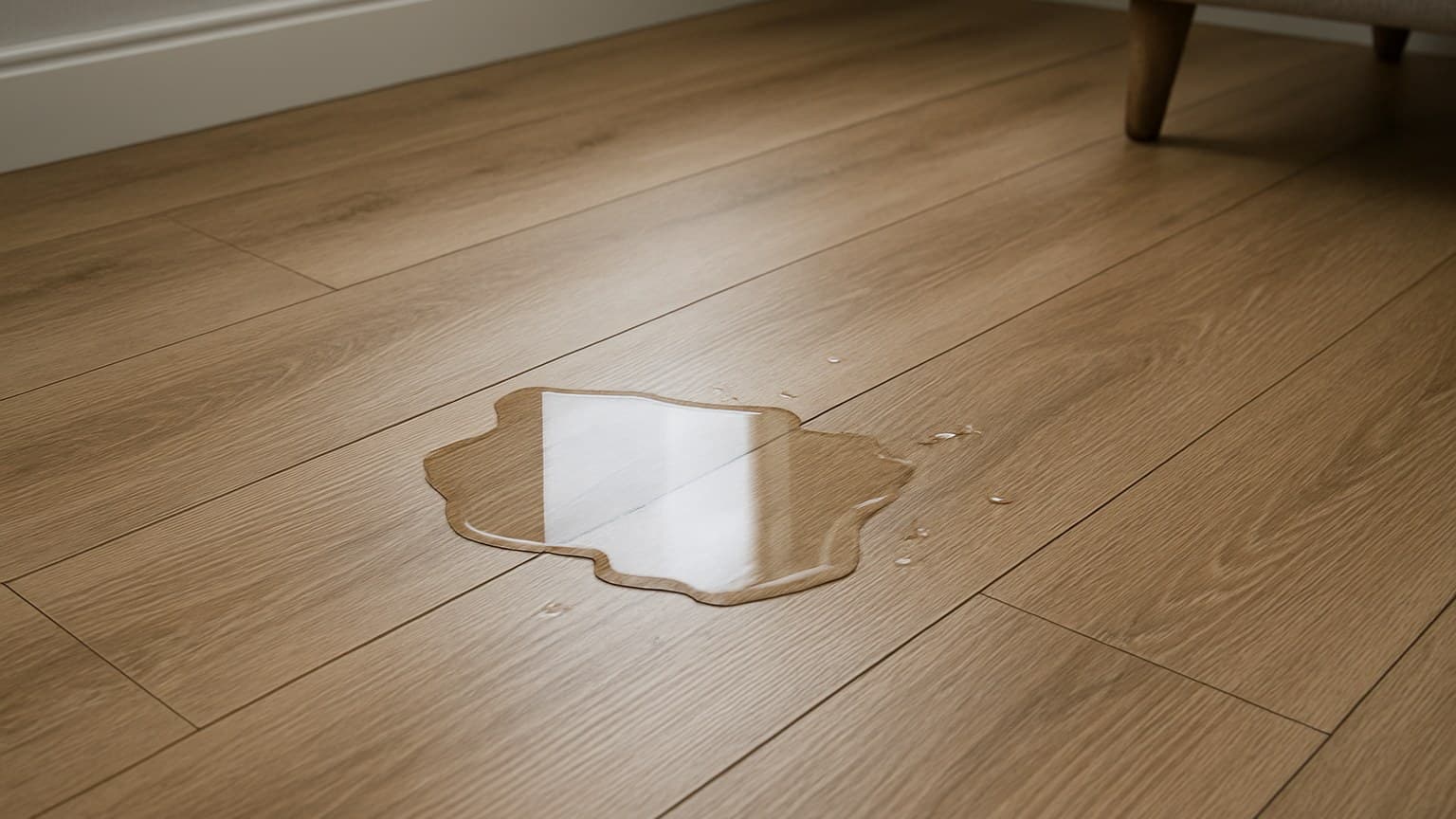
Walk into any store and every laminate box seems to promise it laughs off water. But water resistant laminate flooring and a truly waterproof floor are two different animals, and the gap between them is where planks buckle and money gets wasted. Here's what holds up and what's just marketing.
Key takeaways
- No independent lab standard sets the 24-72 hour 'waterproof' window makers advertise. Those hours come from the manufacturer's own test, not a neutral one, so treat them as a claim, not a fact.
- Water-resistant laminate handles surface spills you wipe up fast. It swells at the seams and edges when water sits on it or soaks in from underneath.
- You can verify an AC abrasion rating (AC3 or higher for homes) and NALFA certification, and check the EPA TSCA Title VI formaldehyde label. 'Waterproof' on the box, by itself, isn't verifiable.
- Best rooms are bedrooms, living rooms, and hallways. Kitchens and entryways work only if you clean spills fast. Skip full bathrooms and damp basements.
- Budget materials around $1-5 per square foot plus labor around $2-5 per square foot, and expect basement or stair jobs to cost more than open rooms.
Water-Resistant vs. Waterproof Laminate: What Actually Differs
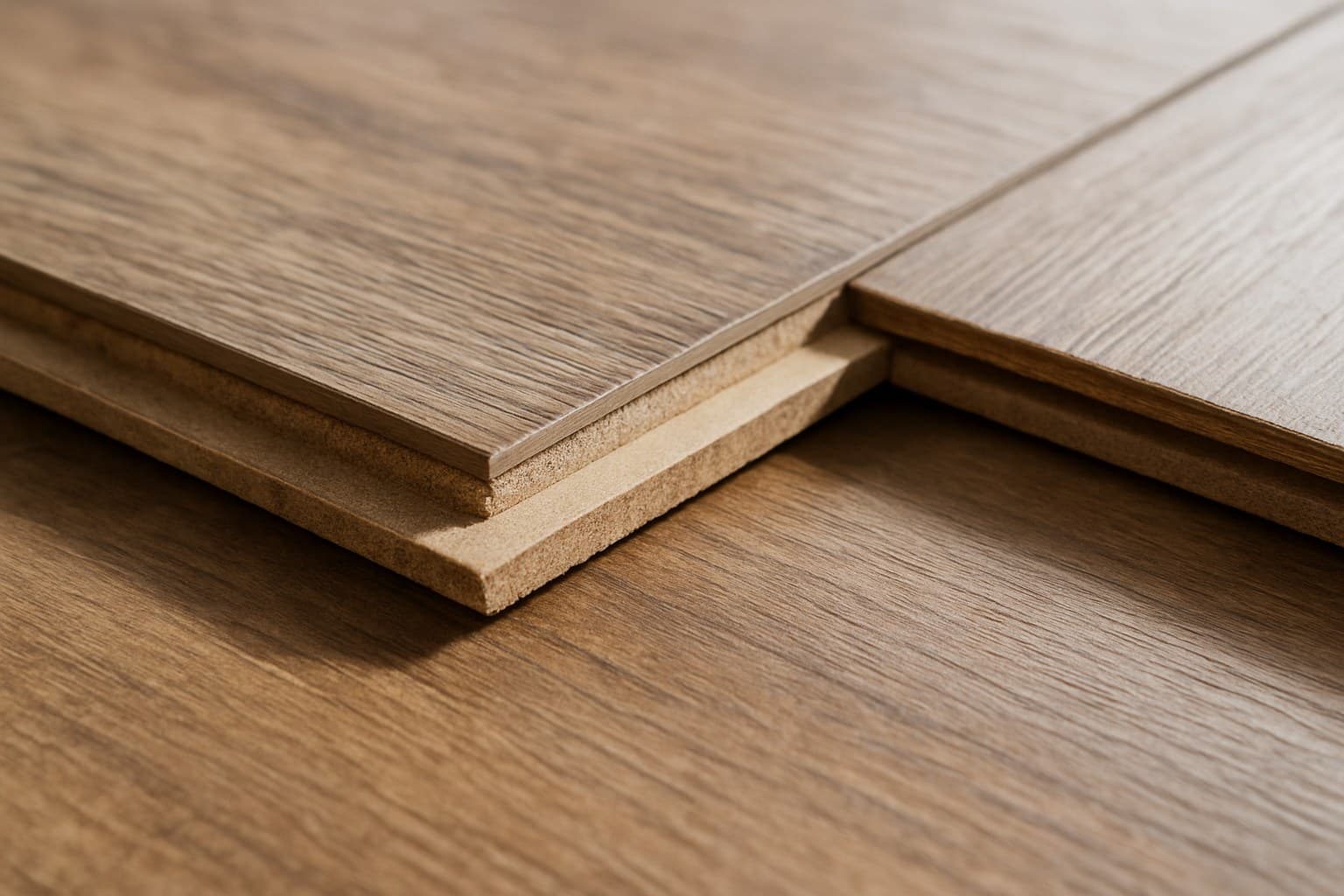
Water-resistant laminate survives a spill you wipe up fast. A floor marketed as "waterproof" resists longer, but the core problem doesn't change: the board underneath is HDF, which stands for high-density fiberboard, a wood-based material that swells once water sits long enough at a seam.
I saw how inconsistent that "waterproof" label can be on a repair job where I matched two boxes of the same product line bought about a year apart. The newer boxes had a slightly different edge coating that beaded water longer before it soaked in than the older stock did. Same brand, same claim printed on the box, different real-world edge protection depending on which production run you happened to get. That's the catch with the word "waterproof": it describes what passed a test on one batch, not a guarantee that carries over to every box with that name on it.
Neither type can be soaked and shrugged off the way a sheet of vinyl can. If you truly need a surface that laughs at standing water, that's a job for vinyl sheet, not laminate. If you want the full breakdown of what "waterproof" on a laminate label does and doesn't cover, our guide to waterproof laminate marketing claims digs into the certifications.
| Attribute | Water-resistant | "Waterproof"-marketed |
|---|---|---|
| Core material | HDF (high-density fiberboard) wood core | HDF core, often denser or treated |
| Surface spill wiped up fast | Fine | Fine |
| Water left sitting on a seam | Swells at the joint | Resists longer, still vulnerable at edges |
| Water soaking up from below | Fails | Fails |
| Can be submerged like vinyl | No | No |
Source: Construction from manufacturer spec sheets; the edge failures are what I see on callbacks Construction and water behavior of water-resistant vs. "waterproof"-marketed laminate, based on product spec sheets and jobsite failure patterns.
How Long Can Water Really Sit on It?
Long enough to wipe it up, and no longer. The 24 to 72 hour "protection" windows you see advertised come from each maker's own bench test, not from a neutral industry lab. There's no independent standard that defines that clock, so treat those hours as a claim, not a fact.
Checking North American Laminate Flooring Association's (NALFA) own published testing information confirms this gap directly: NALFA's certification program (see NALFA's laminate flooring FAQs) covers things like wear, indentation, and impact, but it does not include a standardized "hours of standing water" test, and no ASTM (American Society for Testing and Materials) standard defines one either. That means every "24-hour" or "72-hour" spill-tolerance claim on a box comes solely from the manufacturer's own internal bench testing, not from NALFA, ASTM, or any other independent body. Worth knowing before you treat that number as a guarantee.
The honest answer isn't a countdown. A splash you dry in a minute is a non-event. A puddle left overnight on a seam is a different problem, because that's where water gets past the surface and into the board.
I once got called back to a kitchen where the customer swore the floor was "water damaged" for no reason. The planks looked perfect on top. When I pulled them, every joint near the dishwasher was swollen and soft. A slow leak had been wicking in at the edge for weeks, and the printed surface hid it the whole time.
So picture the joint, not the plank face, as the weak point. Here's how water actually gets in.
The wear layer sheds water off the top. The click-lock joint is the gap where a standing puddle sneaks between planks. The HDF core edge drinks it up and swells, which is the failure you feel as a raised, rough seam. Edge sealant or wax slows it down but doesn't stop a real soak, and a wet subfloor keeps feeding moisture up from below.
What You Can Verify vs. What's Just Marketing
Some claims on the box are backed by a test you can look up. "Waterproof," on its own, is not one of them.
Start with the AC rating. According to NALFA (the North American Laminate Flooring Association), AC stands for abrasion class, and it measures how well the surface resists wear and scratching. For a home, aim for AC3 or higher. For busy rooms with kids, pets, and traffic, AC4 or AC5 holds up better. This number is set by a real test, so it means something.
Next, look for NALFA certification. That's the North American Laminate Flooring Association, an industry body that runs independent testing on laminate products (see NALFA's own explainer on what laminate flooring is). A floor either passes their testing or it doesn't, so a NALFA seal is a pass you can actually trust, not a slogan.
There's also a safety spec nobody in the marketing copy mentions. According to the U.S. Environmental Protection Agency, the TSCA Title VI rule, which comes from the Toxic Substances Control Act, limits how much formaldehyde a floor can give off. Formaldehyde is a chemical that can off-gas, meaning it slowly releases into the air. The label should state that the product meets this rule, and that matters most in a kitchen or a kid's room where people spend real time.
Then there's the warranty. A good one spells out the water exposure limits in plain terms, like how long a spill can sit and what voids coverage. A warranty that just repeats "waterproof" without those limits tells you nothing you can hold them to. The word "waterproof" alone has no neutral test behind it, which is why the checkable specs above are worth more than any headline on the box.
Best Rooms for Water-Resistant Laminate, and the Install Steps That Protect It
Which Rooms This Floor Actually Fits
Bedrooms, living rooms, and hallways are the sweet spot for water-resistant laminate. Kitchens and entryways work if you clean spills fast and seal the edges — and if you want a tile look without tile prices in those spots, guide to stone look laminate flooring covers options built for higher-traffic, spill-prone rooms. Full bathrooms and damp basements are where I steer people toward vinyl instead. Before a tile-look plank goes in those higher-traffic rooms, though, it's worth running through the checks before laying tile-look laminate flooring, since that pattern brings its own set of things to verify beyond the usual water rating.
For the full case on each room, including how laminate affects resale value, our cornerstone guide on which rooms laminate flooring actually works in walks through every space in the house.
Prep and Sealing That Actually Improve Water Resistance
Before a single plank goes down, two checks decide whether the floor lasts: is the subfloor flat, and is it dry. Our full walkthrough on how to install laminate flooring covers both checks step by step along with everything that comes after.
Flatness comes first. Run a long straightedge across the floor and watch for daylight under it. A low spot the size of a dinner plate lets the planks flex, and flex works the click-lock joints loose over time. That gap is exactly where water later gets in.
Then check moisture, especially over concrete. A slab can feel bone dry to your hand and still read wet on a meter, which is a handheld tool that measures dampness in the material. I learned that one the hard way years back, on a job where I skipped the reading to save an afternoon and relaid the whole floor a season later on my own dime.
The parts that do the real work: underlayment for cushion and quiet, a vapor barrier over concrete, which is a plastic sheet that blocks moisture rising from below, and a bead of silicone along the edges near sinks and tubs. That perimeter seal is cheap insurance in the one spot laminate is weakest.
On the DIY question, be honest with yourself. Click-lock laminate over a flat, dry, open room is a realistic weekend job for most people, though the box's own instructions skip a lot of details that trip people up — see the installation rules the box doesn't cover for what actually matters. Stairs, glue-down products, and big open-plan floors with moisture transitions are where hiring a pro usually pays for itself.
Cost & Durability: Laminate vs. Waterproof Laminate vs. LVP
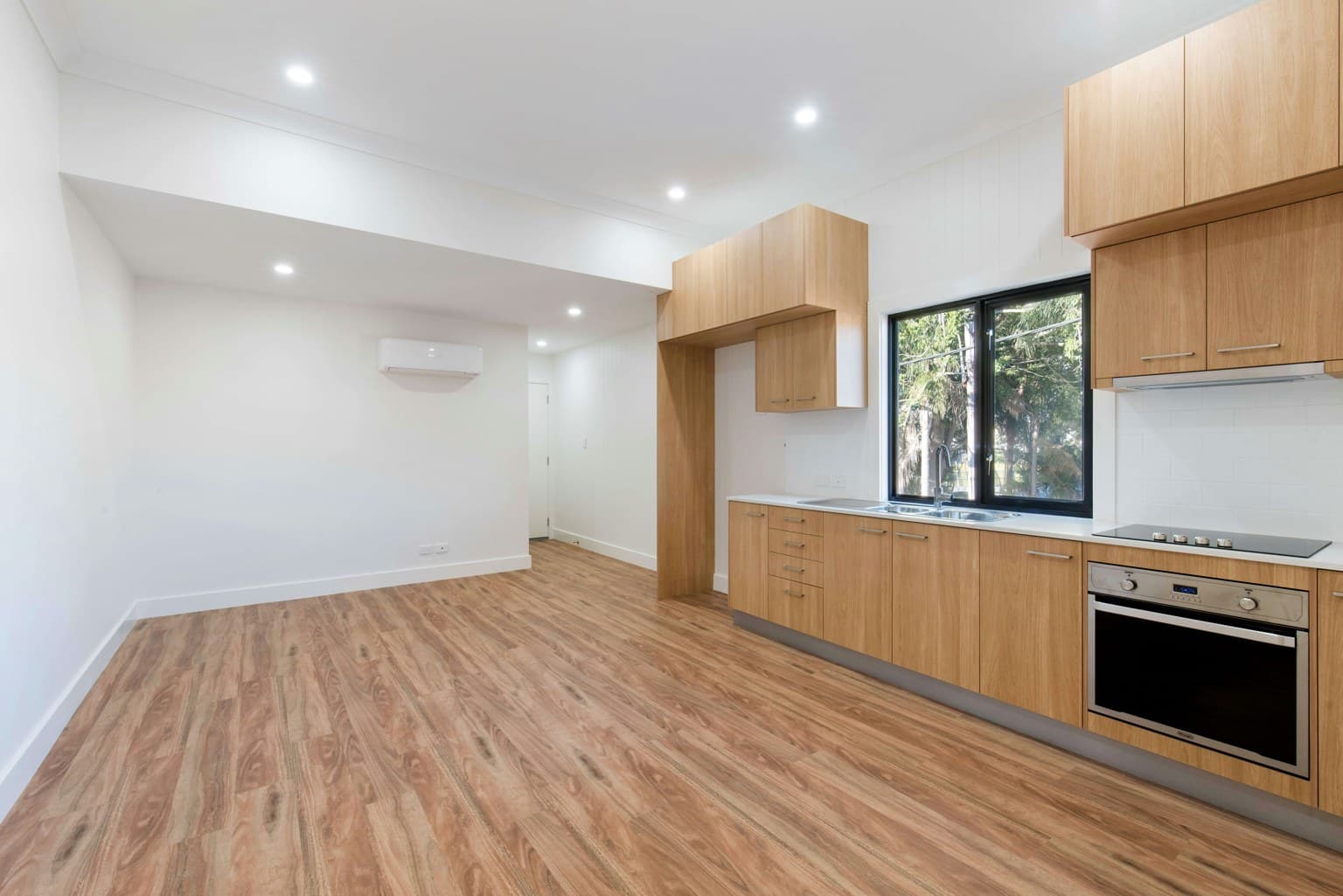
Water-resistant laminate runs cheaper on materials than most vinyl, and all three of these floors install as floating click-lock floors, so labor lands in a similar range for an open room. The real split is how they handle water, and that's what should decide the room.
| Floor type | Materials (per sq ft) | Labor (per sq ft) | Water tolerance |
|---|---|---|---|
| Water-resistant laminate | $1-4 | $2-4 | Surface spills wiped up fast |
| "Waterproof"-marketed laminate | $2-5 | $2-4 | Holds longer at seams, still edge-vulnerable |
| Luxury vinyl plank (LVP) | $2-6 | $2-6 | Best; handles standing water on the surface |
Typical US material and install ranges for floating click-lock floors; open rooms trend to the low end, cut-heavy jobs to the high end. The two laminate rows share the same labor range because water-resistant and "waterproof"-marketed laminate go down with the identical click-lock method, the water rating changes the core, not the install steps. Luxury vinyl plank's (LVP) labor tops out higher because some LVP jobs call for glue-down instead of floating.
To put those per-square-foot ranges in real terms: a typical 1,000 sq ft room running water-resistant laminate at $3-8 all-in per square foot lands around $3,000-$8,000 total. The same room in "waterproof"-marketed laminate, at roughly $4-9 all-in, runs about $4,000-$9,000. LVP over that same footprint, at $4-12 all-in, runs about $4,000-$12,000, with the top end reflecting jobs that need glue-down installation.
Those labor numbers are for a straightforward open room. Basements and stairs cost more, because both are full of cuts, transitions, and prep. I stopped quoting flat rate by the square foot after one job packed with closets, doorways, and a bay window ate an extra full day. The open middle of a room is never where the hours go.
The laminate-versus-LVP call is a real tradeoff, not a winner. Laminate often gives a more realistic wood look and a lower material price, while luxury vinyl plank tolerates water far better. Put laminate in the dry rooms and vinyl where water lingers. That water-versus-look split is just one line item on a longer list of what actually separates the two floors, and nine ranked differences between LVP and laminate breaks down each failure point one at a time.
One durability note that saves regret: a floor's toughness tracks with its AC rating more than its price tag. A cheap AC5 plank will outlast a pricey AC3 one in a busy hallway. For a deeper look at what different floors run once you factor in prep, our laminate flooring cost breakdown splits it out room by room.
If you'd rather start from the brand list, our ranking of the best laminate for what each one is actually good at names which lines back up their water claims with real specs, so you're not shopping on the box alone.