
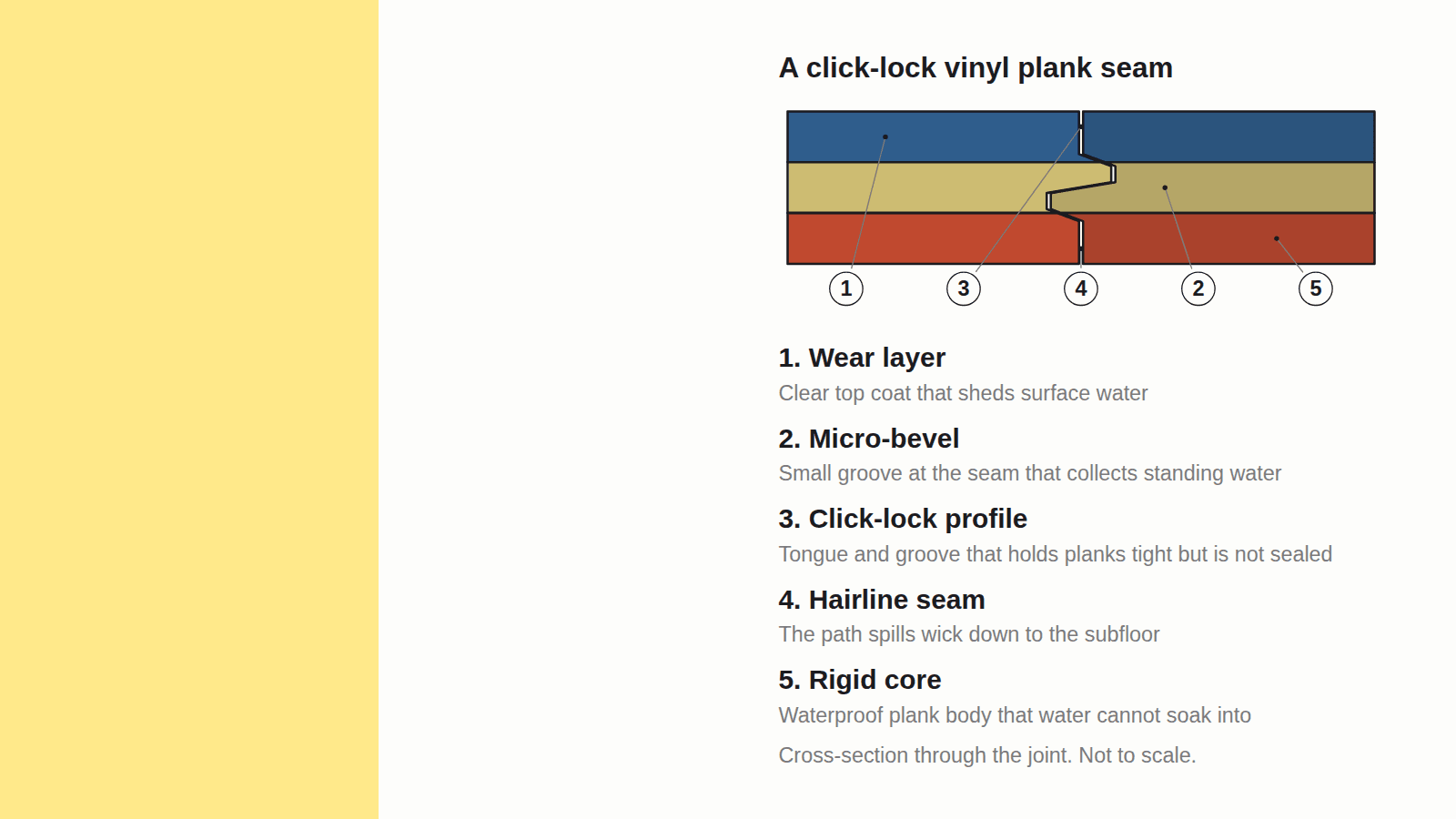
The word "waterproof" on a vinyl box sells the floor, but it describes the plank in your hand, not the floor once it's down. That gap is where I end up back in a bathroom, pulling up planks and chasing mold and lifted seams. These 8 things decide whether your waterproof vinyl flooring actually keeps water out.
Key takeaways
- The plank core is waterproof, but the installed floor is only water-resistant at the seams, the perimeter, and the subfloor, which is where almost every failure starts.
- Sheet vinyl has the fewest seams, so its surface is the hardest to get water under; among planks, SPC rigid-core is the most stable choice for wet rooms.
- On a floating floor, spilled or leaking water slips under the planks at the perimeter gap and sits on the subfloor, where it will not dry on its own.
- Budget about $2-$7 per square foot for materials and $2-$5 for labor, so most jobs land near $4-$12 installed, with basements and stairs costing more.
- A floor that truly holds water out needs a flat, moisture-tested subfloor plus the right underlayment, and in tile transition zones a backerboard like USG Fiberock AquaSmart.
The Half-Truth: "Waterproof" Describes the Plank, Not the Floor
The short answer: the PVC (polyvinyl chloride) or stone-plastic plank itself will not soak up water, but the finished floor is only water-resistant at its seams, its edges, and the subfloor underneath it.
That's why shoppers get confused when a product is sold as "waterproof" on the front of the box and "water-resistant" in the fine print. Both lines are true. They're just talking about different parts of the floor.
The plank core is the part that's genuinely waterproof. It won't swell or rot if water sits on top of it. The seams and locking edges are only water-resistant, meaning water can still wick down through them given time. And the room and the subfloor? The waterproof claim never covered those at all.
So treat "waterproof" as a claim about one material, not a promise about your bathroom. If you want to know how much the marketing word is really doing, it helps to see what that "luxury" label actually buys you and how the industry draws the line between waterproof and water-resistant in its own fine print.
Leak Point 1: The Seams Between the Planks
Standing water finds the seams first. On a click-lock floor, every joint has a tiny gap and most planks have a small micro-bevel groove along the edge for a realistic wood look. Water pools in that groove, then wicks down the hairline seam to the subfloor, where you can't see it. If that realistic wood grain is the main draw for you, it's worth comparing options in wood look vinyl flooring guide before you pick a plank.
The plank won't care. It won't swell. But the water that slipped underneath it has nowhere to go on a floating floor, so it sits. Sitting water breeds mold and a musty smell, and over months it can lift planks at the joints.
Wipe spills fast and don't let water pond on the floor overnight. In rooms that take real splashing, a full bath or a mudroom, lean toward glue-down or sheet vinyl, which give water far fewer paths down to the subfloor than a floating click-lock floor does.
Leak Point 2: The Perimeter Gap at Sliders and Doors
Every floating floor needs an expansion gap around the whole room so the planks can move with temperature. That gap sits hidden under your baseboard or trim, and near a slider or an exterior door it's an open door for water to run straight under the floor.
I learned to respect that gap for two reasons at once. I laid rigid-core plank tight against a south-facing slider for a customer who hated the look of the gap under the trim. The sun cooked that run all summer, and with no room to move, the planks lifted at the joints by the next warm spell. That same tight edge is exactly where water would have run under too.
Leave the expansion gap the manufacturer calls for, every time. Run a silicone bead at thresholds and wet edges to slow water at the door. And don't try to solve the water problem by gluing the field of a floating floor down. That fights the floor's need to move and trades one repair job for another.
Leak Point 3: The Subfloor You Can't See
Moisture doesn't only come from above. It rises up out of concrete slabs and damp basements, and a floating floor traps that moisture against the back of the plank. That's how mold grows underneath a floor everyone swears is waterproof.
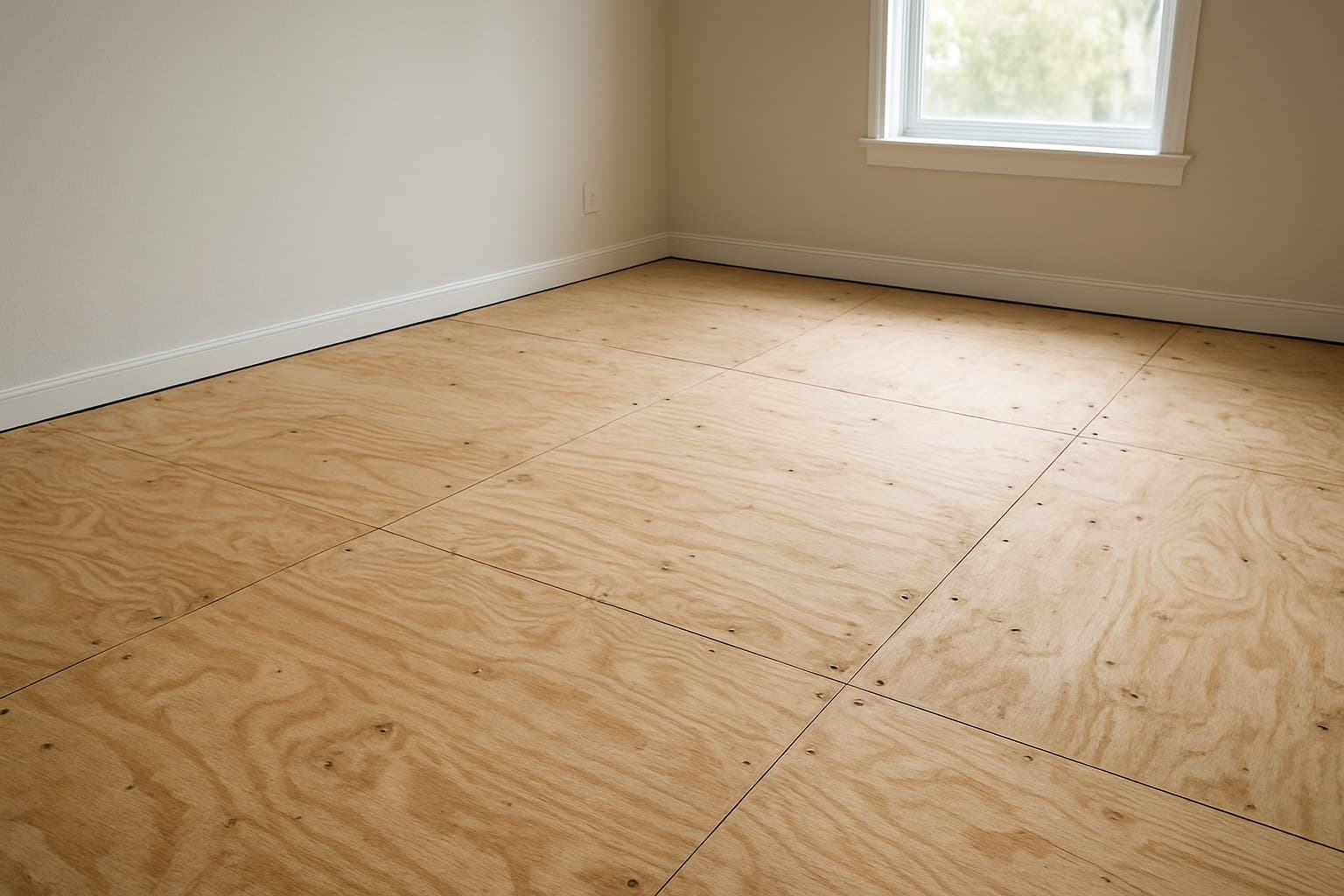
Before anything goes down, I do two checks together, not one. First a moisture test on the slab, using a method that meets ASTM (American Society for Testing and Materials) standards (ASTM is the industry group that writes the official rules for testing building materials), either the calcium chloride test that measures how much moisture comes off the slab, or an in-slab relative humidity probe, and the reading has to meet the product's own limit. Second a flatness check, dragging a long straightedge across the floor and measuring any dips against the maker's tolerance.
Both matter for different reasons. A flat floor stops lippage and gaps between planks. A dry slab stops mold. You need both true before a single plank goes down, and no amount of waterproof plank makes up for skipping either one.
My checklist for every job, every time:
- Moisture test the slab or subfloor with an ASTM-standard method and meet the product's limit
- Check flatness with a straightedge, grind high spots and fill low spots to the maker's tolerance
- Confirm the subfloor is clean, dry, and structurally sound
- Add a vapor barrier over concrete and in basements where the product calls for one
Below-grade rooms are their own project, so if you're going over a slab downstairs, work through a basement vinyl plank approach before you buy, because the vapor barrier choice changes everything there.
Leak Point 4: Fixtures in Bathrooms and Kitchens
The sneakiest leaks aren't spills. They're slow drips at a toilet flange, a tub or shower edge, or a supply line behind a dishwasher or fridge. Water from those runs along under floating vinyl for weeks before a plank finally cups or a smell gives it away.
Waterproof Vinyl for Bathrooms
In a full bath, I'll often steer people away from floating plank and toward sheet vinyl or tile. Fewer seams means fewer places for toilet and shower water to get under the floor. If you want to see where each bathroom material actually fails, I ranked the waterproof bathroom floor options by where they leak so you can match one to your layout.
Waterproof Vinyl for Kitchens
In a kitchen, floating plank is usually fine, with one habit: keep a box of extra planks from your install. If a dishwasher or ice-maker line ever leaks, you can pull and replace just the run around that appliance instead of patching with a plank that no longer matches.
Match the Vinyl Type to the Room
There's no single "most waterproof" vinyl. There's the right type for the room and its moisture level, and the right product within that type. Sheet vinyl usually has the fewest seams, so its surface tends to be the hardest to get water under. Among planks, an SPC (stone plastic composite) rigid-core is usually the most stable choice for a wet click-lock job, but "usually" matters, because the exact seam rating and waterproof claim come from that product's own spec sheet, not just its core type. Once you've settled on a type, best vinyl flooring guide rounds up the specific products and brands worth comparing spec sheets on.
The real families break down like this. SPC rigid-core LVP, that's luxury vinyl plank, the long plank-shaped pieces, has a dense stone-plastic core that stays stable; it's usually my first pick for wet click-lock rooms, though the seam rating still comes down to the specific product. WPC (wood plastic composite) rigid-core is a wood-plastic core that feels softer and warmer underfoot but is thicker and less steady in strong sun. Flexible glue-down LVT, luxury vinyl tile, the same material cut into tile-shaped pieces, bonds tight to the subfloor with few paths for water, as long as it's fully stuck down with the right adhesive. Sheet vinyl is one continuous piece. Peel-and-stick tile has the weakest seams of the bunch, since the thin adhesive backing wears over time.
| Type | Core | Seam risk | Best room | Watch out |
|---|---|---|---|---|
| SPC rigid-core LVP | Dense stone-plastic core | Usually low on click-lock, but check the product's own seam rating | Bathrooms, kitchens, basements | Perimeter gap is still open to water |
| WPC rigid-core LVP | Wood-plastic core, softer underfoot | Usually low to moderate; varies by product | Kitchens, living areas | Thicker, less stable in strong heat and sun |
| Flexible glue-down LVT | Thin flexible vinyl | Low only when fully bonded with the right adhesive | Mudrooms, baths | Needs a dead-flat subfloor and full adhesive |
| Sheet vinyl | One continuous sheet | Lowest surface risk among most sheet products | Full bathrooms | Edges and seams still need sealing |
| Peel-and-stick tile | Self-stick squares | High on most peel-and-stick products | Low-traffic, tight budgets | Seams lift once water gets in |
How these vinyl categories typically compare on core, seam risk, and room, but check the specific product's own spec sheet before you buy.
Plenty of vinyl now mimics grouted tile, and it can look convincing, but it will never have the dead-hard surface or the real grout lines of porcelain. If you're genuinely weighing tile against a tile-look vinyl, read the hexagon tile decisions that come back as callbacks first, because the install is a different animal. And if the whole choice is still vinyl versus laminate for you, that luxury vinyl vs laminate tradeoff comes down to laminate's better, cheaper wood look against vinyl's higher water tolerance.
Build the Full Waterproof System
A waterproof plank is one layer in a stack, and the stack is what actually holds water out. From the bottom up: a flat, moisture-tested subfloor, a vapor barrier where the product and the room call for one, the right underlayment, and the plank on top.
One warning on underlayment. Many rigid-core LVP products already have a pad attached to the back, and adding a second underlayment under those can void the warranty. Whether you need any underlayment at all is set by that specific product's instructions and the subfloor it's going over, not a blanket rule.
In a wet area where vinyl meets tile, a transition zone around a shower or a tub, use a documented moisture- and mold-resistant backerboard like USG Fiberock AquaSmart Tile Backerboard and Underlayment. According to USG's own Environmental Product Declaration for that product, it is documented as moisture- and mold/mildew-resistant and is listed for use as an underlayment beneath vinyl flooring. That gives the tile side a stable, water-tolerant base right where two materials, and two seams, come together.
On the DIY line: click-lock SPC in an open room is realistic for most handy homeowners. Glue-down LVT, stairs, and large open-plan jobs with moisture transitions are where I'd hire out, because the subfloor prep and the adhesive work are easy to get wrong and expensive to redo.
What a Watertight Install Really Costs
Budget two numbers, not one. Materials for waterproof vinyl run roughly $2 to $7 per square foot depending on the core and wear layer, and labor runs roughly $2 to $5 per square foot. That puts most installed jobs somewhere in the $4 to $12 per square foot range all in, though exact pricing varies by region, product, and installer.
| Cost piece | Range per sq ft |
|---|---|
| Materials (plank, underlayment, trim) | $2 - $7 |
| Labor (prep and install) | $2 - $5 |
| Installed, all in | $4 - $12 |
Those are open-room numbers. Basements cost more because of moisture prep and vapor barriers, and stairs cost more because every tread and riser is cut and wrapped by hand. A flight of stairs can run the labor well past the per-square-foot rate you'd pay in a bedroom.
Don't shop that number on price alone. A customer once took the cheapest of three bids over mine. Six months later she called me to fix the lippage and gaps the low bid left, and the repair plus the redo cost her more than my original quote. The prep you can't see is what the whole waterproof claim rides on.