Waterproof flooring for a bathroom can still leak, and it's almost never the surface that fails. A $4-$10 per sq ft SPC vinyl floor, caulked wrong at the toilet base or the tub line, lets water under the plank just as fast as a cheap one does. That gap between the box's waterproof claim and the real leak path is where this ranking starts.
I've pulled up enough bathroom floors to see exactly where they let go, and the seams and grout joints take the blame more often than the plank or tile itself. So I ranked these six by how well they seal at those spots, with real material-and-labor numbers and the exact place I've watched each one fail.
Key takeaways
- Every bathroom floor fails at the same spot: the seams and the perimeter gap hidden behind the baseboard, not the middle of the plank. A waterproof core does not mean a waterproof floor.
- For a tight budget and a small bath, sheet vinyl at about $2-$7 per sq ft installed has almost no seams, so it's the hardest floor for water to get through.
- Porcelain tile lasts the longest but costs the most to install, roughly $10-$25 per sq ft, because of cuts and grout labor in a small room; seal the grout.
- SPC rigid-core LVP is the best all-around pick: waterproof core, click-lock, DIY-friendly, about $4-$10 per sq ft installed, but you must caulk the perimeter and around the toilet.
- Laminate and engineered hardwood are water-resistant only, so keep them out of a full bath unless you accept swollen seams over time.
Where Every Bathroom Floor Actually Leaks
The plank surface or the tile body almost never lets water through. The failure happens at the seams, the grout joints, and the expansion gap behind the baseboard, which is the open channel every floating floor leaves at the wall so it can move.
Two phrases get blurred all the time, so let's split them. A "waterproof core" means the guts of one specific plank, say an SPC vinyl, won't swell if water sits on it. "Water-resistant seams and edges" is a different claim, and it's the weaker one. Water doesn't attack the middle of a plank. It runs to the nearest seam or the perimeter gap and heads down. Once that distinction is clear, it's worth comparing vinyl against itself across categories, which is exactly what the best vinyl flooring guide sets out to do.
I'm not aware of any US standard that certifies a floor as "100% waterproof." That phrase is typically marketing language rather than a tested rating. Judge the seams and the install instead, which is why this list ranks by how well each floor seals at the edges, not by how good the surface looks.
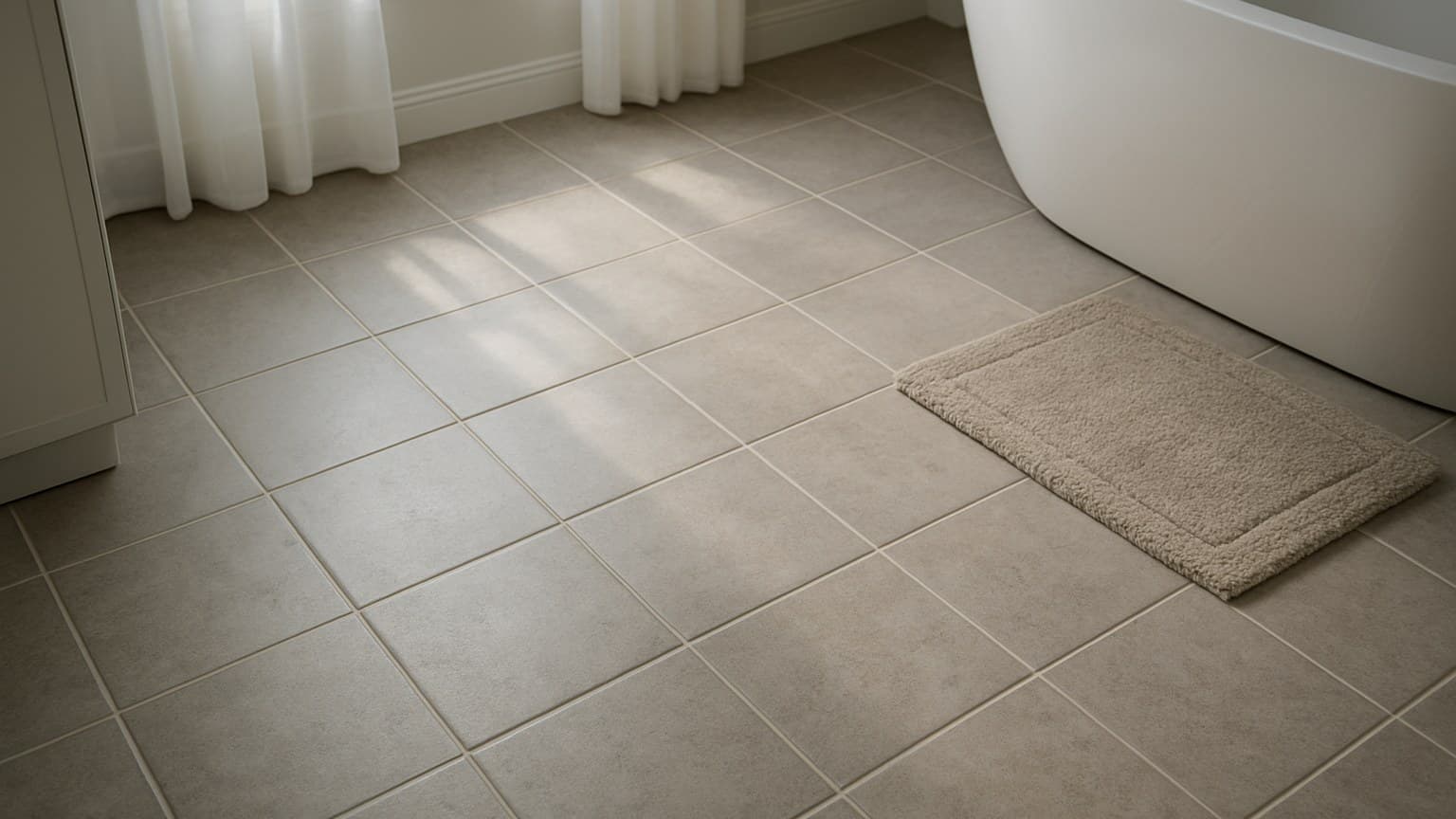
1. Porcelain Tile: The Longest-Lasting Benchmark
Porcelain tile is the floor I'd trust the longest, but the tile body isn't the leak path, the grout is. Seal the grout, and in a shower area put a waterproof membrane under the tile so water that gets through the joints can't reach the subfloor.
Cost splits sharply here. Materials run about $2-$10 per sq ft, but labor is the kicker at roughly $8-$15 or more, because a small bathroom is almost all cuts, layout, and grout time. That labor is why tile lands at the top of the price range.
For slip, pick matte or textured porcelain. Glossy tile is genuinely dangerous when wet. Smaller tiles mean more grout lines, which actually helps grip.
I did a bath in Dayton where the grout had cracked near the tub and wicked water under for months before anyone noticed. The tile was fine. Re-grouting and sealing stopped it, but it proved the point: tile outlives everything, as long as you treat the grout as the real seam.
2. Sheet Vinyl: Fewest Seams, Cheapest Water Barrier
In a small bathroom, sheet vinyl is the hardest floor for water to get through, because there's almost nothing for it to get through. Rolls run about 12 feet wide, so one sheet can cover a typical bath wall to wall with no field seam at all.
It's also the cheapest truly water-tight option. Materials run about $1-$4 per sq ft and labor about $1-$3. The textured embossing grips well underfoot, and it's a touch warmer and softer than tile, which matters on bare feet in the morning.
Where it fails is predictable: the seam at the doorway and the cut around the toilet flange. If those aren't glued and sealed, they lift. I pulled up a curling seam in a Columbus rental where water had been seeping under the floor at that exact seam for months, soaking the subfloor below. The sheet itself was perfect. The edge wasn't.
3. SPC Rigid-Core Vinyl Plank and Tile (LVP/LVT): Best All-Around
If I had to put one floor in most bathrooms, it's SPC rigid-core LVP. The stone-plastic composite core is waterproof, it clicks together so it's realistic for a DIYer, and it comes in both wood-look and tile-look. That combination makes it the best all-around pick for the money. The catch: the core being waterproof doesn't make the floor waterproof, so you caulk the perimeter and around the toilet. For a wider look at how other vinyl plank products compare once you step outside SPC, I ranked the field in the best vinyl plank flooring guide.
Cost is friendly. Materials run about $2-$5 per sq ft and labor about $2-$5, so most baths land around $4-$10 installed. For DIY-or-hire, this is the one most homeowners can actually do themselves. Click-lock planks in a small, mostly square room are forgiving. Where I'd still hire out is a glue-down install or a tricky transition to an adjoining room. If you want the full picture on what separates the good stuff from the filler, I broke it down in the best LVP flooring guide and what the word "luxury" actually buys you in this breakdown of the "luxury" vinyl label.
Waterproof core vs water-resistant seams
Picture it this way. The SPC core can sit in a puddle and not swell. But a floating floor isn't sealed to the subfloor, so water that reaches an unsealed seam or the perimeter gap runs down and pools underneath, where it sits on the subfloor and can grow mold. That's why I caulk the first row at the tub, the toilet base, and the whole wall line with a flexible silicone before the baseboard goes back on. The core buys you time; the caulk buys you the floor.
Wear layer and warranty, by product
Wear layer is measured in mils. A mil is one-thousandth of an inch, so it's just the thickness of the clear top coat protecting the print layer. That number is what separates a plank that survives a busy bathroom from one that scuffs fast. Don't trust a category claim, read the specific product's spec sheet. A thicker wear layer on one named SKU tells you nothing about the bargain box next to it. One more install note that bites people: most rigid-core LVP has a pad already attached, so adding a second underlayment underneath can void the warranty. Check the maker's instructions before you buy foam. Wear layer is just one piece of the puzzle, and I walk through the rest of what separates a vinyl floor that lasts five years from one that lasts twenty in what decides vinyl flooring's lifespan.
Honest caveat from the job: rigid core doesn't hide a bad subfloor, it telegraphs it. I've had seams peak over a lump the customer swore was dead flat. Before any plank goes down, check two things: moisture in the subfloor and flatness across it. Most makers want the floor flat within a set tolerance over a span, and a slab needs a moisture check too. A floating floor only lasts as long as the prep under it.
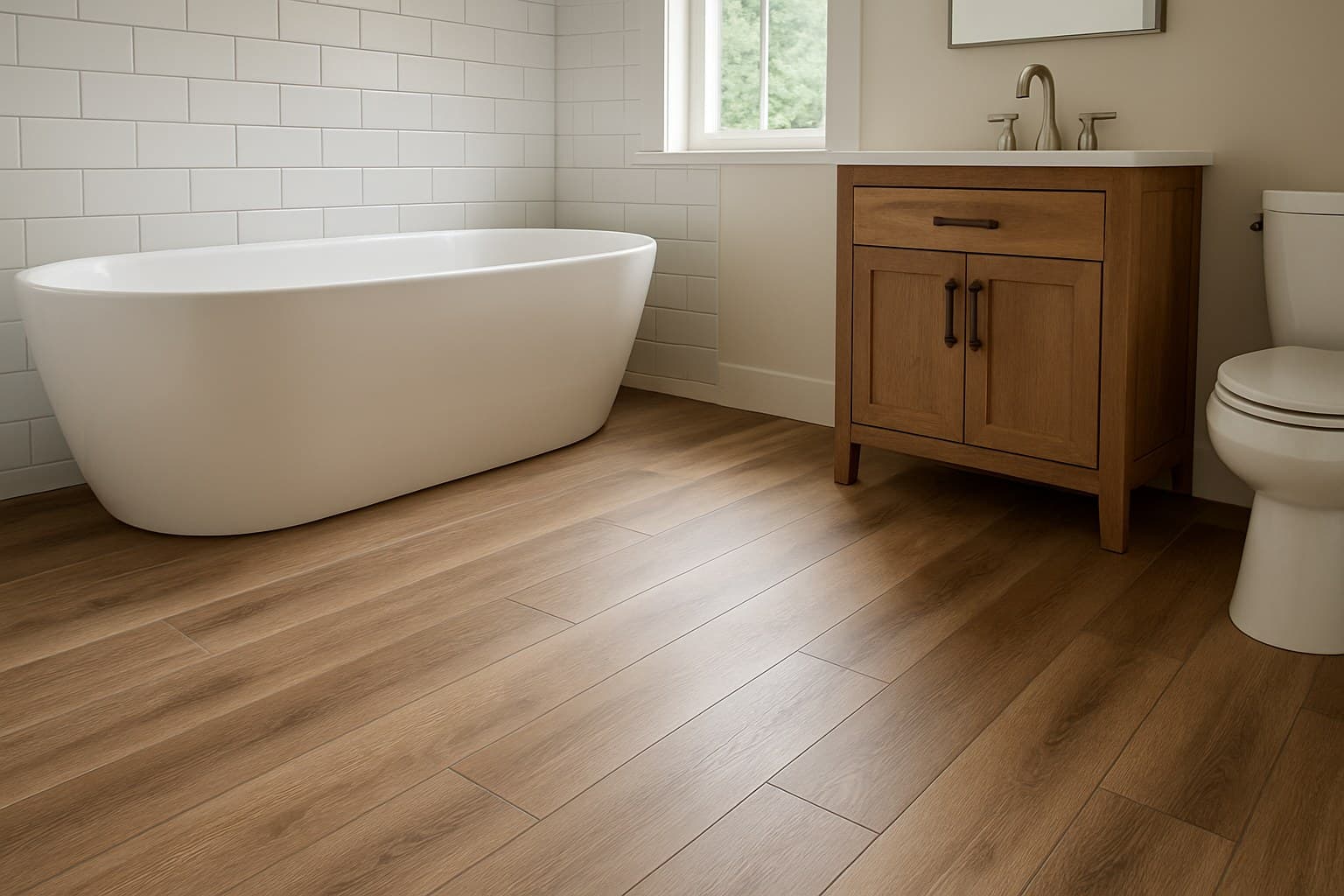
4. Waterproof Rigid-Core Hardwood: Real Wood on a Waterproof Core
This is a thin layer of real wood over a rigid waterproof core, so you get an actual wood surface with far more water tolerance than solid or engineered hardwood. It's still a floating floor with seams, so the same caulking rules apply.
Materials run about $5-$10 per sq ft and labor about $3-$6, which puts it in the upper-middle of this list. It fits powder rooms and half baths better than a shower-heavy full bath, and the thin veneer can still dent and scratch like any real wood.
Read the word carefully. "Waterproof" here means the core, not the finish and not the seams, and that rating is specific to the named product, never the whole category. If you love the wood look but want the water behavior, compare it honestly against vinyl in the wood-look vinyl flooring guide before you spend.
5. Engineered Hardwood: Still Risky in a Full Bath
Engineered hardwood has a plywood core that handles humidity better than solid wood, but it's water-resistant at best. Standing water still swells the seams and lifts the finish, so I don't recommend it for a full bath.
Materials run about $4-$9 per sq ft and labor about $3-$6. Where it works is a half bath with no tub or shower and a working exhaust fan. Keep it away from any tub skirt.
I saw this fail in a Cincinnati remodel where the boards cupped in a line right along the tub skirt. The homeowner kept wiping the top dry, but the water was coming from the gap below, down at the seam, where a rag never reaches. The surface looked clean the whole time it was failing.
6. Laminate: Only With Real Precautions
Laminate is last for a reason: the fiberboard core swells fast once water reaches it, and even laminate sold as "water-resistant" is built for splashes, not standing water. In a full bath, that's the wrong job for it.
Here's the real tradeoff people weigh. Laminate often gives a sharper, more realistic wood look for less money than vinyl. But LVP tolerates water far better, and a bathroom is exactly the room where that matters more than the grain pattern. I dig into that head-to-head by room in vinyl vs laminate flooring and luxury vinyl vs laminate.
Cost-wise, materials run about $1-$4 per sq ft and labor about $2-$4. If you insist on it in a powder room, silicone-caulk every edge, use a product rated water-resistant, and wipe spills fast. It still isn't my pick for a full bath.
The 6 Options Side by Side
Here's the whole list in one place: the waterproof verdict, the cost split, the wet-slip note, and what the warranty really covers, so you can read your own case off one row.
| Material | Waterproof verdict | Materials $/sq ft | Labor $/sq ft | Wet slip | Warranty reality |
|---|---|---|---|---|---|
| Porcelain tile | Tile is waterproof; grout is the weak point | $2-$10 | $8-$15+ | Good if matte or textured; glossy is slick | Tile rarely wears out; grout needs resealing |
| Sheet vinyl | Near-seamless; best in small baths | $1-$4 | $1-$3 | Textured embossing grips well | Term varies by product; check the specific line's warranty |
| SPC LVP/LVT | Waterproof core; seams must be caulked | $2-$5 | $2-$5 | Textured finishes grip; verify per product | Wear layer and term vary by product |
| Rigid-core hardwood | Core is waterproof, not finish or seams | $5-$10 | $3-$6 | Smooth; can be slick when wet | Core rating is product-specific |
| Engineered hardwood | Water-resistant only | $4-$9 | $3-$6 | Smooth; slick when wet | Not rated for standing water |
| Laminate | Water-resistant at best | $1-$4 | $2-$4 | Smooth; slick when wet | "Water-resistant" is time-limited, per product |
The table compares waterproof behavior, material and labor cost, wet slip, and warranty for six common bathroom floors.
Put the installed price per sq ft side by side and the spread jumps out. Tile and rigid-core hardwood run two to three times what sheet vinyl costs, mostly because of labor.
| Material | Installed $/sq ft |
|---|---|
| Porcelain tile | $10-$25 |
| Rigid-core hardwood | $8-$16 |
| Engineered hardwood | $7-$15 |
| SPC LVP/LVT | $4-$10 |
| Laminate | $3-$8 |
| Sheet vinyl | $2-$7 |
This chart shows the installed price per sq ft, material and labor combined, for each of the six floors.
The quick read: the cheapest water-tight floor is sheet vinyl, the best all-around is SPC LVP, and the longest-lasting is porcelain tile. One thing the chart can't show: a small bathroom, lots of cuts, and tricky doorway transitions push labor higher per sq ft than an open room, so budget above the low end if your bath is tight or busy. For a deeper material-and-labor breakdown, the LVP flooring cost guide walks the numbers room by room.