
LVP vs Tile: Which Floor Actually Wins Where (and Why)
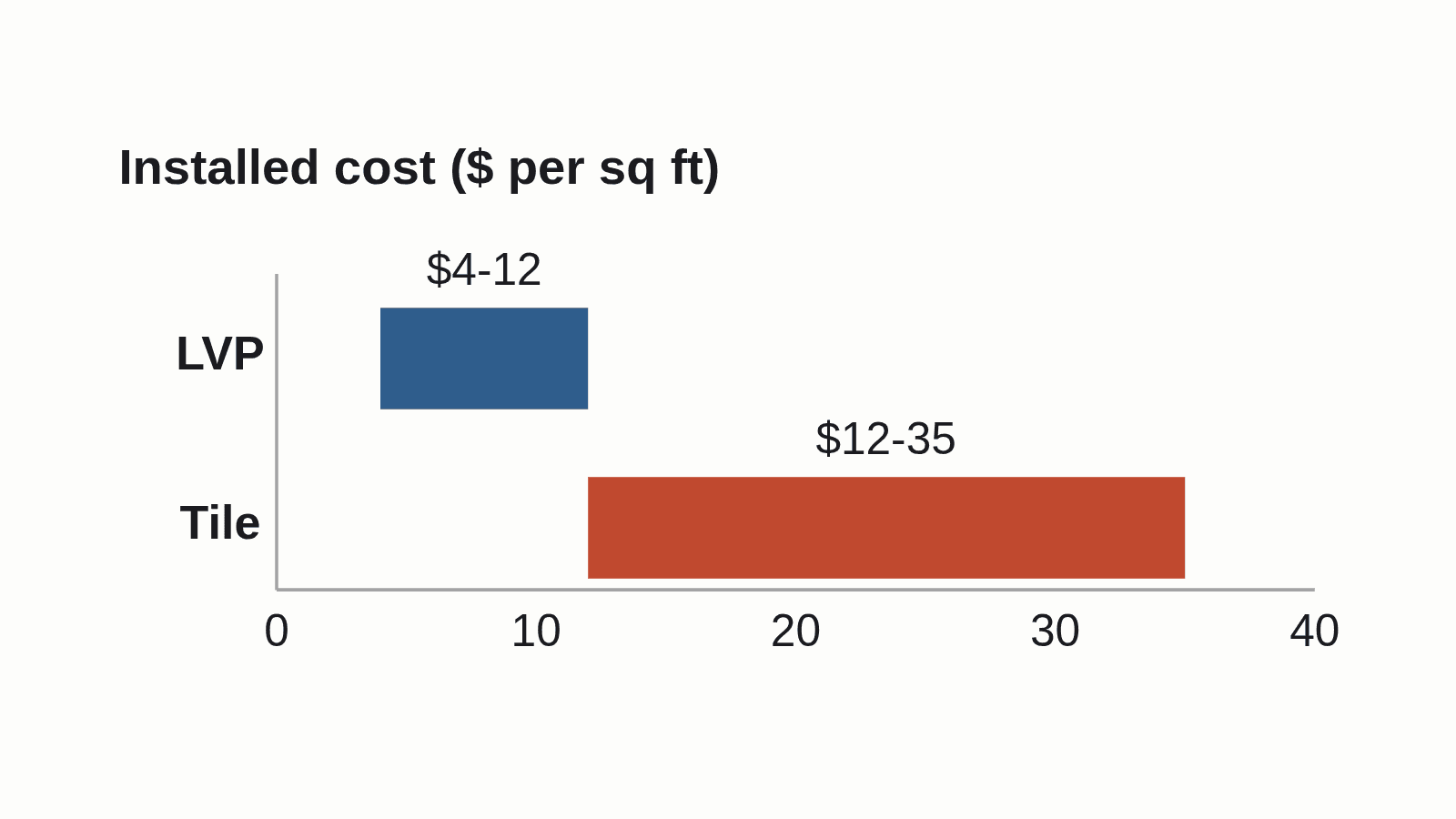
Most LVP (luxury vinyl plank) vs tile guides crown a winner and move on, but the real tradeoff is simple: LVP costs less, feels warmer, and is the one most homeowners can install themselves, while tile costs more upfront but shrugs off standing water and lasts decades longer. Installed, LVP runs about $4-12 per square foot and tile about $12-35. Match the wrong one to a room, though, and you end up paying for the floor twice. The same logic plays out one price tier down, where our tile vs laminate flooring guide walks through why the cheaper laminate option can end up costing more over the life of the floor.
Key takeaways
- LVP runs about $4-12 per sq ft installed; tile about $12-35 installed, but tile's longer life can make the cost per decade closer than the sticker suggests.
- Both shed water at the surface. The real failures are at LVP's click seams and tile's unsealed grout, not the plank face or the tile body.
- Click-lock LVP is realistic DIY for most rooms; tile, stairs, and basement moisture transitions are usually worth hiring out.
- Tile lasts roughly 20-50 years and LVP roughly 10-25, so tile wins on lifespan, but a flat, stiff subfloor matters more than any year count.
- Pick by room: LVP for basements, bedrooms, and comfort underfoot; tile for entries, mudrooms, full baths, and anything over radiant heat.
LVP vs Tile at a Glance
The short version: LVP is cheaper, warmer, and friendly to a weekend install; tile lasts longer and laughs off standing water. Neither is "better." The room decides.
A quick terminology fix, because other guides muddy it. LVP (luxury vinyl plank) and LVT (luxury vinyl tile) are the exact same product cut into different shapes, a plank or a square. Real tile is fired clay, either ceramic or porcelain. So "tile vs LVP" means fired tile against vinyl, not plank against square. Ceramic and porcelain also come cut into long plank shapes meant to mimic hardwood, a category the plank tile flooring guide covers on its own terms.
One wrinkle before we go on. There is now click-lock vinyl made to look like stone and tile, and it competes head-on with the real thing on looks while still being a floating vinyl floor. So if you want the tile look without the tile install, that is a third door.
The rest of this comparison is built around what actually wears out and fails, room by room, instead of a generic ranking. If terrazzo is also on your shortlist, the terrazzo floors guide breaks down how it wears and costs against both of these.
| Factor | LVP | Tile |
|---|---|---|
| Installed cost | $4-12/sq ft | $12-35/sq ft |
| Lifespan | 10-25 yrs | 20-50 yrs |
| Underfoot | warmer, softer, quieter | hard, cold, louder |
| Water | waterproof core, seams can creep | waterproof body, grout is the weak point |
| DIY realistic? | click-lock, yes | usually hire out |
| Repair | swap a plank | re-grout or match a tile |
LVP and tile compared across the six factors that decide most jobs.
Cost: Material, Install, and True Cost Per Decade
LVP runs about $4-12 per square foot installed; tile about $12-35 installed. The spread inside each number is mostly labor, and labor is where tile pulls ahead on price.
Split it out. LVP materials run $2-5 and the install $2-7, because click-lock planks go down fast. Tile materials run $4-15, but the install is $8-20 because someone has to set each piece in mortar, keep it level, and grout it a day later. That setting labor is the real reason tile costs more.
Now the math most guides skip. Divide the installed cost by how long the floor lasts to get cost per decade, and the gap narrows. Take LVP at $8 installed lasting 15 years: that is about $5.30 per square foot every 10 years. Tile at $22 installed lasting 35 years is about $6.30 per decade. Tile costs more up front but spreads that cost over more years.
This per-decade framing isn't just a blog trick, the National Wood Flooring Association runs a formal version of it. NWFA's Life Cycle Cost Analysis (LCCA) models the full ownership cost of 18 different flooring types, including tile and resilient flooring, across a 75-year span, rather than ranking materials by sticker price alone.
| Floor | Material | Labor | Installed | Lifespan | Cost per decade |
|---|---|---|---|---|---|
| LVP (click-lock) | $2-5/sq ft | $2-7/sq ft | $4-12/sq ft | 10-25 yrs | ~$2-12/sq ft |
| Porcelain / ceramic tile | $4-15/sq ft | $8-20/sq ft | $12-35/sq ft | 20-50 yrs | ~$2-18/sq ft |
Installed cost range per square foot, LVP against tile.
One more thing a single number hides: basements and stairs cost more than an open living room. More cuts, more transitions, moisture prep on a slab, and the slow work of wrapping treads all add labor. A per-square-foot quote pulled from a big open room will undersell those jobs for either material.
On DIY, click-lock LVP is realistic for a handy homeowner and is where you save the most. Tile labor is the bigger line, and it is also the harder skill, so hiring it out is usually where the money is well spent.
Durability and Lifespan: What Actually Wears Out First
Tile lasts roughly 20-50 years; LVP roughly 10-25. The ranges are that wide because install quality and traffic matter more than the material itself. A tile floor set over a flexing subfloor can crack in a year, and a cheap LVP in a busy entry can dull in five.
| Floor | Lifespan |
|---|---|
| LVP | 10-25 yrs |
| Tile | 20-50 yrs |
Working lifespan ranges, LVP against tile, assuming a sound subfloor.
On the floors I tear out around the Dayton and Columbus area, mostly kitchens, baths, and basements in the ten- to twenty-year range, this is what typically fails first. LVP's wear layer, the clear top coat, scuffs and goes dull where grit grinds in, and planks can gap at the seams if they moved during install. Tile cracks when the floor under it flexed and the tile had nowhere to give, not because the tile itself is weak. Most of those early gapping and scuffing problems trace back to a plank that was already a poor match for the room, which is the whole case for learning how to spot a plank that'll fail before it ever gets installed.
That is why subfloor stiffness decides tile's fate. The Tile Council of North America, the group that writes the install rules installers follow, calls for a floor that does not flex more than its span divided by 360 for ceramic, and divided by 720 for natural stone. In plain terms, a 12-foot joist span should not deflect more than about a third of an inch under load for ceramic, and half that for stone. A bouncy joist bay cracks both the tile and the grout.
For wear, never trust a generic mil number you read online. A thicker wear layer resists scuffing only on the specific product it is printed on, so read that SKU's own sheet. If you want the fired-clay side of the story, the porcelain tile breakdown digs into density and wear ratings tile by tile.
Water Resistance, Room by Room
Both floors shed water at the surface. The real difference is what happens at the weak points: LVP's click seams and tile's grout.
LVP with a rigid SPC core (stone-plastic composite) has a waterproof middle, true. But water that sits long enough can creep down through the click seams and reach the subfloor underneath. The core does not swell, yet the floor beneath it still can. Tile's body is waterproof too, but unsealed grout wicks water like a sponge, which is why grout is where wet-area tile fails.
In a real wet area, tile wins. In a full bath or a shower surround, tile set with sealed grout, or a tougher epoxy or urethane grout, beats LVP because there are no plank seams for standing water to find. If you are weighing the look, the bathroom tile ideas guide covers the floor side, and if you still want vinyl's give, there are vinyl tiles made for bathrooms worth a look. If natural stone is more your style than ceramic, the stone bathroom tiles guide covers how slate, marble, and travertine handle that same moisture test.
In the kitchen, both handle splashes fine. Tile shrugs off a slow dishwasher leak longer because the water has nowhere to soak in. LVP is more forgiving of the everyday stuff, like a dropped glass that would chip a tile. Anyone planning the whole kitchen floor rather than just the material choice will find the kitchen tiles guide useful for layout and pattern ideas that work with either option.
Comfort, Warmth, and Sound Underfoot
LVP is warmer, softer, and quieter to walk on. Tile is hard, cold, and it echoes. That gap matters most in bedrooms and anywhere you stand for a long stretch, like at a kitchen counter.
On radiant heat, tile is the better partner. It conducts heat well, so in-floor warmth comes through fast and even. LVP can go over radiant heat, but only up to that specific product's stated maximum temperature, so you have to check the SKU before you commit. Run it hotter than the sheet allows and you risk gapping or curling.
For standing comfort in a kitchen or laundry, LVP's slight give is easier on feet and backs over a cold slab. And on sound, tile amplifies dropped objects and foot traffic while LVP dampens both, which is why upstairs rooms often lean toward vinyl.
Maintenance and Repair Reality
LVP is wipe-and-go with no sealing, ever. Tile is low-maintenance on the face, but the grout needs cleaning and, for most types, sealing. High-contrast grout is the trap: a light tile with dark grout looks sharp on day one, then lightens where the mop hits most. Smaller-format tiles like hexagons multiply that grout-line math even further, which is why it's worth reviewing the hexagon tile decisions guide before you settle on a pattern.
I had a customer named Denise in a Dayton kitchen pick a dark grout against a pale tile, and within about eight months of normal daily mopping, it had faded unevenly right along the main walking path where the sealer wore thin. The install itself was fine, she hadn't done anything wrong. A high-contrast grout is a commitment to upkeep, not a one-time look, and I make sure people know that before they fall for the photo.
Repairs tell the same story two ways. A damaged LVP plank can be swapped out if you saved extras. A cracked tile means matching the color and re-setting it in mortar, and old tile gets harder to match as the years pass and dye lots change.
So buy attic stock of either one. Order a box or two extra of the LVP, or a few square feet of the tile, and store it. A future repair that matches the original dye lot is worth far more than the shelf space it costs.
Environmental Impact and Health
Tile is fired clay. It is inert, it does not off-gas, and it holds no smell. LVP is a plastic product, and new vinyl can release VOCs (volatile organic compounds, the fumes that give new material its smell) for a while after install.
That gap shows up in the numbers, too. An industry-wide Environmental Product Declaration (EPD) commissioned by the Tile Council of North America found that North American ceramic tile carries a significantly lower global warming potential than LVT across its full life cycle, from raw materials through end of life. It's one of the only published life-cycle comparisons between the two materials, and it's worth weighing alongside cost and comfort if environmental footprint factors into your decision.
If indoor air quality is a real concern in your home, look for vinyl that carries a recognized low-VOC certification such as FloorScore, which tests hard flooring for indoor-air emissions. It does not make vinyl identical to tile, but it rules out the worst offenders. Airing out a room for a few days after an LVP install also helps the fresh-plastic smell fade faster.
Installation: Subfloor First, Then DIY or Hire
Before either floor goes down, two checks come first, and skipping them is where most failures start. Check the subfloor for flatness, because a floating LVP floor that rocks over a hump will click apart and tile will crack over a dip. And check for moisture, especially on a basement slab, because trapped moisture ruins the bond under tile and can reach the subfloor under vinyl.
Click-lock LVP is realistic DIY for most rooms. If the subfloor is flat and dry, a careful homeowner can lay a bedroom or a living room in a weekend. Leave the expansion gap the manufacturer's sheet calls for around the whole perimeter; the exact size is theirs to specify, not a number you guess at.
Tile is where I tell people to hire out, along with stairs and any large open-plan moisture transition between rooms. Setting tile flat, keeping lippage down so edges do not stand proud, mixing mortar, and grouting clean are all skills that take reps to get right. Glue-down work on a slab belongs on that list too. A bad tile job does not show up the day it is done; it shows up as cracks a season later.
Which One for Whom, by Room
Pick by the room, not by a headline. Room by room, this is how I sort it on real jobs.
LVP is the call for basements, bedrooms, and anywhere comfort underfoot matters. It handles a slab's quirks better, it is warmer and quieter, and most of it you can install yourself. It is also the budget-friendly pick when you want a wood or stone look fast, and products like wood-look tile are really the vinyl's main rival for that job.
Tile is the call for entries, mudrooms, full baths, and anything over radiant heat. Those are the spots that see standing water, grit, and heat, and tile outlasts vinyl in every one of them. If you want a softer, stone-flavored look that still takes the abuse, a limestone-look porcelain tile gives you the warmth of stone without the sealing that natural stone demands. Once you've settled on tile for one of those rooms, sizing up to a large hexagon shape brings its own set of layout and scale tradeoffs worth weighing, covered in this large hexagon tile guide.
And if you are torn between the two looks, remember the click-lock vinyl option from the top of this guide splits the difference: tile and stone looks with a vinyl install.
Resale Value: Does the Floor You Pick Matter at Sale Time?
If you are choosing between LVP and tile with a future sale in mind, the honest answer is that the room matters more than the material. A buyer and an appraiser both read flooring by condition and consistency first, specific product second.
In a primary bathroom or a kitchen, tile still tends to read as the more finished, higher-end choice, and it is the safer pick if you are renovating specifically to prep a house for listing. Quality click-lock LVP, on the other hand, is now widely accepted in bedrooms, basements, and living areas; it no longer carries the "cheap vinyl" stigma it did a decade ago, and most buyers walking through a listing will not count it against the home in those rooms.
Where I have seen floor choice actually hurt a sale is not LVP versus tile at all, it is a patchwork of three or four different floors across one level, or flooring that is visibly worn, chipped, or gapping at the seams. If you are renovating to sell on a budget, that points to a simple split: spend the tile money in the wet rooms where it reads as an upgrade, and use solid LVP everywhere else rather than stretching a smaller tile budget thin across the whole house.
Sources
- Tile Council of North America: Industry-Wide EPD Shows Ceramic Tile's Lower Global Warming Potential vs. LVT
- Tile Council of North America: "Tile, the Natural Choice" (2025 Report)
- National Wood Flooring Association: Life Cycle Cost Analysis (LCCA)
- Tile Council of North America: 2025 Tile Initiative Report