A homeowner in Scottsdale named Teresa handed me a "marble" sample and asked why it cost a third of the quarried stuff. The answer comes down to what she was actually holding: fired clay dressed up to look like stone. These six checks tell fired clay from real rock before it ever changes your install bill.
Key takeaways
- No. Porcelain is clay and minerals fired hard; "stone-look" porcelain just prints a stone pattern under the glaze, it isn't quarried stone.
- Per the ANSI A137.1 tile standard, true porcelain absorbs 0.5% water or less, which is why it never needs sealing and most natural stone does.
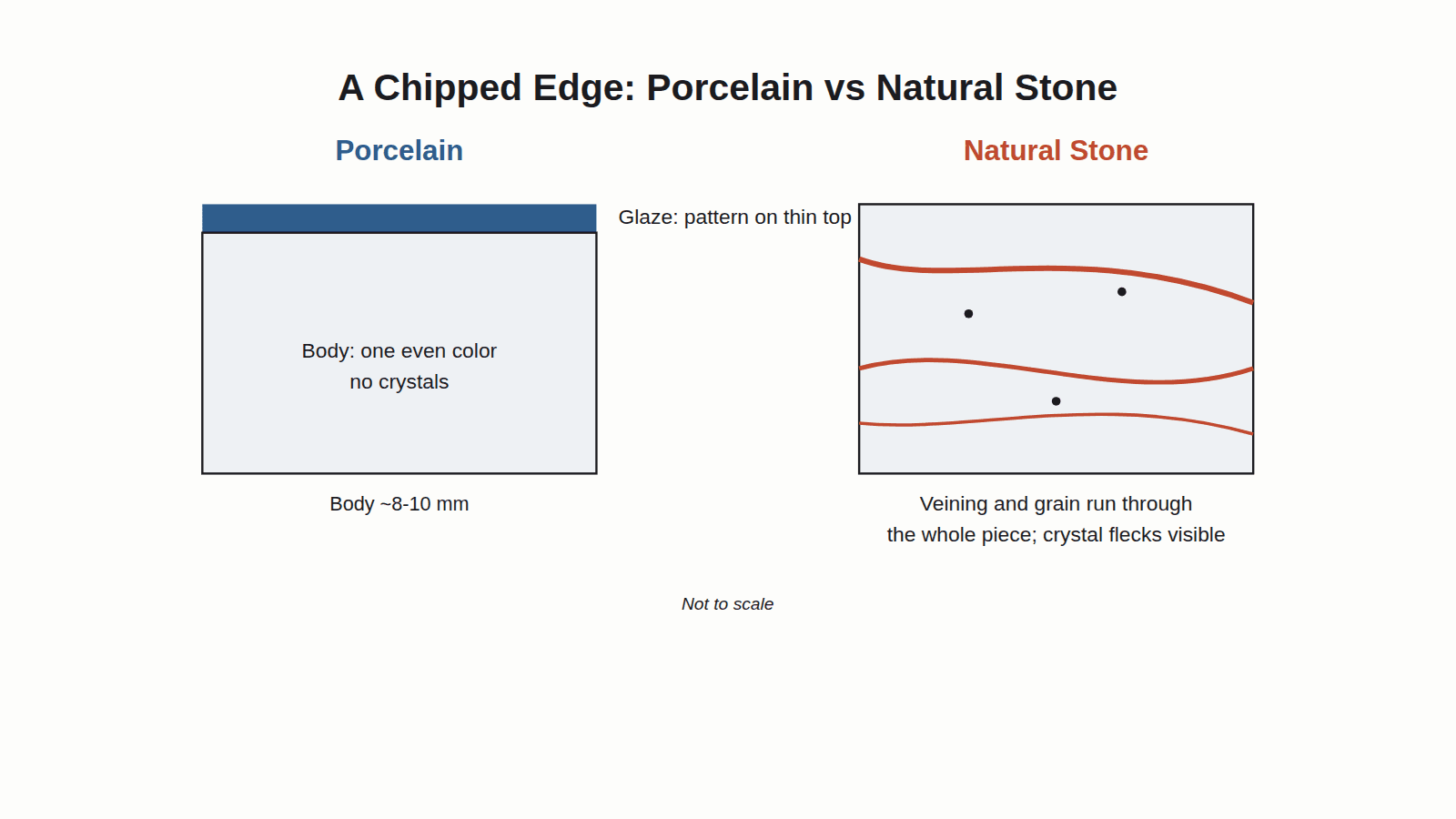
- Broken-edge test: porcelain shows one even body with the pattern only on top, while real stone's veining runs all the way through the piece.
- Materials run roughly $2-7 per sq ft for stone-look porcelain versus about $5-15 for natural stone, and stone adds ongoing sealing cost.
- Porcelain is denser and more brittle to cut (you need a diamond blade), but it shrugs off water and stains better than most stone.
The Short Answer: No, Porcelain Is Fired Clay, Not Quarried Stone
No. Porcelain is a mix of fine clay and ground minerals, pressed into shape and fired at very high heat until it turns hard and dense. Natural stone is the opposite story: it gets cut straight out of the ground as marble, granite, travertine, or slate, then sawn into tiles or slabs.
So where does the confusion come from? "Stone-look" and "marble-look" porcelain. On those tiles, a photo of real stone gets printed on the surface and sealed under a clear glaze. The pattern is skin-deep. It sits on top of the tile the way ink sits on paper, not woven through the material like veining in real marble.
People mix the two up for understandable reasons. Showroom names lean on words like "marble" and "travertine," the samples sit side by side, and a sharp print job fools your eye from a few feet away. You don't need a lab to sort it out, though. You need six checks you can run on a loose sample right there on the display.
Porcelain vs Natural Stone: What Actually Differs
The real differences come down to five things: how it's made, how much water it drinks, whether it needs sealing, how the pattern behaves, and price. Get those straight and the rest of the checks make sense.
The water number is the one that's actually measured. Under the ANSI A137.1 tile standard (that's the American National Standards Institute spec that defines what counts as porcelain), true porcelain absorbs 0.5% water or less by weight. Natural stone drinks more than that, which is why stone usually needs sealing and dense porcelain never does.
| Feature | Porcelain | Natural stone |
|---|---|---|
| What it is | Fine clay + ground minerals, fired hard | Rock cut from a quarry |
| Water absorption | 0.5% or less (true porcelain, ANSI A137.1) | Varies, often much higher |
| Sealing | Never needed | Most types, sealed periodically |
| Pattern | Repeats every few tiles (printed) | Every piece unique |
| Materials cost | About $2-7 per sq ft | About $5-15 per sq ft |
| Broken edge | One even, dense body | Veining runs through the piece |
Source: ANSI A137.1 for the porcelain absorption limit, plus my own install jobs
Porcelain vs natural stone across the five differences that change your budget and upkeep.
If you want the full picture on the real thing, read up on natural stone flooring and how the types rank on cost and upkeep. For the deep dive on the fired-clay side, the porcelain tile breakdown covers grades and uses. And it helps to remember porcelain is just one branch of a bigger tile family worth knowing before you shop.
Checks 1 and 2: Read the Broken Edge and the Back
The broken edge is the fastest tell there is. On stone-look porcelain, the printed pattern sits only on the top glaze, and the body underneath is one even color with no veining. On real stone, the veining and grain keep running right through the full thickness of the piece, because that pattern is the material, not a picture laid over it.
One fair warning: some porcelain is "through-body," meaning it's colored all the way through. That can trip you up for a second. But even through-body porcelain is one uniform man-made color, not natural veins that wander and change from edge to edge. Stone never looks that consistent inside.
Now flip the tile over. A porcelain back is finished and clean, often stamped with a maker's mark, grid lines, or shallow ridges. A stone back is raw sawn rock in its natural color, and thin cuts sometimes carry a mesh backing glued on for strength. A good sample store will let you look at a chipped corner or a cut-off piece, so ask for one before you buy.
Check 3: The Water-Drop Absorption Test
Put a few drops of water on the raw back or a chipped edge, wait 5 to 10 minutes, and watch what happens. Dense porcelain barely darkens because it drinks 0.5% water or less. Ceramic or natural stone soaks the drops right in and leaves a dark wet ring behind.
Here's the trap that fools people: the glazed top of any tile won't absorb water, so testing the finished face tells you nothing. Both a cheap ceramic and a true porcelain will bead water on the glaze. You have to test the unglazed edge or the back, where the raw body is exposed.
A lingering dark ring means the piece is pulling water in, so it is not dense porcelain. This is the closest thing to a home version of the lab absorption test, and it pairs well with the broken-edge check. Run both and you've answered the question two different ways.
Checks 4, 5, and 6: Weight, Price Tag, and Pattern Repeat
Three more checks, and the price tag is the loudest of them. Weight is only a supporting clue: both materials are heavy, but at the same thickness, natural stone often feels denser and varies more from piece to piece, while porcelain feels the same in every tile. Handy to notice, not proof on its own.
Price is where it gets obvious. Stone-look porcelain costs less than the real stone it copies. A bargain "marble" floor is almost always porcelain wearing a marble costume. If the number looks too good for quarried stone, it is not quarried stone.
Pattern repeat is the real giveaway. Lay out six or eight pieces and porcelain will start showing the same veins again, because it is a printed image on a repeating cycle. Real stone never repeats. Every piece is one of a kind, cut from a different spot in the block.
| Material | Materials cost ($ per sq ft) |
|---|---|
| Stone-look porcelain | $2 - $7 |
| Natural stone | $5 - $15 |
Materials-only cost ranges from my own tile jobs; labor is separate and covered below.
If you want the stone look done well, the count of how many pieces before the pattern loops back is what makes it read real. That's the whole game in a limestone-look porcelain tile breakdown, where a higher repeat count is worth paying for.
What the Difference Means for Sealing, Cutting, and Install
Once you know whether you're holding porcelain or stone, three parts of the job change: sealing, cutting, and how much prep and money the floor really needs. Here's the short version before the detail.
- Sealing: skip it. Dense porcelain won't absorb a sealer and doesn't need one. Real stone needs it periodically, and skipping it is a callback.
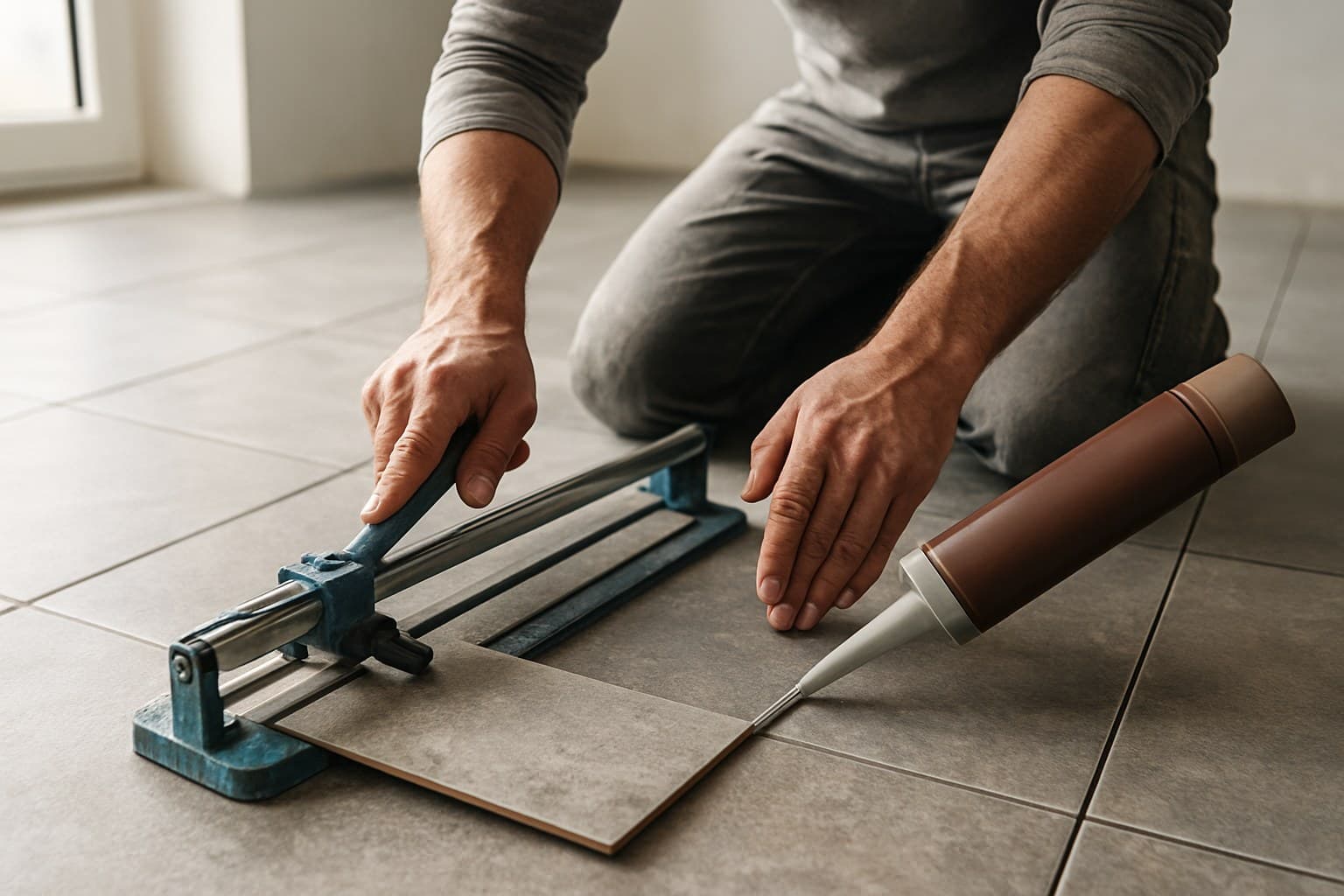
- Cutting: use a diamond blade and score slow. Porcelain is brittle and chips at the edge if you rush it.
- Subfloor: check flatness and moisture before anything goes down, for either material.
- Budget: split materials from labor, and expect stone to cost more up front and keep costing you in sealer.
Source: my own install jobs
Sealing and cutting
Sealing is the biggest split. Dense porcelain won't take a sealer because there's nowhere for it to soak in, and it doesn't need protecting from water or stains anyway. Natural stone is the reverse: it stays porous and needs sealing when it goes down and again every so often after. I've seen that skipped step turn into a stained stone floor and an awkward callback, and the hexagon tile guide walks through that seal-or-not decision in more detail if your tile is stone.
Cutting is the other change under your hands. Porcelain is harder and more brittle than most stone, so it wants a diamond blade and a slow, steady score, or it chips right at the cut edge. Natural stone cuts differently depending on the type, and softer stones like travertine behave nothing like a dense porcelain slab.
Subfloor prep and cost
For either material, the floor is only as good as what's under it. Check subfloor flatness and moisture before a single tile goes down. Large-format porcelain telegraphs every hump in the subfloor, and a wet slab can wreck the whole job. I relaid a cupped floor once on my own dime after a homeowner in Reno named Carl talked me out of a moisture test to save an afternoon, and that's the day I stopped treating that test as optional.
On cost, split materials from labor. Materials run about $2-7 per sq ft for stone-look porcelain and roughly $5-15 for natural stone, and stone piles on the ongoing sealing cost on top. Labor for a standard tile install commonly lands around $5-12 per sq ft depending on the layout, and it climbs for stairs, small cut-up bathrooms, and basement jobs over open rooms. Get the full picture in a tile installation cost breakdown split by material and labor, and if your tile meets wood at a doorway, plan the tile-to-hardwood transition before you set the last row.