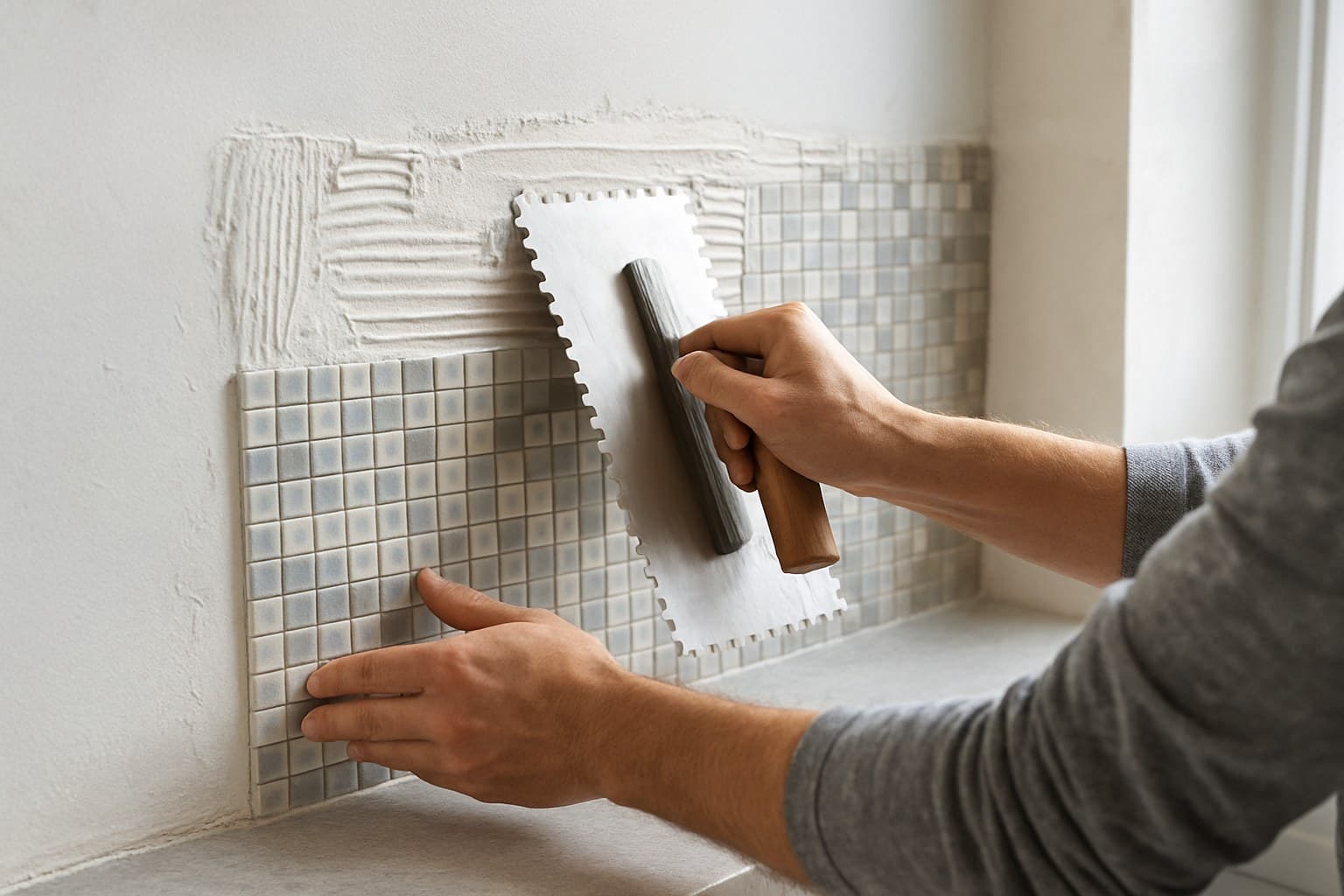
So what are mosaic tiles? Nearly every definition stops at "small tiles," which is true and useless the second you're kneeling on the floor with a sheet in your hand. The part that trips people up is what's holding those little tiles together.
Key takeaways
- Mosaic tiles are small tiles, usually under 2 inches, joined face-up on a mesh backing sheet you press into thinset as one piece.
- The mesh sheet is why they install fast on curves and shower floors, but it also packs in far more grout line: roughly 24 feet of grout per square foot on 1-inch tiles versus about 2 feet on a 12-inch tile.
- That grout is the whole tradeoff: more joints mean better grip underfoot but more sealing and scrubbing over time.
- Materials run from about $5-15 per square foot for ceramic up to $10-40 for glass, stone, and marble, with labor around $8-20 because small tiles take longer to set and grout than big ones.
- A small, flat backsplash is realistic DIY with sheets; shower floors, curved walls, and clear glass over thinset are usually worth hiring out.
What Mosaic Tiles Actually Are
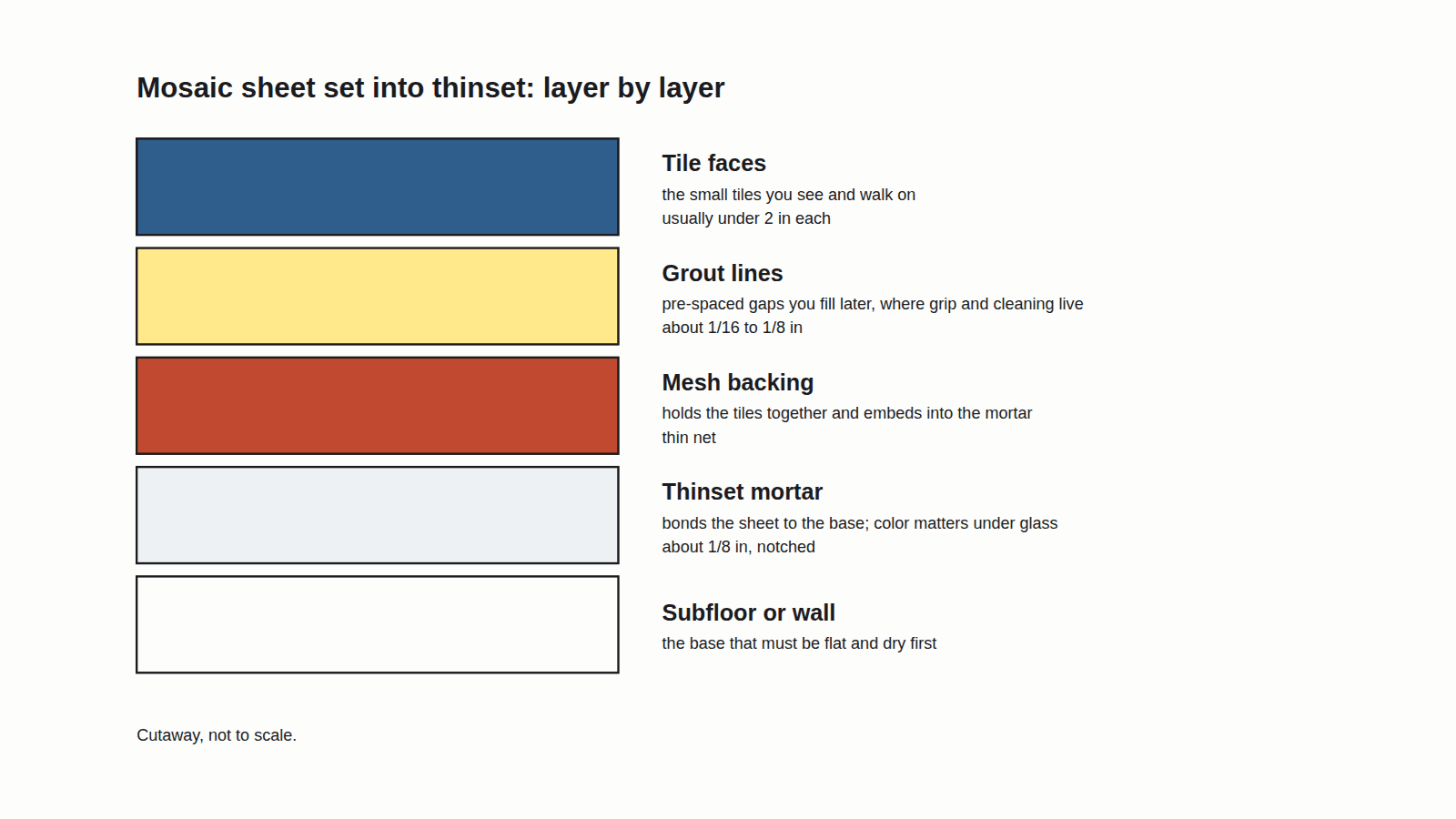
Mosaic tiles are small tiles, usually under 2 inches on a side, joined face-up on a backing so you set a whole cluster at once instead of placing one tiny piece at a time. That backing is almost always a mesh net.
Think of a mosaic sheet like a sheet of stickers made of tile. It's usually about 12 by 12 inches, and you press the whole thing into the mortar as one piece. That's the trick that makes tiny tiles buildable at all.
Here's the confusion I clear up on almost every job: mosaic is a format and a size, not a material. The same little tiles can be glass, porcelain, ceramic, natural stone, or metal — if you want the full rundown on that porcelain option, porcelain tile guide breaks down the different porcelain stone tiles available. Calling something a "mosaic" tells you how big the pieces are and how they come packaged, nothing about what they're made of.
Because the tiles come pre-spaced on the sheet, your grout gaps are set for you before you ever open the box. You don't space these by hand.
The Mesh Backing Is the Whole Story
That little mesh net on the back decides more about how the floor installs, what it costs to set, and where it holds up than the tile material does. Most definition pages never mention it.
One thing I won't let you skip: prep, and it happens before any mortar hits the floor. Mosaics telegraph a hump or a dip worse than big tiles, because there are so many little edges to catch the light. Check the base with a straightedge for flatness and a moisture meter (a tool that reads how damp the slab is) before a single sheet goes down. Get the subfloor flat and dry first, that's what decides whether the install below goes clean or comes back as a callback.
With the subfloor checked, here's how the install goes: spread notched thinset, that's just the mortar that bonds the tile to the base, with a toothed trowel that leaves ridges, then press the sheet in so the mesh embeds into that mortar, then butt the next sheet up tight so the seam between sheets vanishes into the grout pattern. Done right, you can't tell where one sheet ends and the next begins.
Now the classic glass callback, and it's a good example of why the mortar matters. With glass or any see-through tile, the thinset color shows straight through the tile. Gray mortar will muddy a bright glass backsplash into something dull and dirty-looking. White thinset is the fix, and skipping it is a mistake I've had to tear out and redo. On clear glass, the mortar is part of the finished color whether you planned it that way or not.
The layers of a mosaic install, outermost first, showing where color and prep decisions actually land.
Why All Those Grout Lines Cut Both Ways
More tiles means far more grout line per square foot, and that single fact drives almost everything else about a mosaic. On a plain grid, 1-inch tiles pack in about 24 feet of grout line per square foot. A single 12-inch tile has only about 2 feet. That's roughly twelve times the joint in the same space.
The upside is grip. All that grout is exactly why mosaics work well for shower floors and other wet spots. The joints give your feet something to hold, and the small tiles let the floor bend and slope toward a drain in a way one big tile never could.
The cost side is just as real: more grout means more surface to seal and scrub. On a floor mosaic that's ongoing work, not a one-time thing, so pick a quality grout and seal it. In a mosaic, the tile face almost never fails. The grout and the seams do. That's where a mosaic floor is won or lost over the years.
| Tile size | Grout line per square foot |
|---|---|
| 12-inch tile | 2 feet |
| 4-inch tile | 6 feet |
| 2-inch mosaic | 12 feet |
| 1-inch mosaic | 24 feet |
Grout line per square foot on a plain grid, from a 12-inch tile down to a 1-inch mosaic.
The Shapes and Materials You'll See on the Sheet
The material is what your eye picks, but each one behaves differently once water and traffic get involved. Here's the short version of what each is really for.
Glass is bright and reflective, good for a backsplash, but it needs white thinset so the mortar doesn't show through. Porcelain and ceramic are the cheapest and toughest, forgiving on floors, walls, and showers alike. Natural stone gives a warm, earthy look but it's porous, meaning it soaks up water and stains unless you seal it — a limestone-look porcelain tile gets you that same stone look without the sealing upkeep. Marble reads high-end with its veining, but it scratches and stains and has to be sealed. Metal tiles and penny rounds are mostly for accents.
On shape, the ones people search for are penny round (little coins), hexagon, mini subway, tiny square, and fish-scale. If the six-sided look is what you're after, it's worth reading up on hexagon tile in a bathroom and on large hexagon floor tiles, since those play by slightly different rules than the tiny stuff. Before you commit to that pattern, it's worth skimming common hexagon tile flooring mistakes so the callbacks don't land on your job.
| Material | Look | Best use | Watch-out |
|---|---|---|---|
| Porcelain / ceramic | Clean, matte or glazed | Floors, walls, showers | Budget-friendly and forgiving |
| Glass | Bright, reflective | Backsplash, accent bands | Thinset color shows through; use white |
| Natural stone | Warm, earthy | Walls, light-use floors | Porous; must be sealed |
| Marble | High-end veining | Feature walls, low-traffic | Stains and scratches; seal it |
| Penny round / metal | Retro or industrial | Accents, small floors | Lots of grout; metal is decorative |
Common mosaic materials matched to where each one actually fits in a home.
One water note worth repeating: stone and marble mosaics are porous and need sealing to survive a shower, while glazed porcelain shrugs water off on its own — worth knowing since porcelain isn't actually natural stone, even though the two get lumped together, and how porcelain differs from real stone explains why that gap matters here. Don't put unsealed stone on a shower floor and expect it to hold.
Where Mosaics Actually Hold Up
Mosaics show up in shower floors, backsplashes, accent bands and niches, and small bathroom floors. That's the honest short list. On a shower floor you get grip plus the ability to slope to the drain, and on a backsplash you get pattern without much square footage to clean.
Where they struggle is big open floors and busy entryways. There you pay for all that grout twice, once in install time and again in cleaning, and a larger tile often makes more sense. A wide-open room is not the place to fight 24 feet of grout per square foot.
The wet-area point comes back to grout every time: seal the joints and pick the right grout, because in a mosaic the seams do the failing, not the tile. Get that part right and a shower floor will outlast the fixtures.
Grout gaps aren't the only number worth checking before you buy, though. Two ratings on the spec sheet or box tell you far more than "feels grippy" ever will. The R-rating (from the DIN 51130 slip test) measures how slip-resistant a glazed surface is, on a scale that runs from R9 at the low end up to R13 at the high end; for a home shower or bath floor, look for at least R10, and treat anything below that as backsplash- or wall-only territory. The PEI rating measures surface wear resistance on a 0-to-5 scale, from PEI 0 (wall use only, no foot traffic) up to PEI 5 (heavy commercial traffic); most residential floor mosaics fall in the PEI 3 to PEI 4 range, and PEI 0 to PEI 1 tile should stay off any floor. Ask your supplier for both numbers on the box before you buy, grout gaps help with grip, but the tile's own R-rating and PEI rating are what actually tell you how two similar-looking products will perform once they're wet and walked on.
If you want to go deeper on laying these underfoot, the mosaic floor tile guide covers floor-specific patterns and prep, and for the more decorative, whole-room approach there's a mosaic tile house guide worth a look.
What Mosaics Cost and Whether to DIY
Costs split cleanly into material and labor, so let's keep them apart. Ceramic and porcelain mosaics run about $5 to $15 per square foot in material. Glass and natural stone land around $10 to $30. Marble can climb to $40. Labor sits roughly $8 to $20 per square foot, and it runs higher than big tile for a simple reason: small tiles mean more sheets to align, more grout to work into all those joints, and more fussy edge cuts. The per-square-foot labor climbs with the fussiness of the room.
That's why the room matters as much as the material. A flat backsplash is quick. A shower floor with a slope to the drain, a curved wall, or a niche takes far more time to set clean, so those jobs cost more than an open, flat run of the same tile. Basement floors and stair-adjacent tile runs push the price up too, basements often need extra moisture prep first, and stairs mean more edge cuts and more time per square foot than a flat open room.
On DIY, be honest with yourself. A small, flat backsplash is realistic for most handy homeowners working with sheets. Where I'd hire it out is shower floors, curved walls, and any clear glass going over thinset, because that's where a small mistake, like the wrong mortar color or a sheet set proud of its neighbor, turns into a tear-out instead of a touch-up.