
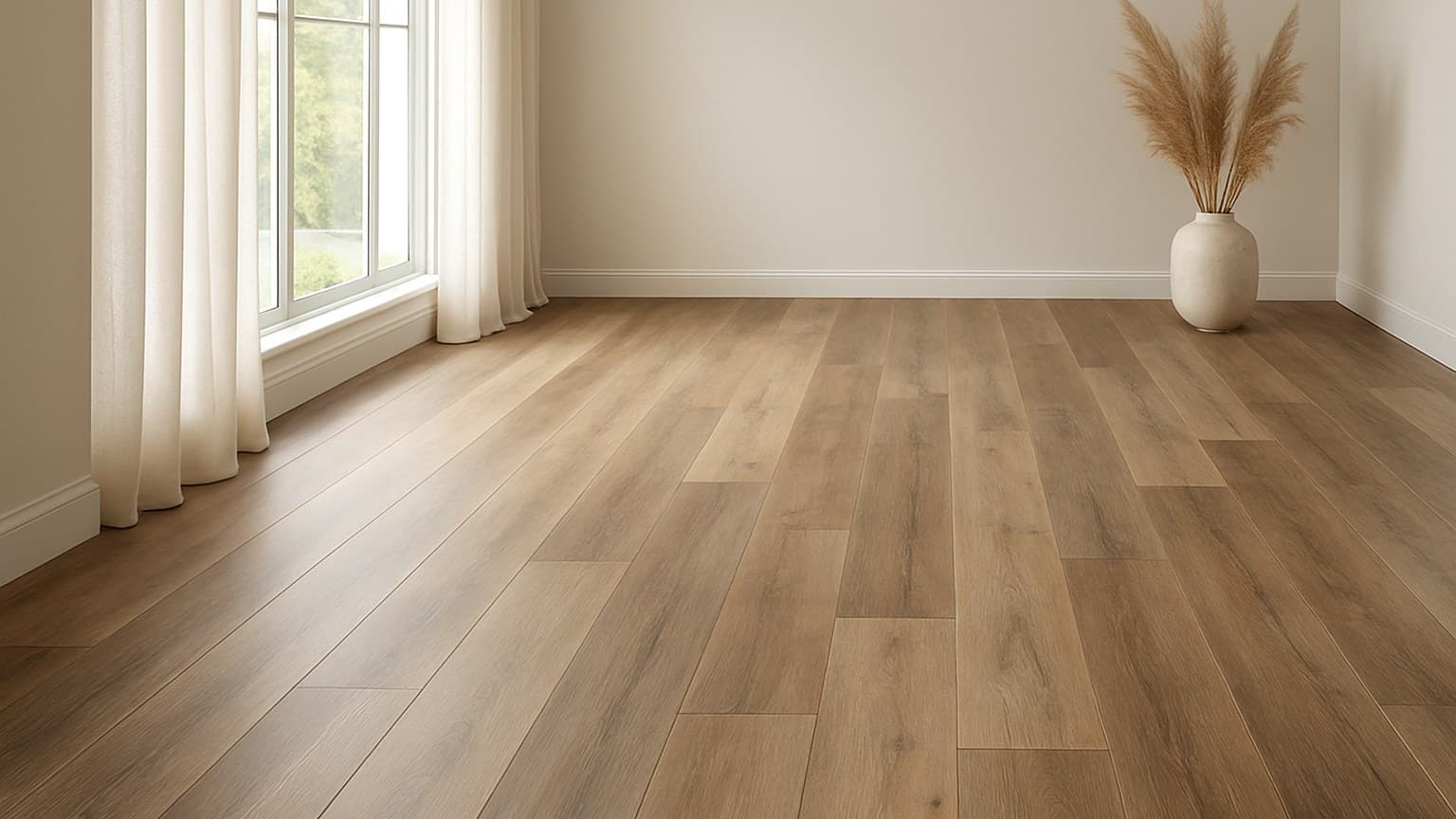
LVP stands for luxury vinyl plank, and that name alone tells you nothing about why one box outlasts another by a decade. It's a plank-shaped vinyl floor with a printed photo of wood sealed under a clear wear layer, and the real quality gap sits in how thick that wear layer is and how the core is built underneath it. Two boxes can look nearly identical on the shelf and still wear out a decade apart. Getting that difference wrong is what turns a cheap floor into an expensive redo. I lay out all nine of those make-or-break factors, from wear layer to subfloor prep, in the vinyl flooring buyer's guide.
Key takeaways
- LVP stands for luxury vinyl plank: a plank-shaped floor with a printed wood image under a clear plastic wear layer, built to click together or glue down over most subfloors.
- The wear layer (measured in mils) drives lifespan: roughly 6-8 mil for light bedrooms, 12 mil for busy family rooms, 20 mil and up for kitchens and pets, but only trust the number printed for that specific product.
- Budget about $2-5 per sq ft for material and about $2-5 per sq ft for click-lock labor, so a 1,000 sq ft job runs roughly $4,000-$10,000 installed; basements and stairs cost more per foot.
- "Waterproof" describes the plank core, not the seams or the room, so water can still get under a floating floor at the edges and sit on the subfloor.
- Click-lock LVP is realistic for most DIYers; glue-down, stairs, and big open-plan moisture transitions are usually worth hiring out.
What LVP Actually Is (and What the Letters Mean)
LVP stands for luxury vinyl plank. It's a plank-shaped vinyl floor with a printed photo of wood sealed under clear plastic, sold in long strips you either click together or glue down over most subfloors.
The word "luxury" is marketing, not a grade or a rating anyone enforces. It mostly separates today's thicker, rigid planks from the thin, floppy sheet vinyl your grandparents had in the kitchen. Nobody checks a box before "luxury" gets printed on the label, so don't read it as a promise of quality.
Here's the part some sellers gloss over: LVP is a picture of wood, not wood. That's not an insult. It's why it shrugs off spills and costs a fraction of what real oak does. You give up the genuine wood grain underfoot, and in return you get a floor that survives a leaking dishwasher. If it's specifically that pale, real-oak look you're chasing, the lighter end of the palette gets its own breakdown in the light oak vinyl plank flooring guide.
LVP is the wood-look member of the vinyl family. If you want to dig into what that "luxury" label really buys you beyond the name, I broke it down in "Luxury" Vinyl Flooring: What That Word Actually Buys You.
How LVP Is Built: The Layers That Decide Everything
A plank is a sandwich, and the layers are where the money and the lifespan hide. From top to bottom you get a urethane top coat, a clear wear layer, the printed design layer, the core, and on many planks an attached pad on the bottom.
Each layer has one job. The urethane top coat takes scuffs and makes the floor wipe clean. The wear layer is the clear plastic shield that decides how much traffic the floor survives, and it's measured in mils. A mil is one-thousandth of an inch, so it's thin, but the difference between 6 and 20 is the difference between a bedroom floor and a mudroom floor.
The print layer is the photo your eye reads as wood. Better planks use a sharper image and a textured film so the grain lines up with what you feel, which is what makes a good one pass the "is that real?" test. If a convincing wood look is the whole point for you, the wood-look vinyl flooring guide covers how far that image has come.
The core is the body of the plank, and it's what makes the plank feel rigid like a board or bend like a mat. Under the core, many rigid planks already have an attached pad. That matters for a practical reason: if you add a second underlayment underneath a plank that already has one, you can void the product's warranty. Read the box before you buy foam you don't need.
LVP vs LVT, Sheet Vinyl, and Vinyl Tile
They're all the same vinyl family wearing different shapes. LVP is plank-shaped with a wood look. LVT is that same material cut into squares or rectangles to mimic tile or stone. Sheet vinyl comes in a wide roll. Vinyl tile is the older, thinner square, often peel-and-stick.
Sheet vinyl rolls come 6 to 12 feet wide, so a small bathroom might have no seams at all. Fewer seams means fewer places for water to sneak through, and it costs less. The catch is that when it tears, you patch a whole area instead of swapping one plank.
All the phrasing you'll see, "luxury vinyl," "vinyl tile flooring," "rigid core," points back to this one family in different clothes. For the tile-shaped and stone-look versions, see the LVT guide and the vinyl tiles guide.
| Type | Shape and look | Seams | Water tolerance | Best for |
|---|---|---|---|---|
| LVP | Long planks, wood look | Many click or glued joints | Some rigid-core lines have a waterproof core; LVP seams overall stay only water-resistant | Living areas, kitchens, basements |
| LVT | Squares/rectangles, tile or stone look | Many joints, often grout-look | Some rigid-core lines have a waterproof core; seams stay water-resistant, not sealed | Baths, entries, laundry |
| Sheet vinyl | Wide roll, any print | Few or none in a room | Fewest seams to leak | Budget baths and laundry |
| Vinyl tile | Thin squares, often peel-and-stick | Many small joints | Least water-tolerant at seams | Low-budget, light-traffic rooms |
This table lines up the four vinyl types by shape, seams, water tolerance, and where each one earns its place in a home.
LVP vs Laminate: The Real Tradeoff
There's no universal winner here, so here's the honest trade. Laminate usually looks and feels a touch more like real wood and tends to cost a bit less. LVP handles water far better. That's the whole fight in one sentence.
Laminate's core is made of pressed fiberboard, basically dense wood dust, and if water sits on it the board swells and the edges puff up like a sponge. LVP's core shrugs that same water off. But, and this is the part that costs people, LVP's seams are only water-resistant, not sealed. Standing water can still work its way through the joints and sit on the subfloor underneath.
So the answer really is room by room. I laid out which one I'd pick in a kitchen, a bedroom, a basement, and the rest in Vinyl vs Laminate Flooring: Which Wins in Each Room of Your House. The short version: wet rooms and basements lean LVP, while living rooms and bedrooms can go either way on look and budget.
Durability, Wear Layers, and How Long LVP Lasts
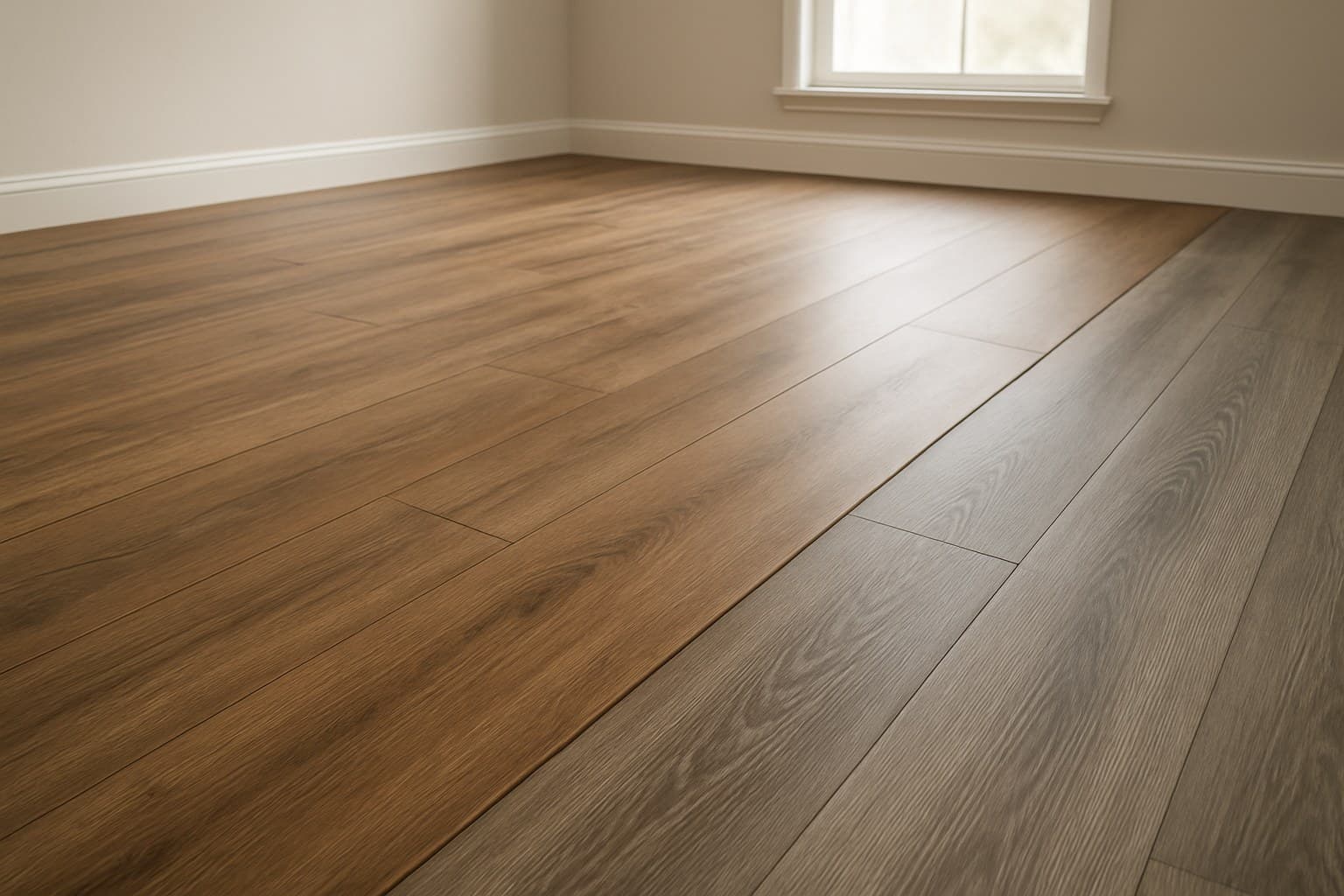
How long an LVP floor lasts comes down mostly to two things: the wear layer thickness and how well the subfloor was prepped. Not the brand name, not the price sticker. I've pulled up premium planks that failed in three years because the slab underneath was never leveled, and I've seen mid-grade planks going strong at year twelve over a good subfloor.
Here's a rough guide, though exact specs shift by product run and year, so treat any brand tie-in loosely. Entry-level residential lines often run around 6-8 mil, mid-range residential lines often sit around 12 mil, and heavy-duty or commercial-grade lines often run 20 mil or more. Treat those as a starting point, then check the actual mil number printed on the specific product you're holding, because "12 mil" on one box is not the same promise as another maker's claim.
| Room and traffic | Wear layer (mil) | Example product tier |
|---|---|---|
| Light traffic (bedrooms) | 6-8 | Entry-level residential line |
| Busy family rooms | ~12 | Mid-range residential line |
| Kitchens, entries, pets | 20-28 | Heavy-duty / commercial-grade line |
This charts the same three example wear-layer tiers from the table above, so you can see the jump from a bedroom-grade wear layer to a kitchen-grade one at a glance. Not to scale.
Keep the waterproof core and the water-resistant seams straight in your head, because a plank can be genuinely waterproof and the floor can still fail at the edges. If that distinction matters for your room, the waterproof flooring guide goes deeper. And that "lifetime residential warranty" on the box? It only holds if the subfloor flatness and moisture levels in the maker's own instructions were actually met. Skip the prep and the warranty is just ink.
Where LVP Works Best, Room by Room
LVP earns its keep in the rooms that destroy other floors: kitchens, bathrooms, laundry rooms, entries, and basements. Water and grit that would ruin hardwood or swell laminate barely register on a decent plank. In the drier living spaces where solid or engineered wood is still on the table, picking between the two matters just as much as picking the right vinyl, a decision I break down room by room in engineered hardwood vs hardwood by room.
Basements come with a catch. A waterproof plank does nothing for a slab that's wet from below or wavy underfoot. Concrete pulls moisture up out of the ground, and if that moisture has nowhere to go it gets trapped under a floating floor. Test the slab for moisture and check it for flatness before you buy a single box. I walk through that whole check in the basement vinyl flooring guide.
Where I'd think twice: a sunroom with hours of hard direct sun, since some planks can fade or expand under that heat, and any room sitting over a subfloor that's already failing. LVP hides a lot, but it won't fix a bad floor under it. For the wettest rooms in the house, steer toward the products built for it in the waterproof vinyl flooring guide.
What LVP Really Costs: Materials vs Labor (and Wholesale vs Retail)
Split the price into two buckets or you'll never make sense of a quote. Material for most residential LVP runs about $2 to $5 per square foot. Professional labor for click-lock runs about another $2 to $5 per square foot. Click-lock LVP is simple enough that most DIYers with basic tools can lay it themselves over a weekend, especially in a bedroom or living room. Glue-down jobs, stairs, and any room with a tricky moisture transition, like a basement meeting an open-plan main floor, are usually worth hiring a pro for, since a bad seam or rushed glue-down there is expensive to redo. Glue-down, stairs, and basements also cost more per foot because of the extra cutting, transitions, and moisture prep.
There's a third standard method worth knowing alongside click-lock and glue-down: loose-lay. A loose-lay plank isn't clicked to its neighbors or glued to the subfloor at all, it's cut to fit the room and held in place by its own weight, a denser backing, and friction against the subfloor, sometimes with a bead of adhesive only around the room's perimeter. That makes it quick to install and easy to lift a single damaged plank later without disturbing the rest of the floor, but it leans on tight, accurate cuts and a stable subfloor to stay put, so it tends to suit smaller, more contained rooms rather than large open-plan floors with a lot of foot traffic crossing the seams.
The arithmetic is simple: installed total equals (material per square foot plus labor per square foot) times your square footage, and then buy 5 to 10 percent extra plank for cuts and waste. Worked example on a 1,000 square foot job at $3 material and $3 labor: $6 times 1,000 is $6,000 installed, plus roughly 50 to 100 square feet of extra plank for offcuts.
| Room size | Material ($2-5/sq ft) | Click-lock labor ($2-5/sq ft) | Installed total |
|---|---|---|---|
| 200 sq ft (bath or laundry) | $400-1,000 | $400-1,000 | $800-2,000 |
| 500 sq ft | $1,000-2,500 | $1,000-2,500 | $2,000-5,000 |
| 1,000 sq ft | $2,000-5,000 | $2,000-5,000 | $4,000-10,000 |
| 1,500 sq ft | $3,000-7,500 | $3,000-7,500 | $6,000-15,000 |
Source: the per-square-foot ranges I quote on LVP jobs and what a box of plank runs at my supplier
Estimated LVP cost by room size, split into material and click-lock labor, before the 5-10% waste add-on. Basement and stair jobs run higher per foot.
Wholesale vs retail: what actually drives the price gap
Wholesale pricing can sometimes undercut big-box retail by a meaningful margin, and sellers love to advertise a specific percentage before you read the fine print. Sometimes the gap is real savings. Often it reflects thinner product lines, no design help, and you eating the delivery cost and any measuring mistakes yourself.
At a big-box or full-service store you're paying a little extra for someone to catch a bad order, help you match a wear layer to your room, and handle a return. Buy wholesale and that safety net is your problem now. If you know exactly what you want and can measure well, the discount is worth it. If this is your first floor, the retail markup is cheap insurance.
If you want a more objective check than eyeballing a sample plank at the counter, it helps to know a real measurement standard is in the works: ASTM International's WK94994 is a draft standard practice for the in-field dimensional measurement of resilient floor tile and plank using precision measuring instruments, essentially a formal way to check a plank's squareness and thickness consistency rather than trusting a seller's word for it. Even before that practice is finalized, it's a useful reminder that plank quality is something you can measure, not just something a sales rep tells you.
One more thing that has saved my customers years later: keep a labeled box of leftover planks and the product info sheet. The jobs that haunt me are the ones where I didn't, and I got a call about a gouged plank from a line nobody makes anymore. A gouged floor with matching offcuts in the closet is a ten-minute fix.