
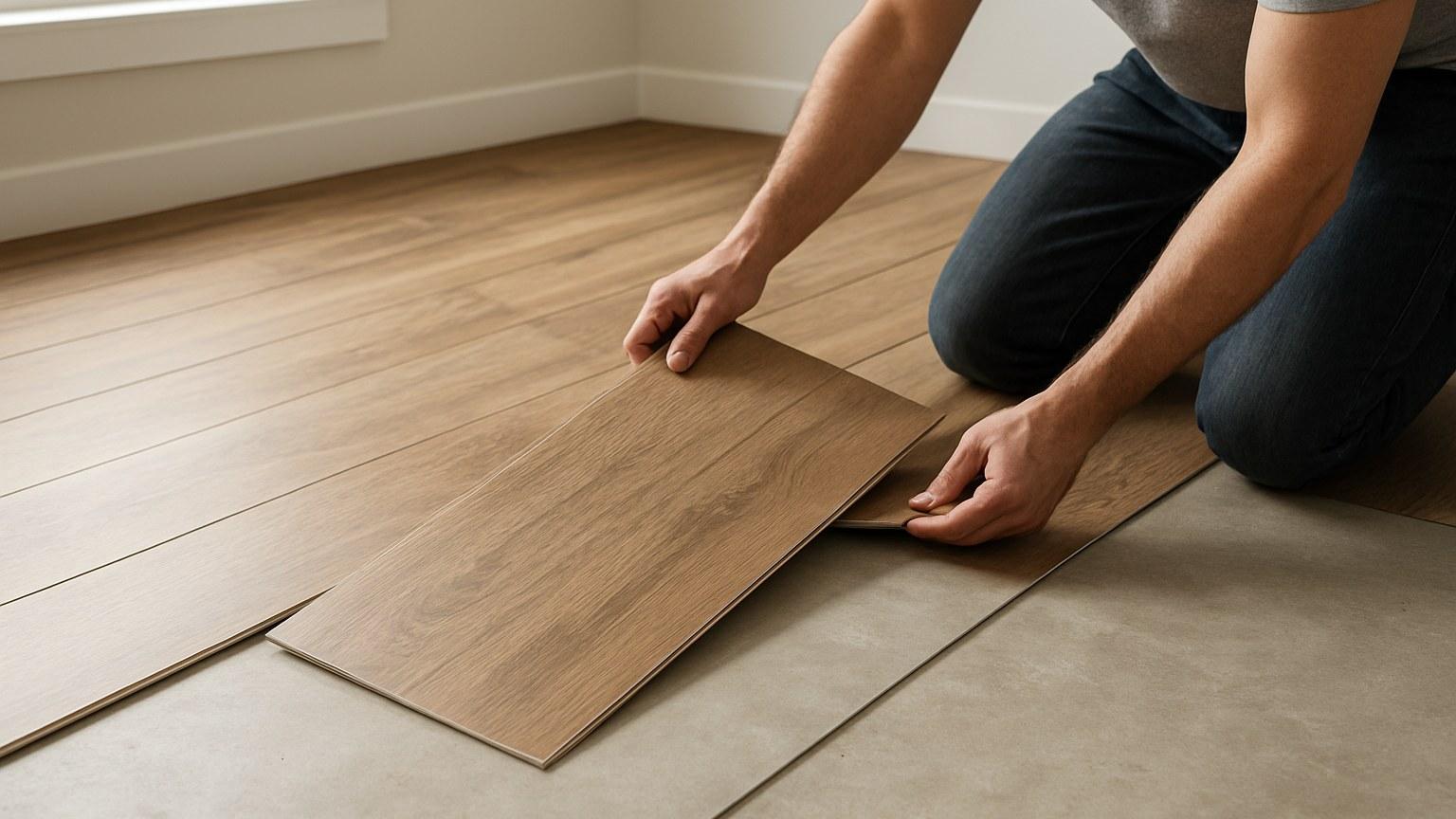
Installed LVP (luxury vinyl plank) flooring cost per square foot is three numbers stacked together: your plank's shelf price, install labor of about $3.00-$5.50 (per carpetguys.com), and subfloor prep when the floor needs it. That stack is why online quotes swing so wildly, and why a bid can look cheap until the prep line finally shows up. Get the three right and you can read your real cost off a table before anyone walks your house.
Key takeaways
- Installed LVP (luxury vinyl plank) is three numbers stacked: the material (your plank's shelf price), install labor, and subfloor prep. Install labor alone runs about $3.00-$5.50 per square foot, per carpetguys.com.
- Prep is the blindside line item: a moisture barrier runs about $2-$8 per square foot (latestcost.com), self-leveling about $1.50-$5 (selflevelingflorida.com), and underlayment about $0.60-$2.70 (angi.com).
- Buy 7-10% extra material for waste, and expect basements, stairs, and cut-heavy layouts to cost more than one open room.
- For a 2,000 sq ft house, install labor alone is roughly $6,000-$11,000 before you add a dollar of material, according to carpetguys.com.
- The number that separates budget from premium is the wear layer on your specific plank, not the install price.
What LVP Flooring Costs per Square Foot (Installed)
The "per square foot" price you see quoted is almost never one number. It is the plank, plus the install labor, plus any prep the floor needs underneath. Install labor by itself runs about $3.00-$5.50 per square foot, according to carpetguys.com. Clearance vinyl plank flooring listings are especially prone to quoting only that first piece, which makes comparing deals harder than it looks.
So when someone says "LVP is three bucks a foot," ask which three bucks. Three dollars might be the plank alone. It might be the labor alone. It is almost never both together with prep folded in.
Material-only price vs the installed price
Material-only is the number on the box. That is the plank shelf price, and it is the one figure you control at the store. Shopping a vinyl flooring sale is one of the most direct ways to push that number down before labor and prep get added.
Installed price is that plank plus labor plus prep. That is the number that hits your bank account.
That's why forum threads show LVP at wildly different prices. One person quotes the sticker on the box, another quotes the full installed bid, and a third forgot their subfloor needed leveling until the installer pointed at it. Same floor, three very different numbers. The same confusion shows up when people compare cheap LVP flooring listings without checking what each price actually includes.
The single thing that moves your material cost most is the quality tier you pick, not the install. Entry-level flexible planks sit at one price, while rigid-core planks, built with a dense, harder inner layer that resists dents and hides small subfloor dips, usually cost more. For how entry, mid, and rigid-core planks stack up at the register, see what vinyl plank flooring installation really costs per square foot, which breaks the tiers out in detail.
Build Your Own Estimate: The LVP Cost Formula
Here is the whole formula a cost estimate actually runs:
(material price + labor + prep) across the area you measured, with 7-10% added for waste.
Name every piece so nothing hides:
Name every piece so nothing hides:
- Material is your plank's shelf price, multiplied by your square footage, times a waste factor of 1.07 to 1.10.
- Labor is $3.00-$5.50 per square foot (carpetguys.com), billed on the room area.
- Underlayment is $0.60-$2.70 per square foot (angi.com), and only if your plank has no attached pad.
- Subfloor prep runs roughly $1.50-$8 per square foot when the floor needs leveling or a moisture barrier, the exact price varies by source and by how much work the subfloor needs.
Run it end to end for a 500 square foot room with a flat, dry slab: material at $3.00 a foot comes to $1,650 with waste, labor at $4.00 a foot is $2,000, and prep is zero because the slab checked out. That's $3,650, or about $7.30 per square foot installed.
| Line | Per sq ft | Example (500 sq ft) |
|---|---|---|
| Material (plank price x area x waste) | your shelf price | $3.00 x 500 x 1.10 = $1,650 |
| Install labor (billed on room area) | $3.00-$5.50 | $4.00 x 500 = $2,000 |
| Underlayment (only if no attached pad) | $0.60-$2.70 | $0 (pad attached) |
| Subfloor prep (leveling/moisture, if needed) | $1.50-$8 | $0 (slab was flat and dry) |
| Total installed | about $7.30 | $3,650 |
LVP cost formula with a worked 500 sq ft example, material and labor split out.
This is the same math a flooring cost calculator runs for you, so you can read your own case straight off it instead of typing it into a box.
Where the Money Goes: Material, Labor, and Prep
Labor and prep together can rival the planks themselves. People fixate on the plank price because that's the number they pick, but the bottom four costs below, sourced from angi.com for underlayment, selflevelingflorida.com for self-leveling compound, carpetguys.com for install labor, and latestcost.com for moisture barrier, all land on the subfloor side of the job.
| Cost component | $ per square foot |
|---|---|
| Underlayment | $0.60-$2.70 |
| Self-leveling compound | $1.50-$5.00 |
| Install labor | $3.00-$5.50 |
| Moisture barrier | $2.00-$8.00 |
Before any of those prep dollars land, two checks come first. The subfloor has to be flat, and a concrete slab or basement floor needs a moisture test before a single plank goes down. Skip either and the floor telegraphs the problem later, usually at the worst time. Those checks are really step one of the install itself, and the full prep, method, and layout installation guide covers how they feed into the rest of the job.
I learned to never take a subfloor on faith. On one Dayton job the homeowner swore the subfloor was brand-new, so I set a start date around it. When I pulled a corner the morning of, there were old adhesive ridges hiding under the new surface, and leveling them ate half a day I had never put on the quote. Now I lift a corner myself before I commit, and the prep line goes on the estimate where everyone can see it.
One more thing on "waterproof." The plank material being waterproof is not the same as the floor being waterproof. A floating LVP floor still allows water to creep in through the seams and at the perimeter, where it pools on the subfloor and real damage begins. If you are shopping deals, the buyer's checklist for judging waterproof vinyl flooring clearance walks through separating the plank claim from the edge claim.
Last, transition strips and door casing are priced per linear foot, about $3-$7 (sumancustomcarpentry.com), not per square foot. They land on the quote as their own line, so don't expect them folded into the square-foot rate.
What LVP Costs for a 1,000, 1,500, or 2,000 Sq Ft House
At $3.00-$5.50 per square foot for labor (carpetguys.com), a 2,000 square foot house runs roughly $6,000-$11,000 in labor alone, before you add a dollar of material. Scale it down and a 1,000 square foot job is $3,000-$5,500 in labor.
| Room size | Labor at $3.00/sq ft | Labor at $5.50/sq ft |
|---|---|---|
| 1,000 sq ft | $3,000 | $5,500 |
| 1,500 sq ft | $4,500 | $8,250 |
| 2,000 sq ft | $6,000 | $11,000 |
Source: carpetguys.com's LVT install pricing
Install labor only by whole-house size; material cost is separate and stacks on top.
Material stacks right on top of these. Multiply your plank's shelf price by the square footage, add your waste factor, and lay it beside the labor figure for your size. Hunting for cheap vinyl flooring starts with getting that shelf-price number as low as you can before the other two lines stack on.
And remember a whole house is never one clean open room. Stairs, closets, hallways, and every transition between rooms add cuts and time, so the real number lands above what the table shows for a flat rectangle.
DIY vs Hiring a Pro
Hiring out costs you that $3.00-$5.50 per square foot in labor. Doing it yourself saves that line, but trades it for tool costs and the price of mistakes while you learn. Knowing which of the four vinyl flooring installation methods fits your subfloor before you start is what keeps those mistakes from happening in the first place.
Call it by install type, because that's what decides it. Click-lock floating LVP is realistic for most DIYers who can measure, cut straight, and keep an expansion gap. Glue-down, stairs, and big open-plan floors with moisture transitions between rooms are where hiring out usually pays for itself. Walking through a step-by-step vinyl plank installation guide before you buy a single tool will tell you fast whether your room actually fits that DIY column.
I'll warn you off chasing fancy tools to shortcut the learning. I once bought a pricier cutting tool figuring it would give me cleaner results, and it barely came out of the bag. The planks I ruined were the ones where I hadn't gotten the technique down yet, not the ones cut with a basic blade. These days I just score the cut on the visible face and snap it, and the edges come out fine. Getting that scoring-and-snap motion consistent matters more once you're actually laying rows, which is where a step-by-step LVP installation guide earns its keep.
For DIYers working with rigid-core planks, there's a notable trap: many come with an attached pad, and a secondary underlayment layer can void the warranty. Read your specific product's install sheet before you buy any extra cushion.
Is LVP Worth It Over the Long Run?
Stop thinking cost per square foot and start thinking cost per year. A cheap plank that fails in five years can cost you more than a pricier one that holds for twenty, once you add the tear-out and the redo. Those failure points track closely with the factors that decide vinyl flooring lifespan, from subfloor moisture to room-specific wear.
The National Wood Flooring Association (the trade group for wood floors) ran a Life Cycle Cost Analysis comparing 18 flooring types over a 75-year horizon. That lifetime lens is the one the quick buying guides skip, and it's the honest way to weigh a floor you plan to keep.
What actually ends an LVP floor early is rarely the surface. The wear layer shrugs off foot traffic. The killer is water getting under the planks at the seams and perimeter, pooling on the subfloor, and rotting things out of sight.
Lifespan tracks the wear layer on your specific plank, measured in mils. Quote the number the maker prints for that product instead of any rule of thumb, because a thin wear layer in a busy kitchen is the floor that comes back.
Red Flags in an LVP Quote
Hold any bid up against this list before you sign. These are the lines that hide money or set up a failure.
- One lumped-together number. If the quote does not split material, labor, and prep, you cannot tell which part is padded or missing.
- No subfloor prep or leveling line. Nobody can price leveling they have not accounted for. A zero here on an old or uneven floor means a change order later.
- No moisture test mentioned. On a slab or basement, this is the check that decides whether the floor survives. Its absence is a gap, not a saving.
- The whole floor called "waterproof." A quote that treats every inch as waterproof, with nothing about seams or the perimeter, is glossing over exactly where floors fail.
- No waste factor, or a suspiciously low one. An angle-heavy room with a tight 5% waste figure will come up short at the register, and the second box rarely matches the dye lot.
- Underlayment charged over a plank that already has a pad. You are paying twice, and the extra layer can void the warranty.
Checklist for reading an LVP quote; flags the lines that most often hide cost or set up failure.
Sources
- NWFA Life Cycle Cost Analysis of Flooring (full study)
- NWFA Life Cycle Cost Analysis of Flooring (summary sheet)
- Carpetguys.com's LVT (luxury vinyl tile) install pricing