
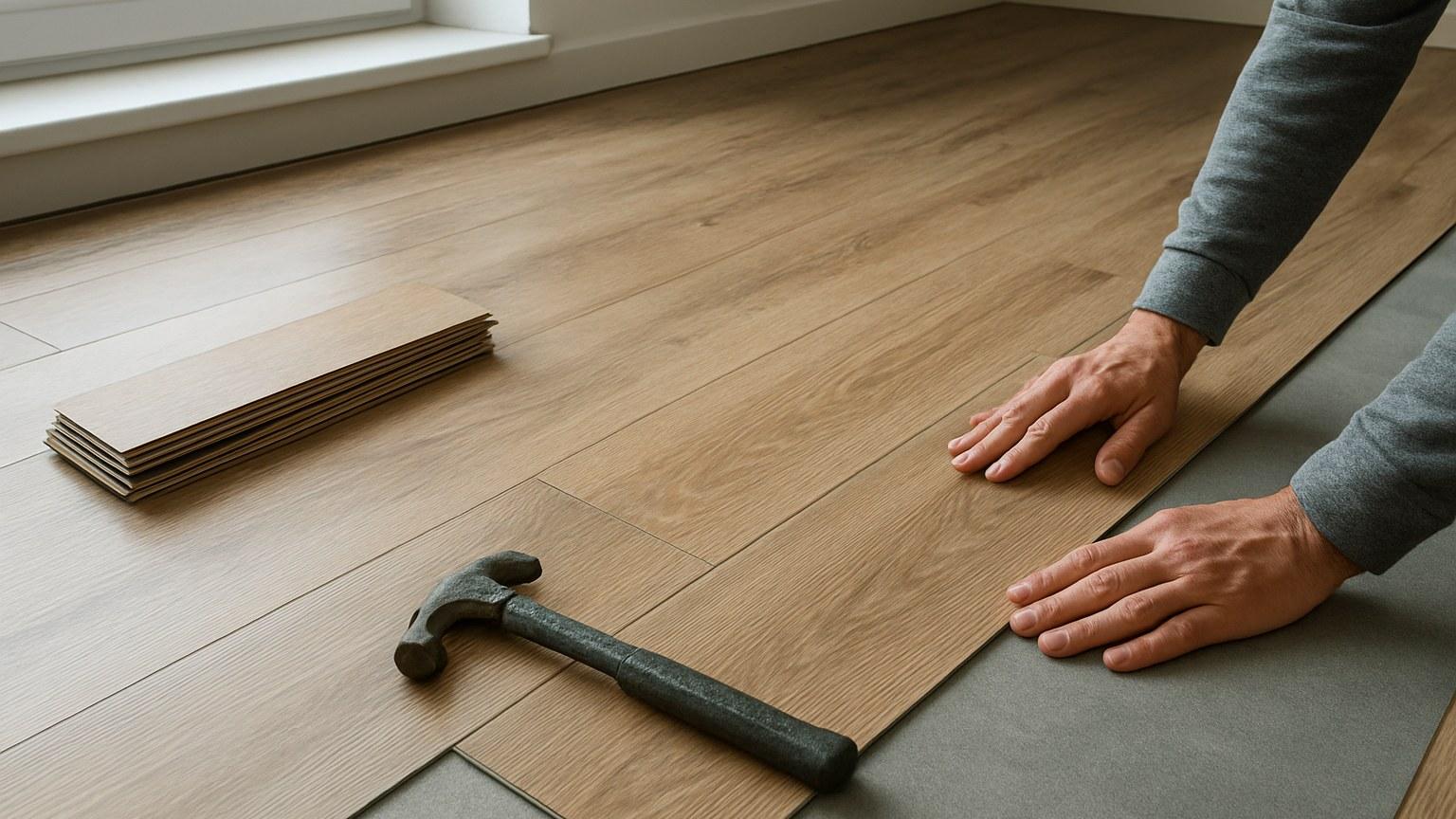
Clearance vinyl plank flooring's sticker, often $0.59 to $3.89 a square foot, buys the plank alone, not the finished floor. Add waste, transitions, underlayment, and labor, and a cheap box can land near regular-price LVP (luxury vinyl plank). Those line items, not the sticker, decide if the deal is real. Clearance pricing is really just one corner of the wider cheap LVP flooring market, where the same price-versus-quality trade-offs show up outside the clearance aisle too.
Key takeaways
- Retailer clearance pages advertise vinyl plank at $0.59-$3.89 per square foot, but that number is the plank alone, not the installed floor.
- Add about 10% for waste, and more if you lay diagonally or match a busy wood-grain pattern.
- Floating click-lock install runs $1.50-$4 per square foot (nedesestimating.com); glue-down or complex jobs run $1-$10 (rightstepflooringnc.com), which is where you hire out.
- Once you add slab leveling and labor, a $0.79 clearance box can land at or above a $2.49 regular-price click-lock LVP (luxury vinyl plank) you float yourself, according to nedesestimating.com.
- Clearance stock is often final-sale and can't be reordered, so buy every box you need plus overage before you leave the store.
What the Clearance Price Covers, and Why the Plank Is Cheap
The $0.59 to $3.89 per square foot you see on store clearance pages is the price of the plank sitting on the pallet. It is not the installed floor, and it is not the whole bill. That same gap between sticker price and installed cost shows up across cheap vinyl flooring purchases generally, not just on clearance racks.
Clearance stock gets marked down for reasons that have little to do with how the plank performs. A line got discontinued. The store over-ordered. A dye lot came in slightly off. Some boxes are factory seconds. None of that means the plank is junk, but it changes how you shop. A discontinued line is the trickiest case down the road, since restocking or matching boxes later means knowing how to find and match discontinued vinyl flooring.
Most buyers miss one thing: clearance runs are limited, and a lot of them are final sale. Come up two boxes short halfway through the job, and there's no matching box to reorder, a different dye lot will read as a patch for the life of the floor. So you buy the whole room, plus overage, in one trip, or you walk away. If you want a full rundown of what to inspect before you hand over the cash, the waterproof vinyl flooring clearance checklist covers that part in detail.
The rest of this article is about the four line items the sticker leaves off: waste, underlayment, transition strips, and labor. Those four are what turn a 79-cent box into a real number.
The Costs the Clearance Sticker Hides
Four things stack on top of the plank price, and together they usually matter more than the discount.
Waste. Add about 10% to your square footage. You cut planks to fit at walls, and the offcuts pile up. Run the planks diagonally or try to match a busy wood-grain pattern across a room and that number climbs, because more of each board ends up in the scrap bucket.
Underlayment. This is the step that costs clearance shoppers the most money. Many rigid-core clearance planks come with an IXPE pad already stuck to the back, IXPE stands for cross-linked polyethylene, a dense foam that cushions the floor and adds some moisture resistance. Add a second underlayment under one of those planks and you can void the plank's warranty. Whether you need any pad at all is set by that specific product's instructions and the subfloor it goes over, not a blanket rule. Where you do need separate underlayment, homewyse.com puts it installed at $4.38 to $5.27 per square foot for 2026.
Transition strips. You need one at every doorway and every spot where this floor meets a different floor. angi.com puts vinyl transition strips at $2 to $4.60 per linear foot and aluminum at $1.30 to $4.90. On a two-door bedroom that's small money; across an open main floor with five transitions it adds up.
Labor, and whether you do it yourself. Floating click-lock plank runs $1.50 to $4 per square foot, per nedesestimating.com, and most DIYers can handle that job. Glue-down and complex work runs $1 to $10 per square foot, per rightstepflooringnc.com, and that's the range where hiring a pro pays off. For a deeper look at how installers price the work, see what vinyl plank flooring installation really costs per square foot.
| Line item | Range | Note |
|---|---|---|
| Clearance plank (sticker) | $0.59-$3.89 / sq ft | what the ad shows |
| Waste overage | +10% of area | more for diagonal or busy patterns |
| Underlayment, installed | $4.38-$5.27 / sq ft | often none needed; many rigid-core planks have an attached pad |
| Transition strips (vinyl) | $2-$4.60 / linear ft | doorways and floor changes |
| Floating install labor | $1.50-$4 / sq ft | click-lock; DIY-friendly |
| Standard install labor | $2-$5 / sq ft | per rightstepflooringnc.com |
| Glue-down / complex labor | $1-$10 / sq ft | hire this out |
| Old floor removal | $0.50-$3 / sq ft | varies by what's being removed; no single published rate |
The line items a clearance sticker leaves off, shown per square foot or per linear foot.
Read Your Case: Clearance Sticker to Installed Cost
The math is short enough to do on a receipt. Installed cost per square foot equals the plank price times 1.10 for waste, plus your install labor. Transitions, any underlayment, and old-floor removal get added on top of that.
Run the common clearance tiers through that formula with nedesestimating.com's floating labor of $1.50 to $4 per square foot and you get a real range, not a sticker.
| Clearance tier | Plank + 10% waste | Plus float labor | Installed / sq ft |
|---|---|---|---|
| $0.79 | $0.87 | $1.50-$4 | $2.37-$4.87 |
| $1.49 | $1.64 | $1.50-$4 | $3.14-$5.64 |
| $2.49 | $2.74 | $1.50-$4 | $4.24-$6.74 |
| $3.89 | $4.28 | $1.50-$4 | $5.78-$8.28 |
Clearance plank tiers carried through waste and floating labor to an installed per-square-foot cost.
Even the cheapest 79-cent box lands around $2.37 to $4.87 per square foot once it's floated, and that's before you add a single transition strip or touch the slab. The sticker is a small slice of the final number.
To plug in your own room size and door count, run it through a flooring calculator instead of doing the arithmetic by hand.
A Worked Example: 220 Square Feet, Start to Finish
Take a 220-square-foot spare bedroom, a $0.99 clearance click-lock plank, and a slab that's already flat and dry. That last part matters, and I'll come back to it.
Before any of these numbers hold, the subfloor has to pass a flatness check and a moisture check. For floating floors, the maker's warranty depends on proper prep, not on which plank you selected. This example assumes it passed.
Now line up the costs:
- Plank: 220 sq ft times 1.10 for waste = 242 sq ft to buy. At $0.99, that's about $240.
- Transitions: two doorways, roughly 6 linear feet of vinyl transition. At $2 to $4.60 per foot, call it $12 to $28.
- Float labor, if hired: 220 sq ft at $1.50 to $4 = $330 to $880.
If you float it yourself: about $240 in plank plus $12 to $28 in transitions, so roughly $250 to $270 in materials. Add a cheap tool kit, a tapping block, spacers, and a sharp knife, say $40 to $80, and you're done for under $350.
If you hire the float: the $250 to $270 in materials plus $330 to $880 in labor lands you at about $580 to $1,150.
That's the DIY-versus-hire gap as a dollar figure: on this room, doing it yourself saves something like $330 to $880. Click-lock in a square bedroom over good slab is exactly the kind of job most people can pull off.
When a Clearance Box Costs as Much as Regular LVP
A clearance box only wins if the job stays simple. Add prep and a harder install method and the deal flips fast.
Picture a $0.79 box going over a slab that's not flat. houzz.com puts self-leveling at $1 to $3 per square foot per 1/8 inch of fill, and if that clearance plank is a glue-down line, labor runs $1 to $10 per square foot on top. Suddenly your 79-cent floor costs more installed than a $2.49 regular click-lock you could have floated yourself. I had that play out on a Huber Heights rec room where the cheap box looked like a steal until the slab read wavy and the leveling bags cost more than the flooring did.
| Scenario | Plank + waste | Labor | Installed / sq ft |
|---|---|---|---|
| Clearance $0.79, you float it yourself | $0.87 | $0 (DIY) | ~$0.87 + tools |
| Clearance $0.79, hired, slab needs leveling | $0.87 | level $1-$3 + install $1-$10 | $2.87-$13.87 |
| Regular $2.49 click-lock, you float it yourself | $2.74 | $0 (DIY) | ~$2.74 + tools |
Three install scenarios compared, installed cost per square foot.
The clearance deal that survives the full install is a click-lock rigid-core box going over a flat, dry subfloor you can float yourself. Benchmark it against the LVP flooring cost per square foot guide so you know what regular price actually is before you call the clearance box a bargain.
Clearance LVP for Bathrooms and Kitchens
Clearance vinyl plank can work in both rooms, but the room decides the install method far more than the price does.
The box label skips over one detail. "Waterproof" on a vinyl label describes the planks themselves, not the seams and not the room. A floating click-lock floor still has a perimeter gap, and water that gets past the baseboards can run under the planks and pool on the subfloor. The core shrugs it off; the seams and edges are where failures actually start.
In a half bath or a kitchen that only sees the occasional spill, a floated clearance click-lock floor is usually fine as long as you seal the perimeter and keep water off it. In a full bath with a tub or a kid's splash zone, I lean toward a glue-down install in wet areas so there's no open gap for water to travel through.
That pushes you into the $2 to $5 (or higher) labor range, and glue-down over an uneven floor is a job I'd hire out rather than fight through on a weekend. Basement bathrooms and any stairs carry their own premium on top of that, since moisture barriers and extra cuts add labor an open kitchen floor never needs. If a basement is where you're planning to put this clearance plank, it's worth checking what decides vinyl flooring's lifespan before the moisture and labor costs change your math.
So treat a clearance bathroom or kitchen deal the same way as any other: price the install method the room needs, not the sticker. A cheap box that forces a glue-down you can't do yourself isn't cheap anymore.
Where to Find Clearance Vinyl Plank, and When It Drops
Clearance vinyl plank turns up in three places, and the drops follow the same pattern in all three. Big-box home centers keep a "last chance" or clearance aisle in the flooring department, usually near the end of the main plank run, and that's where discontinued colors and overstock land first. Flooring liquidators and local flooring stores run their own closeout sections, often with better per-box pricing than the chains because they're trying to clear a whole pallet at once rather than a few leftover cartons.
The drop itself isn't tied to a season so much as a catalog change. A manufacturer retires a color or a pattern, the store's order comes in oversized, or a dye lot reads slightly off from the sample, and the markdown tag goes on that same week. Checking in person pays off more than checking online, because a store's physical clearance shelf often turns over faster than its website updates.
On a Huber Heights job, asking the flooor department directly whether more boxes of a discontinued run were coming off a truck got a straight answer that the online listing never gave. If a pattern looks promising, come back every week or two rather than waiting, since the good lots move fast and don't get restocked once they're gone.