
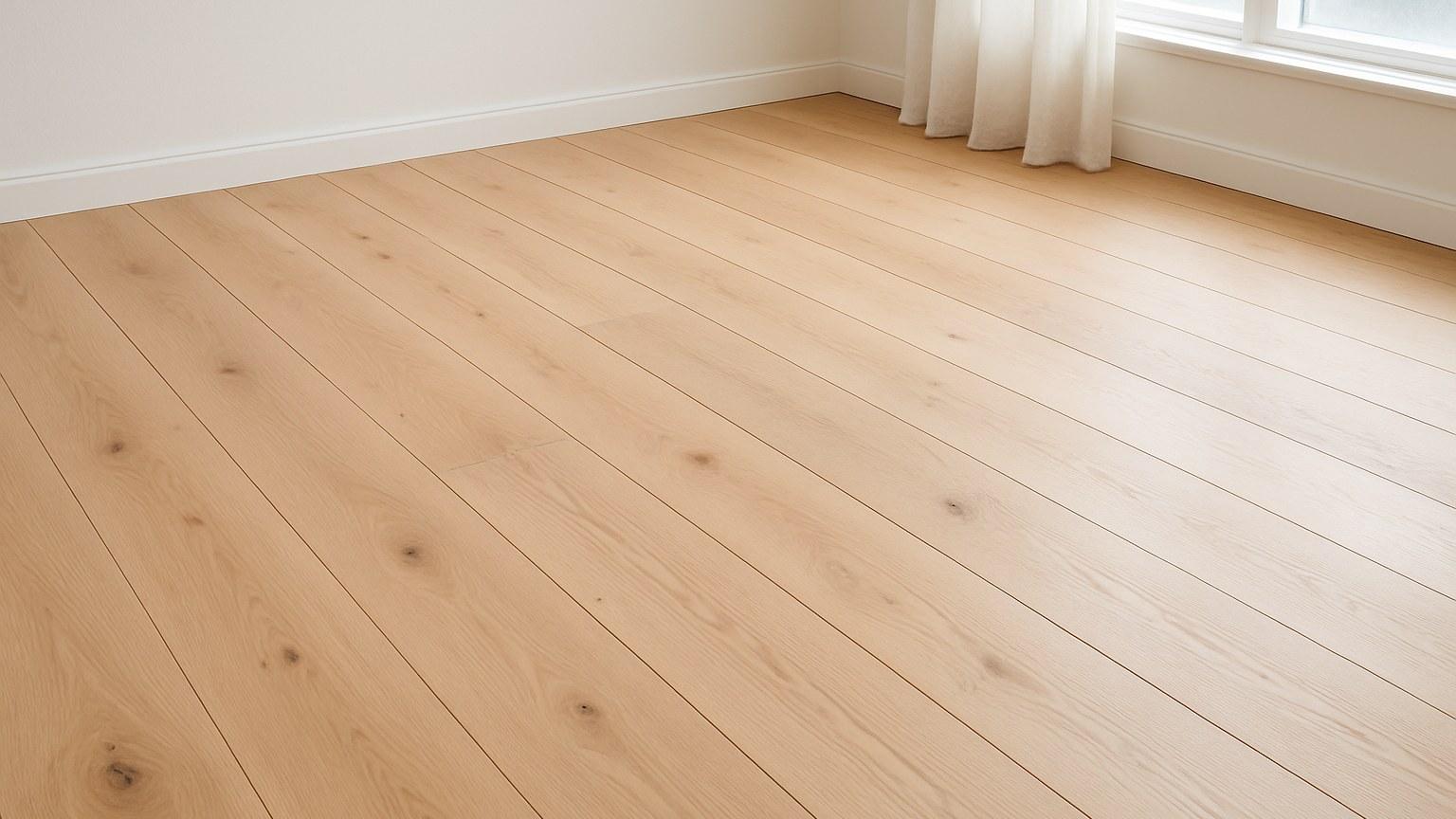
Wide plank white oak flooring stays flat when the moisture is controlled, not when the board is kept narrow. A wide face only makes a bad moisture situation show up bigger. Get the subfloor flat and the moisture reading right first, and a 7-inch board behaves.
Key takeaways
- Wide plank white oak doesn't cup or gap because it's wide; it moves when the moisture is wrong. The National Wood Flooring Association (NWFA) allows an actual-width tolerance of plus or minus .010 inch and a match-position tolerance of plus or minus .008 inch on unfinished stock.
- Engineered white oak is the safer bet for 7-inch and wider boards over concrete or below grade; solid white oak can be refinished more times.
- Rift-sawn and quarter-sawn white oak stay flatter across a wide board than plain-sawn or live-sawn boards.
- Installed cost runs roughly $6-$25 per square foot (Hallmark Floors); solid material alone runs $8-$15 per square foot (Wagner Meters).
- Subfloor flatness and a moisture reading come before the first board, and wide plank is a nail-plus-glue job most homeowners should hire out.
What Wide Plank White Oak Flooring Is
"Wide plank" means boards 5 inches and wider, versus the old 2.25-3.25 inch strip most houses were built with. The wood is white oak (Quercus alba), known for tight grain and natural tannins that handle water better than red oak does.
That width is also what makes buyers nervous, and for a fair reason. A wider board expands and shrinks more across its face than a narrow strip, so the same moisture swing in your house moves a 7-inch plank more than it ever moved a 2.25-inch one.
Shop photos skip this part entirely. What keeps a wide white oak board flat is moisture control, subfloor prep, the sawing method, and the construction you choose. Avoiding width solves nothing on its own. A narrow floor laid over a wet slab fails too, just less dramatically.
So when you search white oak flooring wide plank, you're really shopping for a system: the right board plus the right prep. The board is the easy part.
Will Wide Plank White Oak Cup, Gap, or Buckle? What the Standards Say
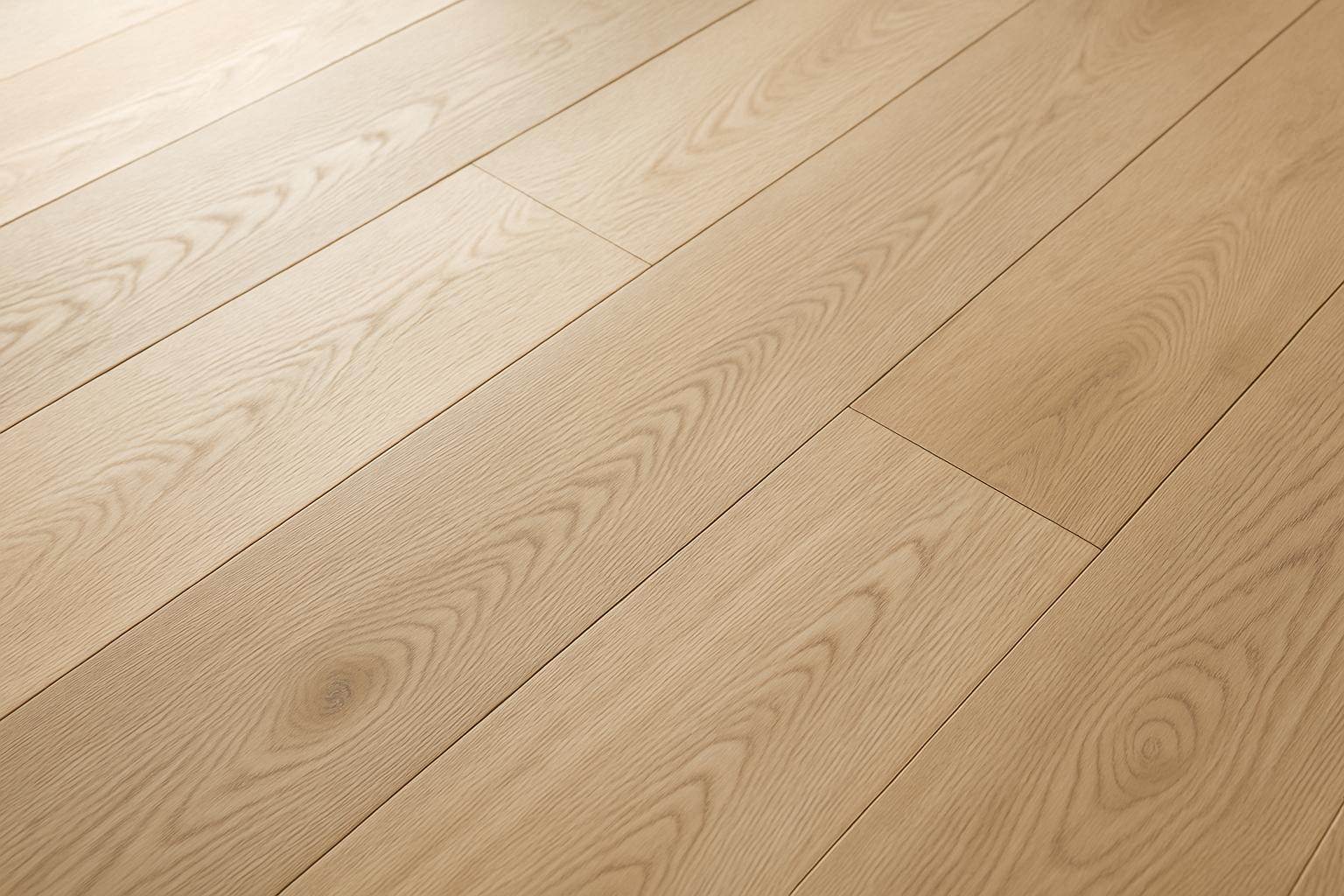
It can, but width isn't the cause. Moisture is. Cupping comes from a wetter underside than top. Gapping comes from a room that runs too dry and shrinks the wood. Buckling comes from a floor with no room to expand that swells and lifts off the subfloor.
In the floors I get called out to, cupped boards trace back to moisture from below or a room that swung from damp summer to bone-dry winter heat. The plank didn't fail. The conditions did.
The National Wood Flooring Association (NWFA) publishes dimensional tolerances for unfinished oak plank that the retail pages skip entirely. According to the NWFA's sawn-flooring standards, an unfinished oak plank is allowed a tight window on both its width and how its tongue and groove line up.
| Spec | Allowance |
|---|---|
| Actual width tolerance | plus or minus .010 in (.25 mm) |
| Match position tolerance | .547 in, plus or minus .008 in (.20 mm) |
| Moisture-content variance | up to 5% of pieces may fall outside the stated variance |
Source: NWFA sawn-flooring standards
NWFA dimensional and moisture tolerances for unfinished oak plank.
The takeaway from that last line: even factory-fresh stock can carry a few boards outside the moisture target, so you check conditions on site rather than trusting the bundle. Every nailed or floating floor also needs an expansion gap around the perimeter, and the exact size comes from the maker's own install sheet, not a number passed around online. Take a moisture reading on the subfloor before a single board goes down.
Those NWFA tolerances mean more once you can confirm the mill itself is certified to produce to them. Lewis Lumber and Milling and Heppner Hardwoods both carry NWFA/NOFMA certification for this kind of unfinished oak plank, per NWFA's own certification announcements. When you're vetting a mill's wide plank white oak, ask whether it holds that same certification and check the mill's name against NWFA's published list, rather than taking a sales sheet's word for it.
If you already have a floor that is cupping or pulling apart at the seams, that's a different job. Start with the guide on fixing a cupped or moving hardwood floor before you blame the planks.
The drawing below shows how each of the three failures actually looks across the face of a board.
The four board profiles that show a correct flat plank against the three moisture-driven failures.
Solid vs. Engineered Wide Plank White Oak
Engineered white oak is the safer bet for wide boards. Its plywood-style core pushes and pulls in different directions across each layer, so the whole plank moves less across its face than a single piece of solid wood. That stability is why engineered can go over concrete or below grade (a basement level, or any floor built partly or fully underground), where solid white oak generally should not.
Solid wins on one thing: refinishing count. A solid board can be sanded several times over its life. An engineered board can only be sanded as many times as its veneer allows. Weighing that refinishing edge against stability and room placement is exactly what the guide to picking solid vs. engineered hardwood walks through.
Is Engineered Better for Wide Boards?
For 7-inch and wider planks, yes, most of the time. The wider you go, the more a solid board wants to cup or gap with the seasons, and the engineered core fights that. The one place solid still earns its keep is a main-floor room over a wood subfloor where you want the option to refinish it two or three more times down the road.
"Can I sand this later" is a spec question with engineered, not a yes or no. The maker publishes the veneer thickness, and that determines if and how many times you can refinish. Read it before you buy.
| Factor | Solid | Engineered |
|---|---|---|
| Core | one piece of white oak | white oak veneer over a plywood-style core |
| Stability at wide widths | moves more across the face | more stable, better for 7 in and wider |
| Over concrete / below grade | generally not recommended | yes, with a proper moisture barrier |
| Refinishing | several times | limited by veneer thickness (maker's spec) |
| Material cost per sq ft | $8-$15 (Wagner Meters) | $4.50-$16 (Easiklip) |
Solid versus engineered wide plank white oak on core, stability, placement, refinishing, and material cost.
How Wide Is "Wide"? Widths, Thickness, and Sawing Methods
"Wide" starts around 5 inches. The 5-8 inch range is where most oak wide plank flooring lands. Boards 10 inches and up are real, but they ask for tighter moisture control to stay flat. Pine is also commonly milled into these same wide widths, and the wide plank pine flooring debate centers on softness rather than moisture.
How the log was cut matters as much as the width for a wide board:
- Rift-sawn and quarter-sawn run the grain nearly straight across the board. That grain direction is why they stay flattest across a wide face. For white oak wide plank floors you want to keep dead flat, this is the cut to ask for.
- Plain-sawn shows the big cathedral arches most people picture as oak. It's the cheapest cut and the one that moves the most across its width.
- Live-sawn gives you the full mix, straight grain at the edges and cathedral in the middle, in one European white oak look that has gotten popular.
European white oak deserves its own explanation here, not just a style tag for live-sawn cutting. It's usually cut from a different oak species than the Quercus alba used in American white oak flooring, typically Quercus petraea or Quercus robur, both native to Europe and still sold under the "white oak" name in US showrooms.
That different sourcing matters for three reasons: grading rules can vary by mill instead of following one shared standard, a European-style wide board still needs the same moisture control and expansion gap as any other wide plank (the species doesn't make it more stable on its own), and imported stock with tighter grading usually lands at the higher end of whatever material range applies to the width and construction you pick. If a listing says "European white oak," ask the seller which species it is and what grading rule it was cut to, the same way you'd ask about veneer thickness on an engineered board.
If you like heavy grain, knots, and color swing, that character leans toward a rustic hardwood look rather than a clear, uniform floor, and the grade you pick drives it.
On thickness, a typical solid board is 3/4 inch. Engineered varies, and the number that matters is the wear layer, the solid white oak veneer on top, because that's what caps refinishing. Those same construction details are usually the fastest way to tell a quality oak hardwood flooring product from one that's simply overpriced.
Extra Wide Plank: 10 to 12 Inches
Planks in the 10-12 inch range read as "extra wide," and they make a striking floor. They also leave less margin for error. A wider board exposes a bigger face to the same humidity swing, so cupping and gapping show up sooner if the moisture is off. I would only run these over engineered construction, with a verified-dry subfloor, and never on a guess. Hickory runs into the same width limits even faster, since its grain variation makes wide plank hickory flooring move more than oak at the same width.
Unfinished vs. Prefinished Wide Plank White Oak
Unfinished boards get sanded and finished after they're installed, so you can stain the whole floor one custom color and end up with a seamless surface with no micro-bevels between boards. Prefinished arrives with a factory finish that's usually tougher and lets you walk on the floor the day it goes down.
For a house with dogs, a matte or wire-brushed surface (the wood is brushed with wire bristles to open the grain, which hides small scratches) holds up better than high gloss. Pair that look with a hard-wax oil finish (a penetrating oil-and-wax blend buffed into the wood instead of sitting on top) or an aluminum-oxide topcoat (a hard mineral coating baked onto prefinished boards at the factory for extra scratch resistance), and scuffs show even less. White oak's hardness helps it take the hits in the first place. Gloss, by contrast, catches every scuff under the light. Regular cleaning habits matter too, since knowing the right hardwood floor cleaning steps keeps grit from scratching either finish over time.
One line to be clear on: white oak is water-resistant at the surface, not waterproof. For a full bathroom or a laundry that stays wet, weigh a different material instead, and the LVP (luxury vinyl plank) vs hardwood comparison walks through that wet-room call.
What Does Unfinished White Oak Cost?
Unfinished boards usually cost less per square foot than prefinished of the same grade, but you add the sanding and finishing labor back on site, so the installed number often lands close. The real swing is who does the sanding. If you're comfortable renting a floor sander and finishing it yourself, unfinished can save money. If a pro sands and coats it, that labor eats most of the material savings.
Installing Wide Plank White Oak: Prep, Method, and DIY vs. Hire
Prep decides everything on a wide plank job. The subfloor has to be flat and dry before anything else, and "dry" means you took a moisture reading, not that it feels fine underfoot. Acclimation is whatever the box's own sheet says for that exact product, not a rule of thumb; some need days, some say it's unnecessary.
I once quoted what a homeowner near Dayton thought was a simple refinish to chase a squeak. Sanding the surface would never have touched the problem, because the squeak was the subfloor failing underneath. Now I find the source of a squeak before I quote any surface work, because the prettiest white oak on earth still squeaks over a bad subfloor.
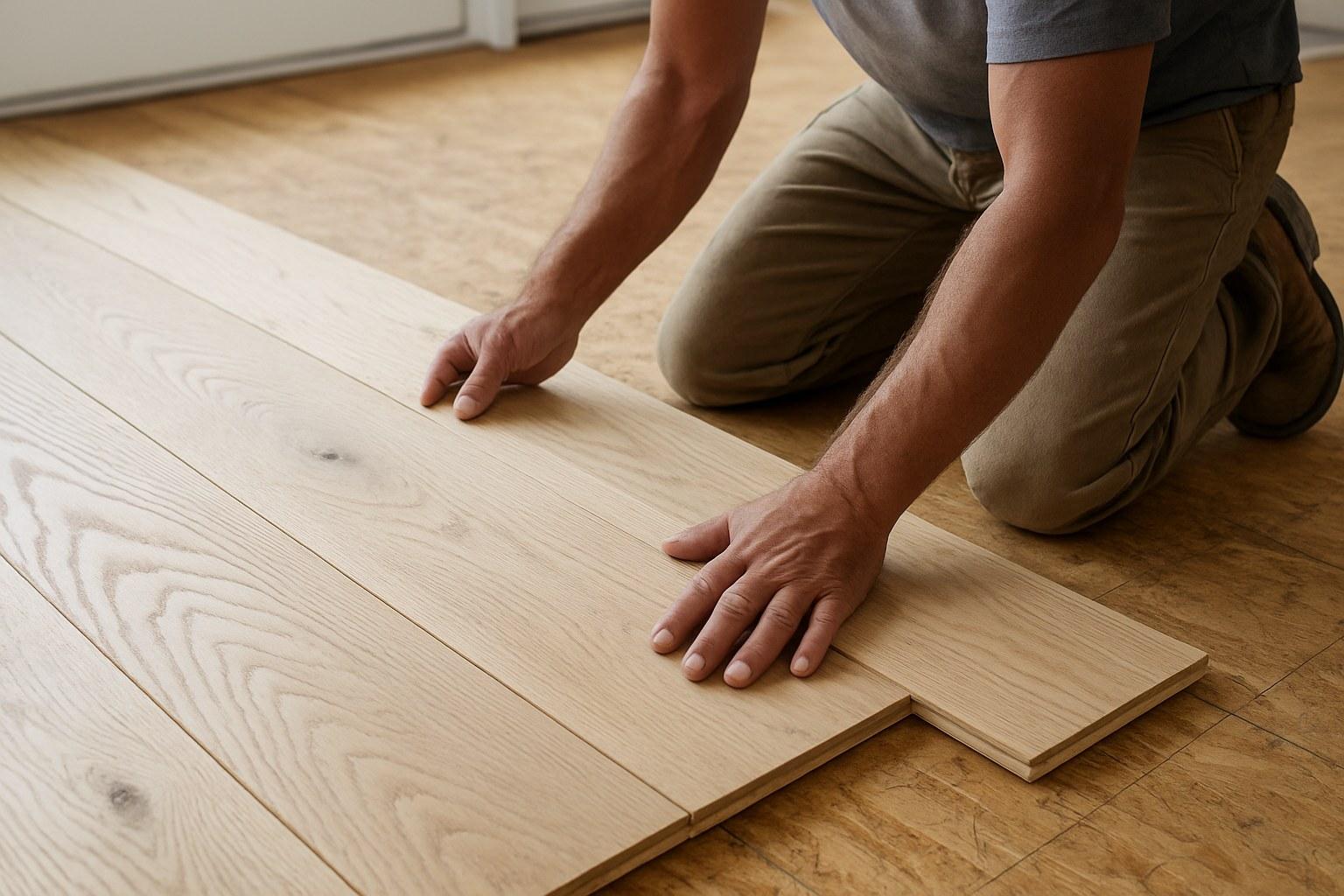
Wide plank is usually nailed down with a bead of adhesive run under each board. That glue-assist fights the extra movement a wide face wants to make, and it's why wide plank costs more labor than a plain nail-down strip floor.
On DIY versus hiring out: a click-together engineered floor is realistic for a careful DIYer. Nail-plus-glue solid wide plank, stairs, and big open-plan floors with moisture transitions are where hiring a pro pays for itself. If you want to see the full sequence, the step-by-step hardwood install walkthrough lays out the prep and the method in order.
What Wide Plank White Oak Costs
According to Hallmark Floors, plan on roughly $6-$25 per square foot installed, which covers both the material and the labor. The low end is budget engineered laid in an easy open room, and the high end is wide solid or extra-wide plank with on-site sanding and finishing.
| Scope | Cost per sq ft | Source |
|---|---|---|
| Engineered white oak, material only | $4.50-$16 | Easiklip |
| Solid white oak, material only | $8-$15 | Wagner Meters |
| Installed, material plus labor | $6-$25 | Hallmark Floors |
Material-only and installed cost ranges for wide plank white oak.
The gap between the material number and the installed number is your labor and prep. That part is not one flat figure; it climbs with the job. Stairs cost more per step than open floor, and a basement adds a moisture barrier and often leveling work that an upstairs bedroom never needs.
Use this arithmetic for your own room. Total equals installed cost per square foot times your square footage, where installed cost already rolls material and labor together. For a 200 square foot bedroom at a mid-range $18 per square foot installed, that's 200 x $18 = $3,600. Swap in your own room size and the quote you get, and the same multiplication gives your number. Measure the room, add about 10% for waste and cuts, and price against that larger figure, not the bare floor area.