
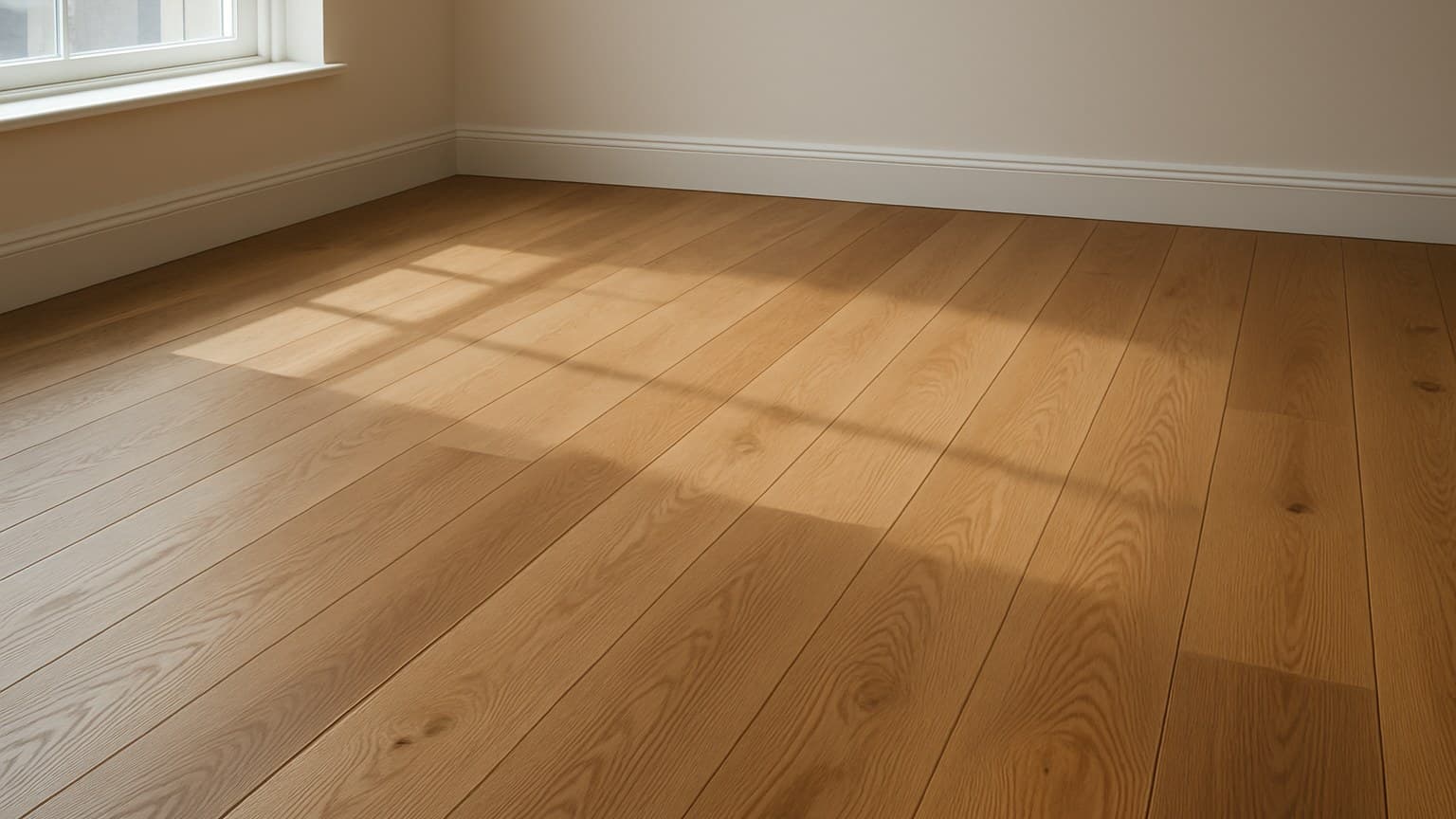
Two boards can both ring up as "oak flooring" at the same price, then wear and move in completely different ways once they're nailed down. The showroom sample never tells you the grade (how clean the boards look) or the cut (how the log was sliced), and those two calls swing your price and how much the floor moves more than red versus white oak ever will. Get them wrong and you pay oak prices for a floor that gaps in a dry Ohio winter.
Key takeaways
- Red vs. white gets the attention, but grade (how clean the boards are) and cut (how the log was sliced) swing oak's price and stability more.
- Red oak sits around 1290 Janka; white oak around 1360, with tighter, more water-resistant grain that takes gray and light finishes cleaner.
- The three NWFA/NOFMA grades (Clear/Select, No. 1 Common, No. 2 Common) are about looks, not strength: a knotty floor is just as hard and long-lasting as a clear one.
- Solid oak lasts 50+ years and refinishes many times; engineered oak lasts 20-40 years, refinishes 0-2 times, and is the pick over concrete, basements, and radiant heat.
- Budget roughly $3-12/SF for material plus $3-8/SF for labor; a 20x20 (400 SF) room runs about $2,400-$8,000 installed, with stairs and basements costing more per foot.
The Two Specs a Sample Board Hides
Red oak versus white oak gets all the attention. But the grade (how clean the boards are) and the cut (how the log was sliced) move price and stability more than color ever does.
Four choices set what you pay and how long the floor lasts: the species (red or white), the grade, the cut (plain-sawn versus rift or quarter-sawn), and the construction (solid versus engineered). A tag that just says "oak flooring" or "hardwood oak flooring" tells you almost nothing until you know those four.
The rest of this guide walks each one and ties it back to cost, in the order that matters for your room.
Red Oak vs. White Oak: Grain, Color, Hardness
White oak is the tougher, more water-friendly board and it costs more. Red oak is easier on the wallet and hides scratches better. That's the short version.
Red oak runs about 1290 on the Janka scale, which is the standard test for how well wood resists denting. It has a warm, pinkish tan tone and a wavy, open grain that helps hide small scratches. White oak runs about 1360, leans brown to greige (a gray-brown), and has tighter, closed pores that shrug off spills better.
That pore difference is why white oak takes gray, natural, and light stains cleaner. It has no pink to fight. Red oak's warm cast pushes cool gray stains muddy, so if you want that pale Scandinavian look, white oak saves you a lot of grief.
Red oak is cheaper and remains the most widely available oak species in the US, so it's easy to find and easy to match. White oak is the better call for kitchens, entries, and anywhere spills happen. If you're open to skipping wood species altogether, weighing bamboo against solid or engineered oak is its own worthwhile comparison, covered in this bamboo flooring vs hardwood breakdown.
| Spec | Red oak | White oak |
|---|---|---|
| Color | Warm, pinkish tan | Brown to greige, cooler |
| Grain | Wavy, open pores, hides scratches | Tighter, straighter, closed pores |
| Janka hardness | ~1290 | ~1360 |
| Water resistance | Lower (open pores) | Higher (closed pores) |
| Takes gray/light stains | Fights cool tones | Clean, even |
| Relative cost | Lower | Higher |
How red and white oak compare on look, hardness, water resistance, and price.
The Three Oak Grades, in Plain Words
Grade is about looks, not strength. A knotty floor is exactly as hard and long-lasting as a clean one; it just shows more character.
You'll see three grades. Clear (or Select and Better) has few marks and even color. No. 1 Common has some knots, mineral streaks (dark natural lines in the wood), and color variation. No. 2 Common, sometimes called character or rustic, has frequent knots, heavy streaks, and big color swings.
Higher grade costs more per square foot because the mill throws away more of the log to get those clean boards. Rustic grades cost less and hide dents and scuffs better because your eye is already busy. In a house with kids and dogs, that's a feature, not a compromise. That same discount logic is why leftover or discontinued runs turn up on clearance hardwood flooring racks at a fraction of the regular price.
These definitions come from the National Wood Flooring Association (NWFA) and the old National Oak Flooring Manufacturers Association (NOFMA) grading rules, see the NWFA/NOFMA grade photos and the NWFA/NOFMA Unfinished Wood Flooring Standard, so "Select and Better" or "Clear" means the same thing across brands. The NWFA also maintains a formal definition of what counts as genuine "real wood" flooring (see the NWFA's Use Real Wood standard), which is why the term has a set standard you can hold a supplier to. A similar patchwork of labels shows up around eco claims, which is why it's worth checking what a sustainable hardwood flooring certification actually verifies before trusting the box.
| Grade | Look | Relative cost |
|---|---|---|
| Clear / Select & Better | Minimal knots, uniform color | Highest |
| No. 1 Common | Some knots, mineral streaks, color variation | Middle |
| No. 2 Common (character/rustic) | Frequent knots, heavy streaks and color swing | Lowest |
Source: the NWFA/NOFMA hardwood flooring grading rules
The three oak grades differ in appearance and price, not in hardness or lifespan.
Plain-Sawn vs. Rift & Quarter-Sawn: The Cut Nobody Explains
The cut decides both the grain pattern and how much the floor moves when your house dries out in winter or swells up in summer. It can add several dollars a square foot.
Plain-sawn is the cheapest and most common. It shows wavy "cathedral" grain (arched, flame-like lines) and moves the most, meaning it cups and gaps more as humidity swings.
Rift-sawn shows straight, tight grain and is very stable, but it costs more because it wastes more of the log. Quarter-sawn shows straight grain plus shimmering "ray fleck" (bright flecks that catch the light), is the most stable cut, and costs the most. Rift and quarter are often sold together as "rift and quartered."
If your room sees big humidity swings, a straighter cut is worth the upcharge for how little it moves.
Solid vs. Engineered Oak (and Where Each Belongs)
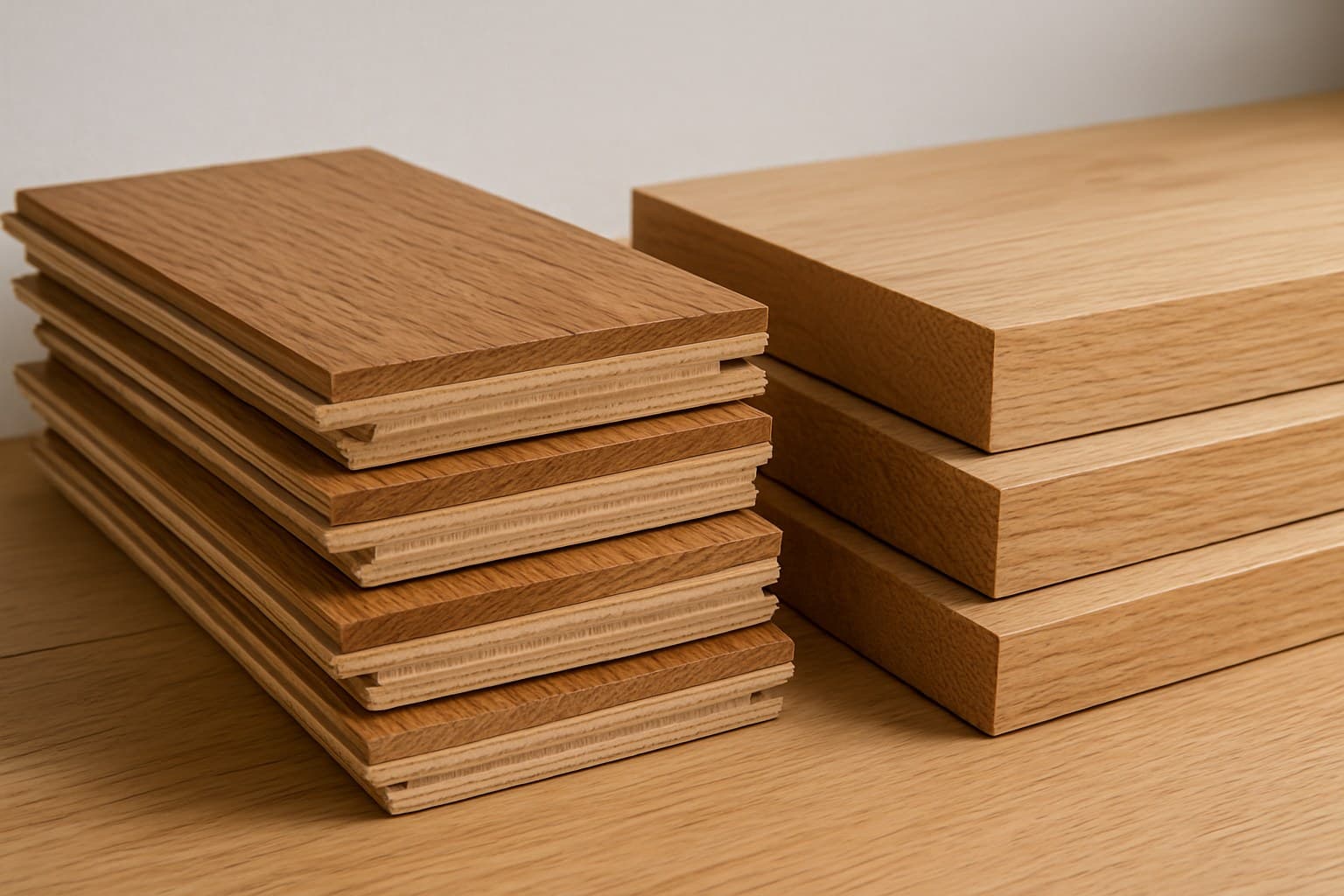
Where the floor is going drives this choice as much as looks do. Solid oak is milled at a standard 3/4-inch thickness, which is what gives it enough wood to last 50 years or more with proper care and refinish many times, but it belongs on or above ground level over a wood subfloor, not over concrete, below ground, or over radiant heat.
Engineered oak has a plywood-style core that stays put when moisture and temperature move. It typically lasts 20 to 40 years, and engineered floors with a thin wear layer (often around 2mm) can usually take 0 to 2 light refinishes before you hit the plywood core; thinner-veneer budget lines may not take even one. For a basement, anything over a concrete slab, or a floor with radiant heat under it, engineered is the pick. If you want to sand and restain for decades, go solid.
Either way, the prep decides the outcome. Check the subfloor for flatness and moisture before you commit, most manufacturers void the warranty over an out-of-flat or damp subfloor, not over the plank you picked. Nearly every floating engineered floor also needs an expansion gap around the room, and the exact size is set by the maker's instructions, not a number you read online. Same with acclimation: the box's own sheet says whether the wood needs to sit in the room first. If you're still weighing which construction and species actually fit your room before you get to prep work, this breakdown of solid vs. engineered hardwood floors is worth reading first.
Plank Width: Strip to Wide Plank
Wide planks look great, but they move more than narrow strips because there's more board to swell and shrink across. A 2¼-inch strip barely budges; a 7-inch plank can show gaps in a dry winter.
If you love the wide look, weigh the species and cut carefully, and lean toward engineered for the extra stability. It's the same trade you face with other wide-board woods, whether that's wide plank hickory or a softer, character-heavy option like wide plank pine.
Textures, Finishes, and the Light Oak Look
Your finish choice ranges from most work on site to least: unfinished (sanded and finished after it's down), finish-ready, and prefinished. Prefinished flooring is generally covered by the NWFA/NOFMA Factory Finished Flooring Standards, and it usually comes with a UV-cured aluminum oxide coat, a tough, factory-baked topcoat that's the fastest and hardest option out of the box.
Unfinished oak lets you match a stain exactly and sand the whole floor dead flat, but it adds days of dust and dry time to the job. If you want to control the color to the shade, that path is covered in more depth in this guide to unfinished hardwood flooring.
Texture adds cost too. Ballpark dealer upcharges often run about +$1/SF for wire-brushed or hand-scraped, +$2/SF for charring or French bleed (a lightly scorched, streaky finish styled after old French farmhouse floors), +$3/SF for sawmark, and +$5/SF for a foot-worn look, though exact pricing varies by mill and region. Those figures are the author's own market research, informal notes from comparing regional dealer price sheets, not a published rate card, so treat them as a planning range and confirm current numbers with your installer. Those are add-ons, not the base price.
Getting the Light Oak Look
For pale, modern oak, start with white oak, not red. The lack of pink is what lets a gray or natural finish read clean instead of muddy.
Then pick a matte or wire-brushed surface. Both hide wear and pet scratches better than a glossy coat, which shows every scuff under a window.
What Oak Flooring Costs Per Square Foot
Split every quote into materials and labor, because the two move for different reasons. Figure roughly $3-8/SF for red oak, $5-12/SF for white oak, and $4-10/SF for engineered oak on materials. Grade, cut, and texture push the top end higher.
For labor, budget about $3-8/SF for a standard open room in Dayton and Columbus installs. Stairs cost more per step, and basements run higher per foot because of moisture prep and cutting around a tighter space.
The ranges below come from the author's own market research, cross-checking price sheets and quotes from Ohio-area flooring dealers and installers over time, rather than a single published price list, so use them as a realistic planning range and get a firm number from your own installer before you budget a job.
| Layer | Red oak | White oak | Engineered oak |
|---|---|---|---|
| Material /SF | $3-8 | $5-12 | $4-10 |
| Labor /SF (open room) | $3-8 | $3-8 | $3-8 |
| Installed /SF | $6-16 | $8-20 | $7-18 |
Per-square-foot oak flooring costs split into materials and labor, for a standard open room; stairs and basements cost more.
Here's the arithmetic. Take your room size in square feet, add the material rate and the labor rate to get an installed rate per foot, then multiply. For a 20x20 room, that's 400 SF. Plain red oak at $3 material plus $3 labor is $6/SF, or about $2,400. Select white oak at $12 material plus $8 labor is $20/SF, or about $8,000. Most jobs land between those two ends.
If your rooms flow into tile at the kitchen or bath, budget for the changeover too; the right approach depends on your floor heights, which is exactly what these wood to tile transition ideas walk through before you buy trim.