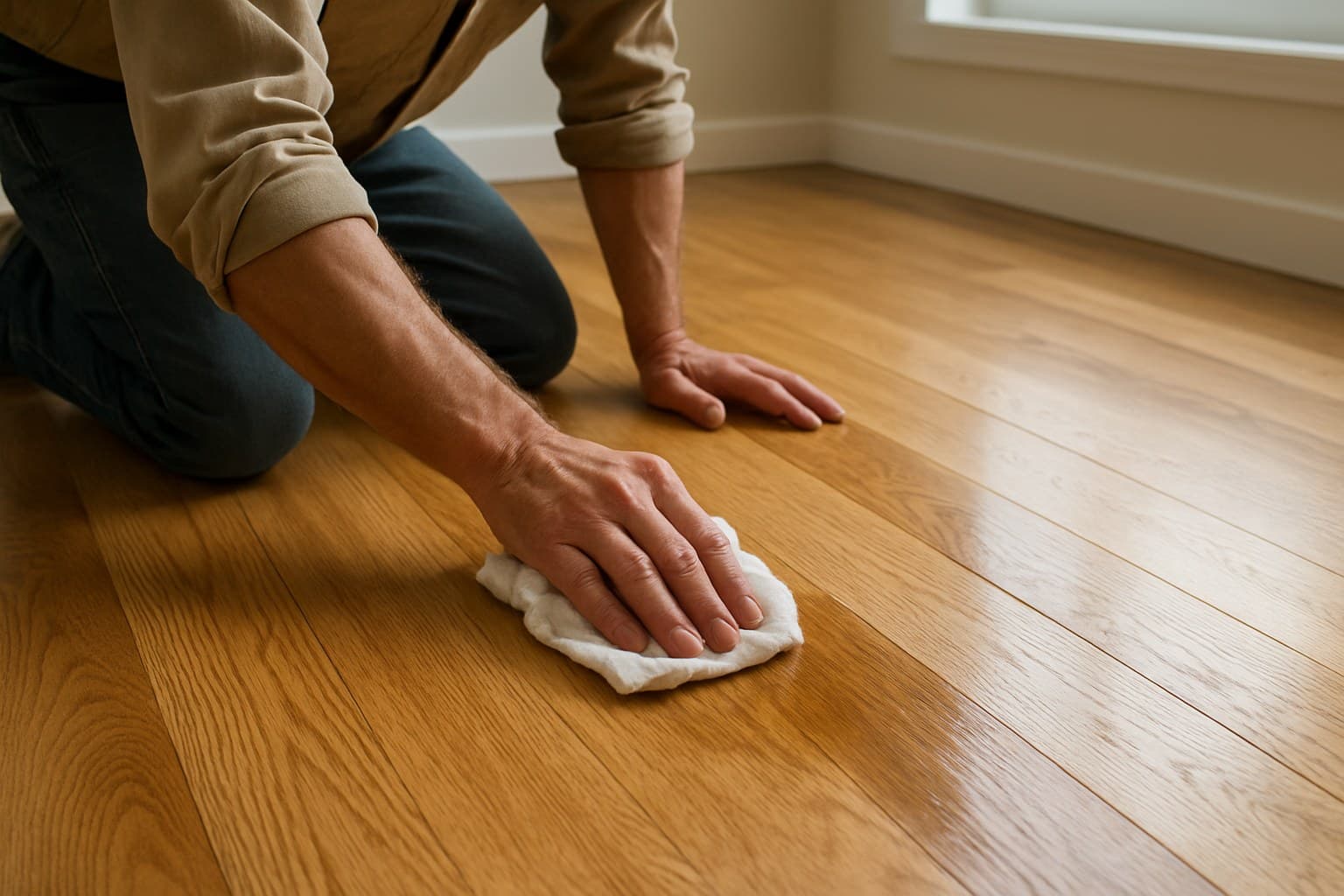
In a Beaverton kitchen last winter, I pulled up a five-year-old "eco" engineered floor that tested clean on the surface but still had seams off-gassing glue fumes from the core. Reclaimed wood is the greenest option you can install, with responsibly sourced engineered wood a close second, the eco logo on the box won't tell you that, or whether the finish and adhesive underneath are safe to breathe around. Mix up those two questions, and you pay a green premium for a floor that leaks fumes at the seams.
Key takeaways
- No single label covers everything: FSC verifies where the wood came from, while Greenguard Gold and FloorScore verify indoor air and VOCs. You need to check for both.
- FSC Mix and FSC Controlled Wood are weaker than FSC 100%. Controlled Wood only screens out the worst sources, it does not certify the forest.
- CARB2 (now folded into the federal TSCA Title VI rule) caps formaldehyde in engineered cores and plywood, but says nothing about the surface finish or the forest.
- Reclaimed wood is the lowest-footprint option; engineered uses far less slow-growing hardwood per plank than solid, so it stretches the same tree further.
- An eco logo often applies to the company or the packaging, not the actual plank, so ask for the certificate number tied to that specific product.
What "Sustainable" Actually Means Here (and What It Doesn't)
That Beaverton floor had a label that was completely true and completely useless at the same time. The forest-sourcing claim checked out. But the seams and the core were still releasing chemical fumes from the plywood glue underneath, and no certification on that box said a word about it.
That job sums up the whole problem. Sustainable hardwood is really two separate questions, and one label almost never answers both.
The first question is where the wood came from. Was the forest managed so it grows back, or was it stripped? The second question is what is actually in the plank you live and breathe around: the core, the glue, and the finish. A forest label tells you nothing about the fumes. An air-quality label tells you nothing about the forest.
That gap between the two is where greenwashing hides. Certifications verify narrow, specific things, and companies lean on that narrowness to make a floor sound greener than it is.
Here is the bottom line before we go deeper. The greenest floor is usually the one already milled, meaning reclaimed wood that already exists. After that comes responsibly sourced engineered wood. The finish and the adhesive decide the indoor-air side of the story, no matter which one you pick. If bamboo is also on your shortlist, my bamboo flooring vs hardwood comparison walks through how it stacks up before you decide.
Solid vs. Engineered vs. Reclaimed: Which Uses Fewer Resources?
According to NWFA's Homeowners' Handbook to Real Wood Floors, reclaimed wood has the lowest impact because no new tree gets cut, engineered stretches slow-growing hardwood the furthest per plank, and solid uses the most premium wood but refinishes the most times, so it can last generations. That premium-wood emphasis is exactly why my hardwood flooring grades explained guide is worth a look before you compare planks side by side.
Solid hardwood
Solid planks are one species all the way through. That means the most premium hardwood per square foot, but it also means you can sand and refinish them several times over their life. A well-kept solid floor can outlive the person who laid it. If you're still weighing solid against engineered for a particular room, this breakdown of picking solid vs. engineered hardwood floors walks through species and room-by-room fit.
There is a limit, though, and it is a spec you look up, not a rule of thumb. I had a customer who wanted solid oak sanded a fourth or fifth time. In one corner it sanded down to the tongue, the interlocking edge, before I caught it. The top looked fine with almost nothing left to take off. Check the remaining thickness at the edges before you assume a floor has another sanding in it.
Engineered hardwood
Engineered is a thin layer of real wood, the veneer, glued over a core of plywood or HDF (high-density fiberboard, a pressed wood-fiber board). Because only the top is premium hardwood, it uses far less of the slow-growing stuff per plank. That's the real resource win. That thin-veneer construction is also why it's worth checking whether a popular brand like Pergo is real hardwood or something else entirely before you buy on name recognition alone.
The catch is the core. That's where formaldehyde and glue enter the picture, so the indoor-air question lands squarely on engineered floors. If you're weighing a floating engineered floor, my guide to whether click hardwood flooring is worth it walks through the install side.
The refinish tradeoff matters too. A thin veneer may only take one sanding, or none at all. That shortens its life compared to solid. Again, this is a per-product spec, not a guess. Read the veneer thickness on that exact floor.
Reclaimed and salvaged
Reclaimed and salvaged wood reuse boards that already exist, keeping them out of the landfill. So does leftover clearance and closeout stock that is just surplus, not defective. Nothing new gets cut, which is hard to beat on footprint.
One warning: transport can erase the benefit. Reclaimed barn wood trucked across the country burns a lot of fuel to get to you. Sourced locally, it wins. Shipped long distances, the math gets a lot weaker.
| Type | Hardwood used per plank | Refinishes possible | Indoor-air risk | Best footprint case |
|---|---|---|---|---|
| Solid hardwood | Most (full thickness) | Several over its life | Finish/adhesive only | Domestic species, low-VOC finish |
| Engineered | Least (thin veneer over core) | One or none, veneer-dependent | Core + glue + finish | CARB2 core, FSC veneer |
| Reclaimed / closeout | None new | Varies by remaining thickness | Old finish may need refinishing | Sourced locally, short haul |
Source: NWFA wood flooring material guidance and what I see pulling old floors out
How the three build types compare on wood used, refinishing life, and where indoor-air risk hides.
Domestic species like oak or maple beat imported ones on transport alone. If you want a darker look without reaching for a tropical species, see what walnut hardwood actually costs as a home-grown option.
Certifications Decoded: What Each Label Actually Verifies
These labels don't overlap the way most shoppers assume. Forest labels say nothing about indoor air. Air labels say nothing about the forest. You need one of each to cover both questions.
Start with FSC, the Forest Stewardship Council, because people treat it as one thing when it has tiers. FSC 100% means all the wood came from certified, well-managed forests. FSC Mix is a blend of certified, recycled, and controlled wood, so not every fiber is fully certified. FSC Controlled Wood is the weakest: it only screens out the worst sources, like illegal logging. It's a floor, not a ceiling. Worth knowing: illegal logging isn't just a sourcing buzzword on a certification chart. The Lacey Act is the actual U.S. federal law that makes it a crime to import, sell, or trade wood that was harvested illegally, and it applies whether or not the plank ever carries an FSC logo of any tier. Controlled Wood is a supply-chain screen; the Lacey Act is the legal backstop underneath it, with real penalties attached.
SFI, the Sustainable Forestry Initiative, is a North American standard founded by the forest industry. Critics see it as looser than FSC. It still beats no label at all, but don't read it as the same rigor.
Then the air side. CARB2, the California rule now folded into the federal TSCA (Toxic Substances Control Act) Title VI standard, caps formaldehyde in composite and engineered cores. It says nothing about the surface finish, the total fumes, or the forest. FloorScore and Greenguard Gold both certify low VOC emissions, meaning low chemical off-gassing, with Greenguard Gold set to a stricter health threshold. Cradle to Cradle and EPDs (Environmental Product Declarations) are broader lifecycle documents, not simple pass/fail seals, NWFA, for example, now publishes its own cradle-to-grave EPDs for solid and engineered wood flooring, which quantify a product's environmental footprint across its full life rather than just checking a single box.
| Label | Verifies | Does not cover |
|---|---|---|
| FSC 100% | All wood from FSC-certified forests | VOCs, formaldehyde, indoor air |
| FSC Mix | Blend of certified, recycled, controlled wood | That every fiber is fully certified |
| FSC Controlled Wood | Screens out illegal/high-risk sources | Full forest certification (it's a floor, not a ceiling) |
| SFI | North American forest management | Same rigor critics expect of FSC; indoor air |
| Greenguard Gold | Low chemical/VOC emissions (strict health threshold) | Where the wood came from |
| FloorScore | VOC emissions for flooring specifically | Forest sourcing, carbon footprint |
| CARB2 / TSCA Title VI | Formaldehyde limits in composite/engineered cores | Surface finish, forest, total VOCs |
Source: The published FSC, SFI, UL Greenguard, and SCS FloorScore program standards
What each common flooring certification actually checks, and the gap it leaves open.
Greenwashing Red Flags I Watch For
The biggest tell is a logo printed on the packaging or the website but never tied to the actual product. A company can be FSC certified while the specific plank you're buying is not. Ask for the certificate number that matches the exact SKU. If nobody can produce one, the logo is decoration.
Watch for vague words with no standard behind them. "Eco-friendly," "green," "natural," and "non-toxic" mean nothing on their own. They need a named certification and a threshold, or they're just marketing. I dig into that trap in my piece on why a "formaldehyde-free" label doesn't mean what you think.
Be skeptical of "carbon neutral" claims with no EPD or lifecycle math to back them up. NWFA now publishes cradle-to-grave Environmental Product Declarations for solid and engineered wood flooring, and they're worth actually opening rather than just citing by name. Each EPD reports a Global Warming Potential (GWP) figure, carbon impact stated in kg CO2-equivalent per functional unit, broken out by life-cycle stage: raw material sourcing, manufacturing, transport, installation/use, and end-of-life. NWFA publishes solid and engineered as two separate declarations rather than one combined number precisely because the two products carry different manufacturing footprints (a solid plank's impact concentrates in milling and kiln-drying; an engineered plank's adds the core and adhesive production step), so a brand's "carbon neutral" claim should be checked against the specific document, not just the fact that an EPD exists. See the solid and engineered EPD PDFs linked in Sources below for the exact per-product figures.
And treat exotic or tropical species sold as "sustainable" with real doubt, since the transport and forest questions get harder, not easier.
The one that burns people is silence. If the finish and the adhesive are never mentioned anywhere, that's a red flag by itself. That silence is exactly where the fumes hid in the Beaverton floor I tore out.
Finishes and Adhesives: The UV-Cured vs. Natural-Oil Debate
This one is genuinely unsettled, so I'll lay out both camps instead of pretending there's one right answer. One side argues factory UV-cured finishes are the healthier, tougher choice. The other side pushes natural low-VOC oils and nontoxic glues. They disagree because they're optimizing for different things.
UV-cured means the coating was hardened under ultraviolet light at the factory. Because the curing already happened before the plank reached your house, almost no fumes off-gas indoors. It's also a hard, durable film. The downside is repairs: a scratch means spot-sanding a tough coating, which isn't a casual weekend fix.
Natural oil or hardwax oil soaks into the wood instead of sitting on top. It wears in rather than off, and you can spot-repair a worn patch without redoing the whole floor. But "natural" isn't automatically low-VOC. You still have to check that specific product's emission number, because some oils off-gas more than a good factory finish does.
My practical take: for the air in your home, a UV-cured factory finish is the safer default because the fumes are already gone by install day. Choose natural oil if easy spot-repair matters more to you, and only after you've read that product's VOC figure, not just its name. Either way, ask what adhesive goes down under the plank. On glue-down engineered jobs, the adhesive can undo a clean floor's whole indoor-air story, and that's the part nobody puts on the box.