
- You're Buying Real Wood, Not Laminate or LVP
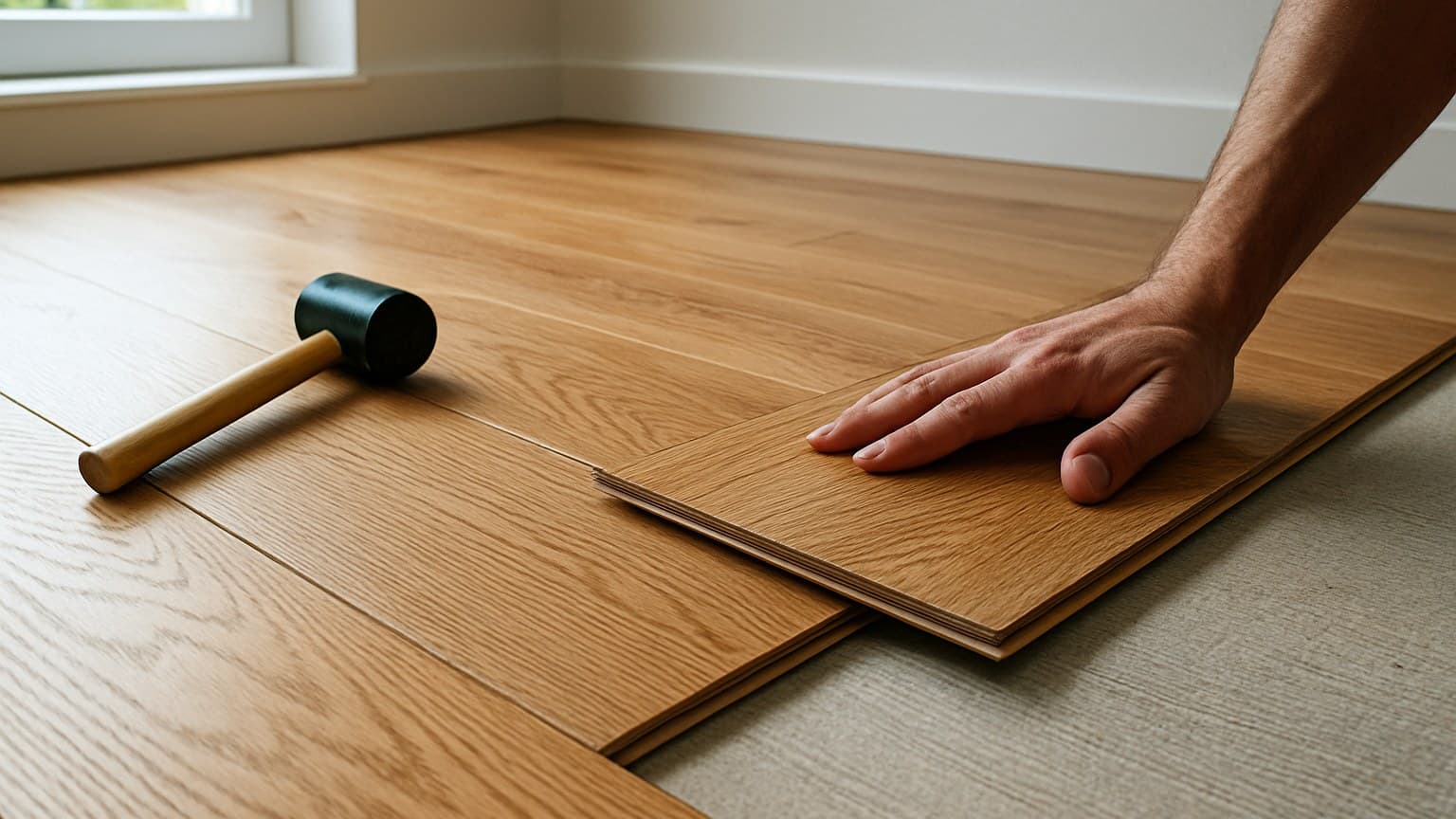
On a job for Renee in Dayton, Ohio, I had to explain her new floor wasn't just fancy vinyl. Click hardwood is real engineered wood, not a look-alike. Under the click edges it's a hardwood veneer (a real slice of wood on top) bonded to a plywood-style core, which meets the official definition of real wood flooring published by the NWFA (National Wood Flooring Association). That same real-wood status matters to buyers working through a non-toxic hardwood flooring guide before they settle on finishes and adhesives for their home.
That matters because it gets sold on the same rack as two fakes. Laminate is a printed photo of wood pressed onto fiberboard. LVP, short for luxury vinyl plank, is a printed vinyl. Both copy the look. Click hardwood is the wood. That mix-up is exactly why so many shoppers end up asking whether Pergo hardwood is real wood before they'll trust a click floor carrying that name.
You still get true wood surfaces, like hand-scraped hardwood flooring with its hand-textured, slightly wavy face, or a wire-brushed finish that pulls out the grain. Because it's real wood, no two boards repeat the way a printed pattern does. That same one-of-a-kind grain gets even more dramatic once you start comparing options in an exotic hardwood flooring guide built around bold color and figure.
Here's my stance up front: you pay more for real wood, and the payoff is a floor that reads like wood and can sometimes be refinished. Both of those come with limits I'll get to below.
Key takeaways
- Click hardwood is real engineered wood that floats over an underlayment. It is not laminate or LVP, even though buyers mix up all three.
- Most squeaks and gaps come from the subfloor, not the plank. NWFA guidance calls for flat to within about 3/16 inch over 10 feet and a moisture test before you lay a single board.
- Materials run roughly $4-9 per square foot; a pro adds about $3-6 per square foot in labor. Basements and stairs cost more than open rooms.
- Click-lock float is realistic DIY in an open, above-grade room. Basements need a slab moisture reading first, and radiant heat needs a product the maker rates for it.
- Whether you can ever refinish is a spec question tied to that product's veneer thickness, not a category promise.
2. The Click-Lock Join Is Where Squeaks and Gaps Start
The click join is what makes this floor float, and it's also its weak point. The plank edges are milled so a tongue (a shaped lip on one board) angles down into a groove on the next, and they snap together. No nails, no glue. The whole floor sits as one connected sheet over a thin pad.
That lock is strong when the floor under it is flat and dry. Put a high spot under a seam and every footstep flexes the join. That flex is what you hear as a squeak, and over time it's what pops a seam loose.
Gaps that open at the seams almost always mean the floor moved. Usually that's moisture, or an expansion gap that was left too small. It's rarely a bad plank.
So the join's durability doesn't really live in the join. It lives in the subfloor under it, which is the next thing to get right.
3. The Subfloor Has to Be Flat and Dry First (NWFA Specifics)
Check flatness and moisture before you open a single box. According to the NWFA Installation Guidelines, a subfloor should be flat to within about 3/16 inch over a 10-foot span. Anything worse, and you're building squeaks and popped seams into the floor from day one.
Moisture matters just as much. Per the NWFA Installation Guidelines, you test the subfloor, either with a moisture meter (a tool that reads how wet the material is) on wood, or a slab test on concrete, and compare that reading to the plank's own moisture level before you lay it. If those two numbers are far apart, the floor will move after it's down. On a job in Kettering, Ohio, my pin meter read 13% in the subfloor against 7% in the boxed planks, a 6-point gap, while a straightedge laid across the hallway found a 5/16-inch dip near the closet wall. Both readings sent me back to the subfloor with a dehumidifier and a self-leveler before a single plank went down; that gap and that dip are exactly what the NWFA numbers above are meant to catch.
Every floating floor also needs an expansion gap around the edge of the room so it can swell and shrink without buckling. The exact size comes from the maker's instructions, not a number someone repeats online.
I learned the moisture part the hard way on a job for Carol in Toledo. She talked me out of a moisture test to save an afternoon, and I let her. The floor cupped before the season was out, and I relaid it on my own dime rather than argue about whose call it was. That's the day I stopped treating the test as optional.
If you want to go deeper on the pad and prep beneath the boards, see what to put under hardwood flooring.
4. Acclimation Rules Come From the Box, Not the Internet
Acclimation needs vary by product, so ignore blanket advice. Some makers want the planks to sit in the room for days before install. Others say their engineered plank needs none at all. Both can be right, because it depends on how that specific floor is built.
The box's own install sheet governs whether you acclimate and for how long. Never a rule of thumb passed around a forum.
Engineered click hardwood is usually more forgiving here than solid wood. The plywood-style core is built up in cross layers, so it swells and shrinks less when the room's humidity swings.
Read the specific install guide. If it asks for acclimation, don't shortcut it just to finish the job the same day.
5. The Wear Layer Decides If You Can Ever Refinish
With solid wood you can sand and refinish many times. With engineered click hardwood, the veneer on top sets a hard cap on how often you can refinish, if you can at all. A thin veneer may not survive a single sanding. That refinishing gap is one of the biggest factors to weigh when comparing solid vs. engineered hardwood floors for your room.
So "can I sand this later" is a spec question, not a category promise. Whether you can refinish it isn't a yes or no. It's printed on that product's spec sheet as a veneer thickness, and you read it before you buy. On real spec sheets that number typically runs from around 1mm on thin, budget-tier planks up to 6mm or more on premium ones. As a rough guide, anything under about 2mm is essentially a one-time surface that will wear through and need replacing rather than sanding, while 3mm and up generally leaves room for at least one light refinish.
The tradeoff runs with price. Thinner veneers cost less but may never sand, which means when they wear through, you replace instead of refinish. Thicker veneers cost more and buy you a refinish or two down the road.
For a species where refinishing potential and price are genuinely worth weighing against each other, see what walnut hardwood flooring actually costs.
6. What It Actually Costs: Materials vs Labor, DIY vs Pro
Split the cost into two lines and it stops being a mystery. Click hardwood materials run roughly $4 to $9 per square foot, the underlayment adds about $0.30 to $0.80, and a pro adds around $3 to $6 per square foot in labor.
| Cost line | Range ($ per sq ft) |
|---|---|
| Underlayment | $0.30 - $0.80 |
| Pro install labor | $3.00 - $6.00 |
| Materials (click hardwood) | $4.00 - $9.00 |
Total installed cost per square foot for a click hardwood floor: doing it yourself versus paying a pro for materials, underlayment, and labor.
Doing it yourself erases the labor line, but not the risk. A bad subfloor call, a missed high spot or a skipped moisture test, costs more to fix than the labor you saved.
Two premiums show up on real quotes. Basements cost more per foot than open rooms because the slab needs testing and prep. Stairs cost more too, because of the extra cuts, nosings (the trim piece that caps the front edge of each stair tread), and transitions. Treat all these figures as a starting range, since region, species, and how much prep your old floor needs all move the number. Get local quotes before you commit.
On a tight budget, weigh clearance hardwood flooring against the veneer tradeoff from the last section, because the cheapest box is a poor deal if its veneer can never be sanded.
7. Best and Worst Rooms (Basement, Kitchen, Radiant Heat)
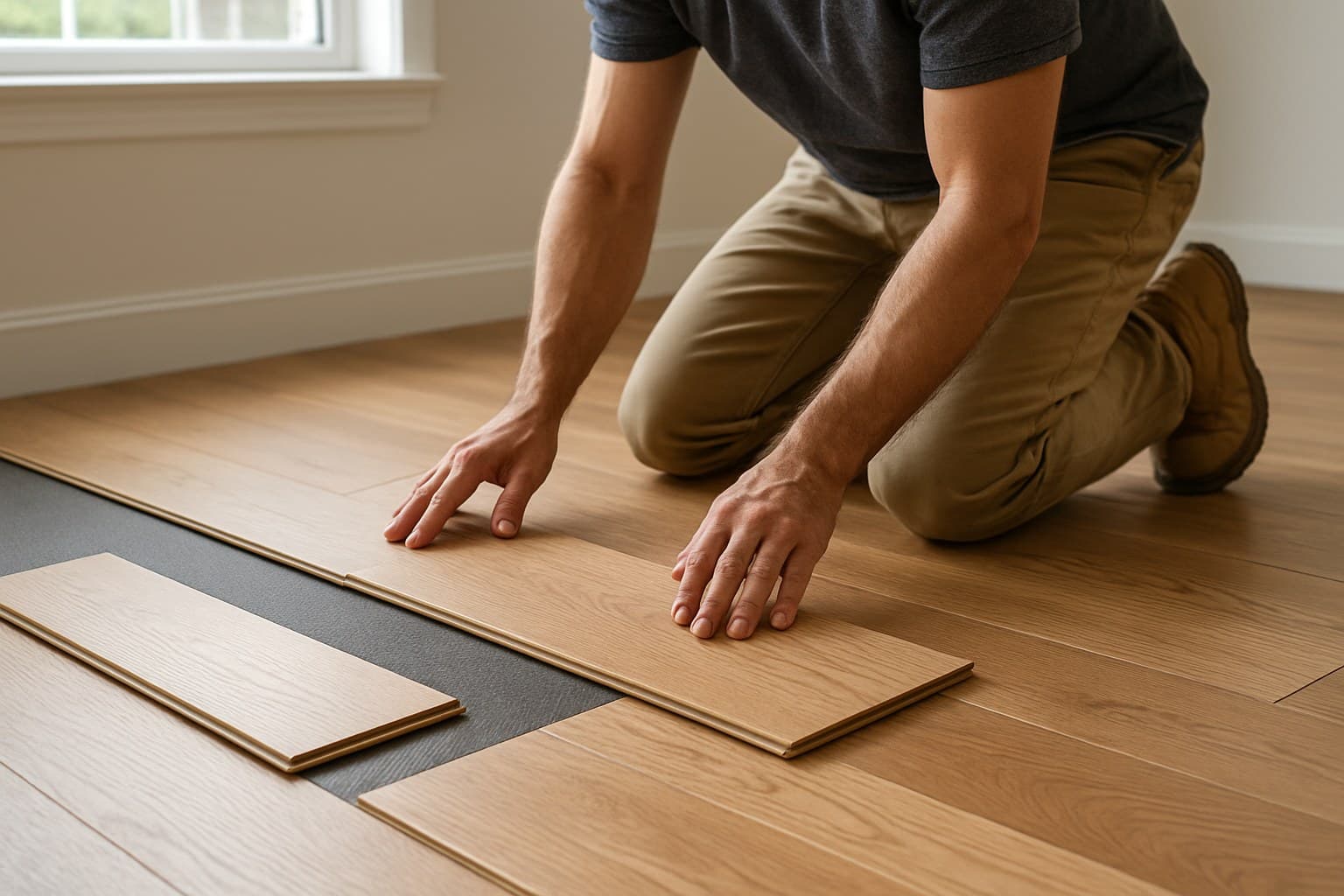
The room decides more than the brand does, so here are plain verdicts by room instead of a generic pros-and-cons list. Bedrooms and living rooms above grade are the sweet spot: dry, stable, and a realistic DIY float job.
Basements are a slab question, not a plank question. I've steered people off both hardwood and LVP down there when the moisture readings came back high, so test the slab before you fall in love with any floor.
Kitchens work if you wipe spills fast, but the seams are the weak point, not the plank face. Radiant heat is fine only with a product the maker rates for it. Bathrooms, where water pools and sits, are a no.
| Room | Verdict | Why |
|---|---|---|
| Bedrooms / living (above grade) | Best | Dry, stable, realistic DIY float |
| Kitchen | OK with care | Wipe spills fast; seams are the weak spot |
| Basement (below grade) | Risky | Test slab moisture first; often better in LVP |
| Over radiant heat | Only if rated | Use a plank the maker rates for radiant heat |
| Bathroom | No | Standing water finds the seams and edges |
Room-by-room verdicts for a floating click hardwood floor, based on moisture and traffic in each space.
8. Click Hardwood vs Laminate vs LVP: The Tradeoff, Not a Winner
None of these three wins across the board. They trade off, and the right pick depends on your room and budget.
Laminate often gives a surprisingly realistic wood look for the money, and it usually costs less than both LVP and click hardwood. Its weakness is water: swelling at the seams once moisture gets in.
LVP tolerates moisture far better, which is why I reach for it near sinks, in basements that pass a moisture test, and in mudrooms. Keep the claim honest, though. A waterproof core is not the same as waterproof seams and edges, and floors fail at the seams, not the plank surface.
Click hardwood is the only one of the three that's actual wood. It reads like wood up close and, with a thick enough veneer, can be refinished. You pay more for that, and it's the least water-tolerant of the three. Pick real wood when the look and the refinish option matter most, and pick LVP when water is the bigger worry.
9. When Click Hardwood Is a Real DIY, and When to Hire It Out
Click-lock float is a realistic DIY in an open, above-grade room with a flat, dry subfloor. If you can measure a 10-foot span for flatness, run a moisture test, and cut clean lines, most bedrooms and living rooms are within reach.
Hire it out when the job stops being a simple open floor. Stairs are the clearest case, since each tread needs cuts and a nosing that click planks aren't built for. Large open-plan spaces with moisture transitions between rooms are another, because getting the expansion gaps and thresholds right across a big run takes experience.
Basements sit in the middle. The float itself is doable, but the slab moisture reading should come first, and if you're not set up to test it, that's a good reason to bring in a pro who is. The labor you save on an easy room is real. The money you lose relaying a cupped floor is real too.