
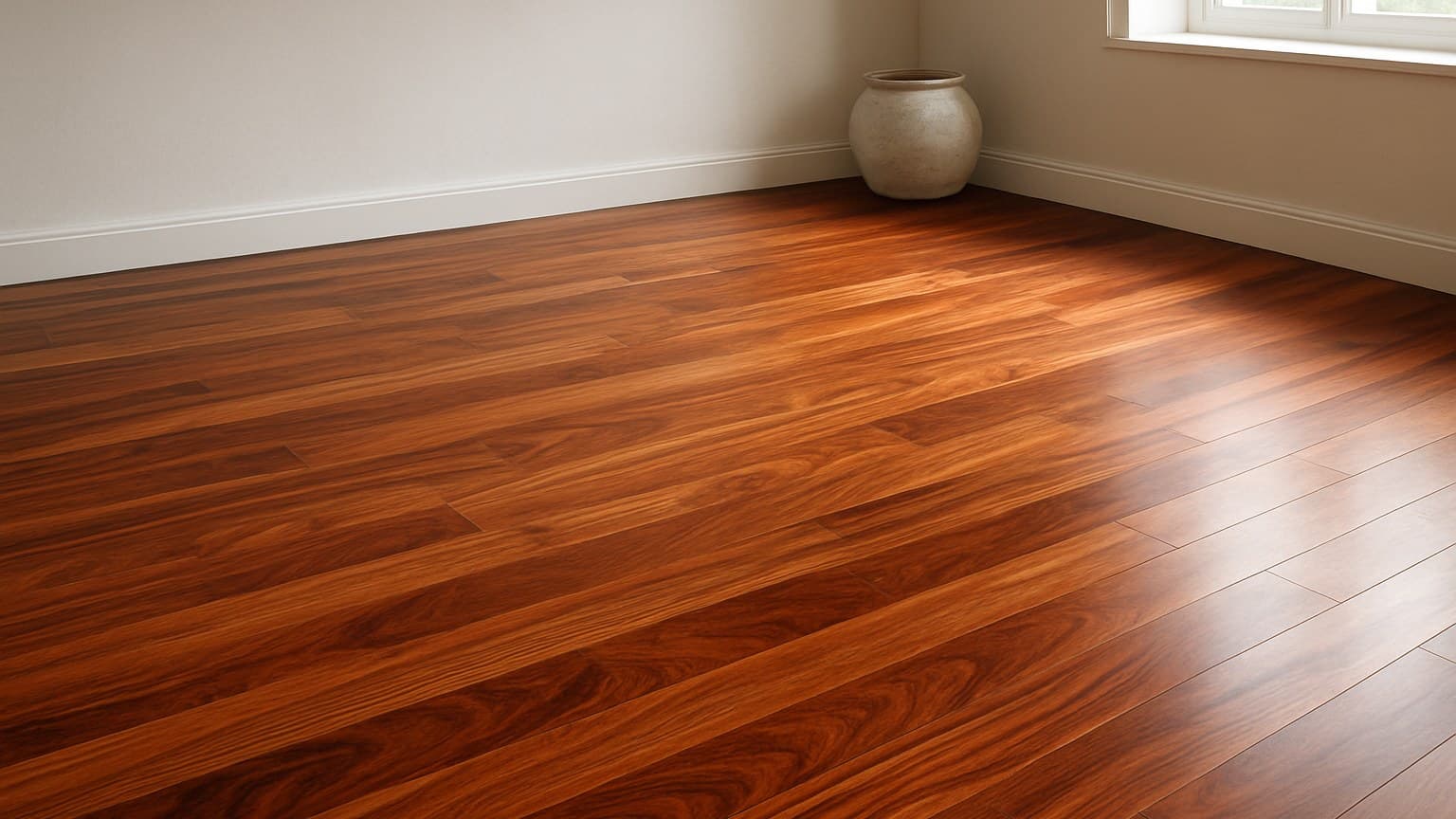
When Rosa in Scottsdale asked me to install Brazilian cherry across her great room, she'd already picked the species off one number: the Janka hardness rating stamped on the box. That number tells you how the floor handles a dropped pan, not how it handles your finish, your slab, or a year of desert sun through her patio doors. Those last three are where the money actually gets lost.
Key takeaways
- The hardest exotics, like Patagonian Rosewood (Janka around 3840) and Cumaru (around 3540), are also the toughest to finish and dry evenly, so a bigger number is not automatically a safer floor.
- Brazilian cherry (Jatoba) shifts color a lot in sunlight over time. Pull up an area rug a year later and you often find a lighter patch that no refinish fully evens out.
- Exotic solid materials commonly run about $4-14 per square foot, with install labor a separate $3-8 per square foot, and stairs or basements cost more than open rooms.
- Engineered exotic planks are more stable over concrete and below grade, where solid exotic is usually not recommended.
- The floor's success comes down to acclimation and a moisture check done to the specific product's own spec sheet, not a rule of thumb.
What "Exotic" Actually Means on a Flooring Box
Exotic hardwood is wood imported from outside North America, usually tropical species prized for high density, deep color, and hardness numbers well above domestic oak. Think Brazilian cherry, Cumaru, or Tigerwood instead of red oak or maple. Domestic softwoods get lumped into the same flooring conversation too, which is why it's worth understanding where cedar hardwood flooring actually fits before comparing it against true hardwoods on price alone.
Here's the paradox this whole article turns on: the same density that makes these floors sell, the dent resistance and the rich look, is what makes them fight the installer and the finish. A board that shrugs off a chair leg also shrugs off the finish trying to soak in. Some manufacturers dodge that fight altogether with a textured surface, which is part of why it helps to understand how wire brushed hardwood flooring is made before ruling it out as an alternative.
"Exotic" is a marketing and origin label, not a quality promise. A higher price or a harder wood doesn't automatically mean a better floor for your room. So the rest of this is about weighing hardness against price and install risk, not just looks. That same weighing exercise is worth running against non-wood options too, including how bamboo flooring compares to hardwood for households that want durability without the exotic price tag.
The Species That Sell Themselves: A Hardness and Risk Matrix
Here are the popular exotics side by side. Notice the two hardest, Patagonian Rosewood and Cumaru, also carry the highest install risk. That's the paradox made concrete: the number that sells the floor is the number that fights it.
| Species | Janka | Color and how it ages | Install risk |
|---|---|---|---|
| Sapele | 1410 | Reddish-brown, ribbon grain, darkens gently | Low-medium |
| Acacia | 1700 | High color variation, warm tones, mild deepening | Medium (wild grain moves) |
| Tigerwood | 2160 | Orange-brown with dark streaks that darken and blend | Medium |
| Santos Mahogany | 2200 | Deep red-brown, darkens richly | Medium-high |
| Brazilian Cherry (Jatoba) | 2350 | Red-brown, shifts strongly with sunlight over time | Medium-high (color shift) |
| Cumaru | 3540 | Medium-dark brown, oily surface | High (resists finish, dries slow) |
| Brazilian Pecan | 3540 | Wide light-to-dark variation | High |
| Patagonian Rosewood | 3840 | Golden to reddish-brown, deepens | High |
Source: I built this from published Janka hardness ratings plus how each species behaved on the exotic floors I've laid
Popular exotic species by Janka hardness, how they age, and install risk from the floors I've laid.
I'm not rating that install-risk column on vibes. It tracks specific gravity, the density measurement that also drives the Janka number, and how far each species' equilibrium moisture content (EMC), the moisture level wood settles at once it matches the room's humidity, has to travel to get there. The denser a species is, the tighter its pore structure, and a tight pore structure resists both finish absorption and moisture exchange. That means the wood takes longer to reach EMC after milling and moves harder once it does. That's a physical relationship, not a hunch: it's why the same three species that top the Janka column, Cumaru, Brazilian Pecan, and Patagonian Rosewood, also top the risk column.
Price doesn't track hardness cleanly, either. Sapele is soft for an exotic but not cheap, and Santos Mahogany costs more than Cumaru despite being less hard. Here's the materials-only spread:
| Species | Materials, $ per sq ft |
|---|---|
| Acacia | $3-6 |
| Brazilian Cherry | $4-8 |
| Cumaru | $5-8 |
| Sapele | $5-9 |
| Tigerwood | $5-9 |
| Santos Mahogany | $6-10 |
| Patagonian Rosewood | $8-14 |
Why the Hardness That Sells You Fights the Install
A sky-high Janka number resists dents, but that same density resists the finish soaking in, holds oils that block drying, and moves hard when the moisture is off. The bigger number protects the floor from your shoe, not from your finish or the weather, and those two gaps are exactly what turn a beautiful new floor into a redo two years later.
Buyers also conflate two different things. Dent hardness isn't the same as dimensional stability. The hardest boards are often the very ones that gap worst when acclimation, letting the wood sit in the room for several days so it adjusts to the home's temperature and humidity before installing, gets skipped. A dense plank fights back harder as it gives up or takes on moisture.
Finishing and Drying Trouble on the Densest Species
Dense, oily species like Cumaru can reject an oil-based finish outright. The oils in the wood slow the cure, so a coat that should be dry overnight can sit tacky or dry blotchy in patches. Rush a site-finish job on Cumaru and you get a floor that looks streaked under raking light, the low-angle light from a window or lamp that shows every ridge and uneven patch, and stays soft in spots.
This is why a lot of the hardest exotics ship prefinished from the factory, where the finish is cured under controlled heat. If you want a site finish on one of these, that's a job for someone who has fought the species before.
The Color Shift Nobody Warns You About
Brazilian cherry, sold as Jatoba, changes color a lot in sunlight over time. People fall for the photos and don't realize what the sun does. I've pulled area rugs off floors like that a year later and found a bright, pale patch underneath, while the rest of the floor deepened to a dark red-brown. No refinish evens that out, because the color change is in the wood, not the finish. I warn every customer before they commit.
Moisture, Acclimation, and the Prep That Decides It
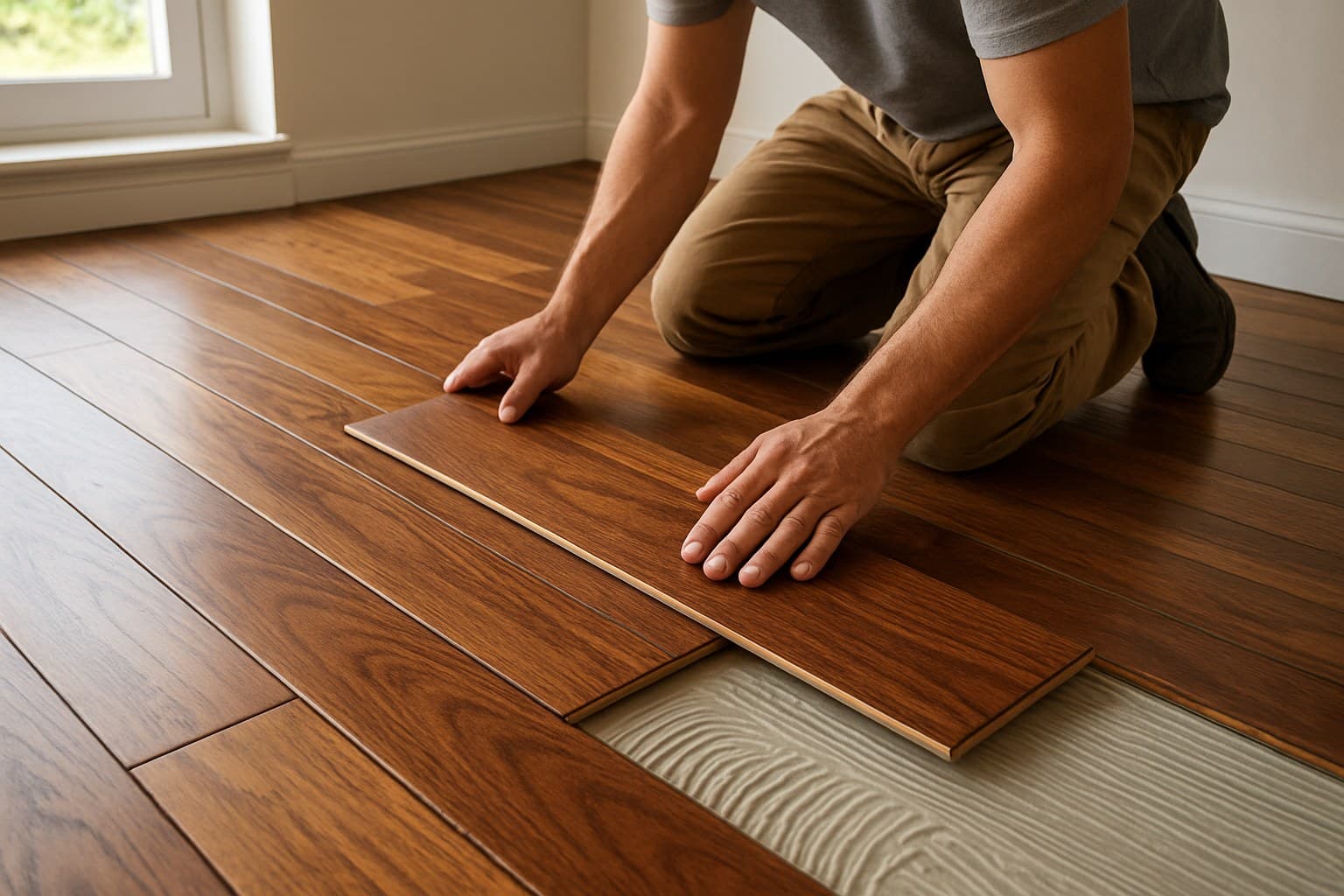
Before you think about species, check subfloor flatness and moisture. This rule outranks everything else, because dense exotics punish a hump or a damp slab harder than domestic oak does. Skip this step and you're gambling with cupped boards and gaps you'll be tearing out within a year.
Read the slab, don't eyeball it. A moisture meter is a handheld tool that reads how wet the wood or the subfloor is, and it will catch a slab that feels dry to your hand but isn't. The NWFA's Homeowner's Handbook to Real Wood Floors recommends testing subfloor moisture with a meter before installation for exactly this reason. Finding that out after the floor is down is a far worse day than the check would ever cost.
Acclimation is honest guesswork only if you skip the paperwork. Some exotic products require it, some say it's unnecessary, so the box's own spec sheet governs, never a rule of thumb you read online. Per the NWFA's Homeowner's Handbook, acclimation needs vary by product and should follow the manufacturer's own instructions rather than a generic rule of thumb. Same with the expansion gap around the room: most floating floors need one, and the exact size is set by the manufacturer's instructions, not a universal figure.
On DIY versus hire, be realistic. Exotic wood dulls saw blades fast and often needs nail holes pre-drilled so the boards don't split. Glue-down installs, stairs, and big open-plan rooms with moisture transitions are usually worth hiring out. A simple prefinished nail-down in one flat, dry room is more doable, but go in knowing the material fights back.
Solid vs Engineered, Sourcing, and What It Really Costs
For exotics specifically, engineered has a real edge below ground. Its plywood-style core is more stable over concrete and below grade, where solid exotic is generally not recommended. If you're putting an exotic look over a basement slab, engineered is the safer call, and a click-lock engineered hardwood floor is also the most DIY-friendly version of it. Unfinished solid exotic flooring sold in the U.S. is also expected to meet the NWFA/NOFMA grading standard for appearance and moisture content, so it's worth asking a supplier whether a given batch is graded before it ships. That solid-versus-engineered calculus isn't unique to exotics, either, so it's worth working through choosing solid vs. engineered hardwood floors for whatever species and room you're planning next.
Radiant heat is its own room-suitability question, separate from below-grade. Solid exotic hardwood is a poor match for radiant systems: the same density that already makes these species slow to reach equilibrium moisture content means they fight the steady, direct heat cycling under the boards even harder than domestic species do, and manufacturers commonly exclude solid exotic products from radiant-heat warranties for that reason. Engineered exotic, with its cross-layered plywood core, tolerates that temperature swing better and is the construction most manufacturers do approve for radiant heat, but that approval is product-specific, so confirm it on the spec sheet the same way you'd confirm acclimation requirements, rather than assuming any engineered exotic plank qualifies.
Sourcing matters here in a way it doesn't for domestic oak. Some imported exotics fall under CITES, the international trade rules for protected species, and many carry FSC, a forest-certification label showing the wood was harvested responsibly. Ask the seller for documentation before you buy. It protects you and the forest both. The NWFA also publishes separate Environmental Product Declarations for solid and engineered wood flooring, which disclose each construction type's lifecycle environmental footprint, worth asking for alongside CITES and FSC paperwork if sustainability factors into your decision.
On cost, split it out. Materials run roughly $4-14 per square foot depending on species, and install labor adds about $3-8 per square foot on top. Basements and stairs cost more per square foot than an open room, because of cutting, transitions, and the extra prep tight spaces demand. According to the NWFA's Life Cycle Cost Analysis research, wood flooring's higher upfront price is often offset over time by its longer service life and refinishing potential compared with flooring types that need full replacement sooner, worth weighing alongside the sticker price below.
| Room | Size | Materials ($4-14/sq ft) | Labor ($3-8/sq ft) |
|---|---|---|---|
| Small bedroom | 150 sq ft | $600-2,100 | $450-1,200 |
| Average room | 300 sq ft | $1,200-4,200 | $900-2,400 |
| Open living area | 500 sq ft | $2,000-7,000 | $1,500-4,000 |
Materials and labor for exotic solid hardwood, split out, across three room sizes. Stairs and basements run higher per square foot.
If those numbers sting, exotic looks turn up in clearance and closeout hardwood stock for a lot less. Just confirm the lot is genuine leftover, not defective seconds, before you haul it home. If even clearance pricing is a stretch, it's worth checking whether Pergo hardwood is real wood before you write off the laminate route entirely.