
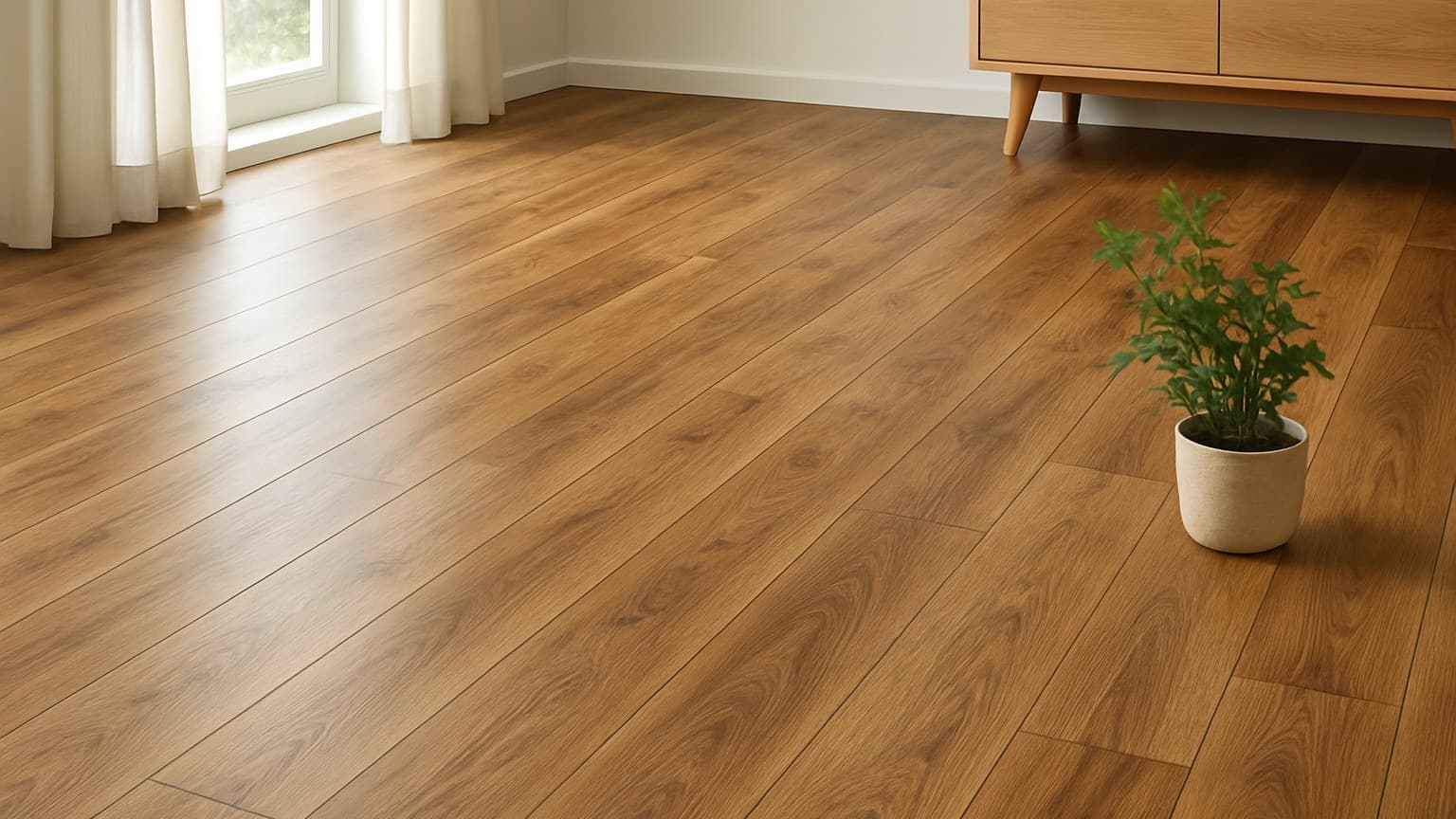
Denise in Loveland called me after her acacia laminate order showed up as a box of engineered hardwood, same name on the label, completely different floor. That mix-up is common: a lot of "acacia laminate" listings online aren't laminate at all. Before you buy acacia laminate flooring, check the label first, not last. These 7 things decide whether the floor lasts or lifts at the joints.
Key takeaways
- Many listings sold as "acacia laminate" are actually engineered or solid acacia hardwood, or acacia-look vinyl plank. Check the product's core material before anything else.
- Match the AC rating to your traffic: AC3 covers most homes, AC4 suits kitchens and busy hallways. A lot of cheap acacia laminate is AC3 or unrated.
- "Waterproof core" claims cover the plank body, not the seams. Laminate almost always swells at the joints first, so it is water-resistant at best.
- Expect materials around $2-5 per square foot and floating-install labor around $2-4 per square foot in open rooms. Stairs, and basements needing moisture prep, cost more.
- The gap between $2 and $5 acacia laminate is real: thicker wear layer, higher AC rating, water-resistant core, embossed texture, and longer, more varied planks.
Start Here: Is It Really Laminate? (Many Listings Aren't)
The first thing to check is what the plank is actually made of, because a lot of listings sold as "acacia laminate" are not laminate at all.
According to NALFA (the North American Laminate Flooring Association), real laminate is a stack: a high-density fiberboard core (HDF, which is just dense pressed-wood board), a printed photo of acacia grain, and a clear wear layer on top. There's no real wood on the surface. It's a picture of acacia, protected by a coating.
Here's the tell. Read the "material" or "construction" field before you look at anything else. Laminate lists HDF or fiberboard. Acacia hardwood lists solid wood, or a wood veneer over plywood. Acacia-look vinyl lists vinyl, SPC (stone plastic composite, a rigid vinyl core), or WPC (wood plastic composite, a softer vinyl core).
This matters before you compare price, because refinishing, water tolerance, feel underfoot, and cost all change with which one you buy. I've seen the exact same name, Tobacco Road Acacia, sold as laminate at one store and as engineered hardwood at another. Same name, three different floors. If the box in front of you really does say solid or engineered wood, our breakdown of solid vs. engineered hardwood floors walks through which one fits your room and how to pick the right species.
If you're still sorting out which is which, our guide to which rooms laminate flooring actually works in covers the laminate side, hickory vinyl plank flooring shows how the LVP versions behave, and sanding and finishing unfinished hardwood explains what only real wood can do.
| Feature | Acacia laminate | Acacia hardwood | Acacia-look LVP |
|---|---|---|---|
| What it's made of | HDF core + printed photo + wear layer | Real acacia (solid, or veneer over plywood) | Vinyl with SPC or WPC core |
| Water tolerance | Water-resistant at best; seams swell | Least tolerant; needs quick spill cleanup | Body is waterproof; seams still the weak point |
| Can you refinish it? | No | Solid yes, several times; engineered maybe once | No |
| Feel and realism | Good print; can sound hollow underfoot | Real wood, warmest, most varied | Softer and quieter; can dent under heavy points |
| Typical materials $/sq ft | $2-5 | $5-12+ | $2-6 |
Source: This is what I've found re-quoting acacia jobs where the box labeled "laminate" turned out to be engineered wood
How the three acacia floors compare on build, water tolerance, refinishing, and materials cost.
Check the AC Rating Against Your Traffic
Match the AC rating to how hard the room gets used: AC3 covers most homes, AC4 suits kitchens and busy hallways. If the listing won't state an AC number, treat that as a warning sign.
According to NALFA, the AC rating is an abrasion class, a scratch-and-wear score from 1 to 6. Higher means the surface takes more foot traffic before it wears through. It's the single best quick read on how tough a laminate is.
For a bedroom or living room, AC3 handles all normal home traffic. For a kitchen, an entry, or a hallway with kids and dogs, step up to AC4. AC5 and AC6 are built for stores and offices, so most homes never need them and you'd just be paying extra.
A lot of budget acacia laminate comes in at AC3, or shows no rating at all. AC3 is fine in the right room. No rating at all tells me the maker either didn't test it or doesn't want to say.
| AC rating | Best for |
|---|---|
| AC1 | Closets and light-use spots only |
| AC2 | Light home traffic (guest bedrooms) |
| AC3 | All normal home traffic (living rooms, bedrooms) |
| AC4 | Busy homes: kitchens, hallways, entries |
| AC5 | Commercial traffic (not needed at home) |
| AC6 | Intense commercial use (not needed at home) |
Source: These classes follow the AC abrasion scale used by NALFA, the North American Laminate Flooring Association
What each AC abrasion class is built to handle and where it belongs in a house.
Check the Wear Layer and How Real the Print Looks
The wear layer and the print quality decide whether your floor reads as wood or as shiny plastic, so check both before you fall for a showroom sample.
The wear layer is the clear top coat that takes the scratches. Many laminates mix aluminum oxide into it for hardness. A thicker, harder coat resists scuffs better, but only trust a millimeter figure if it's printed on that specific product's spec sheet. There's no industry-wide laminate wear-layer number, so ignore any listing that quotes one as if it were a rule.
The design layer, sometimes called the decor layer, is the printed photo of acacia. Cheap ones repeat the same three or four board images across a whole room. Your eye catches the pattern fast, and the floor starts to look fake. Better ones use many unique plank images so no two boards match.
Then there's embossed-in-register, or EIR. That means the surface texture lines up with the printed grain, so the floor feels the way the grain looks. Run your hand across a real-looking acacia laminate and you feel the grooves fall right where the dark grain sits. That lining-up is what separates a convincing acacia floor from a plastic one.
Check the Core and What Really Happens at the Seams
A "water-resistant core" describes the plank body, not the joints, and laminate almost always fails at the seams first. So read any water claim as a claim about the middle of the plank, not the edges.
Keep the two ideas separate. The core can shrug off water sitting on top of it for a while. The seams, where two planks click together, are bare fiberboard. Once water works into a joint and sits there, standard HDF swells and the edge lifts. Only trust a "waterproof" or "water-resistant" rating if it names the exact product it's printed on.
Some acacia laminates use a tighter, water-resistant HDF that buys you more cleanup time. That's a real upgrade, but it's more time, not immunity. And if a listing says the core is SPC or WPC, stop calling it laminate. That's a vinyl floor wearing an acacia print.
The real-world rule for kitchens and baths is simple. Wipe spills fast and never wet-mop. The click seams are the weak point no matter what the box promises.
Check Plank Size, Bevels, and Embossing
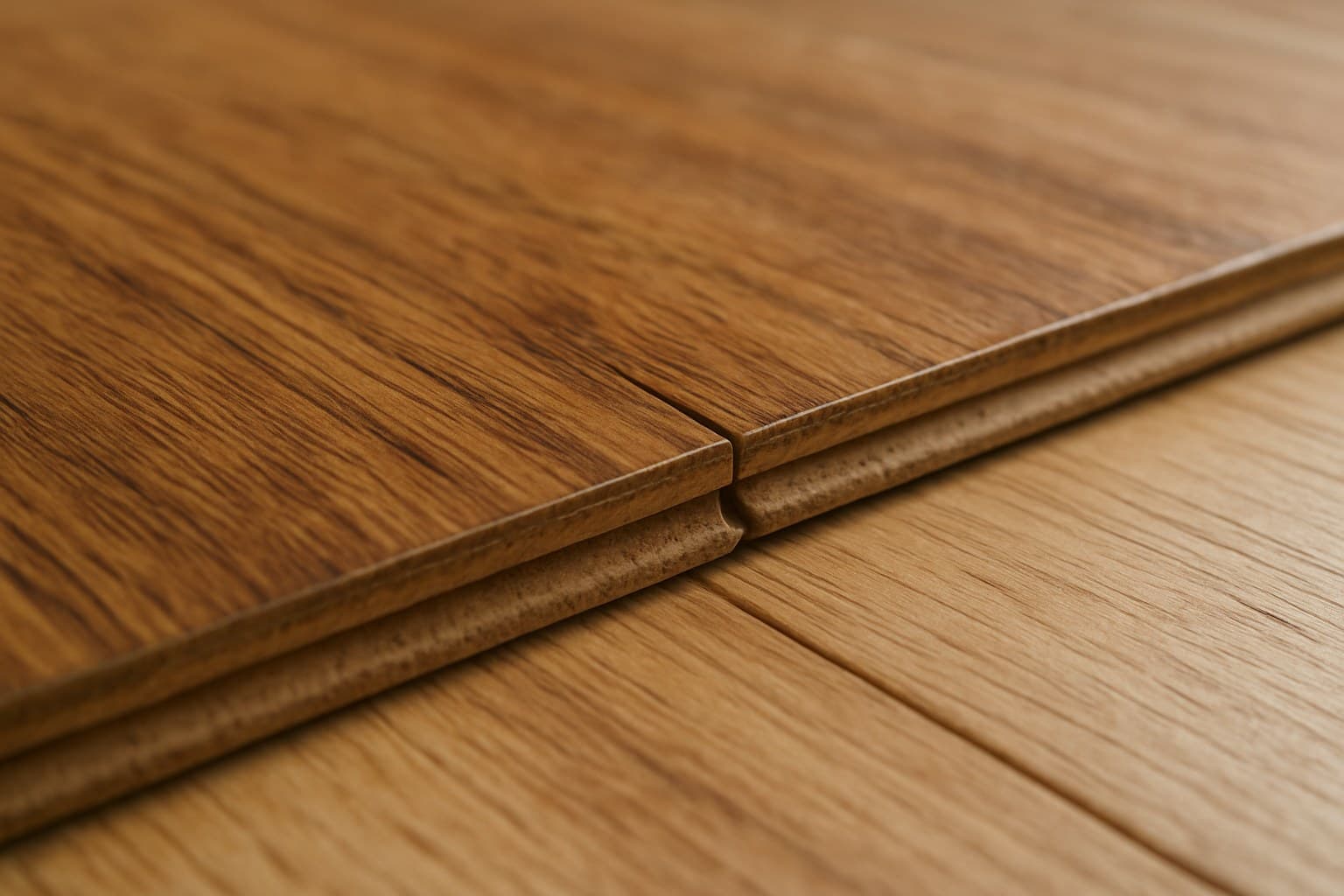
Longer planks with more color variation and a matte, grain-textured surface read as premium; short, uniform, glossy boards read as cheap under kitchen light.
Real acacia grows in short boards with big color swing, from pale tan to deep brown in the same batch. Good laminates copy that with lots of variation and longer planks. The variation hides the pattern repeat, and the length makes the floor look like real lumber instead of tiles.
A micro-bevel is a tiny angled groove along each plank edge. It does two jobs: it makes separate boards look real, and it hides small height differences when your subfloor isn't perfectly flat. Most acacia laminate worth buying has one.
Embossing ties straight back to feel. A matte, grain-textured surface looks like wood. A smooth, shiny one reads as plastic the second the kitchen light hits it. Run your hand over the sample. If it feels like a laminate countertop, it will look like one on the floor too.
Check the Subfloor Before You Lock a Single Plank
Check that your subfloor is flat and dry before you buy, because a floating laminate floor only lasts as long as the prep underneath it. This is the step most people skip, and it's the one that decides whether the manufacturer's warranty actually holds up.
Flatness comes first. Most laminate makers want the floor flat within a set tolerance over a given span, so pull the specific product's install guide and check its number. Lay a long straightedge across the room and look for gaps under it. High spots get ground down, low spots get filled. Skip this and the seams flex, the locks work loose, and you get that hollow tap underfoot.
Moisture comes next, especially over concrete or in a basement. A moisture meter, a small tool that reads how wet the slab or wood is, tells you whether you can install at all. Too much moisture and the core swells from below, no spill required.
Two more things live on the product's own sheet, not on the internet. Almost every floating floor needs an expansion gap around the room's edge, but the exact size is set by the maker, so look it up. And some acacia laminates ask for acclimation, letting the boxes sit in the room first, while others say it isn't needed. The box governs, not a rule of thumb.
Check the Real Price: Materials vs Labor
Expect materials around $2 to $5 per square foot, and floating-install labor around $2 to $4 per square foot in an open room. Stairs and basements needing moisture work cost more, so never trust a single flat number.
The gap between $2 and $5 acacia laminate is real, not just branding. The higher end usually buys a thicker wear layer, a higher AC rating, a water-resistant core, embossed-in-register texture, and longer planks with more color variation. The cheap end gives up most of that.
| Line item | Open room, per sq ft |
|---|---|
| Materials (acacia laminate) | $2-5 |
| Labor, floating install | $2-4 |
| Underlayment and transitions | adds a little on top |
| Stairs | costs more, priced per step |
| Basement with moisture prep | costs more than an open room |
Cost ranges for a floating acacia laminate install; stairs and basements run higher than open rooms.
Here's the math on a 200 square foot living room. Materials run 200 times $2 to $5, so $400 to $1,000. Labor runs 200 times $2 to $4, so $400 to $800. Add it up and you're looking at roughly $800 to $1,800 installed, before underlayment and trim.
One thing I learned the hard way: don't price a whole job at one flat square-foot rate. I used to, until a room full of closets, doorways, and a bay window ate an extra day. The open middle of a room is never where the time goes. All the cutting is. So a small, choppy room can cost more per foot than a big open one.
On DIY versus hiring, be honest with yourself. Click-lock acacia laminate in an open room is a realistic weekend job for most handy homeowners. Stairs, glue-down installs, and large open-plan floors with moisture transitions between rooms are where I'd hire it out. Get those wrong on your own and you're usually paying a pro twice: once to tear out the bad work, once to do it right.