
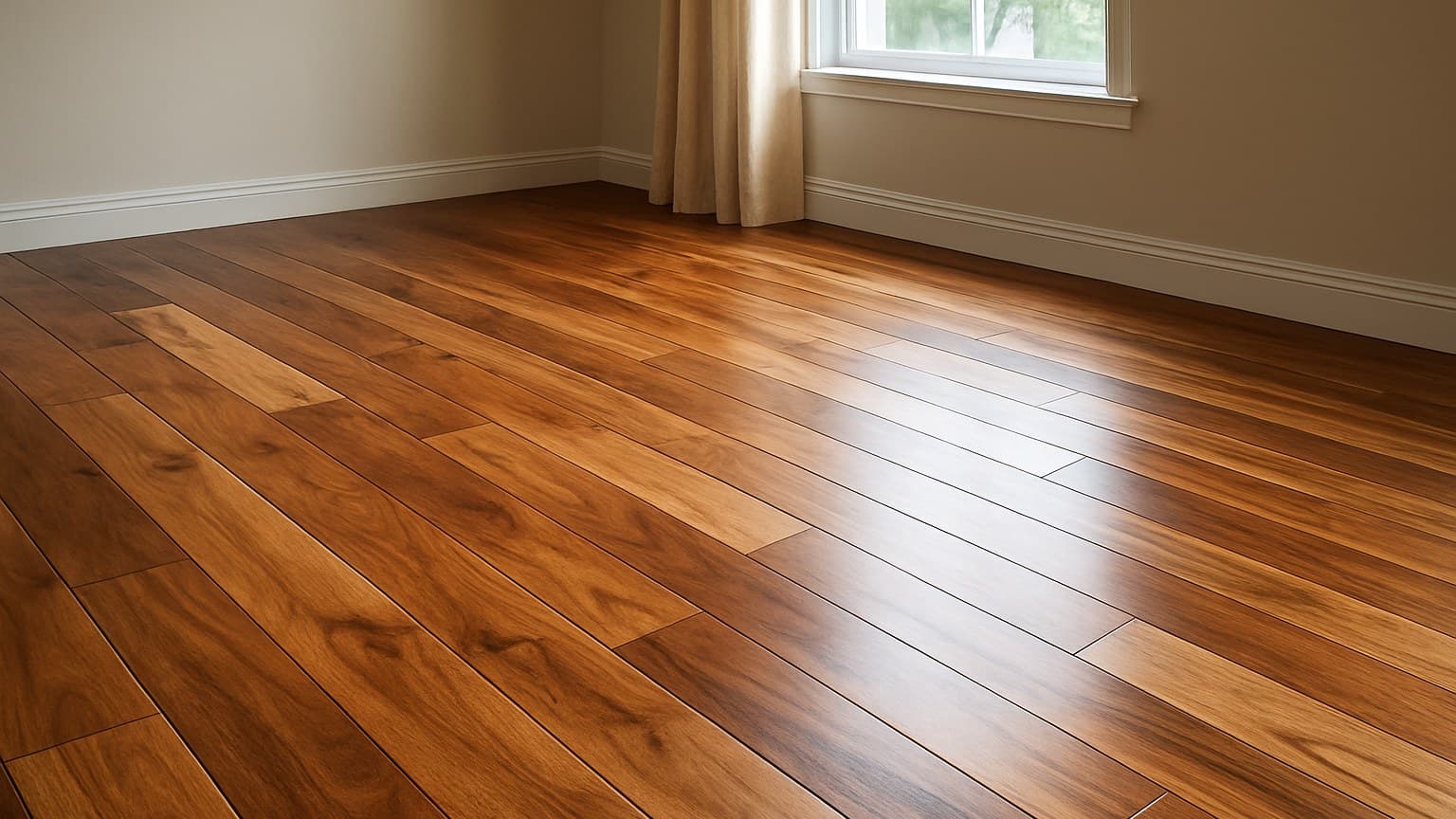
Last month in Aurora, a customer named Dave called me back out because the acacia floor he'd bought online looked nothing like the sample, the second box didn't match the first, and the grade name on the label turned out to mean nothing. That's acacia in a nutshell: the widest color range of any common wood floor, a Janka number that hides a soft finish underneath, and grade labels that shift from brand to brand. Here are the seven things I tell every homeowner before they buy a single box.
Key takeaways
- Acacia's color varies more box to box than almost any wood floor, and it shifts between production batches too, so buy it all in one order and rack from four to five open boxes at once.
- Janka hardness runs high (often cited around 1,700-2,300 depending on species), so the wood itself hides dents well, but the hand-scraped finish wears first where grit collects.
- Put engineered acacia over concrete and in basements; keep solid acacia to wood subfloors above grade because acacia moves a lot with humidity.
- Cost is moderate: figure roughly $3-7 per sq ft for material and $2-6 per sq ft for labor, with stairs and basements costing more than open rooms.
- Grade names like 'select' and 'rustic' are not standardized between brands, so ask for FSC certification and the wear-layer thickness on the spec sheet.
1. The Color Swings Wildly From Plank to Plank, and Worse Between Batches
Acacia has the widest plank-to-plank color range of any common wood floor. Light honey sitting right next to near-black in the same box is normal, not a defect. That's the look people buy it for, so don't return a box because it's mixed.
The real trap is color shift between production lots. A reorder or a second pallet often won't match the first, even in the same product line. Buy all of it in one order, and add 5-10% extra for waste and future repairs.
When you lay it, pull from four to five open boxes at a time and spread the tones by hand. Working straight down one box, then the next, builds obvious dark and light zones down the room.
I pulled up an acacia floor for a customer named Dave in Aurora who'd installed it box by box, and it looked striped, like someone painted bands across it. No finish coat and no refinish fixes that. It's baked into how the boards were laid.
2. It's Hard on the Janka Scale, but the Hand-Scraped Top Isn't as Tough as It Looks
Acacia's Janka hardness runs high. Janka is the standard test for how well a wood resists dents, and acacia is commonly cited around 1,700 to 2,300 depending on the species and source. The wood body itself shrugs off dents better than oak does.
Where wear actually shows is the finish, not the wood. Most acacia comes hand-scraped, meaning the surface is carved into shallow valleys for a rustic look. Grit collects in those valleys, and the factory coating on textured boards thins unevenly over the years. The floor dulls in the traffic path long before the wood dents.
Here's how acacia stacks up against other common choices on the Janka scale.
| Wood | Janka hardness |
|---|---|
| Red oak | 1,290 |
| White oak | 1,360 |
| Natural bamboo | 1,380 |
| Hickory | 1,820 |
| Acacia | 1,700-2,300 |
| Brazilian cherry | 2,350 |
Janka hardness ratings for six common flooring woods; acacia is shown as a range because ratings vary by species. Chart not to scale.
Refinishing acacia is also trickier than a flat oak floor, because the sander fights the scraped texture and flattens the very valleys you paid for. If you want the on-site sand-and-finish reality before you commit, read that first. And if you're weighing an even harder tropical wood, Brazilian cherry runs harder still and comes with its own color quirks.
3. The Busy Grain Hides Dents but Fights You During Install
That heavy, swirling grain and mix of tones is good at hiding scratches, crumbs, and pet claws. In a house with kids and dogs, acacia forgives a lot that a clean, uniform floor would show off. That's a real reason to like it.
The same look comes with a catch during install. Acacia often ships in shorter board lengths, which means more end joints across the floor. More end joints means more chances for lippage, which is when one board edge sits higher than the board next to it and you feel the ridge under a bare foot.
Boards can also arrive slightly cupped or bowed. Plan to open and pre-sort more than you would with oak, and cull the worst pieces or save them for closet cuts.
This is why prep decides the job. Before the first board goes down, check that the subfloor is flat within the maker's own tolerance, and test its moisture with a meter, which is a small tool that reads how wet the subfloor is, not your hand. According to the National Wood Flooring Association's installation guidelines, verifying subfloor flatness and moisture content is a required step before any wood floor goes down, not an optional one. Then open several boxes, sort out the bowed or cupped boards, and dry-lay a few rows to blend the color and see how the end joints fall. Short, bowed boards over an uneven subfloor is lippage you'll feel every day.
4. Solid vs. Engineered Acacia Comes Down to Where the Floor's Going
The room decides this, not your taste. Solid acacia is one piece of wood through and through. According to the NWFA's Homeowner's Handbook to Real Wood Floors, solid wood flooring can be sanded and refinished multiple times over its life, but it isn't recommended over concrete or below grade because of how much it moves with humidity.
Engineered acacia is a real acacia veneer over a plywood-style core. That core makes it far more stable over concrete and in basements. The tradeoff is the thin wear layer on top, which caps how often, if ever, you can refinish it.
Acacia is fairly reactive to humidity swings either way, so expect some seasonal gapping in dry winters. Engineered handles tougher climates better. Put solid in bedrooms and living rooms above grade on a wood subfloor; lean engineered for basements, slabs, and humid rooms. Where that acacia run meets tile in a kitchen or entry, the height difference at that seam is really what determines which wood-to-tile transition works.
| Factor | Solid acacia | Engineered acacia |
|---|---|---|
| Over concrete / basement | Not recommended | Yes, most stable choice |
| Refinishing | Several times over its life | Once or not at all, depends on wear layer |
| Humidity movement | Moves more, seasonal gaps | More dimensionally stable |
| Install method | Usually nail-down on wood subfloor | Nail, glue, or float |
| Relative cost | Similar to slightly higher material | Wide range by wear-layer thickness |
Source: This is what held up on acacia I've laid over both plywood subfloor
Where solid and engineered acacia each belong, based on install method, refinishing, and moisture.
If you want the full decision worked through, here's the deeper look at how to choose solid vs. engineered by room, plus a breakdown of how an engineered board is actually built.
5. What Acacia Hardwood Flooring Really Costs, Materials vs. Labor
Acacia is moderate, and it's often priced below oak or hickory of the same grade. That lower material cost is a big part of why people land on it in the first place.
Split honestly, figure roughly $3-7 per square foot for the material and $2-6 per square foot for labor. Stairs and basements run higher than an open room, because stairs are slow, fussy nosing work and basements add moisture prep and often glue-down over concrete. Here's a 200 square foot room worked out end to end.
| Line | Per sq ft | 200 sq ft |
|---|---|---|
| Material (engineered acacia) | $3-7 | $600-1,400 |
| Labor (nail, glue, or float) | $2-6 | $400-1,200 |
| 10% overage on material | add 10% | $60-140 |
| Underlayment / adhesive | $0.30-1 | $60-200 |
| Rough installed total | $5.60-14.70 | $1,120-2,940 |
Source: These ranges track the acacia estimates I've written up for homeowners over the past year
Worked cost for a 200 sq ft acacia install, split into material, labor, overage, and underlayment.
Add that 5-10% overage, since acacia needs more culling and color blending than most woods. Every one of these figures is a starting range. Get two or three local quotes before you budget, since labor swings by region and by how much your subfloor needs fixing first.
6. The Sourcing and Grade Question Retailers Won't Answer
Most acacia is imported from Asia, and the grade names are not standardized. "Select," "natural," "rustic," and "cabin" mean different things from brand to brand, so the same word can describe two very different floors. Don't buy on the grade name alone. Vinyl buyers run into the same marketing fog, since a wood-look product like maple vinyl hides its build quality behind similar vague labels, and six ways to spot good maple vinyl flooring breaks down what actually separates a durable plank from a flimsy one.
Ask about FSC certification, which stands for Forest Stewardship Council and means the wood is tracked back to responsibly managed forests. Plenty of acacia lines simply don't disclose it, and that silence tells you something.
Lower grades bring more color swing, more knots, shorter boards, and more waste. That's fine if you want the wild rustic look, but know that a lower price often buys you more culling and more offcuts, which eats into the savings. Vinyl plank makers chase that same rustic-barnwood effect for a fraction of the cost, and whether the result reads as convincing wood or obviously fake often comes down to why barnwood vinyl looks fake in some rooms.
On engineered acacia, the red flag is an undisclosed thin wear layer. Get the actual spec sheet and read the veneer and wear-layer thickness in real numbers. Don't trust the floor-model name to tell you, because a thin top layer is where a cheap engineered board gives itself away.
7. How Acacia Compares to Oak, Hickory, and Bamboo
Against oak, acacia is harder, busier looking, and usually cheaper. Oak is the safer classic: more uniform, easier to color-match on a reorder, and simpler to refinish down the road. If you want a calm, even floor you can add to in five years, oak is the more forgiving pick.
Against hickory, both are hard and busy-grained, so they compete for the same buyer. Hickory tends to be harder and its grain reads a touch more consistent, while acacia usually costs less and swings wider in color.
Against bamboo, the two land near each other on hardness, but they're different products. Natural bamboo is a grass pressed into planks and tends to look more uniform and modern, while acacia gives you that rich, varied real-wood character. If you like the wood look but want easy water tolerance, you might also weigh a wood-look vinyl instead, like hickory-look luxury vinyl plank, before committing to real wood. A cherry-toned vinyl brings its own matching puzzle once it's underfoot, since cabinets, trim, and wall colors either play off that warm red tint or clash with it, and the cherry vinyl pairing guide sorts out which combinations actually work.
Acacia earns its spot when you want a hard, forgiving, character-heavy floor for less than oak, and you can live with the color lottery. If you want easy matching and refinishing, look at oak first.