
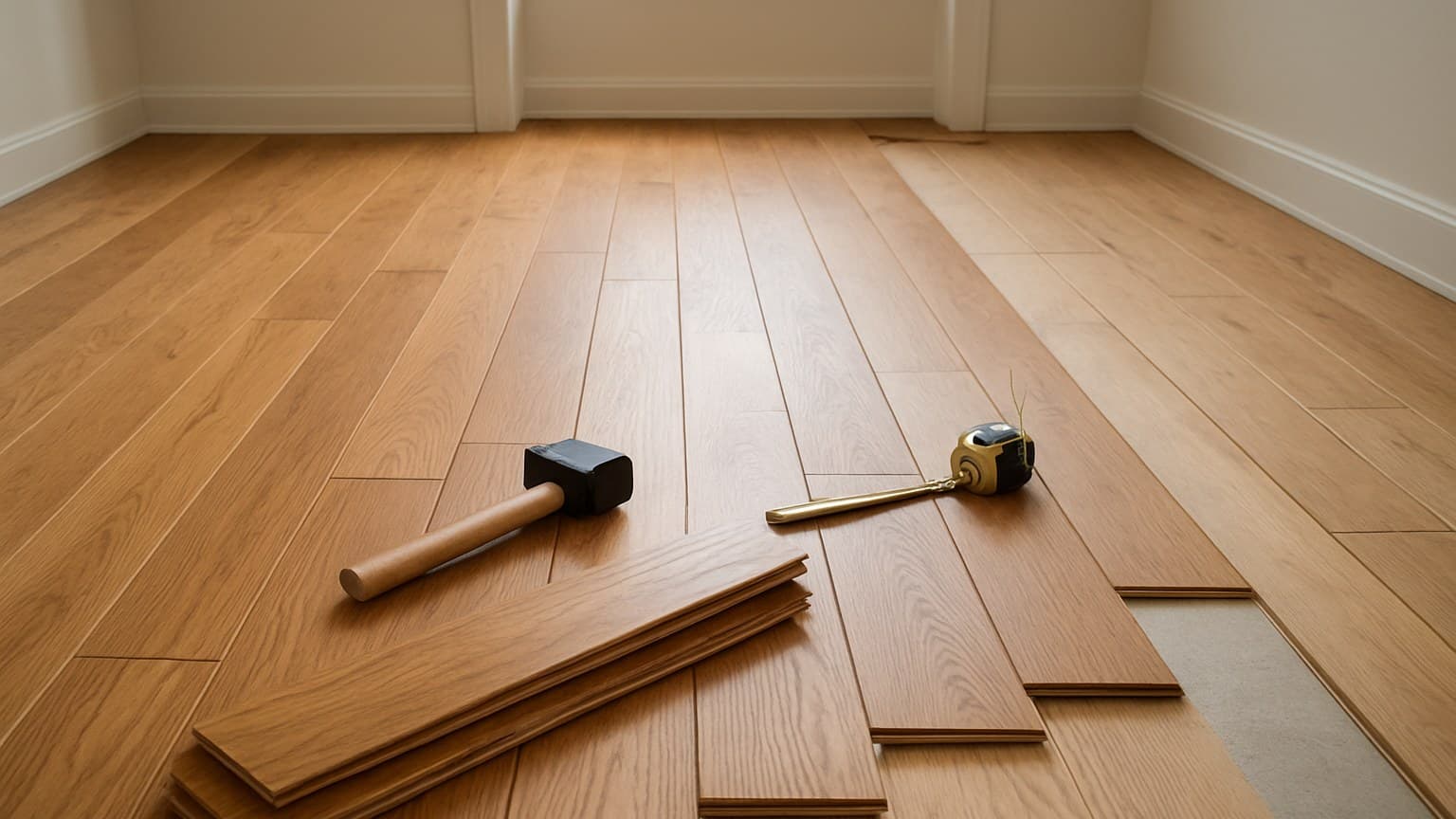
When I quoted a straight-lay oak job for the Ramirez family in Tulsa last month, they'd already gotten three online quotes and couldn't tell what any of them actually covered. Installed hardwood runs about $8 to $25 per square foot in 2026, and that range only makes sense once you split it into materials versus labor, plus whatever a lowball quote leaves off. Get those wrong and you either overpay or get blindsided mid-job. Here's how the real numbers break down. Since that particular job was red oak, the red oak prefinished hardwood flooring guide is a good next stop if that's the species you're pricing out.
Key takeaways
- Installed hardwood usually runs about $8-$25 per square foot in 2026: roughly $6-$14 in materials and $3-$8 in labor, before subfloor prep or old-floor removal.
- Solid and engineered often overlap on price. Where the floor goes (concrete slab, basement) decides the choice more than looks do.
- Herringbone and chevron patterns add roughly 20-30% to labor, and subfloor repair, removal, and finish are the lines a lowball quote leaves off.
- Over a long life, hardwood's cost per year drops below carpet and laminate because you refinish it instead of tearing it out and replacing it.
- A federal tariff report is due October 1, 2026 and could nudge imported wood prices, so lock quotes in writing before a big buy.
What Hardwood Flooring Costs in 2026 (Quick Answer)
Installed hardwood typically runs about $8 to $25 per square foot in 2026, materials and labor combined. That's a wide range because it has to be: the low end is straight-lay oak going into a flat, open main-floor room, and the high end is a pricier species, a fussy pattern, or a job that needs prep before a single plank goes down. Hardwood floor installation cost guide goes further into what pushes a specific quote toward either end of that range.
Don't price your project off a national average. Read it off your own room size instead.
| Room size | Low | Typical | High |
|---|---|---|---|
| Small room (150 sq ft) | $1,350 | $2,400 | $3,750 |
| Average room (300 sq ft) | $2,700 | $4,800 | $7,500 |
| Great room (500 sq ft) | $4,500 | $8,000 | $12,500 |
| Whole floor (1,000 sq ft) | $9,000 | $16,000 | $25,000 |
Source: the straight-lay oak quotes I write up, before any subfloor or removal add-ons
Total installed cost by room size for straight-lay hardwood in 2026, before subfloor prep or old-floor removal.
One thing every one of those numbers assumes: no surprises underneath. Basement rooms, stairs, and any job that needs leveling or moisture work land at the high end or above. An open, flat living room sits toward the low end. Those add-ons are real line items, and I'll get to them.
Materials vs. Labor: Where Your Money Actually Goes
Split every quote you get into two buckets. Materials usually run $6 to $14 per square foot, and that covers the planks, underlayment, fasteners, and any adhesive. Labor usually runs $3 to $8 per square foot, and that pays for tear-out, subfloor prep, the actual install, and finish work.
| Cost bucket | Range (per sq ft) |
|---|---|
| Labor (prep + install + finish) | $3-$8 |
| Materials (wood + supplies) | $6-$14 |
Materials and labor cost per square foot for a standard hardwood install in 2026.
A good chunk of the bill is hands-on work. On a plain room the labor can be a third of the total, and on a stair or basement job it can be closer to half. Labor also swings hard by region. A metro with high trade rates pushes the same floor to the top of the labor range, while a smaller market sits lower. If you want the full line-by-line walkthrough of every cost, I break it all down in the hardwood flooring cost guide.
Big-Box vs. Specialty Suppliers (Floor & Decor and Others)
For materials, a big-box or warehouse supplier like Floor & Decor usually beats a specialty dealer on the sticker, and for common oak that price gap is real money on a large floor. Where specialty shops earn their keep is species selection, grade consistency, and someone who can flag a bad lot before it ends up in your living room. My honest take: buy commodity oak on price, but for a wide plank or an exotic where color match matters, the specialty supplier is worth the premium. For that reason, I often point clients toward Johnson Hardwood flooring options when they want a specialty brand known for consistent wide-plank color matching.
Solid vs. Engineered, Species, and Grade: What Moves the Sticker Price
Solid and engineered hardwood prices overlap far more than people expect, so the real decider isn't looks, it's where the floor is going. Engineered wood has a cross-ply core, like plywood layers, that stays stable over concrete and in below-grade rooms where solid usually isn't recommended. If you're putting wood over a slab or in a basement, that stability is the whole ballgame, and it's worth reading up on waterproof engineered hardwood before you commit.
Species and grade move the material price the most. Common red oak sits at the bottom, walnut and exotics sit at the top, and hardness rides along with price without perfectly setting it. If you're still weighing full solid boards against engineered construction for a particular species, our breakdown of hardwood floors: solid vs. engineered walks through how to match that decision to the room and species you want.
| Species | Janka hardness | Material price (per sq ft) |
|---|---|---|
| Red Oak | 1,290 | $4-$8 |
| White Oak | 1,360 | $5-$10 |
| Hard Maple | 1,450 | $5-$9 |
| Hickory | 1,820 | $5-$11 |
| Walnut | 1,010 | $8-$14 |
| Brazilian Cherry | 2,350 | $6-$12 |
Source: NWFA's published Janka ratings, priced off my hardwood supplier's current species sheets
Janka hardness (higher is harder) and 2026 material-only price per square foot for common species.
Look at walnut: it's one of the softer woods on that list but one of the priciest, because you're paying for the color, not the dent resistance. Grade matters too. A clear or select grade, with clean, even boards, costs more than a character grade full of knots and color streaks, even in the same species. Wide planks carry a premium over standard strip widths, both in the material price and in the extra care they need going down, which is why I walk through them separately in the wide plank hardwood flooring guide.
Installation Method, Patterns, and the Add-On Costs Quotes Hide
The install method changes your labor line. Nail-down over a plywood subfloor, glue-down over concrete, and click-lock floating all price differently, and floating click-lock is the one most DIYers can realistically handle. Glue-down and stairs are where I tell people to hire it out. If you're weighing doing it yourself, the installing hardwood flooring guide lays out which methods are DIY-friendly and which aren't.
Patterns add labor. Herringbone and chevron run roughly 20 to 30 percent more in labor than straight-lay, purely from the extra cutting and layout time. That's not the installer padding the bill, it's real hours.
Here's the part a lowball quote leaves off. Before any planks go down, the subfloor has to be checked for flatness and moisture. I've seen jobs go bad from a slab that read fine to the hand but not to a moisture meter (the tool that reads how much water is sitting in the subfloor), or a hump I talked myself into ignoring. Skip that check and you risk both the floor and the manufacturer's warranty, because most warranties require proof the subfloor was checked before installation.
The add-ons that belong in an honest quote:
- Old-floor removal and haul-away
- Subfloor repair or leveling
- Finish work: site-finished floors cost more in labor than a factory-prefinished floor with a tough aluminum oxide coating, plus any future refinishing
If a quote doesn't name these, it's not cheaper, it's incomplete.
The Real Number: What Hardwood Costs Per Year You Own It
Here's the math that changes the whole decision: cost per year equals the installed price divided by how long the floor realistically lasts. A pricier floor that lasts decades can beat a cheap floor you keep tearing out and replacing. The National Wood Flooring Association's Life Cycle Cost Analysis (LCCA) is the source for the framework used here: it tracked cost-per-year across 18 flooring types over a 75-year span. The 75-year window and the flooring categories below come from that study; NWFA doesn't publish its underlying per-category dollar figures for public reference, so the specific installed-price and cost-per-year numbers in the table are my own calculation, applying the LCCA's divide-by-lifespan method to current install prices and industry lifespan/refinish data.
| Floor | Installed (per sq ft) | Realistic lifespan | Cost per year | Replacements over 75 yrs |
|---|---|---|---|---|
| Solid/engineered hardwood | $8-$25 | 30-100 yrs (refinished 3-5x) | $0.15-$0.45 | 0-1 |
| Tile | $10-$25 | 40-75 yrs | $0.15-$0.40 | 0-1 |
| Laminate | $3-$8 | 10-25 yrs | $0.35-$0.80 | 3-5 |
| Carpet | $2-$6 | 7-12 yrs | $0.45-$1.10 | 6-9 |
Source: the cost-per-year I get by dividing each floor's install price by its realistic lifespan
Installed cost divided by realistic lifespan gives the cost-per-year for each floor over a long ownership window.
That 0-1 replacement count for solid hardwood isn't just wood being durable on its own, refinishing is what actually drives it. Solid hardwood has enough wood above the tongue-and-groove to be sanded down and refinished roughly 3 to 5 times over its life, and each refinish resets a worn surface without a tear-out or a full replacement, which is what stretches it into that 30-100 year range instead of needing replacement the way laminate or carpet does. Engineered hardwood has a thinner wear layer on top of its plywood core and typically tolerates only 1 to 3 refinishes before that veneer is gone, which is why "solid/engineered" is shown here as a combined range rather than a single number.
Hardwood wins over the long haul because you refinish it instead of tearing it out. One wood floor can outlast three to five laminate floors or six to nine carpets over the same window. There's a resale angle too. The National Wood Flooring Association's consumer research found about 66 percent of homeowners feel wood floors add value to a home, a payback carpet rarely offers. Just know the specific dollar figures above are my calculation applying the NWFA's LCCA framework to current prices, not numbers published directly by NWFA itself, so treat them as directional rather than exact study data.
2026 Market Watch: Tariffs and Timing
One recency flag worth knowing: a federal tariff report is reportedly expected in the coming weeks that could shift import costs on wood flooring, so the prices you see now may move. Imported species carry more exposure than domestic wood. Brazilian cherry and other exotics ride on tariff and supply swings, while domestic oak, maple, and hickory are steadier.
My advice is plain. Get your quote in writing with a price-hold date, because on imported wood especially, the number you're shown today isn't guaranteed to hold once that report lands. If you're set on an exotic and can time it, lock the material price before a big buy rather than after.
Sources
- National Wood Flooring Association: Life Cycle Cost Analysis (LCCA) Overview
- NWFA Life Cycle Cost Analysis Sales Sheet (2024, TISE)
- NWFA 2023 Life Cycle Cost Analysis Report (PDF)
- NWFA Event: The Truth About the Cost of Premium Hardwood Flooring
- NWFA Industry Consumer Study on Wood Flooring Value (PDF)