
I was on my knees in Sandra Ellis's kitchen in Toledo, Ohio, prying up laminate that had swollen into ridges at every seam by her sink, and she asked me straight: what's the best floor for a kitchen? A kitchen punishes a floor in ways a bedroom never does, so the pick that's right for her house is wrong for the next one. Here's how I actually score it, after years of pulling up the ones that failed.
Key takeaways
- For most kitchens, click-lock LVP is the best all-round pick: it shrugs off sink splashes, is warm underfoot, and most homeowners can install it themselves.
- Porcelain tile lasts the longest and handles water best, but labor runs the highest of any option at roughly $6-12 per sq ft on its own.
- Kitchen floors almost never fail at the plank surface. They fail at the seams and edges near the sink and dishwasher, which is where laminate loses to LVP.
- Installed cost per sq ft, splitting is what matters: sheet vinyl runs about $2-6, laminate $3-8, LVP $4-9, engineered wood $7-15, and tile $8-19.
- Tile is the one kitchen floor most people should hire out; click-lock LVP and laminate are realistic DIY jobs if the subfloor is flat and dry.
The best kitchen floor, in one line
For most kitchens, click-lock LVP (luxury vinyl plank) is the best all-round floor. It shrugs off sink splashes, feels warmer underfoot than tile, and most homeowners can snap it together themselves over a weekend.
The runner-up is porcelain tile. It outlasts everything else and handles water better than any other option, so it's the pick if you want a floor that outlives the kitchen and you can pay for the labor. If money is tight, sheet vinyl is the cheapest floor that still holds up in a kitchen. If you're after the warmest wood look, laminate or engineered hardwood get you there.
I score all five on the same four things a kitchen actually tests: water tolerance at the sink and dishwasher, comfort underfoot, install difficulty, and cost split into materials versus labor. There's no single "best" here. The right floor depends on your budget, whether you have dogs, and whether this is a forever kitchen or a resale flip you'll hand off in two years. If you're still working through the basics before you get into scores like these, the guide to choosing kitchen flooring breaks the decision down in plain terms.
The five kitchen floors, scored side by side
Here's the head-to-head. Read water tolerance as how the floor holds up at the seams, not just on the surface, because that's where kitchens fail. Read comfort as how hard and cold it feels when you stand on it.
| Material | Water tolerance | Comfort underfoot | Install difficulty | Relative cost tier |
|---|---|---|---|---|
| LVP (luxury vinyl plank) | Excellent - a line like COREtec Pro Plus carries a waterproof-rated core, but seams can still let water reach the subfloor if flooded | Good - warmer and softer than tile | Easy - click-lock is DIY-friendly | $$ (full breakdown below) |
| Porcelain / ceramic tile | Best - the surface and, with sealed grout, the seams both handle water | Poor - hard and cold unless heated | Hard - hire it out for most kitchens | $$$$ (full breakdown below) |
| Laminate | Fair - better realistic wood look, but swells at the seams if water sits | Good - warm, slightly firm | Easy - click-lock is DIY-friendly | $$ (full breakdown below) |
| Engineered hardwood | Fair - real wood veneer, wipe spills fast, not for standing water | Good - warm and solid | Moderate - glue or nail-down often means hiring out | $$$ (full breakdown below) |
| Sheet vinyl | Very good - few seams, so few places for water to get in | Best - softest of the five | Moderate - big sheets are awkward to cut and lay | $ (full breakdown below) |
Source: my own install jobs
Five common kitchen floors scored on the four factors that decide a kitchen job.
The standouts jump out once you scan the columns. Tile wins on water, sheet vinyl wins on price, and LVP wins the balance, which is why it's my default recommendation. If you want the full menu with more materials and looks, the broader kitchen flooring options rundown goes wider than these five.
Water at the sink and dishwasher: where kitchens actually fail
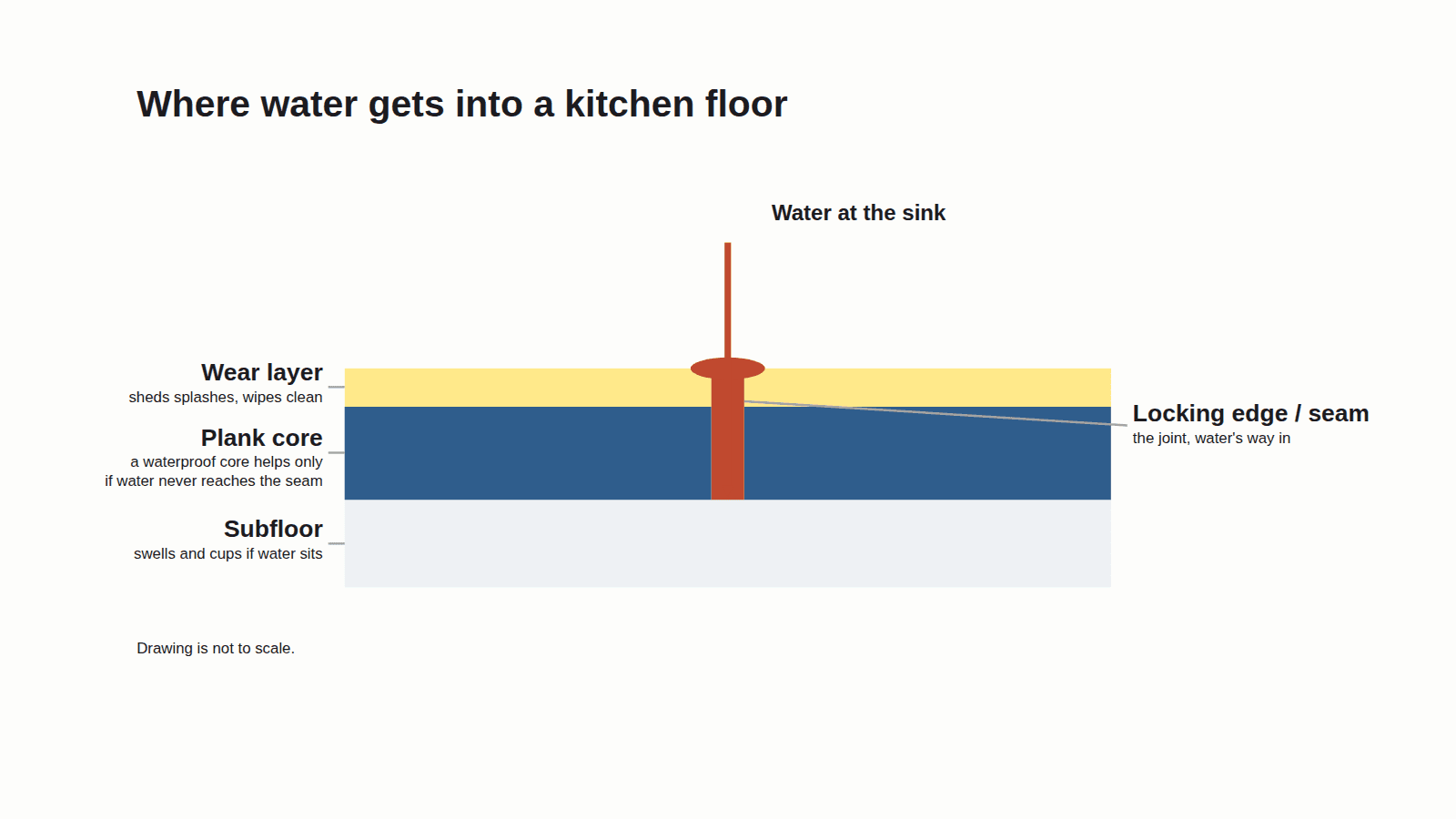
Kitchen floors almost never fail at the plank surface. They fail at the seams and edges where water pools, and in a kitchen that means right in front of the sink and under the dishwasher.
This is the part the marketing blurs. A plank like COREtec Pro Plus carries a waterproof-rated core, meaning that specific plank body won't swell, but water can still slide down through the joints between planks and sit on the subfloor underneath. A waterproof core protects the plank, not the floor. That same fine print trips people up when they're shopping waterproof vinyl plank flooring for bathrooms, since a shower splash finds the seam just as easily as a kitchen spill does. The seam is the way in.
How the water reaches the subfloor near a plank seam.
Rank the five on how their seams hold up in real life and it looks like this: sheet vinyl and tile are best, because sheet vinyl has almost no seams and tile's grout seals shut when it's sealed properly. LVP is next. Laminate and engineered wood are the most at risk, because a laminate seam swells and lifts once water sits in it, and engineered wood only has a thin real-wood layer on top before you hit trouble.
I learned the moisture side the hard way in Karen Michaud's kitchen outside Grand Rapids, Michigan. She talked me out of running a moisture test, a quick check with a meter (a handheld tool that reads how wet the subfloor is), to save an afternoon, and her new laminate cupped before the season was out. I relaid it on my own dime. A dishwasher that weeps for a week punishes laminate hardest of the five, so if you go laminate, keep a close eye on that appliance connection. This same seam-and-moisture logic is why damp rooms need extra planning, which I cover in the basement flooring guide.
Comfort underfoot: what your feet and back notice
Rank the five on how they feel during a long stretch at the counter and sheet vinyl is softest, LVP and laminate are warm and forgiving, engineered wood is solid but pleasant, and tile is dead last: hard and cold.
Tile feels cold because stone and porcelain pull heat out of your feet, and hard because there's zero give. If you love the look, the fix is underfloor heating or a cushioned mat at the sink, but budget for it up front.
Don't treat comfort as a small thing. A kitchen is a room you stand in, often for an hour or more at a stretch, and you'll feel the gap between tile and vinyl in your knees long before you feel it in your wallet.
Comfort also rides on what's underneath. A floating floor over a firm, flat subfloor feels solid and quiet, while the same floor over a soft or wavy subfloor feels hollow and cheap no matter what you spent on the planks.
Install difficulty: what you can DIY and what to hire out
Here's the honest split: click-lock LVP and laminate are realistic for most DIYers, while tile and glue-down engineered wood are usually worth hiring out. Sheet vinyl is the odd one, cheap material but a pain to lay, because you're templating and cutting one big piece and one bad cut ruins the whole sheet.
Before any of these goes down, do the prep. Check that the subfloor is flat, run a moisture test, and plan the expansion gap the product's own instructions call for around the edges (the exact size varies by product, so read the box, don't guess).
| Job | DIY or hire? |
|---|---|
| Click-lock LVP over a flat, dry subfloor | DIY-friendly for most homeowners |
| Click-lock laminate in an open kitchen | DIY-friendly with careful cuts |
| Porcelain or ceramic tile | Hire out - layout, thinset (the mortar that bonds tile to the floor), and grout are unforgiving |
| Glue-down or nail-down engineered hardwood | Hire out unless you've done it before |
| Sheet vinyl in a room with cutouts | Hire out - one bad template ruins the whole sheet |
| Any floor with a failing moisture test | Stop and fix moisture first, whoever installs |
Source: my own install jobs
Where each kitchen floor lands on the DIY-versus-hire line.
The spots where DIY jobs go wrong are always the same three: cabinet toe-kicks (the recessed space tucked under your lower cabinets), the cutouts around appliances, and the transitions in doorways. Take your time there or the whole floor looks amateur.
What each floor really costs: materials vs labor
Never trust a single flat kitchen flooring number. What matters is installed cost per square foot, split into materials and labor, because the labor is where tile and engineered wood get expensive.
| Material | Materials/sq ft | Labor/sq ft | Installed/sq ft |
|---|---|---|---|
| Sheet vinyl | $1-3 | $1-3 | $2-6 |
| Laminate | $1-4 | $2-4 | $3-8 |
| LVP | $2-5 | $2-4 | $4-9 |
| Engineered hardwood | $4-9 | $3-6 | $7-15 |
| Porcelain / ceramic tile | $2-7 | $6-12 | $8-19 |
Source: my own install jobs
Rough installed ranges from my own kitchen jobs, split into materials and labor.
Two things move these numbers. A cut-up galley kitchen with lots of cabinet returns and appliance cutouts costs more per square foot than a big open room, because labor is about the fiddly edges, not the field. And a below-grade job like a basement kitchenette runs higher again, since the slab needs moisture handling first. For a fuller breakdown by layout and kitchen size, see the dedicated kitchen flooring cost guide.
Which kitchen floor for which homeowner
Match the floor to your situation, not to a ranking - how long you're staying, who's underfoot, and what's happening in the room next door. Here's how I'd point five different homeowners:
Pick click-lock LVP if you're staying put for years, have kids or dogs tracking through the kitchen, and want to lay it yourself over a weekend instead of scheduling a crew.
Pick porcelain tile if you plan to stay long enough to get your money back on the labor, and you're fine budgeting a mat or floor heat so bare feet don't dread mornings.
Pick sheet vinyl if you're flipping the house for resale or outfitting a rental, and you need a floor that survives tenants without eating into your budget.
Pick laminate if your kitchen sees light water traffic, you want the closest real-wood look for the price, and you're willing to watch the dishwasher line for slow leaks.
Pick engineered hardwood if your kitchen opens into a hardwood dining or living room and you want the grain to match, and you'll commit to wiping up spills the moment they happen.
Before you commit, look at real installed pictures of kitchen floors and bring a sample home so you can see the color in your own light, morning and night. Photos on a screen lie about tone.
For a room-by-room look at how these floors play out in real layouts, kitchen flooring ideas is the useful next read once you've settled on a material, because it shows the colors and patterns that hold up to daily use.