
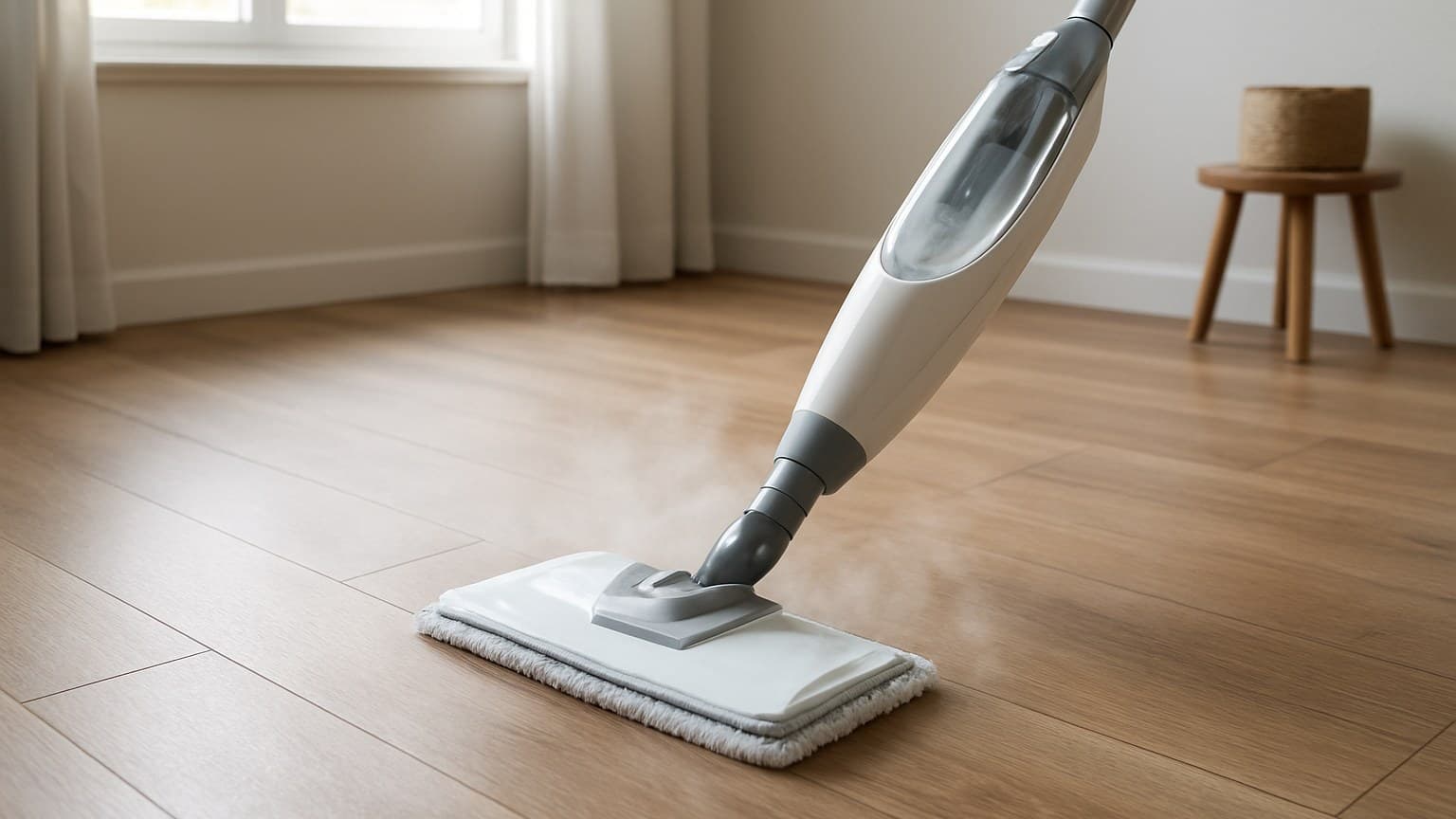
Steam mops promise a deep, chemical-free clean, so it's fair to ask whether you can use a steam mop on vinyl flooring. The confusion is real, because "steam-resistant" labels and five-star reviews make the floor sound tougher than it is. The answer is no, hot vapor forces its way into the seams between planks, softens the glue underneath, and loosens the locks long before it ever hurts the surface you can see.
Key takeaways
- Don't steam mop any vinyl floor, LVP, LVT, or sheet. The heat softens the wear layer and drives vapor into the seams.
- The damage shows up at edges, seams, and transitions first, not in the middle of the plank where you aimed the mop.
- Reconciled routine: dry-sweep or vacuum daily, damp-mop weekly with a pH-neutral cleaner, and never leave standing water.
- Skip bleach, ammonia, wax or 'mop and shine' polish, abrasive pads, and heavy vinegar mixes on a urethane wear layer.
- With that care, vinyl commonly lasts 15 to 30 years depending on the product and how thick its wear layer is.
Can You Use a Steam Mop on Vinyl Flooring? The Short Answer
No. Not on luxury vinyl plank (LVP), not on luxury vinyl tile (LVT), and not on sheet vinyl. Every vinyl floor there is says no to steam.
The heat is the real problem. Steam mops generate vapor that's extremely hot, far beyond anything the floor or its adhesive was engineered to sit under. Neither the vinyl nor the glue holding it down is built to sit under heat like that, even for the few seconds the mop passes over.
Watch for the marketing trap. A floor sold as "steam-resistant" is not the same as steam-safe, and most makers' own care sheets say no steam, full stop. Run a steam mop anyway and you risk warping and lifting seams, and your manufacturer's care instructions likely won't cover that kind of damage, check your floor's own paperwork before you risk it.
The open field of a plank rarely fails first. What actually gives out is the glue and the locking edges once vapor works its way in. If you're weighing a new floor and want to know what really decides whether vinyl lasts 5 years or 20, the cleaning routine is a bigger piece of that than most people think.
Where the Heat Actually Kills a Vinyl Floor
Heat damage almost never starts in the open middle of a room. It starts at the glue line, where planks meet and vapor can work its way in.
Heat softens the clear urethane wear layer on top and the vinyl right under it. At the same time, steam is vapor, and vapor works its way into every seam it can find.
Once that vapor gets under a plank, it starts loosening the adhesive. You don't see it that day. You see it weeks later as lifting, curling edges, and seams that peak up where two planks meet.
The trouble tends to start at edges, doorways, and transitions, where water and heat find a way in, not in the open field of the floor, which is exactly where people aim the mop. A foyer sits right at that doorway transition, which makes its flooring especially exposed to this kind of damage, so it pays to think through what makes a good foyer floor before you ever reach for a mop.
Does Vinyl Type Matter? LVP, LVT vs Sheet Vinyl
Every vinyl type is vulnerable to steam, just in different spots. So the answer doesn't change whether you have planks or a rolled sheet. "Can you use a steam mop on vinyl plank flooring" lands right here, and the answer is still no. The same question comes up just as often for a different material, and whether you can steam mop laminate floors gets the same no for nearly identical reasons.
LVP and LVT: the seams are the weak point
Plank and tile floors have a lot of seams, whether they click together or glue down. A floating click floor is the worst case, because vapor that sneaks under it has nowhere to go. It sits trapped against the backing and the subfloor and slowly works the locks loose. The failure you get is edges that peak and lift. This is the same seam weakness that makes LVP in a bathroom survive the plank face but fail at the edges.
Sheet vinyl: fewer seams, same heat problem
Sheet vinyl has fewer seams because it comes in wide rolls, so people assume it's safe. It isn't. The heat can discolor the surface and work loose the perimeter adhesive and the backing. Lose the glue at the walls and the sheet starts to release and bubble.
| Vinyl type | Weak point | What fails first |
|---|---|---|
| LVP / LVT (floating click) | Click seams and trapped vapor | Edges peak and lift |
| LVP / LVT (glue-down) | Adhesive under the plank | Planks loosen and shift |
| Sheet vinyl | Perimeter glue and surface finish | Edges release, finish dulls or discolors |
How steam threatens each vinyl type, by where the heat gets in first.
Steam Mop Safety Recalls You Should Know About
Set the floor aside for a second. The appliance itself has a track record most vinyl guides skip. Steam mops have been recalled over burn, shock, and laceration hazards.
According to the U.S. Consumer Product Safety Commission (CPSC), the federal agency that tracks product recalls, the Thane International H2O Mop was recalled in 2009 for shock and burn hazards, and the Lysol Steam Cleaning Mop by Conair was recalled in 2010 for burn and laceration hazards.
The plain danger is easy to picture. These units hold a tank of hot water and shoot steam, so a failure means a scald. That's a real reason to keep them away from kids and bare feet.
So even if your floor could take it, a steam mop isn't the low-risk tool it looks like on the store shelf.
Daily Cleaning: What to Use Instead
Start dry. A dust mop, a soft broom, or a vacuum set for hard floors with the beater bar switched off handles most daily cleaning without touching the floor with water at all.
The real enemy here is grit. Fine sand tracked in underfoot scratches the wear layer faster than any mop ever will. Running a dust mop over your high-traffic lanes every day or two helps protect the finish.
Entry mats help catch that dirt at the door. Skip the rubber or latex-backed ones, though. The backing can stain or discolor vinyl over time. Choose a colorfast woven or felt mat instead, and shake it out often.
And wipe spills as they happen. The goal is that nothing sits on a seam long enough to work its way in.
Deep Cleaning: Mopping Vinyl the Right Way
Damp, not wet. A well-wrung microfiber flat mop and no standing water anywhere. Water pooling on a seam is just the slow version of what steam does fast, so the rule is the same: keep liquid off the joints.
Use a pH-neutral cleaner made for hard floors, or a few drops of mild dish soap in warm water. Vinegar only heavily diluted and used sparingly, about one cup to a gallon of water, because acid dulls a urethane finish over time. If you want an off-the-shelf pick, look for cleaners registered with the EPA (the Environmental Protection Agency, the federal agency that reviews cleaning products) and formulated for vinyl and LVT, the Bona STL label, for instance, carries an EPA pesticide registration specifically for sealed hard-surface floors.
The method is simple. Clean with the solution, rinse the same area with plain water, then dry it so nothing stands. For rooms that take heavy, frequent mopping, it's worth seeing which kitchen flooring options actually hold up to that before you commit. If you haven't settled on a material yet, a broader rundown on how to choose the right kitchen flooring can help you weigh those options before narrowing in on vinyl.
| Deep-clean steps that won't hurt vinyl |
|---|
| Sweep or vacuum first so you're not grinding grit |
| Mix a pH-neutral cleaner, or mild dish soap, in warm water |
| Wring the microfiber mop until it's just damp |
| Mop a small area, rinse with plain water, then dry |
| Never let water stand on a seam or transition |
A damage-free deep-clean sequence for LVP, LVT, and sheet vinyl.
Products and Tools to Avoid (Beyond Steam)
Steam gets the headline, but a few everyday cleaners and tools do their own quiet damage.
Keep bleach and ammonia off the floor. Both can discolor the surface and break down the finish. On tools, skip abrasive or scouring pads and steel wool, which scratch straight through the wear layer and leave dull tracks you can't buff out.
Wax, polish, and "mop and shine" products are another trap. A no-wax urethane floor doesn't want them. They haze over the top, trap dirt, and are miserable to strip off later.
Round it out with heavy straight vinegar and oil soaps, plus those rubber-backed mats, all of which dull or stain over time. That's the short version of the "what not to clean with" question, and the FAQ below spells it out.
What Good Cleaning Actually Buys You
Treated right, a vinyl floor commonly lasts roughly 15 to 30 years, depending on the specific product and how thick its wear layer is, estimates vary by manufacturer. Steam and harsh cleaners attack the seams and finish the warranty depends on, and that can shave years off that number.
The routine that protects all of it is boring on purpose: dry-sweep or vacuum daily, damp-mop roughly once a week (or every other week in lower-traffic homes) with a pH-neutral cleaner, wipe spills right away, and never leave standing water. Do that and the floor stays flat at the edges, which is the whole ballgame.
If you're still choosing material and want the full picture on what makes one vinyl floor outlast another, read Vinyl Flooring: 9 Things That Decide If It Lasts 5 Years or 20; it covers the wear-layer and seam details that this cleaning routine is built to protect.
Sources
- CPSC: Thane International Steam Cleaner Recall for Shock and Burn Hazards (2009)
- CPSC: Lysol Steam Cleaning Mop Recalled by Conair for Burn and Laceration Hazards (2010)
- EPA Pesticide Product Label Registration (Bona STL)
- EPA Mold and Moisture Webinar Q&A
- Carpet and Rug Institute: Cleaning and Maintenance Guidelines