
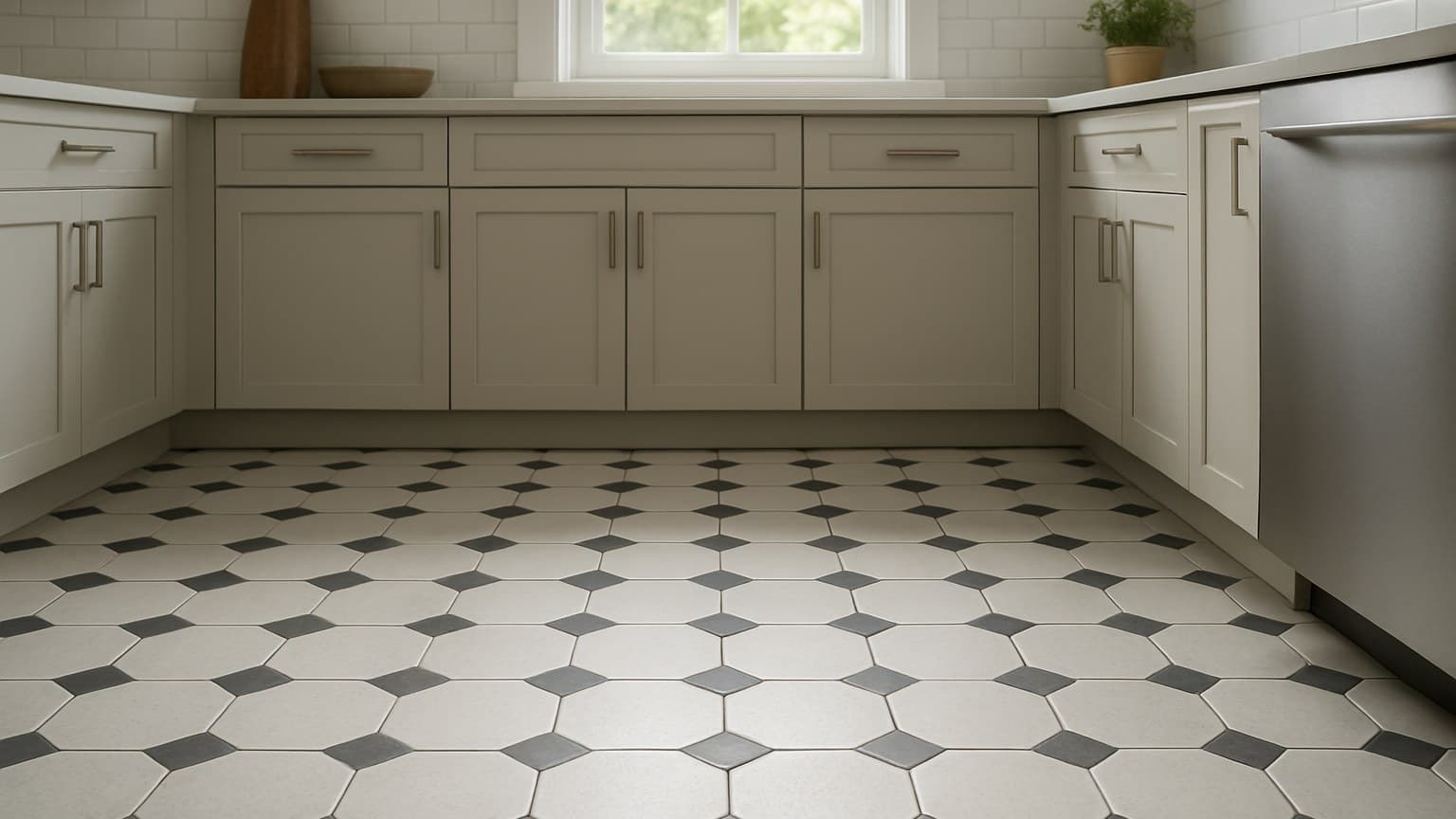
Kitchen flooring runs $6 to $20 per square foot installed in most homes, and that figure only makes sense once you split it into material and labor instead of treating it as one flat number. I price and rip up these floors for a living, and the real gap between an $800 kitchen and a $6,000 one almost always comes down to which half of that split you're paying for.
Key takeaways
- Most kitchen floors run $6-$20 per sq.ft. installed; a 200 sq.ft. kitchen lands around $800-$6,000 depending on material and prep.
- Reconciled installed ranges: sheet vinyl $3-$7, LVP $4-$12, laminate $4-$14, porcelain tile $10-$50, solid hardwood $8-$25 per sq.ft.
- Demo and disposal add $1-$3 per sq.ft., and subfloor leveling plus moisture fixes are the hidden costs that blow up a quote.
- On cost per year of use, porcelain tile and solid hardwood (50-plus years) often beat vinyl you replace every 12-20 years.
- "Waterproof" describes the plank core; most kitchen failures happen at the seams and edges, which are only water-resistant.
What Kitchen Flooring Really Costs in 2026
Most kitchen floors land between $6 and $20 per square foot installed in 2026, with the full field running from about $2 for the cheapest sheet vinyl to $50 for natural stone with prep. For a typical 200 square foot kitchen, that's roughly $800 on the low end and $6,000 on the high end.
The number splits into two parts, and you should always ask for it that way. Material is what you carry in the door. For resilient floors like vinyl plank or laminate, materials run $2 to $8 per square foot, and labor adds another $2 to $7. For tile and stone, labor jumps to $5 to $15 per square foot because the work is slower and the prep is unforgiving. If the job isn't a simple open-room kitchen floor, say it spills into a basement level or includes stairs, budget more on top of those labor numbers, since basement and stair installs always run higher than a flat, open floor.
So when a contractor hands you one flat "ten bucks a foot" number, that's fine as a ballpark. But the money moves based on which half you're spending it on, and that's where two homeowners with the same size kitchen end up thousands apart.
This guide reconciles the material prices into one table, names the hidden costs that blow up a quote, and runs a cost-per-year figure that changes which floor is actually "cheapest." If you want the full menu of what goes in a kitchen rather than the pricing, start with the kitchen flooring options guide.
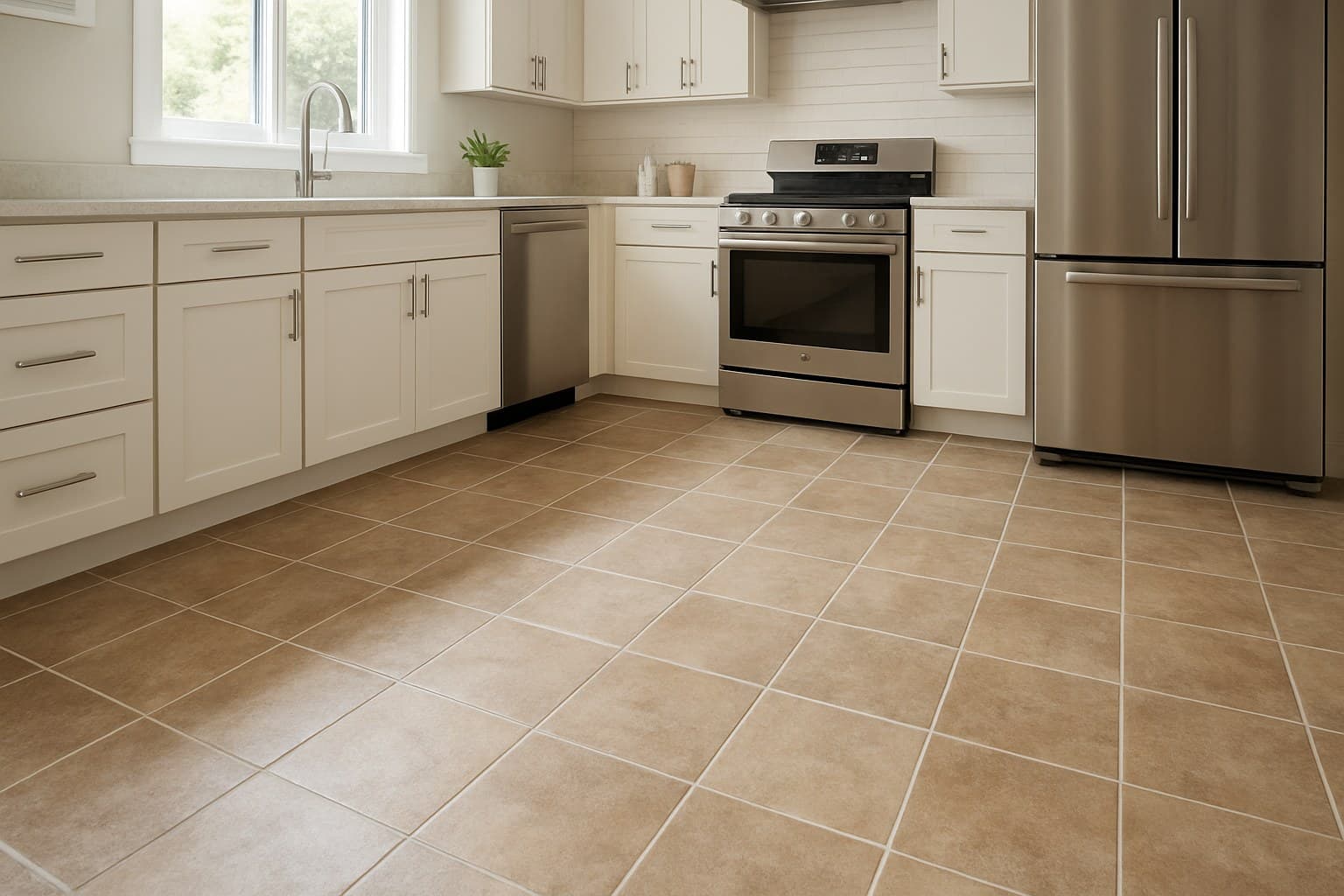
Kitchen Flooring Cost by Size: Small, Average, Large
The table below breaks down the total installed bill by kitchen size, so you can read your own case off it instead of doing the multiplication yourself.
| Kitchen size | Low end | High end |
|---|---|---|
| Small (70 sq.ft.) | $500 | $2,000 |
| Average (200 sq.ft.) | $800 | $6,000 |
| Large (400 sq.ft.) | $1,600 | $9,000 |
Source: blockrenovation's kitchen flooring cost guide
Caption: Total installed kitchen flooring cost by kitchen size, low to high across common materials.
The wide spread inside each row isn't guesswork. It's the material. The low number assumes click-lock vinyl plank floating over a clean, flat subfloor. The high number assumes porcelain tile or stone set in mortar, with leveling and demo rolled in.
One thing the square footage doesn't tell you: a galley kitchen packed with cabinets and an island won't save you as much labor as the smaller open floor area suggests. Cabinets mean more cuts, more scribing, and more transitions, so the per-foot labor rate creeps up even as the total footage drops.
Cost by Material: One Reconciled Table
Different guides quote different numbers for the same floor, so I pulled them into one range per material, with the material-only cost beside the installed cost. Budget both, the gap between them is your labor bill.
| Material | Material only | Installed |
|---|---|---|
| Sheet vinyl | $1-$3 | $3-$7 |
| LVP / LVT | $2-$8 | $4-$12 |
| Laminate | $2-$6 | $4-$14 |
| Cork | $3-$6 | $6-$9 |
| Bamboo | $3-$7 | $5-$11 |
| Engineered hardwood | $4-$12 | $7-$20 |
| Solid hardwood | $4-$14 | $8-$25 |
| Porcelain / ceramic tile | $2-$15 | $10-$50 |
| Natural stone | $5-$25 | $15-$40+ |
Caption: Reconciled material-only and installed cost per square foot for nine kitchen flooring materials.
Caption: Installed cost per square foot, drawn as a floating bar from the low to the high end of each material's range.
A quick durability note on each, since price only matters next to how it holds up at the sink:
- Sheet vinyl shrugs off water and is soft underfoot, but it dents under a dropped pan and looks cheap up close.
- LVP (luxury vinyl plank) / LVT (luxury vinyl tile) has a waterproof core, which is the plank itself. Water still gets in at the seams and edges, which are only water-resistant, so sealed transitions matter.
- Laminate gives the most realistic wood look for the money, but standing water at a seam will swell the core. Keep it away from the dishwasher run.
- Cork is warm and quiet on your feet, though it needs a good finish to take spills.
- Bamboo wears hard but reacts to humidity swings like a wood floor does.
- Engineered and solid hardwood look and feel like real wood because they are, but both hate standing water and scratch under claws. If you've got a dog, read the pet-proof flooring guide before you commit, because the wear layer and finish are what save the surface.
- Porcelain and ceramic tile take anything a kitchen throws at them. The grout is the weak point, not the tile.
- Natural stone is the premium look and the premium price, and most types need sealing to resist stains.
That seam-and-edge issue only gets more serious in a wet room, which is why the same floor behaves differently in a bathroom flooring guide than it does in your kitchen. If you're specifically weighing LVP for that bathroom, the LVP bathroom flooring guide covers the plank thickness and seam sealing wet rooms actually need.
Why Two Online Guides Quote You Different Numbers
The answer is simple: you're not comparing the same floor. One guide I checked quoted hardwood at $7.50 to $24.50 installed while another put it at $11 to $25. Laminate came up as $6 to $13 on one and $4 to $14 on another. Both are "right," because they're pricing different grades.
Three variables move the number, and almost every disagreement traces back to one of them.
First is grade and species. A builder-grade red oak in a narrow plank is a different animal than a wide, character-grade white oak. Same with tile: a basic ceramic is a fraction of a large-format porcelain.
Second is brand tier. A thin, value LVP and a thick rigid-core plank from a premium line both get called "luxury vinyl," but one costs twice the other. The plank you choose decides where in that range you land.
Third is your region's labor rate. What an installer charges in one metro isn't what it is in another, and that gap is real money on a big floor.
So read any online price as a starting band, not a quote. Pin yours down by naming the grade, the brand line, and then getting one local installer to measure. Until you do all three, every number you see is a guess wearing a dollar sign.
What Inflates Your Quote: Subfloor, Demo, and Labor
The single biggest surprise on a kitchen quote is almost always the subfloor. Before anyone lays a plank, check two things together: is it flat, and is it dry. A moisture reading alone won't tell you the floor is ready, and a flatness check alone won't catch a slab that's going to sweat under vinyl. You need both.
This is what actually gets added to a kitchen flooring quote once the old floor comes up:
| Add-on | Typical cost |
|---|---|
| Demo and disposal of the old floor | $1-$3 per sq.ft. |
| Subfloor leveling or plywood replacement | $1-$3+ per sq.ft. when needed |
| Moisture barrier or underlayment on a slab | varies by product |
| Transition strips at doorways and adjoining rooms | per opening |
| Diagonal, herringbone, or small-tile patterns | labor premium |
| Permits for subfloor or plumbing work | city-dependent |
Caption: Common line items added to a kitchen flooring quote beyond the base material and install.
A straightedge laid across the floor tells the whole story. A dip lets a floating floor flex until the click joints give out. A ridge makes planks rock and tile corners sit proud of each other, which is the uneven edge you feel with a bare foot. Leveling that out is the cost nobody budgets for and the one that blows up the quote. Another add-on that catches people the same way is in-floor heating, and the heated floors cost guide breaks down what that upgrade typically adds to the bill.
On the DIY question, be honest with yourself. Click-lock LVP over a flat, dry subfloor is a real weekend job for most people. Glue-down vinyl, any tile, stairs, and a big open-plan transition where moisture conditions change are where I'd hire out every time. Those are the jobs that come back to bite you, and the labor is cheap next to tearing out a failed floor.
One trick from the field: I learned the hard way to schedule the dumpster before I lift a single board. I once had a kitchen's worth of ripped vinyl and underlayment sitting in a homeowner's garage in Dayton for a week waiting on a haul-off, and that delay cost more grief than any tool on the truck. If your kitchen sits on a concrete slab, test it properly first. The slab moisture steps in the basement flooring guide are the same ones I run on a slab-on-grade kitchen.
True Cost Over Time: Cost Per Year of Use
The figure no other guide publishes is cost per year: take the installed cost and divide it by how many years the floor realistically lasts. That number is the one that actually tells you what's cheap.
| Material | Installed (midpoint) | Service life | Cost per year |
|---|---|---|---|
| Solid hardwood | $16.50 | 50 yrs | $0.33 / sq.ft. |
| LVP | $8 | 20 yrs | $0.40 / sq.ft. |
| Sheet vinyl | $5 | 12 yrs | $0.42 / sq.ft. |
| Engineered hardwood | $13.50 | 30 yrs | $0.45 / sq.ft. |
| Laminate | $9 | 15 yrs | $0.60 / sq.ft. |
| Porcelain tile | $30 | 50 yrs | $0.60 / sq.ft. |
Caption: Installed midpoint divided by an estimated service life gives a working cost per square foot per year. These service-life and cost-per-year figures are illustrative estimates built from common industry lifespan ranges for comparison purposes, they are not numbers published directly by NWFA (National Wood Flooring Association) or TCNA (Tile Council of North America).
The LVP row is the one to be most careful with, because "20 years" is doing a lot of work for a single line of a table. Unlike solid hardwood or tile, where the wood itself or the fired clay is what wears, a vinyl plank's lifespan lives almost entirely in its wear layer, the clear top coating that takes the foot traffic, the dragged chair, and the dropped pan. That layer is specified in mils (thousandths of an inch), and it's the main variable that decides whether a given LVP floor is closer to a 10-year floor or a 25-year floor, not the plank's price alone. A thin builder-grade wear layer on the low end of what's sold for kitchens will show wear well before 20 years in a busy cooking space, while a thicker commercial-rated wear layer can outlast that 20-year midpoint by a decade or more under the same traffic. So before you lean on the LVP row of this table, ask your supplier for the wear-layer mil thickness on the specific plank you're buying, it matters more to your actual cost-per-year number than the installed price does. The same mil-thickness check matters just as much if you're shopping vinyl flooring for a living room, which the living room flooring guide covers in more detail.
Look at what that does to the pecking order. Solid hardwood costs the most to put down, but spread over decades of use it can work out cheaper per year than a resilient floor you'll replace every 12 to 20 years. Porcelain tile lands in the same long-life bucket. The cheap floor isn't always the cheap floor.
This is life-cycle thinking, and it's not something I made up. According to the National Wood Flooring Association's Life Cycle Cost Analysis (LCCA), weighing the full-life economics of a floor, not just the day-one install, can change which material actually costs less to own over time, and the Tile Council of North America makes a similar case for ceramic tile's long-run value in its "Tile: The Natural Choice" report. Both land on the same point: the install price is only the first number.
The catch is that the lifespan only holds if you don't wreck the floor cleaning it. Steam is the usual killer. Before you point a steam mop at a resilient floor, check whether you can use a steam mop on vinyl and whether a steam mop is safe on laminate, because heat and forced moisture at the seams can cut years off the exact lifespan this math depends on.
Picking by Budget: Cheapest Upfront vs Best Value
If your goal is the lowest possible bill this month, sheet vinyl or a value LVP over a clean subfloor wins, and a small kitchen can come in under $800. That's the right call for a rental, a flip, or a kitchen you plan to gut in a few years anyway.
If you're staying put, run the cost-per-year lens instead. For a busy family kitchen that takes spills and dog traffic, porcelain tile or a thick rigid-core LVP gives you good value because the yearly cost is low and neither one flinches at water. For a kitchen open to living space where you want warmth and a floor that can be refinished, solid or engineered hardwood earns its higher sticker over the long haul. If you're still torn between those options, this guide on how to choose the right kitchen flooring walks through matching material to your specific layout and habits.
Match the floor to the room and how long you'll own it, then let the cost-per-year number break the tie. For the full side-by-side of which floor suits which kitchen setup, the kitchen flooring options guide walks through every material by use, and it's the natural next read once you've settled on a budget here. If you want a straight ranking rather than a matching exercise, the best flooring for kitchen guide scores the top five materials side by side.
Sources
- NWFA Life Cycle Cost Analysis, full report
- NWFA: Life Cycle Cost Analysis (LCCA) overview
- NWFA LCCA sales sheet, TISE 2024
- TCNA, "Tile: The Natural Choice" (2025 edition)
- TCNA, "Tile: The Natural Choice" (2026 edition)