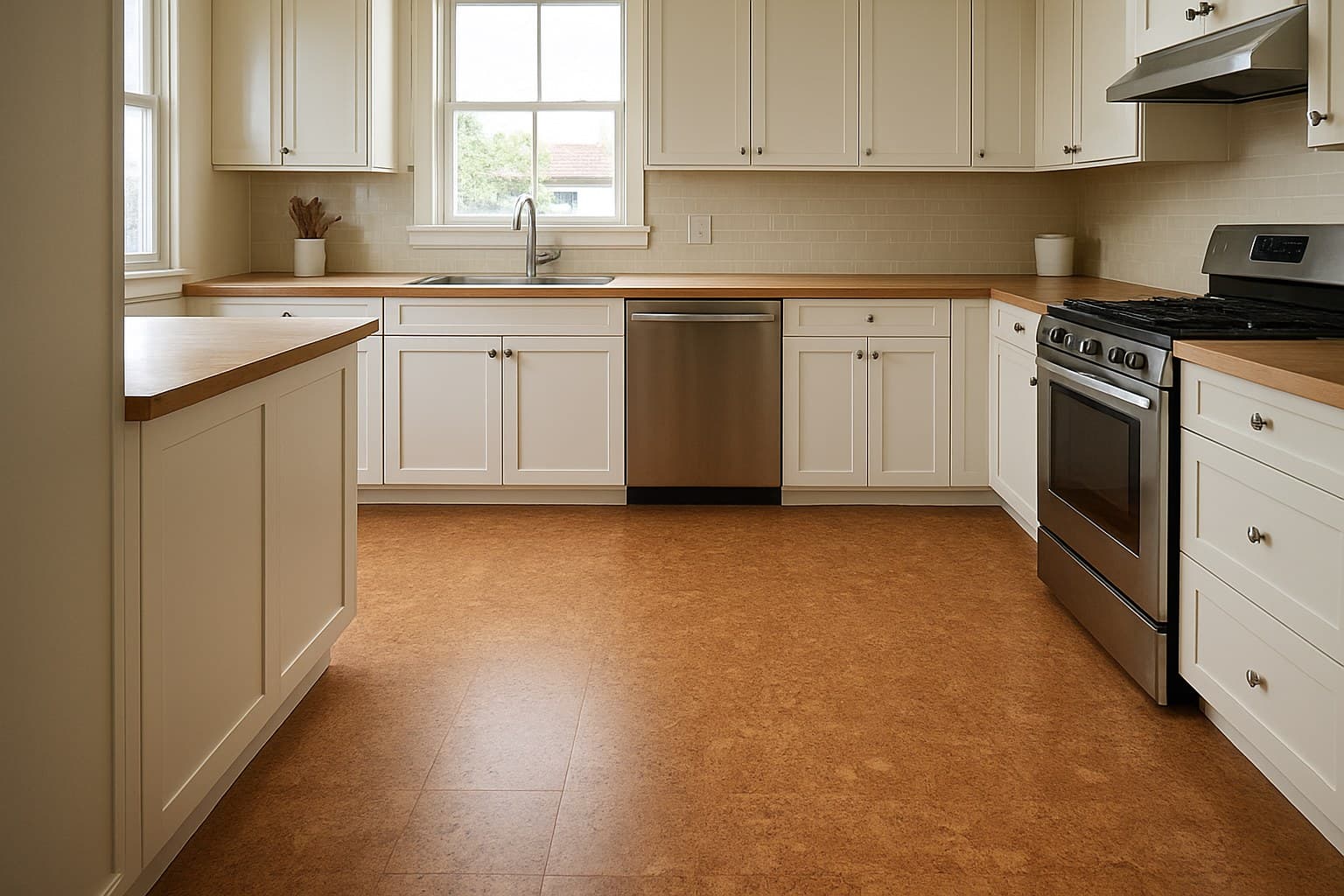
Dana in Austin called me six months after I installed her kitchen's cork floor, sure the swollen seams by her sink meant cork was a mistake. The room and the install were solid, a sink spill had just sat too long. Get the room and the seams wrong and cork fails fast. Get them right and it holds up for decades.
Key takeaways
- Cork's core resists water, but the seams and edges do not; most water damage starts at the joints, not the plank face.
- Budget $5-$20 per square foot installed, split roughly $3-$8 materials and $2-$5 labor; basements and stairs run higher than open rooms.
- Sealed cork lasts about 15-25 years; reseal glue-down cork every 3-7 years to keep water out at the seams.
- Cork dents under heavy furniture legs and fades by a sunny south window; felt pads and blinds stop both.
- Great for bedrooms and living rooms; risky for bathrooms, entries, and below-grade basements without extra sealing and a moisture check first.
The Short Verdict: Is Cork a Costly Mistake?
Cork is a smart floor in the right room and a callback waiting to happen in the wrong one. The choice is about placement, not luck.
Here are the worries I hear most, and which ones are real. Water damage is real, but it starts at the seams, not the plank face. Denting under heavy furniture is real. Fading by a bright window is real. Pets are mostly fine with sealed cork. The idea that cork is fragile junk is overblown, and so is the idea that it is bulletproof and waterproof everywhere.
The one thing to hold onto: cork's core shrugs off water, but the joints and edges between planks do not. Seal those and match the room, and cork lasts. Skip either, and it swells and lifts.
Cork does not fail because it is cork. It fails at the seams, under furniture legs, and in rooms it never belonged in.
The rest of this guide runs in that order: a failure map, then the real upsides, a side-by-side comparison, honest cost split by format, install and sealing, and finally which rooms cork belongs in.
What Cork Flooring Is and How It's Made
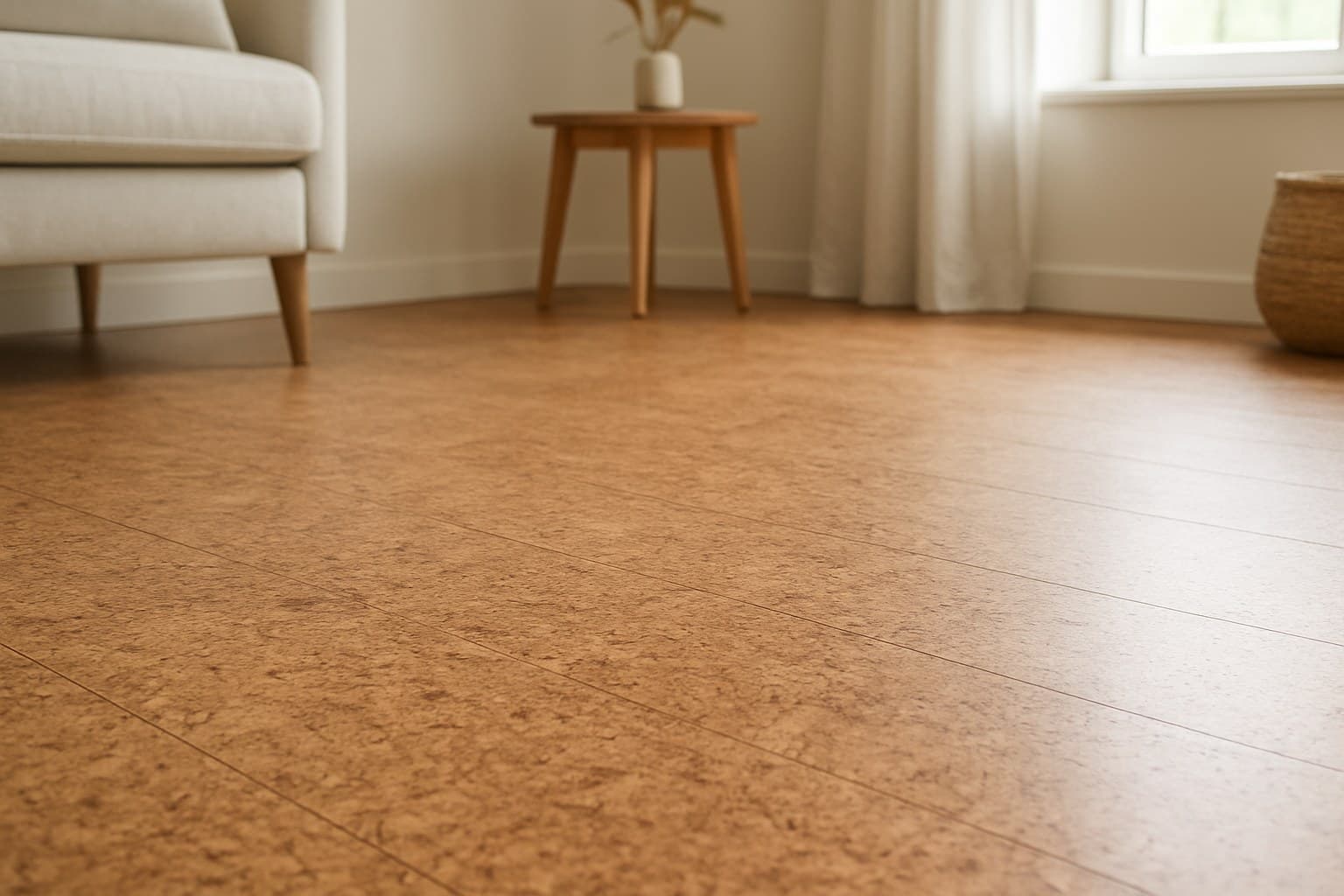
Cork comes from the bark of the cork oak tree. Workers strip the bark by hand without cutting the tree down, so the same tree keeps giving. The first harvest happens around age 25, then the bark is peeled every 9 to 11 years, and a healthy tree lives 100 to 120 years.
What makes cork work as a floor is a natural waxy substance in the bark called suberin. Suberin is the reason cork resists water, mold, and bugs on its own, before any factory finish goes on top. According to the U.S. Environmental Protection Agency, flooring materials that naturally resist moisture and mold can be a meaningful factor in a home's indoor air quality.
If you want a real quality benchmark, look for cork tile tested to ASTM International's newly published resilient floor-covering standard, which spells out test requirements specifically for cork floor tile. As ASTM notes, the standard "specifies cork floor tile requirements" for the category. Most buying guides never mention it, but it tells you the product was tested to a spec instead of just labeled "cork."
You will see cork sold in four main formats:
- Glue-down tile sticks straight to the subfloor with adhesive.
- Floating click plank snaps together over a pad and floats free.
- Parquet or sheet cork lays in a tighter pattern.
- Cork underlayment, a thin cushion layer that goes under another finish floor (underlayment just means the layer under the floor you actually see).
Most floating planks are built in layers. Here is what you are standing on, top to bottom.
The layers of a Wicanders Series 100 floating cork click plank and what each one does, per that product's spec sheet.
6 Ways Cork Floors Actually Fail
Almost every cork callback I get traces back to one of these six things, and only one of them is really about the cork itself.
1. Water at the seams. The cork core resists water, but the tongue-and-groove joints and cut edges swell if a spill sits on them. This is my number one callback. The plank surface is fine; the water sneaks into the joint and lifts the edge.
2. Dents under point loads. Cork gives, which is why it feels good underfoot, but that same softness takes a permanent dimple under a heavy sofa leg, a fridge foot, or a high heel. The weight per inch is what does it, not the total weight of the item.
3. Fading by a sunny window. A south-facing patch of cork will lighten over a few years while the shaded part stays darker. You end up with a sun stripe unless you shade the glass.
4. Scratches from grit and pet nails. Sand and grit act like sandpaper on the finish. Long dog nails add fine scratches on top.
5. Moisture rising from a below-grade slab. "Below grade" just means below outside ground level, like a basement floor. In a basement, water vapor can push up through that concrete and attack cork from underneath, where you never see it coming.
6. Gapping or lifting from bad prep. When the subfloor was never leveled or moisture-checked, planks gap and lift no matter how good the cork is. Fix the flatness and moisture before the first plank goes down, and this problem mostly disappears.
Here is how water works its way into a seam once a spill is left to sit.
A spill that sits works down through the joint, not through the sealed plank face.
What Actually Holds Up: The Real Pros
When cork is placed and sealed right, four things make it worth the money.
Comfort and warmth. Cork gives a little underfoot and feels warm because it insulates. Its R-value is about 1.125 per inch, so it slows heat loss better than tile or stone, and the floor doesn't feel cold to bare feet.
Quiet and forgiving. Cork deadens sound, so footsteps and dropped dishes go soft instead of sharp. It's easier on your knees and back over a long day than tile or hardwood, which is why I like it in kitchens and playrooms when moisture is under control.
Healthy and green. That suberin in the bark makes cork naturally resistant to mold and common allergens. And because the tree is stripped instead of cut down, cork is one of the greener floors you can buy.
If you want the full ledger with nothing left out, the deeper breakdown of cork flooring pros and cons weighs every upside against its matching downside.
Where cork earns its keep: soft, warm, and quiet underfoot, real insulation from an R-value near 1.125 per inch, natural resistance to mold and allergens, and bark harvested without felling the tree.
Cork vs. Hardwood, Vinyl, Laminate, and Tile
The pick follows the room. Cork and hardwood are the warm, comfortable floors; tile and vinyl win on water. Here is how the four things buyers actually weigh stack up.
| Floor | Installed cost /sq ft | Water tolerance | Lifespan | Feel underfoot |
|---|---|---|---|---|
| Cork | $5-$20 | Water-resistant core, weak seams | 15-25 yrs | Soft, warm, quiet |
| Hardwood | $8-$25 | Poor; warps if wet | 30-100 yrs | Hard, warm |
| LVP / vinyl | $3-$12 | Waterproof core on rigid SPC (stone plastic composite) planks; seams still a risk | 15-25 yrs | Medium, cool |
| Laminate | $3-$10 | Water-resistant, weak edges | 15-25 yrs | Hard, cool |
| Tile | $10-$25 | Waterproof body; grout lines still need sealing | 50+ yrs | Hard, cold |
Installed cost, water tolerance, typical lifespan, and feel for five common residential floors. Figures are general ranges and vary by product and region.
A word on the vinyl and laminate question, since so many buyers land between them. Laminate gives a sharper, more realistic wood look for less money, while luxury vinyl plank (LVP) tolerates water better at the surface. Neither one refinishes the way some thicker glue-down cork can. If you're stuck deciding between cork and laminate specifically, the cork versus laminate flooring comparison lays out that exact matchup.
The short version: choose warmth and quiet, cork or wood earns it; choose water above all, tile or vinyl wins.
Cork Flooring Cost by Format
Budget roughly $5 to $20 per square foot installed for cork, but that flat range hides a lot. What you pay depends on the format and the room. Basements and stairs cost more than an open room because the layout is fussier and stairs are slow, hand-cut work.
Here is the cost split by format, materials versus labor, from my own recent cork quotes. The installed column is just the two added together.
| Format | Materials /sq ft | Labor /sq ft | Installed /sq ft | Note |
|---|---|---|---|---|
| Glue-down cork tile | $3-$6 | $3-$5 | $6-$11 | Higher labor; sealing adds time |
| Floating click plank | $4-$8 | $2-$4 | $6-$12 | Fastest; DIY-friendly |
| Parquet / sheet cork | $2-$5 | $3-$5 | $5-$10 | Tight layout raises labor |
| Cork underlayment only | $0.50-$1.25 | $0.50-$1 | $1-$2.25 | Goes under another floor |
Source: my own recent cork install quotes
Cork cost per square foot by format, split into materials and labor, with the installed total.
Glue-down runs higher on labor because the layout is fussier, the adhesive has to be spread and set, and the floor usually needs sealing after. Floating click plank is the fastest and the most DIY-friendly, which is why its labor line is lower even though the material can cost more.
Working your own number is simple. Multiply your square footage by the material rate, then by the labor rate, and add the two. A 200 square foot bedroom in floating plank runs about 200 x $4 to $8 in materials ($800 to $1,600) plus 200 x $2 to $4 in labor ($400 to $800), so roughly $1,200 to $2,400 installed. Add 15 to 30 percent for a basement or a staircase, since those eat labor hours.
The glue-down route has its own steps and costs worth reading before you commit; the full glue-down cork flooring walkthrough covers adhesive, layout, and the bathroom case in detail.
Installation and Sealing: Get the Prep Right
The floor only lasts as long as what's under it, so prep comes before a single plank goes down. Two checks decide the job.
Flatness. Run a straightedge across the subfloor and look for gaps. Most cork makers want the floor flat within a set tolerance over a given span, and their own instruction sheet gives the exact figure. Humps and dips cause the gapping and clicking I get called back for.
Moisture. Check the subfloor with a moisture meter, which is a small tool that reads how much water is in the wood or concrete. This matters most over a concrete slab, especially below grade in a basement, where vapor can push up for months after the floor looks dry. A slab that feels dry to your hand can still read wet on the meter, and that reading is the one that counts.
After that, follow the box. Some cork wants a few days to acclimate in the room first, some says it's not needed, so read that product's sheet instead of a rule you saw online. Leave the expansion gap the maker calls for around the whole perimeter; a floating floor has to move, and the exact gap size is set per product.
For glue-down, you trowel adhesive onto a clean, flat, dry subfloor, set each tile tight to the last, roll it, and then seal the surface. Floating plank just clicks together over a pad, no glue.
Sealing is not optional if you want the seams to survive. On glue-down cork, plan to reseal roughly every 3 to 7 years to keep water out at the joints, though the right interval varies by product and traffic. If your room sees real water, the details in the waterproof cork flooring guide explain how far sealing can and cannot take you.
Honest DIY call: click-lock floating cork is realistic for most handy homeowners. Glue-down, stairs, and any large open-plan floor with a moisture transition are where I'd hire it out, because a bad glue spread or a missed moisture reading is expensive to redo.
Where Cork Belongs: Room by Room
The same cork that thrives in a bedroom fails in an entry. Match the format and sealing to how wet and busy the room is.
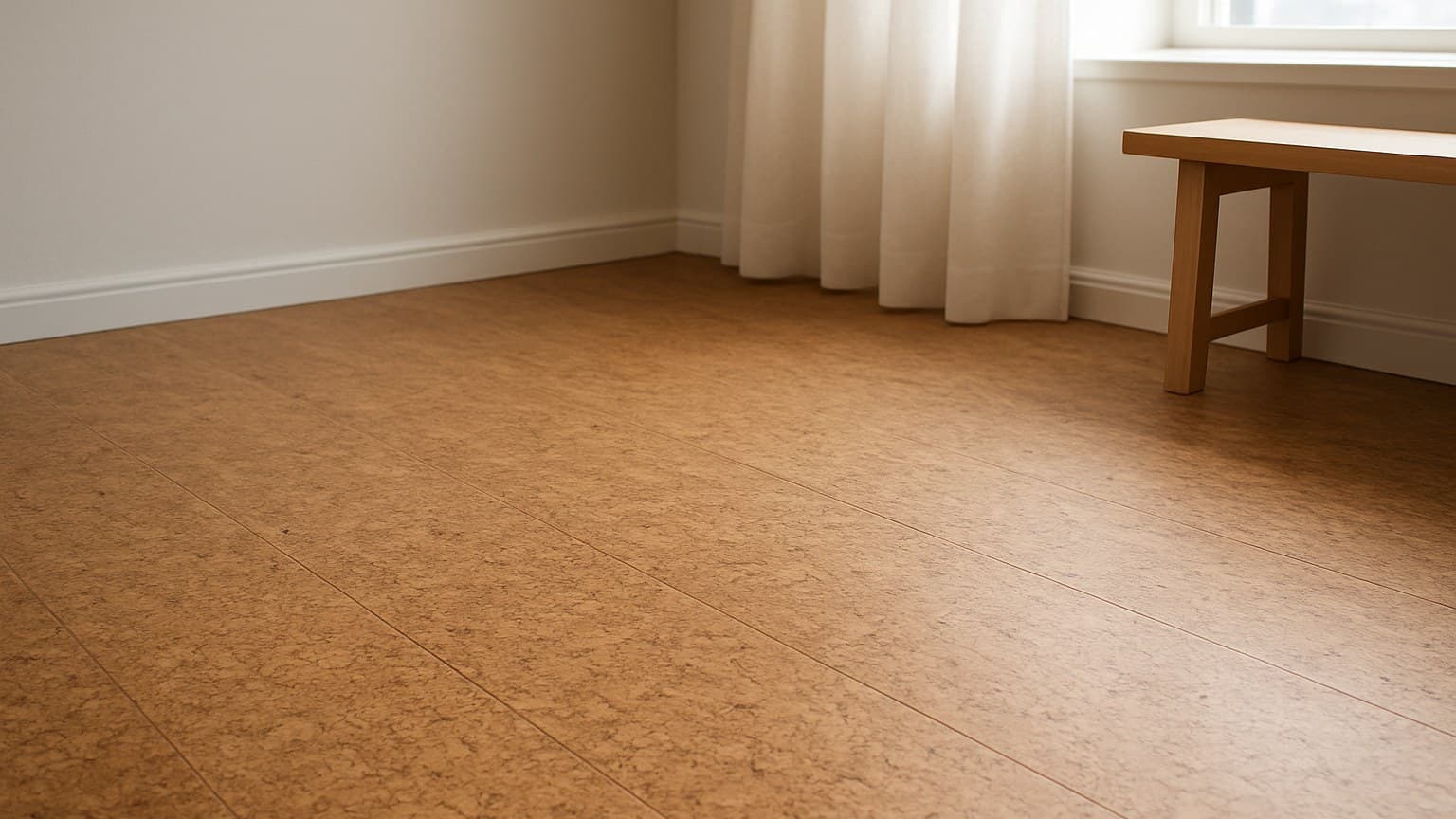
Bedrooms and living rooms. The best fit. Low water risk, and the softness and warmth pay off where you stand and sit barefoot. Floating plank is plenty here.
Kitchens. A good candidate with care, because cork is easy on the legs during long cook sessions, but drips and dishwasher leaks make sealing non-negotiable. The room-specific tips in the kitchen cork flooring guide cover the sealing and mat setup I use.
Bathrooms and entries. Risky. Standing water and grit go straight at the weak seams. If you insist, use glue-down cork tile with a fully sealed surface, and know it needs more upkeep. Tightly fitted cork floor tiles with sealed joints are the version that has the best shot in a damp room.
Basements below grade. Do the moisture check first, every time. If the slab reads wet, cork is the wrong pick until you fix the moisture, no matter how well you seal the top.
Cork doesn't have to stay on the floor, either. A cork board accent wall uses the same material for sound and warmth where water is never a worry, and thin cork underlayment quietly does its job under other floors. If you already have cork down and just want it to last, the routine in the cork floor cleaning guide keeps grit and standing water off the seams.