
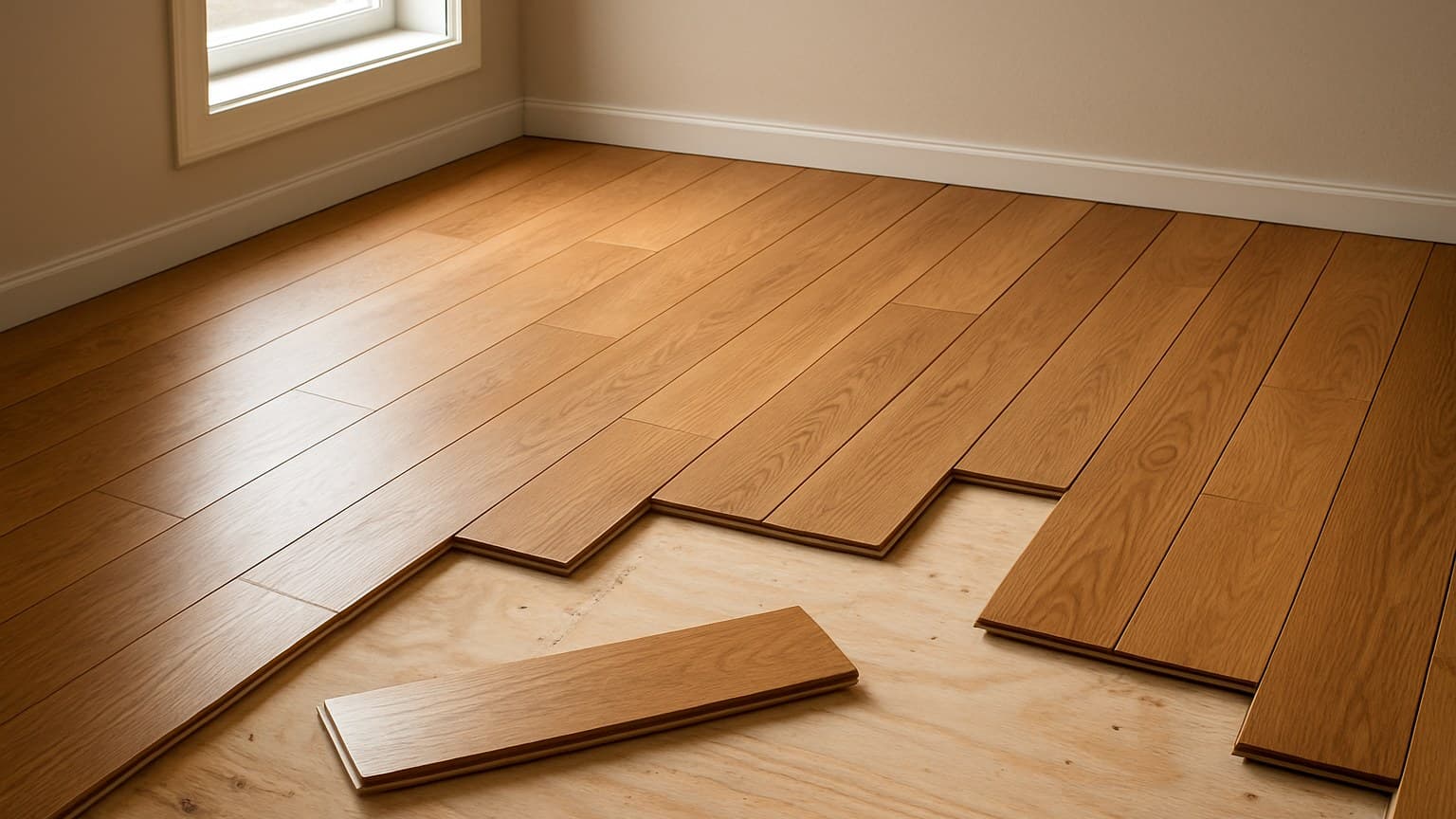
Real sheet linoleum, porcelain tile, and FloorScore-certified LVP are the fastest path to a floor that's both cheap and non-toxic, each one runs under roughly $9 per square foot installed and carries a certification you can actually verify. Most floors that dodge that price tag either skip the emissions testing altogether or charge you double once they add it. This guide shows exactly which materials clear both bars, and which certifications prove it instead of just claiming it.
Key takeaways
- Cheap and safe overlap in a handful of materials: real sheet linoleum, porcelain tile, FloorScore-certified LVP, and PET (polyester) carpet all land under about $9/sqft installed and carry real low-VOC certs.
- For any wood-core product (laminate, engineered wood, bamboo), the label that matters is CARB2 or NAUF, which caps formaldehyde; skip any composite plank with no emissions stamp.
- Cheap imported strand-woven bamboo and some composite cork can exceed formaldehyde limits, so a rock-bottom price with no certification is the real red flag, not the material itself.
- Always add underlayment, adhesive, and labor to the sticker price: tile has the cheapest material but the highest labor, while sheet linoleum's all-in cost stays flat.
- For carpet, low-VOC polyester (PET) is the budget-safe pick; wool is naturally low-VOC but usually costs 2-3x more.
Where Cheap and Non-Toxic Flooring Actually Overlap
Cheap and non-toxic do overlap, and the shortlist is small: real sheet linoleum, porcelain or ceramic tile, FloorScore-certified LVP, PET (polyester) carpet, and polished concrete. Every one of those lands under roughly $9 per square foot installed and carries a real low-VOC certification you can look up.
The table below puts all 11 common floors side by side, split into material cost and labor cost, because a sticker price alone hides half the bill. A few terms show up in that table before I walk through them later: VOC (volatile organic compound, a gas some materials release into the air), CARB2 (California Air Resources Board Phase 2, a formaldehyde limit for composite wood cores), NAUF and ULEF (no-added-formaldehyde and ultra-low-emitting formaldehyde binders), CRI (Carpet and Rug Institute) Green Label Plus, and thinset (the mortar that bonds tile to the floor). Where a floor is wood, I've listed its Janka score, which is just a dent-resistance number, higher means it shrugs off dents better.
| Flooring type | Material $/sqft | Labor $/sqft | VOC risk | Cert to look for | Janka |
|---|---|---|---|---|---|
| Sheet linoleum (real) | $3-6 | $3-5 | Very low (natural) | FloorScore / GreenGuard Gold | n/a |
| Porcelain/ceramic tile | $1-8 | $7-14 | Very low (watch thinset/grout) | GreenGuard on adhesives | n/a |
| Polished concrete | $2-6 | $3-8 | Very low (watch sealer) | Low-VOC sealer | n/a |
| Solid oak hardwood | $4-9 | $3-6 | Low-med (site finish) | Low-VOC/natural-oil finish | ~1290 (red oak) |
| Engineered hardwood | $4-10 | $3-5 | Med (core adhesive) | CARB2 / NAUF | Varies by veneer |
| LVP / vinyl plank | $2-5 | $2-4 | Low-med | FloorScore | n/a |
| Laminate | $1-4 | $2-4 | Med (formaldehyde core) | CARB2 / NAUF | n/a (AC wear rating) |
| Strand-woven bamboo | $3-6 | $3-5 | Med-high (cheap imports) | CARB2 / FloorScore | ~3000+ |
| Cork (floating) | $3-7 | $3-5 | Low-med (binder) | FloorScore / GreenGuard | n/a |
| Polyester (PET) carpet | $1-4 | $2-4 | Low-med | CRI Green Label Plus | n/a |
| Wool carpet | $5-12 | $2-4 | Very low (watch moth-proofing) | CRI Green Label Plus | n/a |
Material vs. labor cost ranges and VOC risk for all 11 common residential floor types.
Two cells surprise people. Tile has almost no material off-gassing, yet it carries the highest labor cost on the whole chart because setting and grouting it is slow, skilled work. According to the Tile Council of North America (TCNA), tile's long service life is part of what offsets that higher installed cost, since a floor that doesn't need replacing for decades can cost less over time than a cheaper material that wears out sooner. Laminate is the opposite: the cheapest material on the board, but its wood-fiber core is exactly where the formaldehyde question lives.
One thing that quote sheet won't show you: labor climbs with the room. On an open living room the crew flies. On stairs or a chopped-up basement with doorways and closets, the same square footage can eat an extra day. I used to quote flat per square foot until a remodel for a customer in Dayton, Ohio, full of closets and a bay window blew my day-rate estimate, so now I count the cut-heavy areas on their own.
If you care about the healthiest floor regardless of price, the pure health ranking lives in what flooring is the least toxic.
What "Non-Toxic" Really Means for Your Air
"Non-toxic" mostly comes down to what a floor breathes into your room. VOCs are gases a floor releases into the air. Off-gassing is that release happening slowly over time. Formaldehyde is the big VOC hiding in cheap wood-core floors and the glues that hold them together. For the fuller picture of what makes a floor healthy overall, the healthiest flooring for a home walks through those tradeoffs in detail.
This matters most for the people living lowest to the ground. Kids crawling and pets sleeping breathe right at floor level, where off-gassing concentrates. Anyone chemically sensitive feels it first too.
The timing works in your favor, at least. Off-gassing is strongest when a floor is brand new and fades over months as the gases work their way out. Heat and humidity speed that up, which is why a closed-up house in summer can smell like new flooring for weeks.
For the specific products that off-gas the worst, what flooring materials to avoid.
The Certifications Worth Trusting (and What They Miss)
A certification is only proof of the one thing it tests, so knowing what each stamp skips keeps you from over-trusting a single label. GreenGuard Gold is one of the most cited stamps for low emissions, but the GreenGuard Gold certified flooring brand list shifts often enough that it's worth double-checking before you assume a product still qualifies. Here's what the common ones actually check, in plain terms:
- FloorScore and GreenGuard Gold are low-VOC emissions tests; GreenGuard Gold uses stricter limits aimed at schools and kids' spaces.
- CARB2 is the California Air Resources Board Phase 2 rule, a cap on formaldehyde in composite wood cores.
- NAUF / ULEF describe the binder itself: no added formaldehyde, or ultra-low formaldehyde.
- Cradle to Cradle looks at whole-lifecycle material health.
- CRI Green Label Plus covers carpet and its adhesive.
| Certification | What it limits | What it misses |
|---|---|---|
| FloorScore | VOC emissions from hard flooring and adhesives | Durability, formaldehyde in the core, total cost |
| GreenGuard Gold | Stricter VOC limits, aimed at schools and kids' spaces | Tested per product, not brand-wide; no wear rating |
| CARB2 (Calif. Air Resources Board Phase 2) | Formaldehyde in composite wood cores | Other VOCs and the surface finish |
| NAUF / ULEF | Binder type (no added / ultra-low formaldehyde) | Not an emissions test; trace levels can remain |
| Cradle to Cradle (C2C) | Full material health and lifecycle | Rare and pricier; not a VOC-only guarantee |
| CRI Green Label Plus | Carpet and carpet-adhesive VOCs | Carpet only; not moth-proofing or stain treatments |
Source: what each certification's own published standard actually limits
What each flooring certification limits and what it leaves out.
Here's the rule that saves you money and grief: on a composite product, a missing emissions stamp is the warning sign, not a neutral blank. Certified factories advertise it because the testing costs them. A bargain plank with no cert usually means nobody paid for the test, and you don't want to guess why.
Where Cheap Products Hide Real Risk
The cheapest lots aren't risky because of the material. They're risky because price got cut somewhere you can't see: the binder, the glue, or the finish. Two categories trip people up.
Cheap bamboo and composite cork
Bamboo and cork are both fine materials, but the cheap imported versions are where formaldehyde sneaks in. Strand-woven bamboo is glued together under pressure, and rock-bottom imports can sometimes exceed CARB2 formaldehyde limits. Some composite cork tiles do the same through their binder. Ask for the CARB2 or FloorScore emissions cert before you buy the bargain lot, and if the seller can't produce it, walk.
Cork also earns a word on upkeep, I installed a floating cork floor in a sunroom for a customer in Asheville, North Carolina, and it's held up well. Keep it to a damp mop and a gentle cleaner, and never let water pool. I've seen soaked cork swell and lift at the seams, and there's no un-swelling it. If you want to see the mistakes that cause that kind of damage in the first place, I broke them down in common cork flooring failures I see on jobs.
Wool vs. low-VOC polyester carpet
For budget-safe carpet, low-VOC PET (polyester) carpet with the CRI Green Label Plus stamp is the pick. Wool is naturally low-VOC and lovely, but it typically costs noticeably more. Each has one catch to watch: wool is often treated with moth-proofing chemicals, and cheap synthetics can carry stain treatments. Ask what's been added, not just what the fiber is.
Under all of this sits one pattern. The VOCs ride in the binder, the glue, and the seams, not the plank surface. That's why even a certified core off-gasses most at freshly cut edges, and why sealing cut ends and using a low-VOC adhesive matters as much as the floor you picked.
If you'd rather see the products to avoid outright, most toxic flooring guide names them. And if price is your first filter, the cheapest non-toxic flooring breakdown starts from the bottom of the budget up.
Sources
- Tile Council of North America (TCNA)
- TCNA, Tile: The Natural Choice (life-cycle cost data)